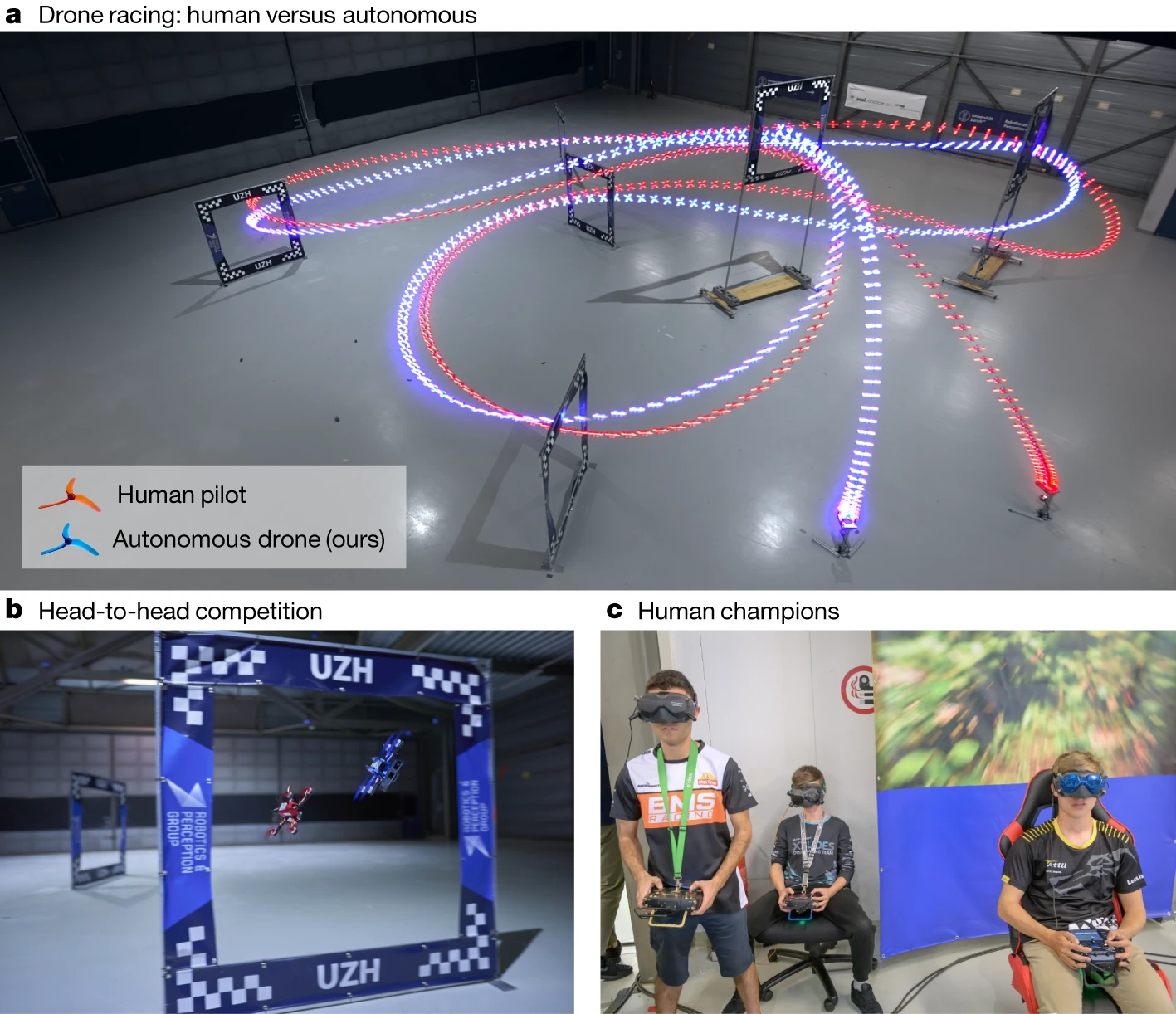
From the Swift research paper: “Swift (blue) races head-to-head against Alex Vanover, the 2019 Drone Racing League world champion (red). The track comprises seven square gates that must be passed in order in each lap. To win a race, a competitor has to complete three consecutive laps before its opponent. b, A close-up view of Swift, illuminated with blue LEDs, and a human-piloted drone, illuminated with red LEDs. The autonomous drones used in this work rely only on onboard sensory measurements, with no support from external infrastructure, such as motion-capture systems. c, From left to right: Thomas Bitmatta, Marvin Schaepper, and Alex Vanover racing their drones through the track. Each pilot wears a headset that shows a video stream transmitted in real time from a camera aboard their aircraft. The headsets provide an immersive ‘first-person-view’ experience.”
Credit: Regina Sablotny / UZH
From the Swift research paper: “Swift (blue) races head-to-head against Alex Vanover, the 2019 Drone Racing League world champion (red). The track comprises seven square gates that must be passed in order in each lap. To win a race, a competitor has to complete three consecutive laps before its opponent. b, A close-up view of Swift, illuminated with blue LEDs, and a human-piloted drone, illuminated with red LEDs. The autonomous drones used in this work rely only on onboard sensory measurements, with no support from external infrastructure, such as motion-capture systems. c, From left to right: Thomas Bitmatta, Marvin Schaepper, and Alex Vanover racing their drones through the track. Each pilot wears a headset that shows a video stream transmitted in real time from a camera aboard their aircraft. The headsets provide an immersive ‘first-person-view’ experience.” Credit: Regina Sablotny / UZH
The races occurred between June 5 and June 13, 2022, on a specially designed track that covered a 25-by-25-meter area and featured seven square gates that the drones had to pass through in a specific order to complete a lap. The circuit also included challenging maneuvers such as a “Split-S,” which is “an acrobatic feature that involves half-rolling the drone and executing a descending half-loop at full speed,” according to UZH.
Swift secured multiple wins against the human champions and even recorded the fastest lap, finishing with a half-second lead over the best human pilot. However, it was noted that the AI system showed limitations in generalization and adaptability, struggling when the conditions differed from those it was trained for, such as changes in lighting. Overall, the contest demonstrated that while AI has made significant strides in navigating physical environments, human pilots still maintain an edge in adaptability and responding to variable conditions.
The research team behind the new drone AI system includes Elia Kaufmann, Leonard Bauersfeld, Antonio Loquercio, Matthias Müller, Vladlen Koltun, and Davide Scaramuzza. They published their results on Wednesday in a Nature article, titled “Champion-level drone racing using deep reinforcement learning.”
According to the team, this new technology has several potential real-world applications. Scaramuzza, the head of the Robotics and Perception Group at UZH, says that flying drones faster increases their utility due to their limited battery capacity. Swift’s capabilities could find applications in forest monitoring, space exploration, and the film industry, where fast-moving drones could shoot action scenes. Additionally, the technology could be helpful in search-and-rescue missions where drones need to cover large areas quickly.
While surveying the social landscape online, it’s clear that UZH’s work with drones has been impressing others. On Hackernews, a user who identified themselves as a consultant who has developed computer software for drone racing in the past said, “So glad to see this team from UZH continued pushing the envelope and are now beating human champions. If you saw the team and what they managed in under a year, it was clear they were highly talented and human racers had their work cut out for them to stay ahead.”