Last week, Swiss software engineer Matthias Bühlmann discovered that the popular image synthesis model Stable Diffusion could compress existing bitmapped images with fewer visual artifacts than JPEG or WebP at high compression ratios, though there are significant caveats.
Stable Diffusion is an AI image synthesis model that typically generates images based on text descriptions (called “prompts”). The AI model learned this ability by studying millions of images pulled from the Internet. During the training process, the model makes statistical associations between images and related words, making a much smaller representation of key information about each image and storing them as “weights,” which are mathematical values that represent what the AI image model knows, so to speak.
When Stable Diffusion analyzes and “compresses” images into weight form, they reside in what researchers call “latent space,” which is a way of saying that they exist as a sort of fuzzy potential that can be realized into images once they’re decoded. With Stable Diffusion 1.4, the weights file is roughly 4GB, but it represents knowledge about hundreds of millions of images.
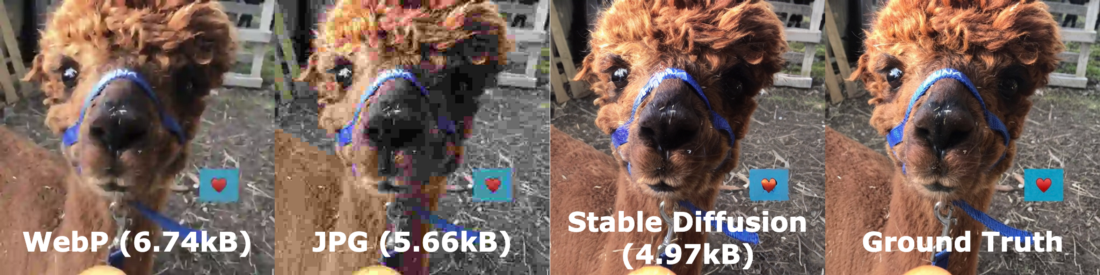
Examples of using Stable Diffusion to compress images.
Examples of using Stable Diffusion to compress images.
While most people use Stable Diffusion with text prompts, Bühlmann cut out the text encoder and instead forced his images through Stable Diffusion’s image encoder process, which takes a low-precision 512×512 image and turns it into a higher-precision 64×64 latent space representation. At this point, the image exists at a much smaller data size than the original, but it can still be expanded (decoded) back into a 512×512 image with fairly good results.