Short answer: “Yes, with an if…” Long answer: “No, with a but…”
"The court is empty because all potential competitors are scared to face me." Credit: Aurich Lawson
"The court is empty because all potential competitors are scared to face me." Credit: Aurich Lawson
Last weekend’s New York Times profile of Uber CEO Travis Kalanick had plenty of important revelations about Kalanick and the company he runs, both of which have been facing some tough PR lately. But there was one incidental, almost throwaway line buried in the piece that made me stop in my tracks:
“In other personal pursuits, he once held the world’s second-highest score for the Nintendo Wii Tennis video game.”
The line baffled me for a number of reasons, not least of which was that the concept of a “high score” in “Wii Tennis” didn’t make much sense. Claiming the “world’s second-highest score” in Wii Sports tennis is like claiming the second-highest score in Pong based on nothing but playing against the computer and your friends. Absent some sort of sanctioned tournament or logical third-party ranking system, the claim just doesn’t parse.
And yet, the boast is oddly specific. Kalanick hadn’t earned the best “Wii Tennis” score in the world according to The New York Times. He achieved the second best. If this was just a fabulist boast, why limit yourself to number two? And if it wasn’t just puffery, who was number one?
What’s more, the paper of record doesn’t hedge its declaration with a “he said” or “he claimed.” Kalanick’s “Wii Tennis” high score is stated as a fact, and one that piece author Mike Isaac said on Twitter was “triple sourced.” (Isaac didn’t respond to further request for comment on his basis for the line.)
I’ve spent an admittedly ridiculous amount of time looking into this one sentence over the past few days. As it turns out, getting to the bottom of Kalanick’s Wii Sports skill requires delving into the vagaries of human memory, reverse engineered asymptotic leveling systems, and the semantic meaning of video game achievement itself.
What Sacca saw

Your honor, I’d like to call Mr. Sacca to the stand…
Your honor, I’d like to call Mr. Sacca to the stand…
Though The New York Times gave it a fresh burst of attention, Kalanick’s claim to the second-highest “Wii Tennis” score is not a new one. The factoid appeared on Uber’s about page at least as far back as 2013, where, in addition to other achievements, the site says that Kalanick “somehow… also managed to rack up the second highest Wii Tennis score in the world. Game, set, match.” The boast is mentioned in a Chicago Tribune piece from last month as well.
In a 2014 Financial Times interview, Kalanick also claimed to be “number seven in the country in Angry Birds.” In all these profiles, the boast is supposed to reflect a wider drive to win at pursuits others treat less seriously. “If somebody gives me a casual game and says, ‘OK, here’s the world record,’ I’ll just go until I’m there,” Kalanick told the Financial Times.
For more details on the “Wii Tennis” story, we need to rely on Chris Sacca, the (recently retired) silicon valley investor who became something of a household name through ABC’s Shark Tank. In a 2015 Medium post, Sacca uses a “Wii Tennis” anecdote to highlight Kalanick’s extreme competitiveness.
As the story goes, during a holiday get-together with friends and family, Sacca’s father challenged Kalanick to “a friendly Wii Tennis match.” The elder Sacca held his own against Kalanick… until the Uber executive revealed that he was using his weaker hand. “With full Princess Bride panache,” as Sacca writes, Kalanick switched to his dominant hand and proceeded to win every single point going forward.
The key detail in Sacca’s story comes next, when Kalanick tries to “offer… a touch of consolation” to his vanquished opponent:
“I have a confession to make, Mr. Sacca. I’ve played a fair amount of Wii Tennis before,” [Kalanick said]. While talking, he used his controller to navigate through the settings pages on the Wii to a list of high scores. “In fact,” he continued, “on the Wii Tennis global leaderboard, I am currently tied for second in the world.”
Reading this detailed explanation only set off more alarm bells in my head. Wii Sports doesn’t have any “global leaderboard,” as Sacca claims. There is no “settings pages” on the system or the game to let you compare your performance to anyone else online. I literally wrote an entire reference book about the Wii, in which Wii Sports filled an entire chapter, so I’m pretty confident on this point.
Yet Sacca also seemed pretty confident in citing a “Wii Tennis global leaderboard.” It’s a story he’s repeated at a convention and in a podcast in recent years, citing “global leaderboards” both times.
Sacca discusses “the Nintendo Wii story” with CNN Money at the 2016 Collision conference.
I tried desperately to come up with some explanation that meshed with what Sacca saw. Were they maybe playing on the Wii U re-release of Wii Sports Club, which did feature online multiplayer and regional leaderboards? Sacca said the story takes place on “New Year’s Day, 2010 I believe,” well before the Wii U was available, so that doesn’t help.
Were they possibly playing another tennis game on the Wii? Titles like EA’s Grand Slam Tennis and Sega’s Virtua Tennis 2009 seem to have online competition, after all. This also feels unlikely; Wii Sports has been a pack-in game and primary system seller for the Wii since its 2006 launch, to the point that “Wii Tennis” can safely be assumed as the tennis mode in that game (though the wording is frustrating for the sake of clarity, in this case).
Maybe Kalanick had navigated to some sort of online score listing via the Wii’s Web browser? There are a few sites that maintain high score lists for some Wii Sports training modes and the game’s “skill level.” However, Sacca refers to it specifically as a “settings page on the Wii” in multiple tellings, and training mode scores don’t seem a likely focus for this kind of boast (Twin Galaxies, the closest thing to official scorekeepers that the industry has, says it has no idea what Sacca is referring to, for what it’s worth).
Desperate for more details, I reached out to Sacca to confirm and explain some of the details in his story, specifically the details about a “leaderboard.” To my surprise, he actually responded. You can see our entire discussion in the Twitter thread linked above, but here’s the core of his reply:
I assure you there was a world ranking at that time. I just checked with other friends and family who were there. Among the reasons we remember it clearly is that we had a long discussion about whether #1 was actually a hack or not. We talked at length about whether hacking the top spot would be a penetration of the software itself or a mechanical hack of the controller.
We also remember that he didn’t exclusively occupy #2. He was tied with others. This again highlighted #1 as a potential hack. Sorry I don’t have anything else to offer as you hunt this down.
It seems clear that Sacca (and his friends and family, apparently) has a distinct memory of seeing Kalanick at No. 2 on some sort of “world ranking” for “Wii Tennis.” Yet it’s just as clear that there has never been any in-game, online ranking in the original version of Wii Sports. What’s going on?
Enter the “skill level”
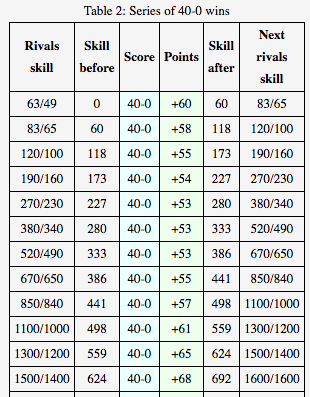
A small sample of the reams of data collection needed to reverse engineer the Wii Sports tennis skill level algorithm. Credit: Orden y Concierto
While Wii Sports doesn’t have any online leaderboards, it does have one in-game measure of progress through each of its component sports. This “skill level” is an Elo-style measure of performance that goes up and down depending on how well you do against the computer-controlled AI.
The skill level is the closest thing to an overarching “score” that it makes sense to refer to in Wii Sports, though I’d argue calling it a “score” is incorrect at worst and misleading at best. In any case, I believe confusion over this skill level is probably at the heart of Kalanick and Sacca’s “Wii Tennis” claims.
The most detailed and accurate breakdown of the Wii Sports tennis skill level system I’ve been able to find is here. The full explanation gets into some pretty detailed math, so here’s a brief summary:
In Wii Sports, every Mii you use starts with a skill level of zero. Every time you beat a computer opponent, that skill level increases based on your score in that match and the (simulated) skill level of the opponent.
The skill level of your next computer opponent goes up alongside your skill level until you face the top-ranked computer opponents in the game, Elisa and Sarah, who have skill levels of 2000 and 1900 respectively.
This is what it looks like to play against the most difficult computer opponents in Wii Sports tennis.
Once you reach Elisa and Sarah, the rate of skill level increase quickly reaches a point of diminishing returns. At a skill level of 2300, you can earn up to five skill levels per game won. At level 2350, you earn up to two levels per win. To go from skill level 2398 to 2399 requires 14 perfect games in a row.
All told, it takes at least 160 wins against the computer AI to reach a skill rating of 2399, and that’s only if you can pull off dozens of perfect 40-Love matches against the toughest computer opponents the game can throw at you.
The mythical 2400
There’s a decent amount of online debate over whether a skill rating of 2400 is even possible in Wii Sports tennis (Nintendo refused an opportunity to discuss the leveling algorithm for this piece). However, based on the reverse-engineered algorithm discussed above (which seems accurate in tests), the potential skill rating graph is an asymptote that can approach but never reach 2400.
While skill levels are stored internally as a floating point value, Wii Sports always displays the value rounded down to the nearest whole number. Thus, no matter how close you get to 2400, the game will always show your skill level as 2399.
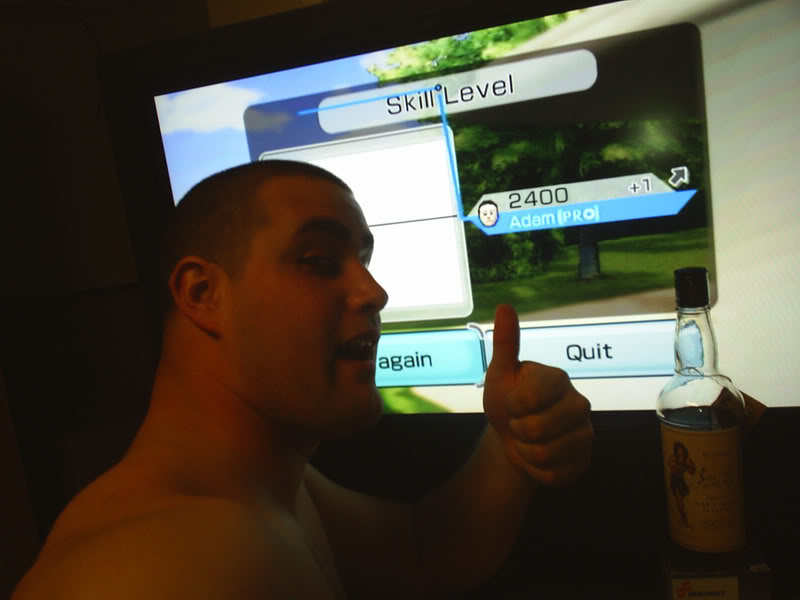
This unnamed Internet poster holds the only semi-credible claim to a Wii Sports tennis skill level of 2400 I could find.
This unnamed Internet poster holds the only semi-credible claim to a Wii Sports tennis skill level of 2400 I could find. Credit: Archive.org
Aside from one YouTube video that seems to be an obvious joke—Nintendo is not going to “recommend you get a life” in a congratulatory screen—the only hard “evidence” for an actual 2400 rating in the wild comes from an unsigned post on defunct Web host 250free back in early 2007 (and archived here).
The unnamed poster (though his screenshot shows a Mii named “Adam”) claims that it took “nearly 20,000 games” to finally break through to the 2400 skill level barrier, or about 900 hours of play spread over 40 to 80 days. Yet the page also inaccurately states that the skill level adjustment depends on factors like “power serves, number of volleys, volley times, and distribution of players used.” Only the final game score and the skill rating of the opponent seem to have any actual effect on the skill level change.
Maybe 20,000 wins is enough to overflow the Wii’s floating point calculations to the point where the game finally rounds up to 2400. Maybe this is just a random joker posing next to a photoshopped screen. It’s quite possible that 2399 is actually the highest skill level in the game, not the second-highest.
Regardless, the important point here is that a semi-plausible claim to a 2400-point skill level existed on the Web shortly after the game’s release.
[Update: Months after this piece was published, Adam Haller reached out to Ars to confirm that he was behind the 2400 skill rating hoax discussed here.]
Reconstructing the scene
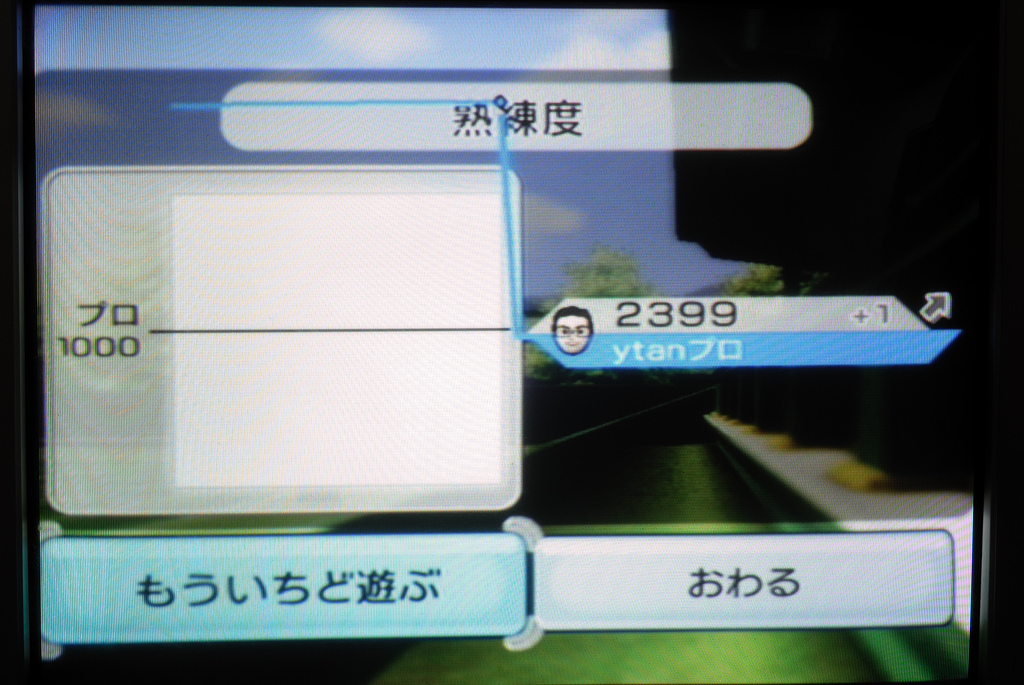
This is the kind of in-game “skill level” graph onlookers could have later remembered as a “global leaderboard” display.
This is the kind of in-game “skill level” graph onlookers could have later remembered as a “global leaderboard” display. Credit: Flickr / Yu Tan
With Kalanick and Uber yet to respond to a request for comment, the rest of this piece necessarily delves into speculation of what’s driving Kalanick’s Wii Sports “high score” claim. That said, I think the explanation detailed below adequately explains all the claimed facts involved with a few small wriggles to account for the vagaries of human memory.
So with all that preamble, here’s what I think actually led to the “second-highest score” claim:
- Sometime after Wii Sports comes out, Kalanick plays in-game tennis obsessively to the point where he can beat the computer perfectly and reliably. He works his skill level up to 2399 after dozens of matches.
- Noting the diminishing returns in skill level increase, Kalanick searches online to find out how hard it would be to push his skill level higher. He finds the page mentioned above, which claims it would take tens of thousands of games to get that 2400 skill level. He stops pushing for a higher level, satisfied that he has reached the second-highest level possible.
- Later, with Sacca and friends and family around, Kalanick proceeds to show off his pre-existing skill level of 2399 (which is visible on an easy-to-access graph via an in-game menu). He explains that 2399 is the second-highest “score” possible in the game, meaning he’s tied for second.
- Kalanick mentions the story of the mythical 2400 level player that he saw online. The assembled guests discuss whether someone actually played 900 hours of Wii Sports to get that ranking or whether the ostensible No. 1 might have skipped the grind by hacking the software or the controller.
- Years later, through the vagaries of memory, that discussion of relative “high scores” (and the on-screen graph of Kalanick’s single-player skill level performance) becomes, in the retelling, an online “global leaderboard” that confirmed Kalanick’s second-place position.
When a “score” isn’t a score
Absent further information from the parties involved, this is the best explanation I can come up with for the source of this “high score” claim. Even if the details are off in a few respects, I’m relatively confident that the “Wii Tennis score” Kalanick and others are referring to is actually a skill level of 2399 (which Kalanick could have reasonably assumed was a “tie for second” based on the online evidence at the time).
Even if this is the case, I still have a real issue with the connotation involved. While reaching 2399 is definitely not insignificant, I’d argue it’s not fair to refer to it as a “high score” with all that implies, either.
By the Merriam-Webster definition, Wii Sports‘ skill levels could technically be called a score: “a number that expresses accomplishment (as in a game or test) or excellence (as in quality) either absolutely in points gained or by comparison to a standard.” In general video game parlance, though, the skill level is better understood less as a score and more as a character level.
In general, a video game score starts at zero with every play session and increases until that session ends through in-game death or some sort of victory or kill screen condition. A video game character level, on the other hand, tracks a single player across multiple play sessions, measuring progress in a way that’s usually more closely tied to time spent playing (though the rate of increase can change based on specific achievement).

A player that simply reached level 110 in World of Warcraft couldn’t credibly say they’re “tied for first” on the game’s leaderboards…
A player that simply reached level 110 in World of Warcraft couldn’t credibly say they’re “tied for first” on the game’s leaderboards… Credit: YouTube / LowkoTV
In short, while a score measures skill, a level measures progress. While a score generally measures how well you play the game, a level measures how much you’ve played the game. Both numbers require skill to increase, but a high score is much more reflective of the relative skill of the player.
In the case of Wii Sports, it would be much more accurate to say that a “2399” player had merely reached the second-highest level in the game (or possibly even the highest level, as discussed above). That doesn’t quite have the same ring to it, but such phrasing gives a much clearer implication of what’s actually been achieved.
Yes, a Wii Sports skill level can technically go down unlike most in-game character levels. But losing a game doesn’t prevent you from winning a few more to get back to the maximum level. Once you are able to play a perfect game against Wii Sports‘ top-level computer opponents, reaching a ranking of 2399 is simply a matter of repeating the process dozens of times.
Reaching a skill level of 2399 in Wii Sports tennis is akin to grinding out a higher level in a game like World of Warcraft, only with less social interaction. Past a point, getting a higher “skill level” is a test of your ability to endure monotony more than a measure of true skill (and it doesn’t even require the real-world stamina of a video game marathon, since it’s spread across multiple sessions).
Using your Wii Sports skill level as evidence of your prowess at the game is like saying you’re really good at a Street Fighter game because you beat the single-player arcade mode dozens of times on the hardest difficulty without dying once. It’s an achievement, for sure, but one that’s somewhat meaningless in a game centered around competition between humans.
Twin Galaxies does track one record surrounding Wii Sports tennis skill level, but that record focuses on the level achieved in a single “Best of 5” match when starting from skill level 0. That single-match limit is what separates a “score” from a “level” in this case (though this particular “score” seems relatively easy to max out).
Angry Birds, on the other hand, gives players a discrete score on each stage, and those scores can reasonably be compared against each other as a measure of maximum skill. That means Kalanick’s claim to have been ranked seventh in the world at Angry Birds at least makes sense, even if hackers have made it hard to determine how accurate the game’s online leaderboards really are.
Words have meanings, and so do scores

You don’t become the world’s second-best tennis player just by practicing against a machine a whole lot.
You don’t become the world’s second-best tennis player just by practicing against a machine a whole lot. Credit: YouTube / Tri-Tennis
This may seem like pedantic, semantic nitpicking, but I don’t think it is. The clear implication of saying you have the “second-highest score” in Wii Sports is that you’re the second-best player there is at the game (or, at the very least, that you at one point put in the second-best performance ever seen in the game). This is especially true to listeners who might not be familiar with the vagaries of the Wii Sports leveling system seemingly being used here.
Sacca himself has fallen into this trap. In a 2015 podcast, he said Kalanick “was the second best player in the world in Wii Tennis,” showing the potential danger of semantic slippage when scores and character levels are used interchangeably. Speaking to CNN Money last year, Sacca said Kalanick was “ranked No. 2 in the world at ‘Wii Tennis,’” which is also misleading. It brings to mind images of the world’s second-best actual tennis player, who competed with other humans to achieve that title rather than simply practicing a lot against a serving machine.
Saying you have one of the highest scores in a popular game implies preternatural skill and a single-minded devotion to pushing the limits of human performance, as seen in movies like King of Kong or Man vs. Snake. Saying instead that you reached one of the highest character levels in the game implies that you managed to grind out a higher in-game status through a lot of repetitive play, as countless others have done in the exact same way (here’s a list of 92 other players who’ve reached skill level 2399 and bothered to share the achievement with one ranking site).
So while I’m sure Kalanick is very good at Wii Sports tennis, I wouldn’t call him or anyone else the second-best player in the world until I saw them play against some actual humans in a tournament setting. Even the online rankings in Wii Sports Club are no doubt a much more accurate representation of who is actually the second-best Wii Sports tennis player in the world, but those leaderboards are segregated by region and limited by a dwindling player base (plus Nintendo seems to be in the process of shutting them down, in any case).
If Kalanick actually reached skill level 2399 in Wii Sports tennis, it definitely says something about his competitive nature. It shows a man who’s willing to perfect a narrow skill and repeat that skill over and over to achieve an automated, external validation of his success.
But that’s very different from a “high score” or a “ranking,” which would imply some sort of ordering based on relative skill in direct, structured competition with other players. And when the record in question becomes bragging rights for one of the most powerful executives in Silicon Valley, it’s worth getting to the bottom of that difference.
Listing image: Aurich Lawson

Kyle Orland has been the Senior Gaming Editor at Ars Technica since 2012, writing primarily about the business, tech, and culture behind video games. He has journalism and computer science degrees from University of Maryland. He once wrote a whole book about Minesweeper.