“For example, the assessment is based on a small number of ‘newest’ models, which represents only a fraction of the devices available to customers globally. In addition, scoring may also be influenced by the timing of repairability documentation updates. Given the scale of Lenovo’s portfolio, updates are made on an ongoing basis as part of our commitment to providing comprehensive information to customers, including across configure-to-order products with multiple configurations.”
Lenovo’s spokesperson also pointed to Lenovo’s ThinkPad portfolio, saying the devices have “customer repairable components.” The OEM also offers “extensive service documentation and parts access through our global support infrastructure” and works with iFixit, the rep said.]
PIRG’s report concluded that “laptops are pretty stagnant in terms of repairability” across many of the eight most popular laptop brands in the US.
However, Proctor noted to Ars that consumers’ access to parts, tools, and information that vendors have has improved, but improvements around ease of disassembly “take longer to realize.”
He also praised vendors’ efforts to release more repairable designs, such as Apple’s MacBook Neo.
Phone repairability scores
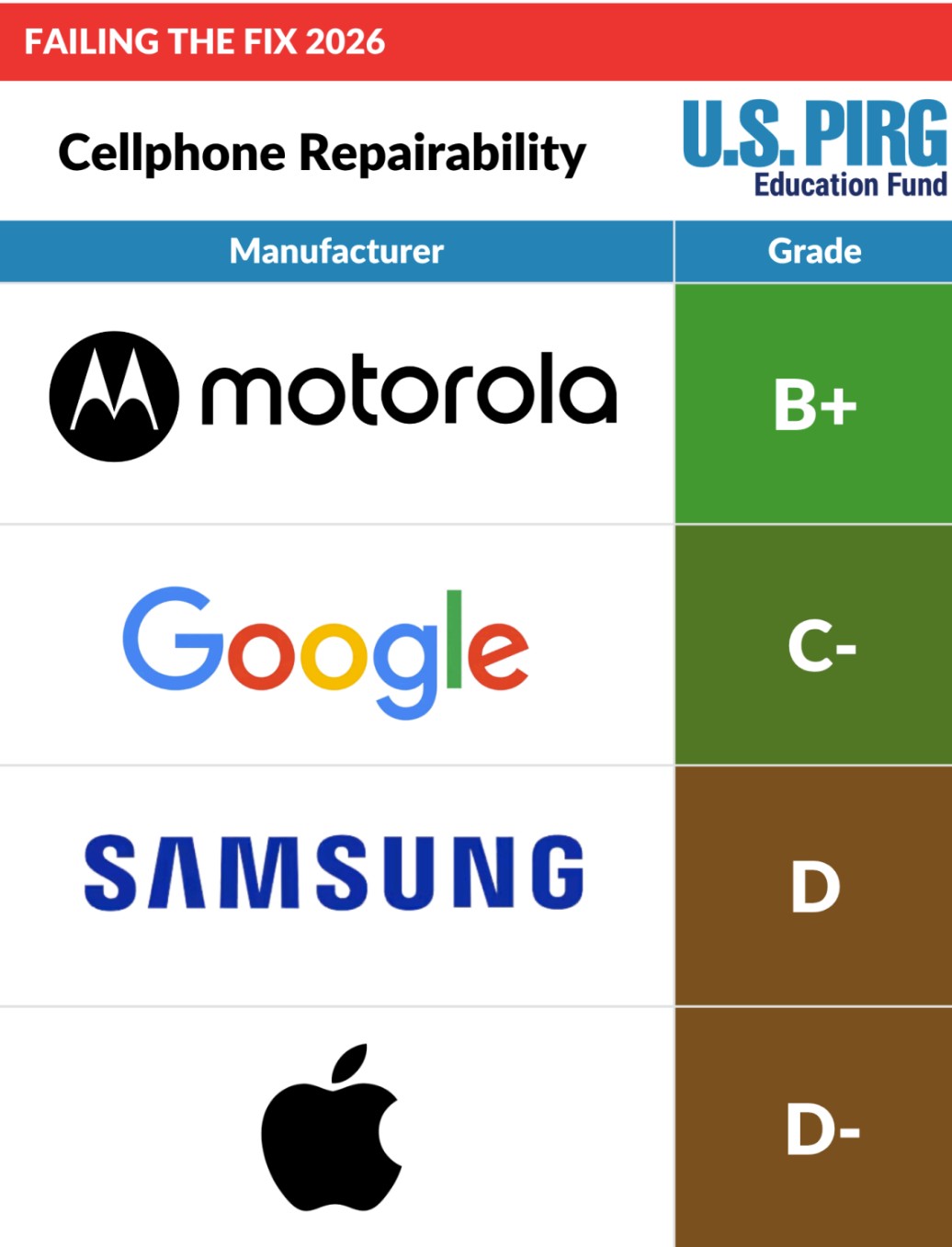
Lenovo’s Motorola brand earned the best grade.
Lenovo’s Motorola brand earned the best grade. Credit: US PIRG Education Fund
PIRG’s scores for phone manufacturers this year are based on the European Product Registry for Energy Labelling (EPREL), a scoring system that the European Commission created in June 2025 for scoring smartphone and tablet repairability. It’s based on six factors:
- Disassembly depth
- Fasteners
- Tools
- Spare part availability
- Software updates
- Repair information
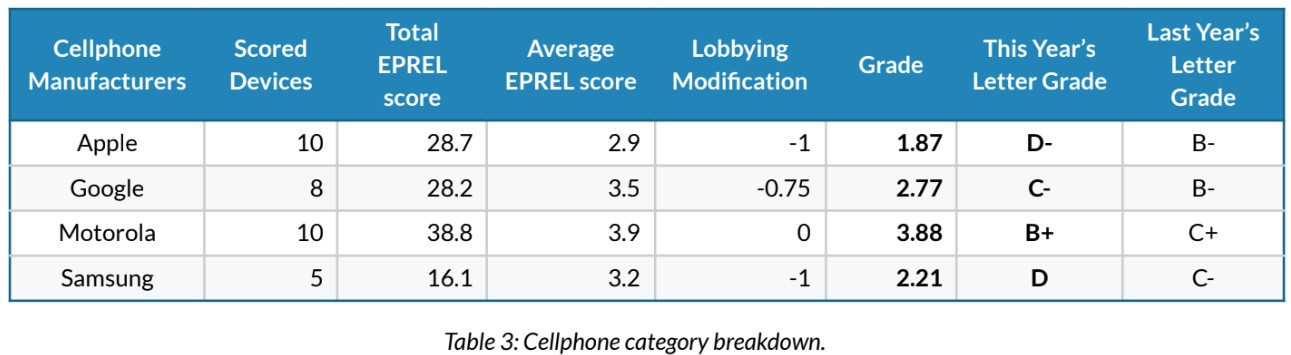
US PIRG used different criteria for this year’s report.
US PIRG used different criteria for this year’s report. Credit: US PIRG Education Fund
PIRG’s report said that Apple and Samsung scored so low under EPREL criteria partially because all of the phones scored are guaranteed to receive updates for five years and not longer.
PIRG noted that Apple made progress in phone repairability by moving away from parts pairing, which is when companies require parts to be verified through encrypted software checks in order to function, and through the introduction of the Repair Assistant. However, the report’s author lamented that third-party Face ID replacements still don’t work. The report adds:
Apple also extended its Activation Lock anti-theft feature to individual parts, which repair advocates warn will strand large numbers of perfectly functional components—locking them out of the repair ecosystem entirely.
Apple isn’t alone: parts pairing and software restrictions remain an industry-wide problem that consumers and independent technicians continue to face across manufacturers.