The Korean company insists that its 3 nanometer yield rates have improved. But according to two people close to Samsung, the yield rate of its simplest 3 nm chip is just 60 percent, well below customer expectations and likely to fall further when producing more complex chips equivalent to Apple’s A17 Pro or Nvidia’s graphic processing units.
“Samsung tries to do these quantum leaps,” said Dylan Patel, chief analyst at research firm SemiAnalysis. “They can claim all they want, but they still have not released a proper 3 nanometer chip.”
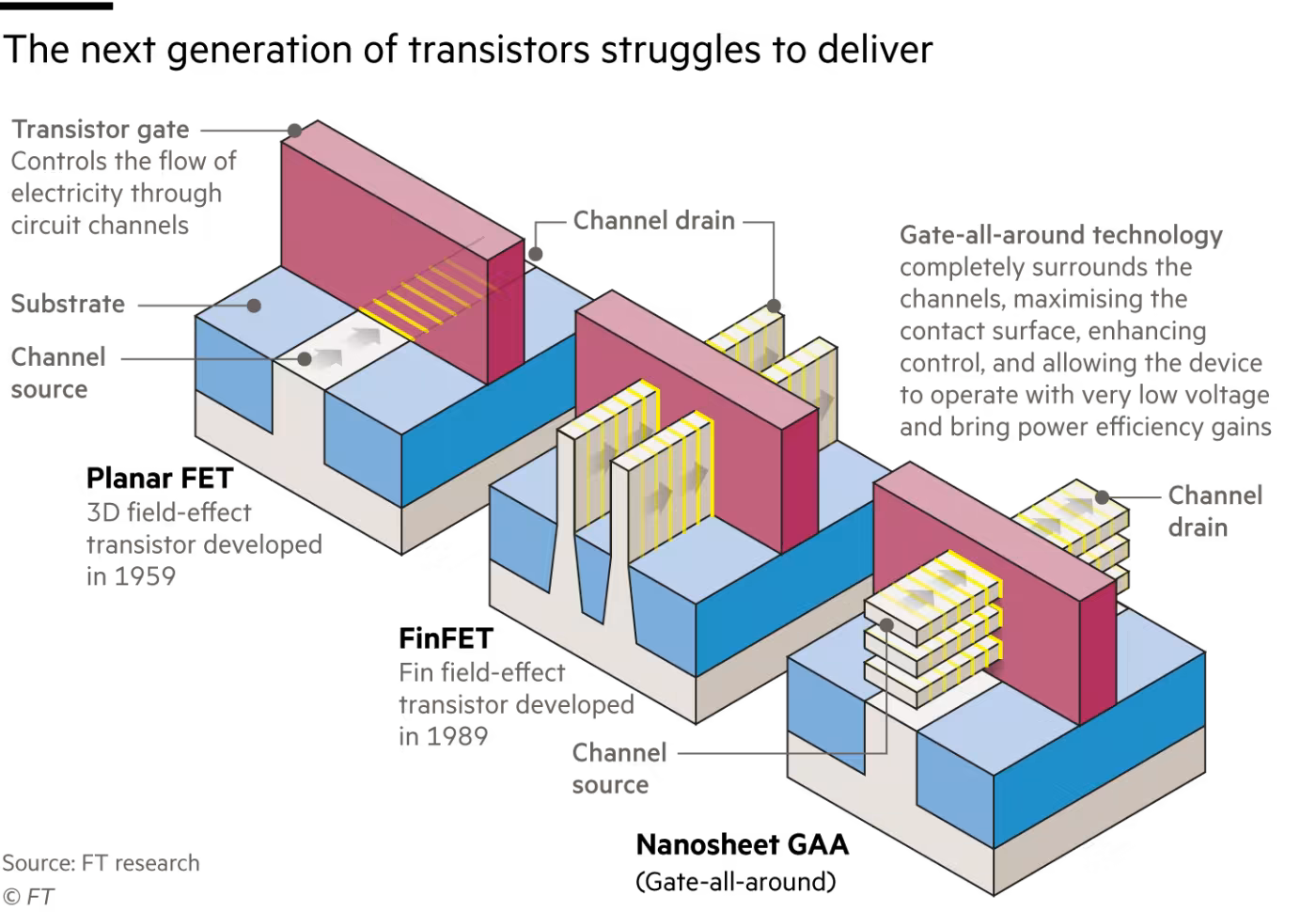
Lee Jong-hwan, professor of system semiconductor engineering at Sangmyung University in Seoul, added that Samsung also suffered from the fact that its smartphone and chip design divisions were fierce competitors of the potential customers for the logic chips produced in its foundry division.
“Samsung’s structure causes concern to many potential customers about possible tech or design leaks,” said Lee.
Meanwhile, former market leader Intel is promoting its next generation “18A” node at technology conferences and offering free test production to chip design firms. The US company says it is set to begin production of 18A in late 2024, potentially making it the first chipmaker to migrate to the next generation.
But CC Wei, TSMC’s chief executive, appears unfazed. He said in October that according to the Taiwanese company’s internal assessment its latest 3 nanometer variant, which is already on the market, is comparable to Intel’s 18A in terms of power, performance, and density.
Both Samsung and Intel also hope to benefit from potential customers looking to reduce their dependence on TSMC, whether for commercial reasons or out of concern about a potential Chinese threat to Taiwan. In July, the chief executive of US chipmaker AMD said it would “consider other manufacturing capabilities” besides those offered by TSMC, as it pursued greater “flexibility.”
Leslie Wu, chief executive of consulting firm RHCC, said major customers who require technology at the 2 nanometer level are looking to spread their chip production across multiple foundries. “It’s too risky to rely on TSMC solely.”
But Mark Li, Asia semiconductor analyst at Bernstein, questioned “how meaningful that [geopolitical] factor is compared to factors such as efficiency and schedule is open to debate. TSMC remains superior when it comes to cost, efficiency, and trust.”
© 2023 The Financial Times Ltd. All rights reserved. Not to be redistributed, copied, or modified in any way.