Besides the Dell, which consumers would struggle to find, data for the Seagate BarraCuda 120 SSD ZA250CM10003 and BarraCuda SSD ZA250CM10002 and Crucial’s CT250MX500SSD1 are the most helpful, since they feature at least 100,000 active days. Among those drives, the Seagate ZA250CM10003 showed the lowest AFR, 0.73 percent.
Taking a step back further, Backblaze also shared 2020, 2021, and 2022 data for its SSDs, including four models Backblaze added last year.
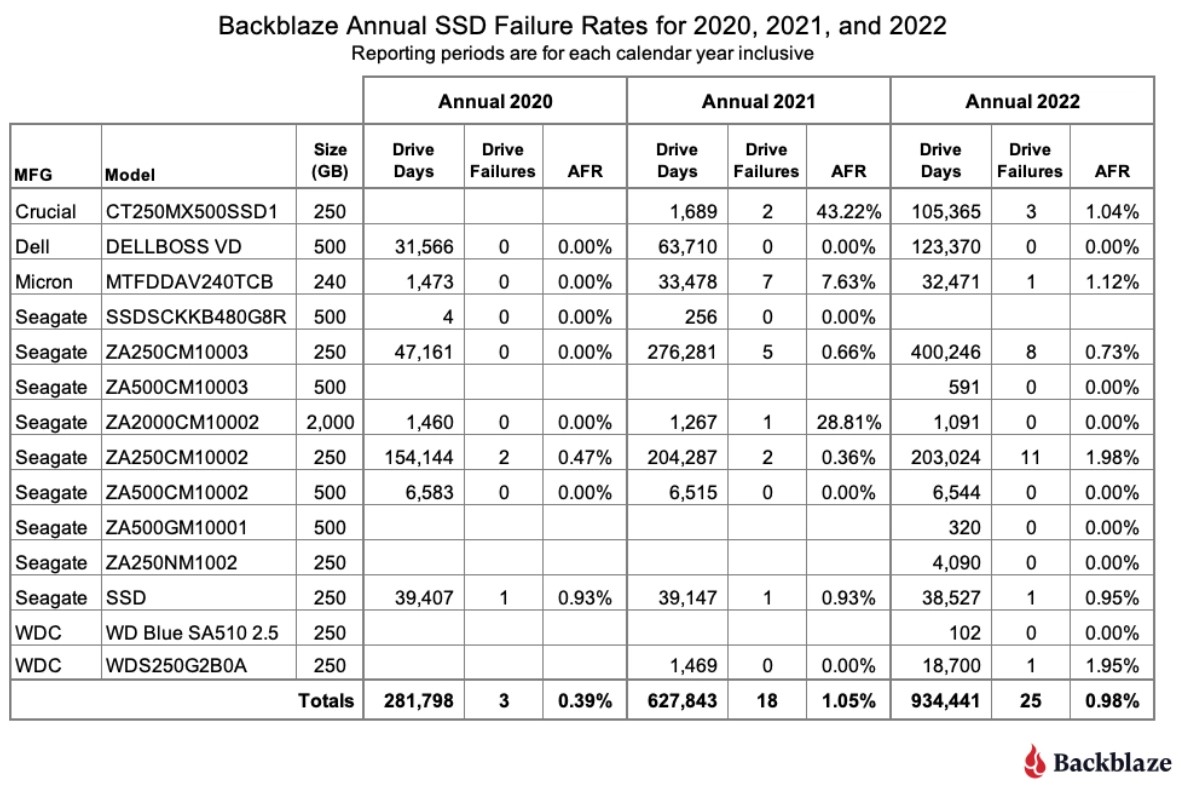
You may notice a high AFR from the Crucial 250GB CT250MX500SSD1, but note that Backblaze only added the drive in 2021, and it “recovered nicely in 2022 after having a couple of early failures in 2021,” according to Backblaze, which expects that trend to continue. The Crucial SSDs’ early failures coincide with the bathtub curve, which expects device failures to occur early in the release cycle before dropping to a stable rate and then increasing as the product ages.
Backblaze also highlighted differing AFRs from the 250GB Seagate ZA250CM10003 and 250GB Seagate ZA250CM10002.
“The Seagate drive (model: ZA250CM10003) has delivered a sub-1% AFR over all three years. While the AFR for the Seagate drive (model: ZA250CM10002) slipped in 2022 to nearly 2%. Model ZA250CM10003 is the newer model of the two by about a year. There is little difference otherwise except the ZA250CM10003 uses less idle power, 116mW versus 185mW for the ZA250CM10002. It will be interesting to see how the younger model fares over the next year,” the blog said.
Backblaze has previously shown the reliability of SSDs over HDDs across a five-year period, but this recent data gives us a model-by-model breakdown of AFRs of SSDs in its arsenal across a slightly longer time period. The longer Backblaze has these SSDs and puts them through their paces, the more insight it will be able to provide about SSD reliability.
Backblaze’s complete dataset is available on its Hard Drive Test Data page.