Newton becomes real
The combination of the efficient Acorn CPU and a new vision from Steve Capps and his team brought the Newton project back on track. There were still debates about the final size and form factor of the product, and at one point, there were three different sizes being considered. John Sculley laid down the law when he said that the Newton had to fit inside his jacket pocket. Some of the engineers joked that they wanted to sneak into his house at night and re-tailor his jackets to make the pockets larger.
The Newton was finally demonstrated to the public at the Consumer Electronics Show on May 29th, 1992, although the product was still far from shipping. John Sculley referred to the Newton as a “personal digital assistant,” or PDA, a term he coined at his announcement speech. While the Newton was not the first compact digital organizer to be released, it would end up being the first PDA, simply because the name stuck.
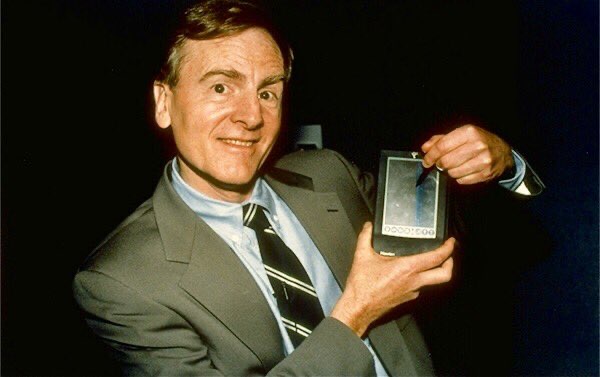
John Sculley demonstrates the Newton at the Chicago Consumer Electronics Show. Credit: Time
The product demonstration excited the crowd, and the press went into full hype mode. Some of the features shown at CES, like the ability to draw rough shapes that turned into solid ones that could be dragged around and deleted by scribbling over them, showcased Capps’ vision of being the “smartest piece of paper.” But the demo was carefully staged to only show the parts of Newton that worked and to avoid the features that had massive bugs and would cause crashes.
The pressure to deliver the Newton reached a boiling point, and Apple engineers were routinely working 15- to 20-hour days. One engineer, 30-year-old Ko Isono, died by suicide on December 1992. Apple instituted mental health checks and support programs for its employees after the incident.
Finally, after a long and painful development process, Apple announced that the Newton was officially shipping on August 2, 1993.
The product
The Newton MessagePad 100 went on sale for $900 in 1993 dollars, or about $1,800 today. For that money, you received a device that was absolutely innovative and different but which still had many rough edges.
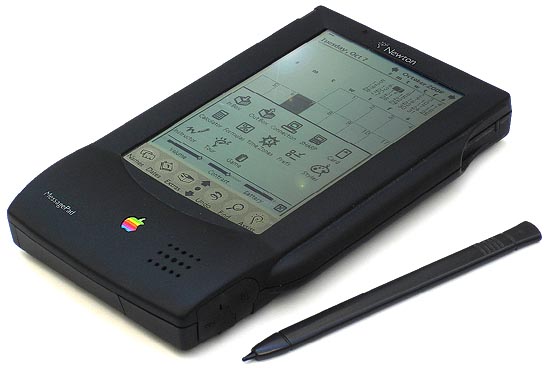
The Newton MessagePad 100, showing off its user interface. Credit: old-computers.net
To interact with the device, you used the included plastic stylus to write on the non-backlit, black-and-white LCD screen. The display was approximately 4.5 inches by 3.5 inches and had a resolution of 240 by 320 pixels.
The primary feature of the device, the handwriting recognition, did not work well out of the box. It had to be trained on a user’s unique writing, and it failed to recognize many words.
This flaw led to a massive backlash in public opinion, and the Newton became the go-to reference for expensive but flawed high-tech gadgets. Doonesbury author Garry Trudeau wrote a series of comic strips in which a character tried to get the Newton to recognize his handwriting, with hilarious results. The Simpsons released an episode in which Nelson Muntz told his friend to “take a note on your Newton.” He wrote, “Beat Up Martin,” but the Newton translated it as “Eat Up Martha.”
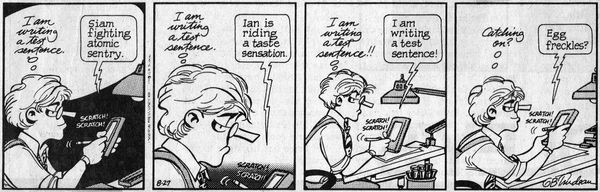
Garry Trudeau takes a shot at the Newton. Credit: Computer History Museum
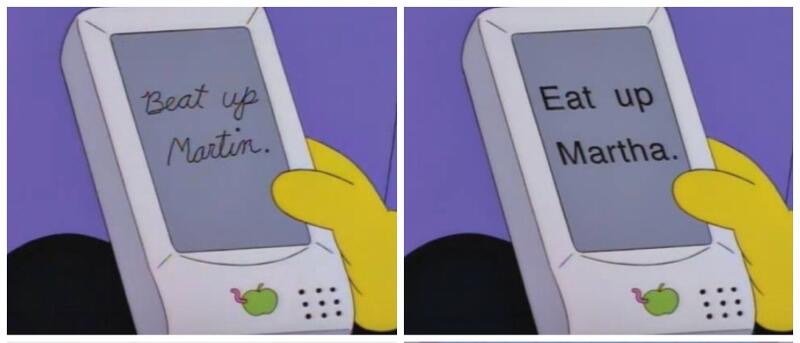
The Simpsons join in the fun.
Credit: Simpsons Quotes
The Simpsons join in the fun. Credit: Simpsons Quotes
The handwriting problems wouldn’t have been fatal by themselves, but the rest of the product failed to live up to the massive media hype and public expectations. With the original Newton, you could take notes, use the calculator, run some simple formulas, update and search contacts in an address book, and keep track of appointments in a calendar. And that was about it.
Some features were ahead of their time. For example, the Newton came with support for reading ebooks a full fourteen years before the launch of Amazon’s Kindle store. Other features would have been amazing, if only the wireless infrastructure had existed to use them. The first 802.11 WiFi standard for computers would not appear until 1997, and cellular phones were still using analog signals. (An optional accessory card did allow messages to be sent via pager.) The Newton came with an infrared port, like those in remote controls, that you could use to “beam” messages and other information from one Newton to another, assuming both owners were in the same room. The primary way to sync your data with your computer was using a wired cable.