The new iPhone offers better battery life, superior cameras, and great screens.
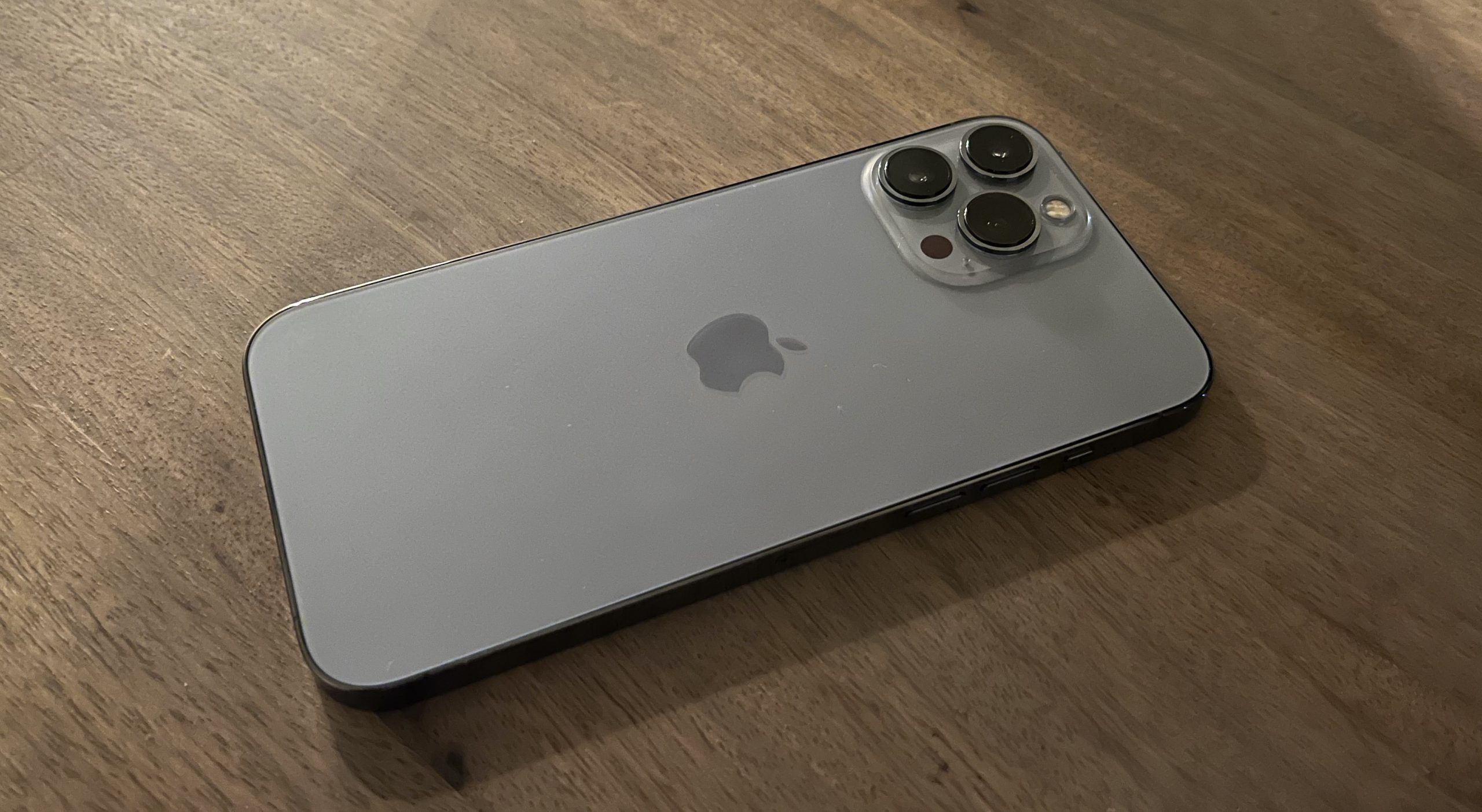
The iPhone 13 Pro Max, photographed by the iPhone 13 Pro in low light. Credit: Samuel Axon
The iPhone 13 Pro Max, photographed by the iPhone 13 Pro in low light. Credit: Samuel Axon
Imagine you were visited by a genie who would grant you three wishes, but they all had to be about what you want from your next smartphone. As market research and surveys tell it, almost everyone would make the same three wishes: great battery life, excellent cameras, and big, beautiful screens.
This year, Apple is that technology genie, because that’s exactly what the iPhone 13, iPhone 13 mini, iPhone 13 Pro, and iPhone 13 Pro Max deliver when they hit store shelves today.
Cupertino’s flagship phone lineup might seem like an iterative “S”-style update, given that the phones look almost the same as last year’s models and that there are no major new features apart from screens with higher refresh rates in the priciest models. But since Apple zeroed in on most people’s highest priorities, this seemingly iterative update ends up being a noteworthy one.
Apple iPhone 13 and iPhone 13 Pro
Table of Contents
Specifications
| Specs at a glance: iPhone 13, 13 mini, 13 Pro, 13 Pro Max | |
|---|---|
| Screen | 2532×1170 6.1-inch OLED (13/Pro), 2778×1284 6.7-inch OLED (13 Pro Max), 2340×1080 5.4-inch OLED (13 mini) |
| OS | iOS 15 |
| CPU | Apple A15 Bionic |
| RAM | 4GB (13/mini); 6GB (13 Pro/Max) |
| GPU | Apple A15 Bionic |
| Storage | 128, 256, or 512GB for 13/mini; 128, 256, 512GB, or 1TB for 13 Pro/Max |
| Networking | Wi-Fi 6, Bluetooth 5, 5G |
| Ports | Lightning |
| Camera | Two 12MP rear cameras (wide-angle, ultra-wide-angle) for 13/mini; three 12MP rear cameras (wide-angle, ultra-wide-angle, telephoto) for 13 Pro/Max; 7MP front camera; Dolby Vision HDR 4K video capture |
| Size | 146.7×71.5×7.65mm (13/13 Pro), 160.8×78.1×7.65mm (Max), 131.5×64.2×7.65mm (mini) |
| Weight | 173 g (13), 204 g (Pro), 240 g (Max), 140 g (mini) |
| Starting price | $699 (mini), $799 (13), $999 (Pro), $1,099 (Max) |
| Other perks | MagSafe, Face ID |
Last year, I stopped short of recommending the iPhone 12 Pro because the iPhone 12 offered enough. The two phones were not significantly differentiated beyond nicer materials and the inclusion of a zoom lens and a lidar sensor in the pricier phone. This time around, the Pro model has some more going for it: a better camera system, faster graphics, and markedly improved battery life over the iPhone 13.
Now it’s the iPhone 13 Pro and iPhone 13 Pro Max that aren’t all that different from each other. For reference, last year saw the Max get the better camera system. Now they’re the same, so it’s just about screen size and battery life.
Battery life
Apple claims that the iPhone 13 mini can last for 13 hours when playing a streaming video, and the iPhone 13 is rated for 15 hours. It’s a big leap up to the iPhone 13 Pro, which claims to offer 20 hours—and the iPhone 13 Pro Max promises a remarkable 25 hours.
This is thanks to several things, like a more efficient processor, the ProMotion display in the Pro phones (we’ll get to that soon), and importantly, bigger batteries. Apple has rejiggered the internals in all the phones to make room for more battery capacity. When it comes to lithium-ion batteries, you can’t change the laws of physics—but you can brute force them.
A15 Bionic
That more efficient processor is the A15. Apple hasn’t made many specific performance claims about how the A15 compares to last year’s A14, but we know the new SoC has a 6-core CPU with two performance and four efficiency cores, a 5-core (in the Pro models) or 4-core (in the regular iPhone 13 models) GPU, and a 16-core NPU (that’s “neural processing unit,” for hardware-accelerated machine learning).
Performance doesn’t seem to be the main focus of Apple’s latest iPhone refresh—which is just fine, because last year’s phones were already far and away the fastest on the market, and no one else has matched them. But we’ll share our benchmark results later in the review.
Dimensions
The iPhone 13 measures 5.78×2.82×0.3 inches, or 146.7×71.5×7.65 millimeters. The iPhone 13 mini comes in at 5.18×2.53×0.3 inches, or 131.5×64.2×7.65 millimeters.
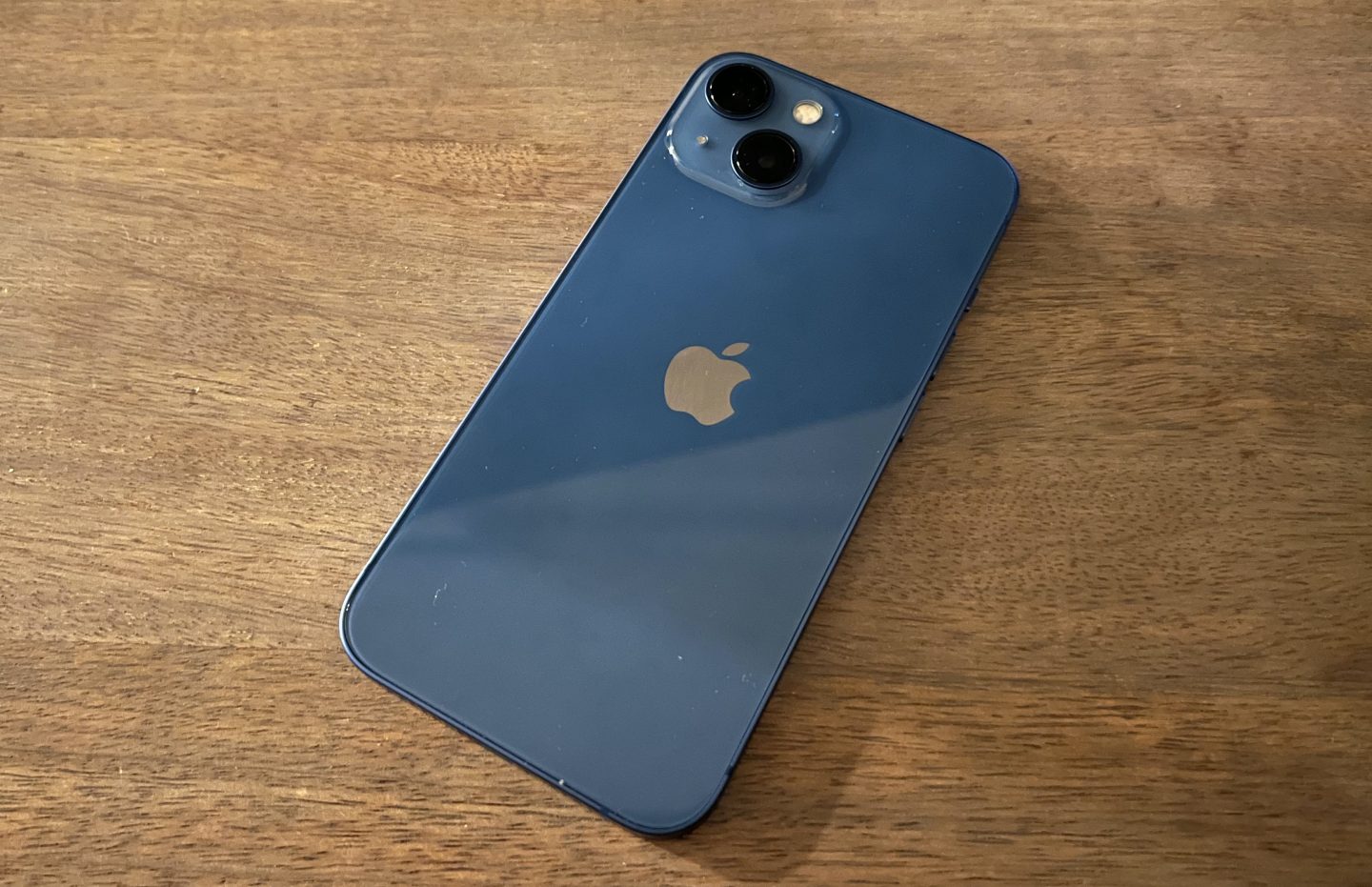
The back of the iPhone 13.
Credit: Samuel Axon
The back of the iPhone 13. Credit: Samuel Axon
That makes them ever so slightly thicker than their predecessors. The iPhone 13 mini is still adorably tiny, and it’s great to see a one-handed phone with so many features in Apple’s lineup again. If only we could be confident it will still be around next year.
Both weigh more than their 2020 counterparts, at 6.1 ounces or 173 grams for the iPhone 13, and 4.94 ounces or 140 grams for the iPhone 13 mini. That’s up from 5.78 ounces/164 grams and 4.76 ounces/135 grams, respectively.
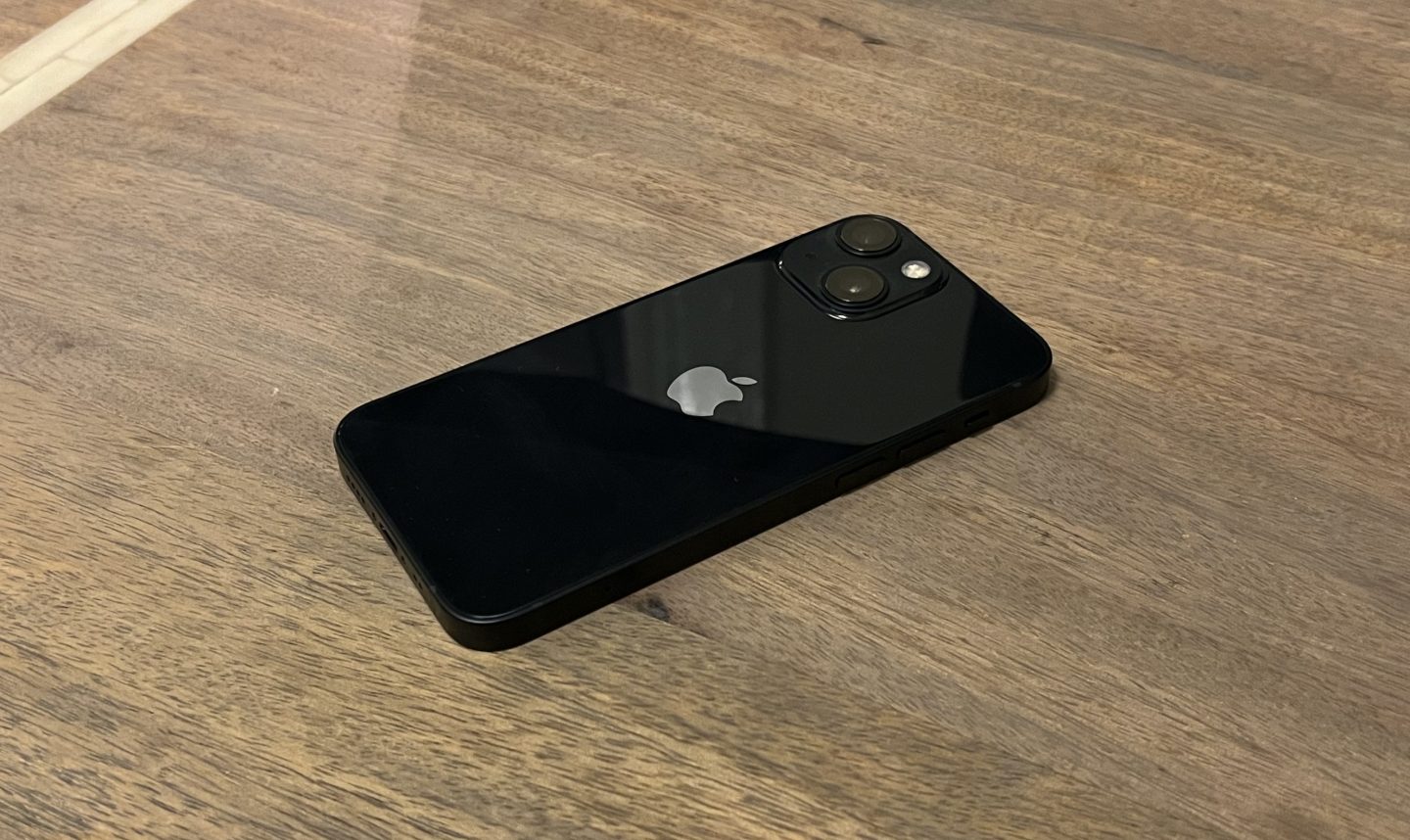
The back of the iPhone 13 mini.
Credit: Samuel Axon
The back of the iPhone 13 mini. Credit: Samuel Axon
Meanwhile, the iPhone 13 Pro is 7.19 ounces or 204 grams, and the iPhone 13 Max is a hefty 8.46 ounces or 240 grams. Last year: 6.6 ounces/189 grams for the 13 Pro and 7.96 ounces/226 grams for the Max. You’d feel the difference when holding them side by side with the iPhone 12 Pro and iPhone 12 Pro Max.
The iPhone 13 Pro is 5.78×2.82×0.3 inches, or 146.7×71.5×7.65 millimeters. The iPhone 13 Pro Max: 6.33×3.07×0.3 inches, or 160.8×78.1×7.65 millimeters. They’re also a smidge thicker than last year’s comparable devices.
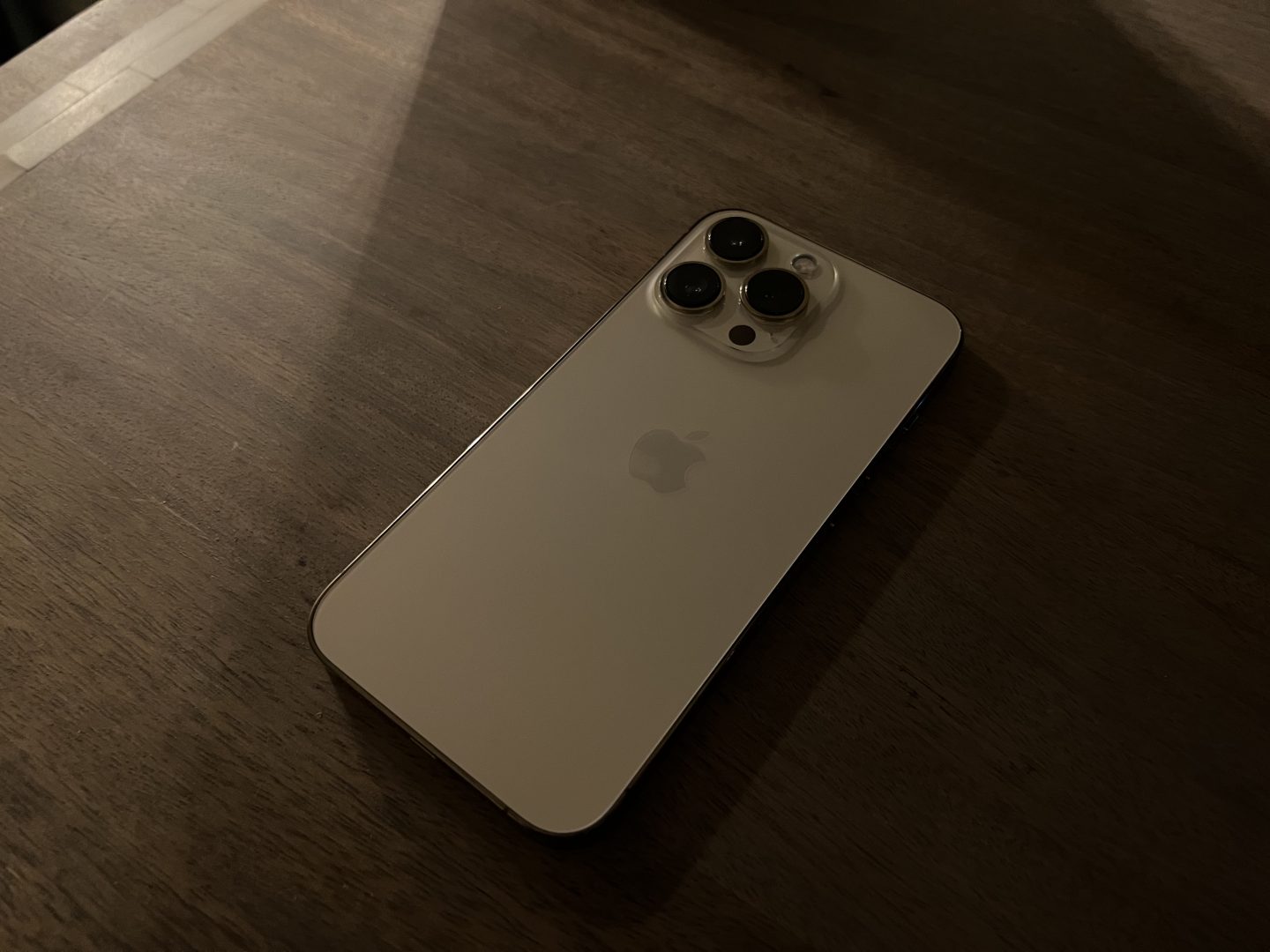
The back of the iPhone 13 Pro, photographed in low light with the iPhone 13 Pro Max’s Night Mode.
Credit: Samuel Axon
The back of the iPhone 13 Pro, photographed in low light with the iPhone 13 Pro Max’s Night Mode. Credit: Samuel Axon
Storage
For the first time, the Pro models can be configured with 1TB of storage at purchase. To be honest, I don’t think most people need that much storage on their phones. I have more than 200 apps and games installed on mine—far more than your average iPhone user—and some 4K videos to boot, and I nudge right up to the 256GB mark. I have a long way to go before 512GB might become inadequate.
You could hit that 1TB mark relatively easily if you’re shooting a lot of ProRes video (once that capability is added), but that’s not going to be a common use case.
More exciting is the fact that the lower-priced iPhone 13 and iPhone 13 mini now start at 128GB instead of a paltry 64GB but for the same price that the 64GB models cost last year. Further, they can now be configured with up to 512GB of storage, which is plenty for almost everyone.
All told, the iPhone 13 and iPhone 13 mini come in 128GB, 256GB, and 512GB configurations, and the iPhone 13 Pro and Pro Max offer all the same, plus the 1TB option.
Design
Apple has again differentiated the iPhone 13 Pro and iPhone 13 Pro Max from their slightly lower-end siblings via the materials; the former have stainless-steel edges with a beautiful treatment on them, plus rougher backs that feel nice to hold. The iPhone 13 and iPhone 13 mini have aluminum edges and plainer backs, but they still feel great.
Last year, I described the iPhone 12 and iPhone 12 Pro’s design as a throwback to the iPhone 4 and iPhone 5, which many people (myself included) consider to be the nicest-looking iPhones. That same design returns today. It’s the exact same look and feel as before, with two notable exceptions.
Nicer notch
The most-discussed design change addresses something that never bothered me too much but that sure seemed to drive a lot of other folks batty: the notch, that opaque black segment on the phone’s screen that houses the front-facing sensor array.
For the first time since the notch was introduced, it has become smaller—by about 20 percent horizontally. It’s slightly taller (you wouldn’t know that part without looking at it side by side with a previous iPhone) but overall, you’re getting some screen real estate back.
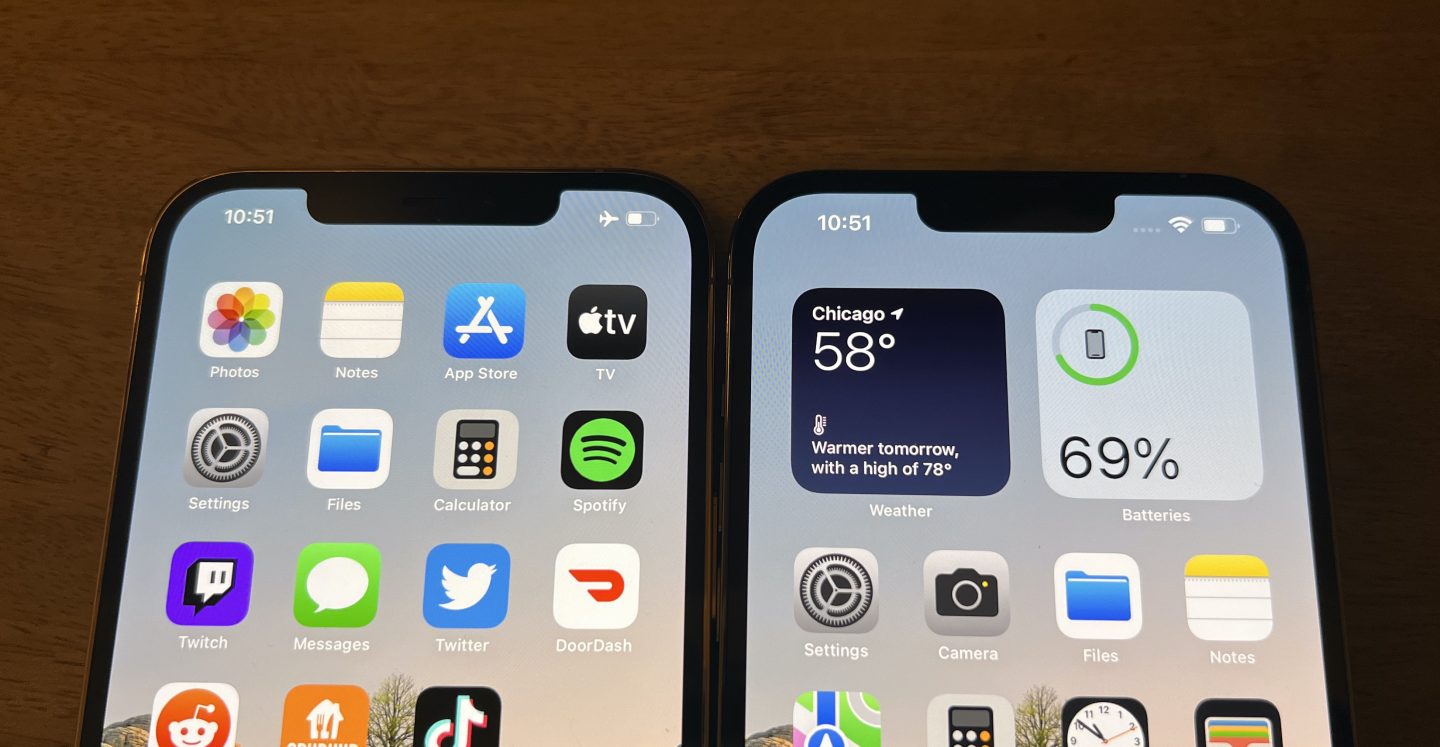
The iPhone 12 Pro Max’s notch (left) next to the iPhone 13 Pro Max’s notch (right).
Credit: Samuel Axon
The iPhone 12 Pro Max’s notch (left) next to the iPhone 13 Pro Max’s notch (right). Credit: Samuel Axon
This mainly matters for some full-screen games or other apps with custom interfaces, whose designers just chose to pretend like the notch wasn’t there when laying out the UI. Apple hasn’t made any changes to its own software to make use of this reclaimed space.
Colossal cameras
But the slightly shrunken notch is not the most noticeable design change compared to the iPhone 12 and iPhone 12 Pro. The rear camera system is huge. The lenses are bigger. The camera bump protrudes farther. It’s impossible not to notice.
It doesn’t look any better or worse than last year’s camera bump. But something else about this change really bugs me: it makes the phone wobble wildly when placed flat on a table or desk.
I know, I know—the past several iPhones already did that to some degree. It bothered me a little then, too, but this is another level. It sometimes makes it awkward to type on or otherwise use the phone in that position. This applies to both the iPhone 13 and the iPhone 13 Pro, but it’s worse with the iPhone 13 Pro.
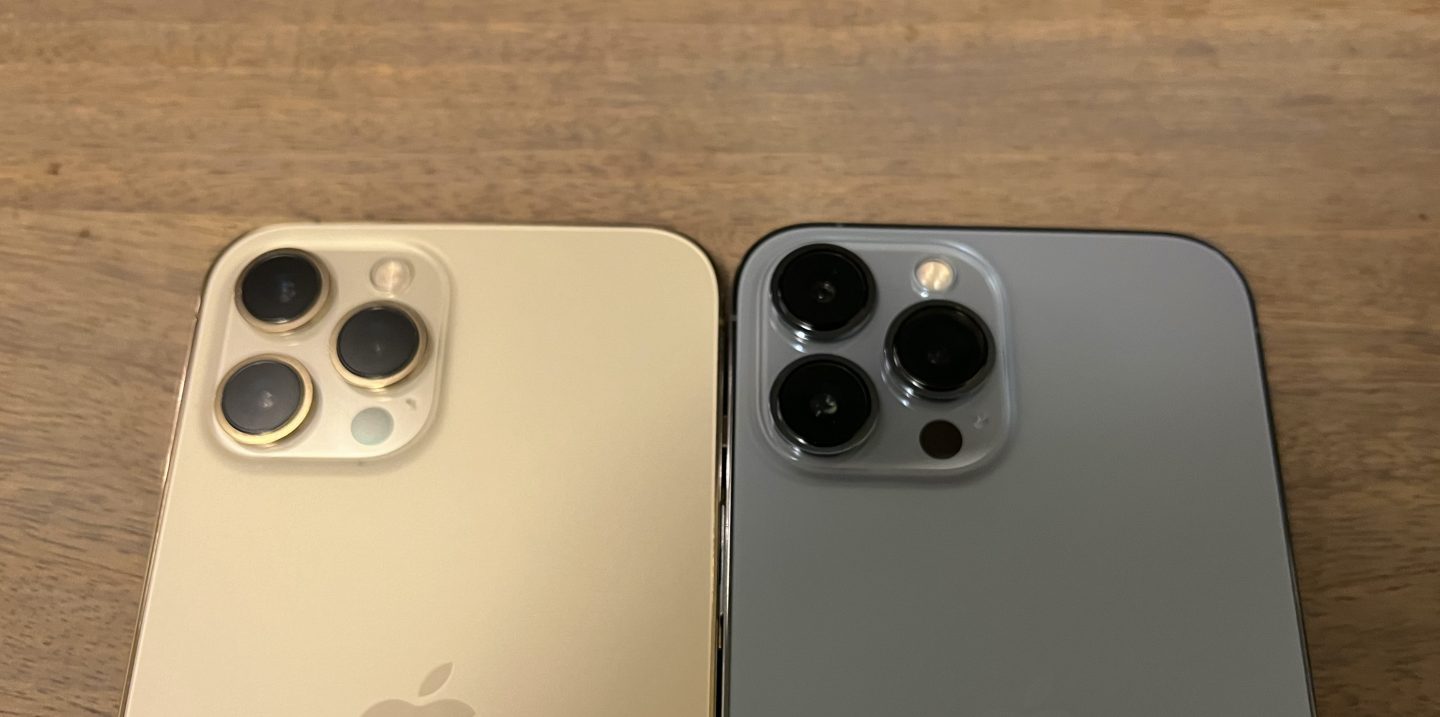
On the left: the iPhone 12 Pro Max’s camera system. On the right: the iPhone 13 Pro Max.
Credit: Samuel Axon
On the left: the iPhone 12 Pro Max’s camera system. On the right: the iPhone 13 Pro Max. Credit: Samuel Axon
That said, cameras are key, and this is how we get better cameras, I suppose.
As with other recent phones, the Apple-made cases for the iPhone 13 and iPhone 13 Pro make the back almost flush again, suggesting that Apple would probably prefer a design like that too. Nonetheless, I’m sure Apple is happy to upsell you on those cases to get your phone to a less wobbly point!
MagSafe, I guess
One of the big new features last year was MagSafe, which combines wireless charging with in-phone magnets and some wireless communication to enable faster charging and other unique features for accessories.
Apple suggested then that a third-party ecosystem of innovative peripherals would pop up around MagSafe, but we’re one year in and the offerings are mostly the same as they were then. You get a mediocre battery pack, a new but too-tiny wallet, some cases and chargers, and some admittedly useful magnetic car mounts. It’s mostly fine, but it’s hardly a thriving ecosystem.
I also remain skeptical about wireless charging, though I wouldn’t be surprised if Apple’s next iPhones drop the charging cable completely to use only wireless.
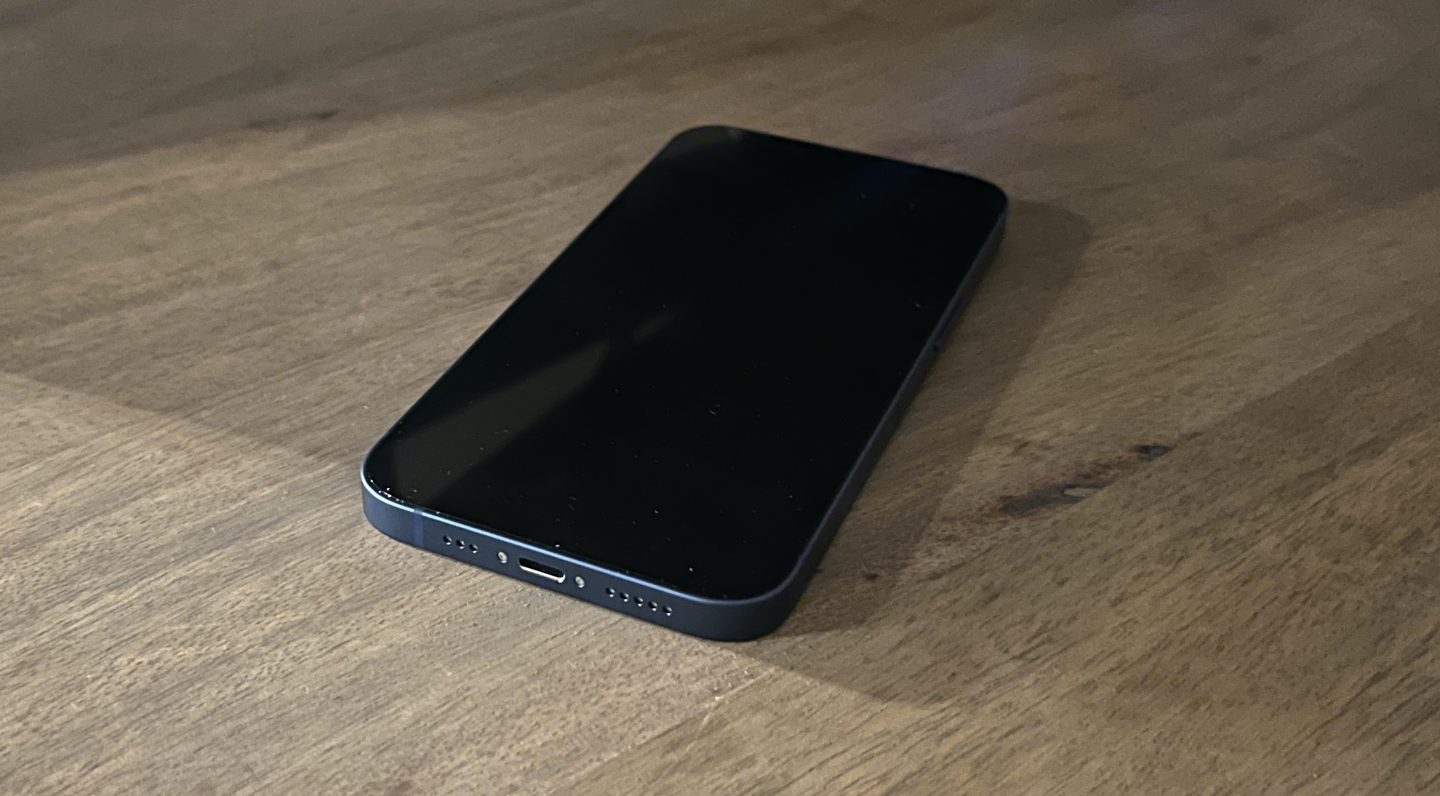
All of these phones still have Apple’s proprietary Lightning port instead of USB-C, if you were wondering.
Credit: Samuel Axon
All of these phones still have Apple’s proprietary Lightning port instead of USB-C, if you were wondering. Credit: Samuel Axon
You still need a cord from the wall to your charger, so apparently high-end phones have comparatively fragile glass backs and more expensive components so we can save a fraction of a second plugging a cable into a port. And we get much slower charging speeds than when wired, too.
There may eventually be some advantages to dropping the port entirely, like water resistance, but right now it still seems pointless to me.
Display
Just like in 2020, 2021’s flagship iPhone lineup comes in three screen sizes: 5.4 inches (iPhone 13 mini), 6.1 inches (iPhone 13 and iPhone 13 Pro), and 6.7 inches (iPhone 13 Pro Max). The resolutions are the same as before, with all the phones in the general ballpark of around 460 pixels per inch. (That’s the exact number for the iPhone 13 and iPhone 13 Pro. The iPhone 13 mini’s a little denser at 476, while the iPhone 13 Pro Max falls just short at 458.)
These are still the best smartphone displays you can buy today. Yes, Samsung’s best and newest have their comparative perks, but if you prioritize accuracy, these are the phone screens to get.
I’ve written plenty about the basics of these screens on prior iPhones, so I won’t go extolling the virtues of OLED over LCD or anything like that yet again. Rather, I’ll just note that these displays are improved over their 2020 predecessors in a couple of ways.
They’re generally brighter. Apple’s promised peak brightness for HDR highlights haven’t changed (1,200 nits across the lineup), but the “typical” max brightness is higher. The iPhone 13 and iPhone 13 mini claim to reach 800 nits on that spec (to last year’s 625), and the iPhone 13 Pro and iPhone 13 Pro Max claim 1,000 nits (to last year’s 800).
Additionally, the Pro phones now both have variable refresh rate displays that can range from 10 Hz all the way up to 120 Hz. (Apple calls this technology “ProMotion,” and we’ve seen the same in the iPad Pro.) Every iPhone before these sat consistently at 60 Hz. This new capability is valuable for three reasons.
First, 120 Hz just feels a little nicer and more responsive. It’s subtle, though. While certain tech obsessives and hardcore gamers have been screaming the virtues of 120 Hz for years, most people won’t consciously notice the difference unless told. But it joins with iOS’s already zippy animations to subtly feel more pleasant.
Some competitive gamers like 120 Hz displays because the added responsiveness sometimes allows for a very slight edge in online play, provided you’re already playing near the skill cap. (Of course, the phone must have the graphics horsepower to run the game in question at 120 frames per second to produce this advantage, which isn’t always going to be the case.)
ProMotion is also nice because it makes it possible to serve some content in its native refresh rate for more accurate motion—specifically films, which are usually 24 frames per second.
Finally, and most importantly, the ability to vary the refresh rate as low as 10 Hz means that battery life can be improved. The phones dynamically adjust to match what’s happening at the time. When the screen is static, the iPhone drops to 10 Hz, using less power. When your finger is back on the screen zipping between menus, it goes up again, and so on.
It’s tough to quantify the effect ProMotion has on battery life, but it’s common sense that it would have some positive impact. It might even be responsible for some portion of the disparity in claimed battery life between the iPhone 13 and the iPhone 13 Pro.
The high frame rates afforded by ProMotion are not a “must have” feature, though people with high-end devices may “get used to” 120 Hz and then get distracted when they return to 60 Hz. (Though I used a 144 Hz computer monitor for a couple of years, then downgraded to a 60 Hz one, and it only bugged me for about two days before I stopped noticing.)
The higher refresh rate is neat, though I wouldn’t recommend spending more for a phone just because it can hit 120 Hz. A lot of people won’t even notice. If you’re one of the people who will, you know who you are already.
But the general story about these phones is about battery life, and I think that’s the truest value these screens presumably offer. The higher typical brightness is nice when you’re out in the sun, too.
Cameras
There’s a lot going on here. Let’s start with the iPhone 13 and iPhone 13 mini, then graduate to what’s different in the iPhone 13 Pro and iPhone 13 Pro Max. Also, nothing much has changed about the selfie camera and TrueDepth sensor array on the front of the phones, so just know that those are the same as they were before—in other words, as good as anything you’ll find in competing phones.
iPhone 13 and iPhone 13 mini cameras
The iPhone 13 and iPhone 13 mini have two cameras: one wide camera, with an ƒ/1.6 aperture, and one ultra-wide with an ƒ/2.4 aperture and a 120-degree field of view. Both are 12 megapixels. You’ll use the former most of the time, but the latter is helpful for group selfies and similar shots.

A photo taken with the iPhone 13’s wide-angle lens.
Credit: Samuel Axon
A photo taken with the iPhone 13’s wide-angle lens. Credit: Samuel Axon
These phones have an improved wide-angle camera with 1.7µm pixels. Apple says the new design gathers 47 percent more light, reducing noise in low-light photos. Also, sensor-shift optical-image stabilization (first introduced in just the iPhone 12 Pro Max last year) has now made its way to the wide-angle lens in all four iPhone 13 models.

A photo taken with the iPhone 13’s ultra-wide angle lens.
Credit: Samuel Axon
A photo taken with the iPhone 13’s ultra-wide angle lens. Credit: Samuel Axon
As for video, both of these phones can shoot 4K video in Dolby Vision HDR at 60 frames per second. The new phones record better-quality video in low light than prior devices.
iPhone 13 Pro and iPhone 13 Pro Max cameras
The iPhone 13 Pro and iPhone 13 Pro Max also have wide-angle and ultra-wide cameras, and both are also 12 megapixels. As for apertures, it’s ƒ/1.5 for the wide and ƒ/1.8 for the ultra-wide. Apple says the ultra-wide camera boasts a 92 percent increase in light gathering over last year; for the wide camera, it’s 49 percent.

A photo taken with the iPhone 13 Pro’s wide-angle lens.
Credit: Samuel Axon
A photo taken with the iPhone 13 Pro’s wide-angle lens. Credit: Samuel Axon
They also add one additional 12-megapixel, ƒ/2.8 aperture telephoto camera, which now offers 3x optical zoom—so these can zoom in farther than any previous iPhones. While some competing Android phones are claiming wacky high zoom levels thanks to various digital tricks, Apple stuck to the basics here in a sort of quality over quantity approach.
There’s not a single camera feature offered by the iPhone 13 and iPhone 13 mini that the Pro phones don’t match or beat. Like last year’s Pro phones, they have a lidar scanner, which helps with augmented reality apps but also helps the phones take Night Mode photos much faster.
The Pro cameras offer a way to automatically trigger a macro photography mode. You need ideal lighting conditions to get the best out of it and the way it triggers automatically without your control is not ideal, but it is a huge improvement for those kinds of shots, as you can see below. It works for video too.
A close-up, macro-like photo taken with the iPhone 12 Pro Max. Samuel Axon
New features
All the new phones support photographic styles, which are computational photography presets that reflect some of the more heightened looks of some competing smartphones’ cameras. One looks a bit like what you get with Samsung’s high-end phones—that is to say, unnaturally vivid. And the other is decidedly Google Pixel-esque. I don’t love them, and you can’t undo your selection after taking a photo like you can with a lot of other iPhone photo settings. But some people will like them.
On the video side, Apple has introduced “Cinematic Mode,” which uses machine learning to emulate a rack focus effect. It adds a bokeh-like depth blur behind people’s heads and attempts to shift the focus appropriately and dramatically when subjects move or turn away.
As with Portrait Mode, a similar still-photo feature that Apple has offered for a couple of years now, Cinematic Mode can be hit and miss. It looks cool if the proverbial stars align, but it’s pretty gimmicky, to be honest. Apple talks about it like it’s an amazing feature for pro videographers, but it gives you way too little control to be useful for professional applications. It’s mainly just a neat toy.
Throwing a more substantial bone to pros, Apple plans to add support for the ProRes video codec. Recording in ProRes will mean cleaner, rawer, larger files that can be manipulated at will in professional programs, similar in some ways to the still-photo ProRAW format. This is coming after launch.
Finally, the latest version of Apple’s computational photography algorithm is now smarter when it comes to assessing multiple individuals within the frame. It manages color and contrast for people distinctly, which is especially useful for taking good-looking photos of groups of people of varying skin tones.
All that said, the bigger sensors are the main story here, and they’re all about improving low-light performance. Here are some low-light photos taken with various iPhones, including these new ones, for comparison.
A medium-low-light photo taken with the iPhone SE. Samuel Axon
The focus of Apple’s camera system is still more on making amateur photographers feel like professional photographers through the magic of machine learning and algorithms than it is about serving actual “pros.” But it’s safe to say that at the moment, no one is doing that better. These are monster camera systems, and they’re the best you can get in a smartphone today.
Performance
Performance improvements aren’t what this iPhone refresh is about, but there are some nonetheless. We ran some basic benchmarks to see where 2021’s iPhones stand.
One quick point to make before we get into the results: we didn’t break down all four new iPhones in these tests. We just compared the iPhone 13 to the iPhone 13 Pro and excluded the iPhone 13 mini and iPhone 13 Pro Max from the charts to keep them uncluttered.
This is because the iPhone 13 and iPhone 13 mini should (and according to our tests, do) offer essentially the same performance—same goes for the iPhone 13 Pro and iPhone 13 Pro Max.
Anyway, here goes. For multi-threaded CPU tasks, we found that the iPhone 13 is about 15 percent faster than the iPhone 12 and that there’s no clear difference in CPU performance between the iPhone 13 and iPhone 13 Pro.
As always, this comes with the caveat that Apple prioritizes burst performance. Some throttling will occur when it comes to sustained performance.
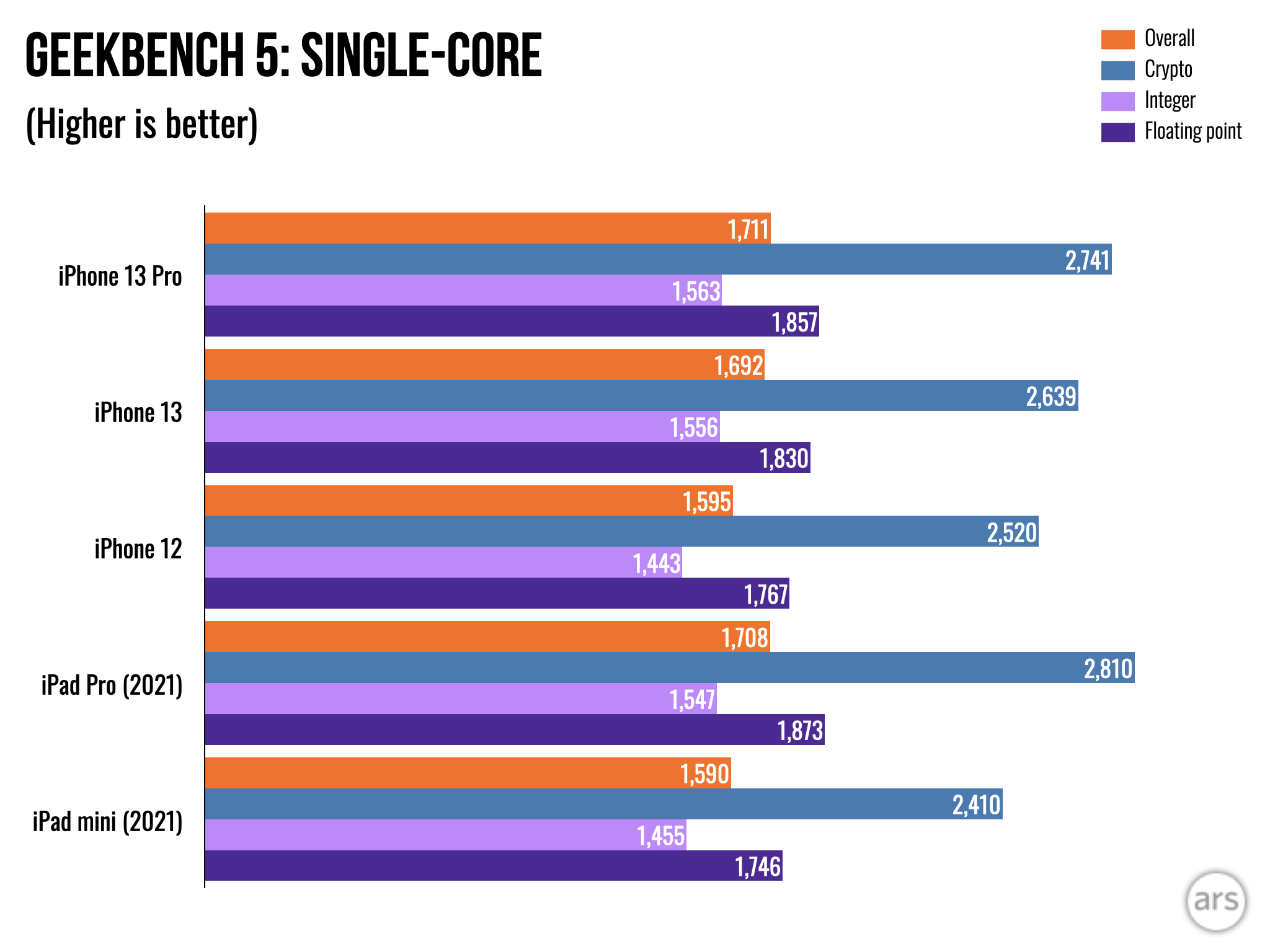

Things get a bit more interesting when we talk about the GPU, though. As stated earlier, the iPhone 13 Pro (and iPhone 13 Pro Max) have one GPU core more than the iPhone 13 and iPhone 13 mini. And yes, at least in synthetic benchmarks, that does translate into a real performance difference.
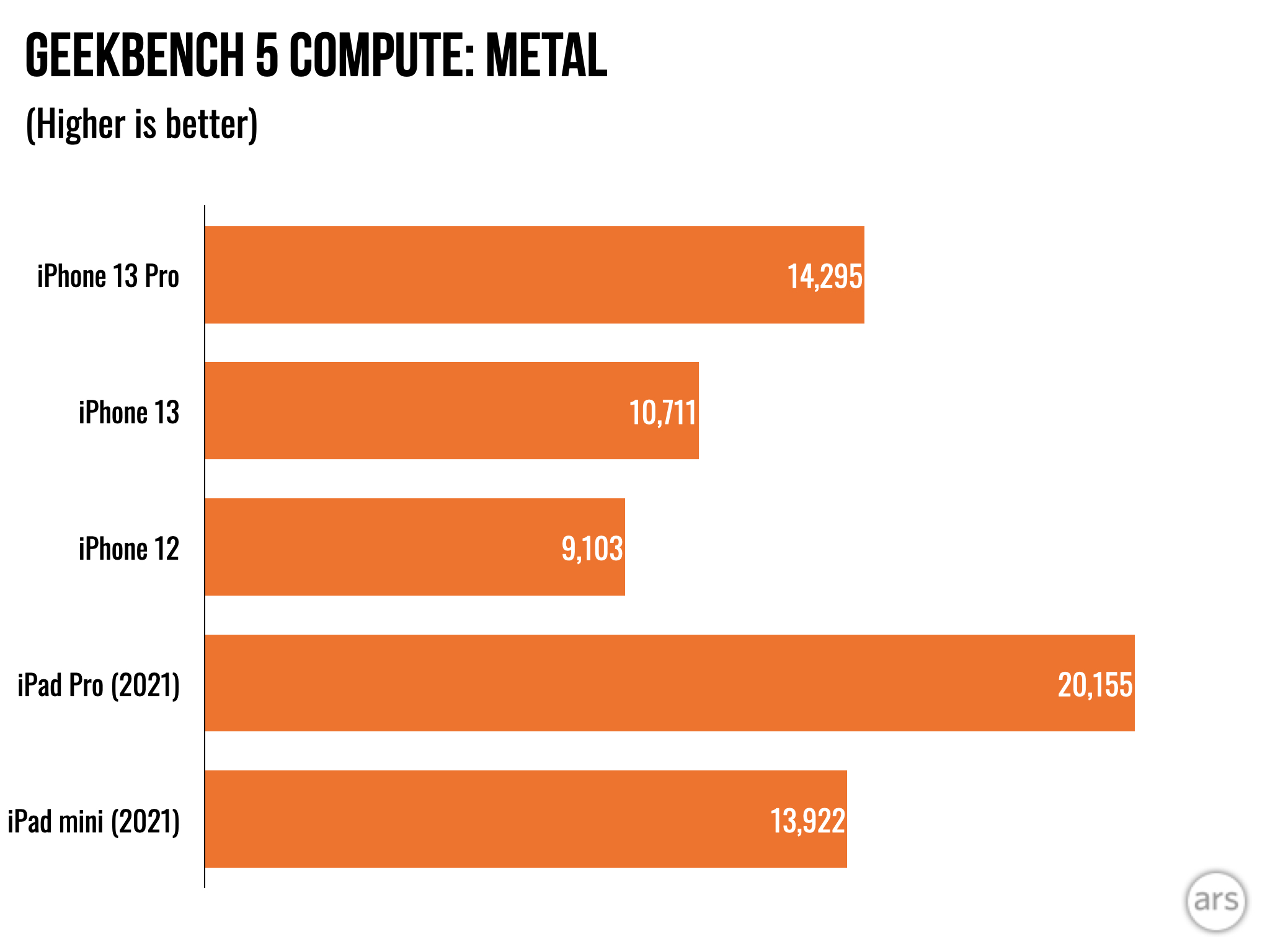
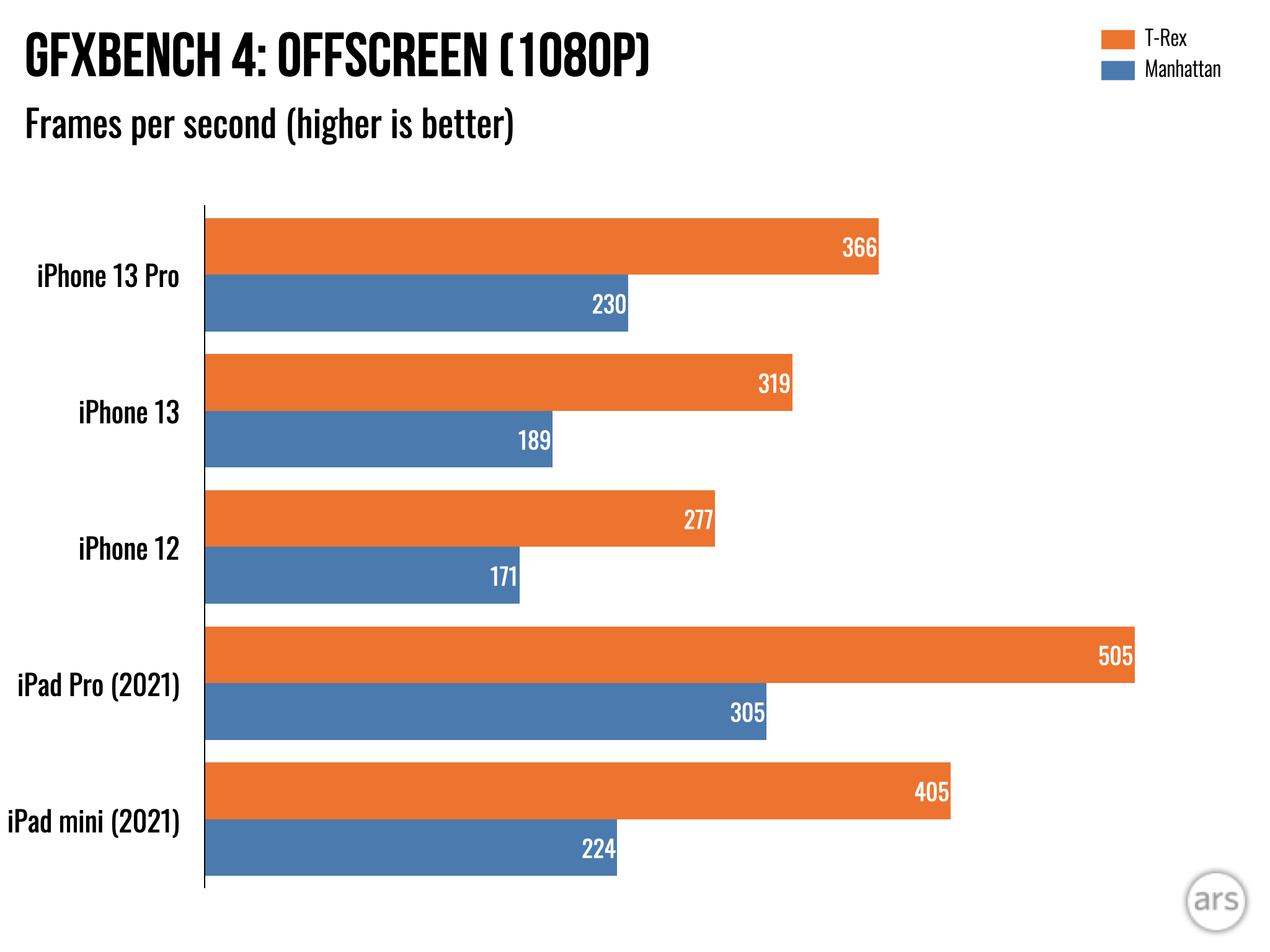
This kind of disparity hasn’t been the case with Apple’s iPhone lineups in the past, so this is an interesting new development. 2020’s iPhone 12 and iPhone 12 Pro weren’t much differentiated, but this is yet another example of a widened gap between the two products’ successors in 2021.
When Apple first announced the iPhone 13 and iPhone 13 Pro, it didn’t share any comparative claims about performance between last year’s phones and these, so we didn’t expect much of a bump. Our modest expectations were matched in terms of CPU performance, but there actually is a notable graphics improvement year over year—especially for the Pro phones. That’s a nice surprise.
These are by far the fastest phones on the market, replacing their predecessors, which were also by far the fastest phones on the market, which replaced their predecessors—also the fastest phones on the market.
In other words, what was true last year is still true this year, exactly as expected. The only takeaway here is that if you play a lot of demanding 3D games on your phone, it might be worth spending extra for one of the iPhone 13 Pro models. 3D games are demanding on battery life, too, and you’ll see advantages to going with the iPhone 13 Pro there as well.
Battery life
Battery life claims are essential to Apple’s pitch with these phones, which puts us in a bit of an awkward position: we’ve only had the phones for a couple of days and doing representative battery testing takes longer than that.
Since the phones are available for purchase now, we’re publishing this review with anecdotal impressions of battery life.
But I think I can spoil what you’ll see in later tests: battery life is noticeably better than what we saw in the iPhone 12 lineup. If you go back as far as 2018’s iPhone XS (or, heaven forbid, the iPhone 7 or iPhone 8, which now feel like phones from another epoch of civilization) it’s much better.
This can’t save the iPhone 13 mini, whose small chassis can’t fit a large battery, so even Apple isn’t claiming much here beyond an iterative improvement over last year’s uptime. It’s better than you might expect for a phone so small, but it’s a compromise compared to the bigger models.
But the iPhone 13 Pro, and especially the iPhone 13 Pro Max, really do offer all-day battery life. It’s been claimed before, but I believe this is the first iPhone that actually delivers it under anything resembling normal circumstances.
I would argue based on experience that the iPhone 13 comes in just shy of that threshold, but it’s still really good.
Heavy use of demanding augmented reality apps, shooting a lot of 4K video, or downloading bunches of stuff at 5G speeds are the only things that will make these phones fall short of that “all day” target. Most other tasks—even watching streaming video over Wi-Fi for hours on end at reasonable brightness levels—won’t.
Let me put it this way: I ordered myself an iPhone 13 Pro to replace my iPhone XS as my personal daily driver, and I initially planned to buy a battery pack for it. After using our review unit for a couple of days, I decided not to bother ordering the battery pack.
Wish fulfillment
Better battery life, better cameras, and big, beautiful screens. Here you go.
Sometimes, opinionated denizens of the Internet complain that Apple doesn’t innovate and that new iPhones aren’t exciting anymore. It would seem that the iPhone 13 lineup is ripe for that sort of criticism, right? Other than a screen feature that plenty of competing phones already had, there aren’t any flashy new additions to the iPhone 13, iPhone 13 mini, iPhone 13 Pro, or iPhone 13 Pro Max.
But sometimes exciting isn’t what you want or need the most. You might just want something that makes your day to day a little better. With these phones, you’ll take better photos, and you’ll make it all the way to bedtime with less anxiety about your battery running out, even on a busy airport travel day.
That might not be as mind-blowing as some transformational new innovation, but it’s every bit as welcome.
The new lineup also introduces greater differentiation between the standard flagships and the Pro models—even though the “Pro” moniker still makes no sense and probably never will. But unlike last year, the Pro models are almost certainly worth the upgrade if you can afford it.
Provided you want to live in Apple’s ecosystem, these are without a doubt the best smartphones you can buy today.
Now, for my next three wishes: a flush back that doesn’t make the phone wobble, USB-C, and no notch at all. If you have a magic lamp you can spare, let me know.
The good
- Outstanding battery life
- The best smartphone cameras you can buy
- The best smartphone screen you can buy
- The best performance you can buy
The bad
- The huge camera bump makes the phones wobble on flat surfaces
- MagSafe still hasn’t proved its value
The ugly
- These phones are very expensive, and that’s before the pricey add-ons
Listing image: Samuel Axon
Ars Technica may earn compensation for sales from links on this post through affiliate programs.

Samuel Axon is the editorial lead for tech and gaming coverage at Ars Technica. He covers AI, software development, gaming, entertainment, and mixed reality. He has been writing about gaming and technology for nearly two decades at Engadget, PC World, Mashable, Vice, Polygon, Wired, and others. He previously ran a marketing and PR agency in the gaming industry, led editorial for the TV network CBS, and worked on social media marketing strategy for Samsung Mobile at the creative agency SPCSHP. He also is an independent software and game developer for iOS, Windows, and other platforms, and he is a graduate of DePaul University, where he studied interactive media and software development.