A minimum wage gig in the 1990s turns into pretty much the Best Job Ever.
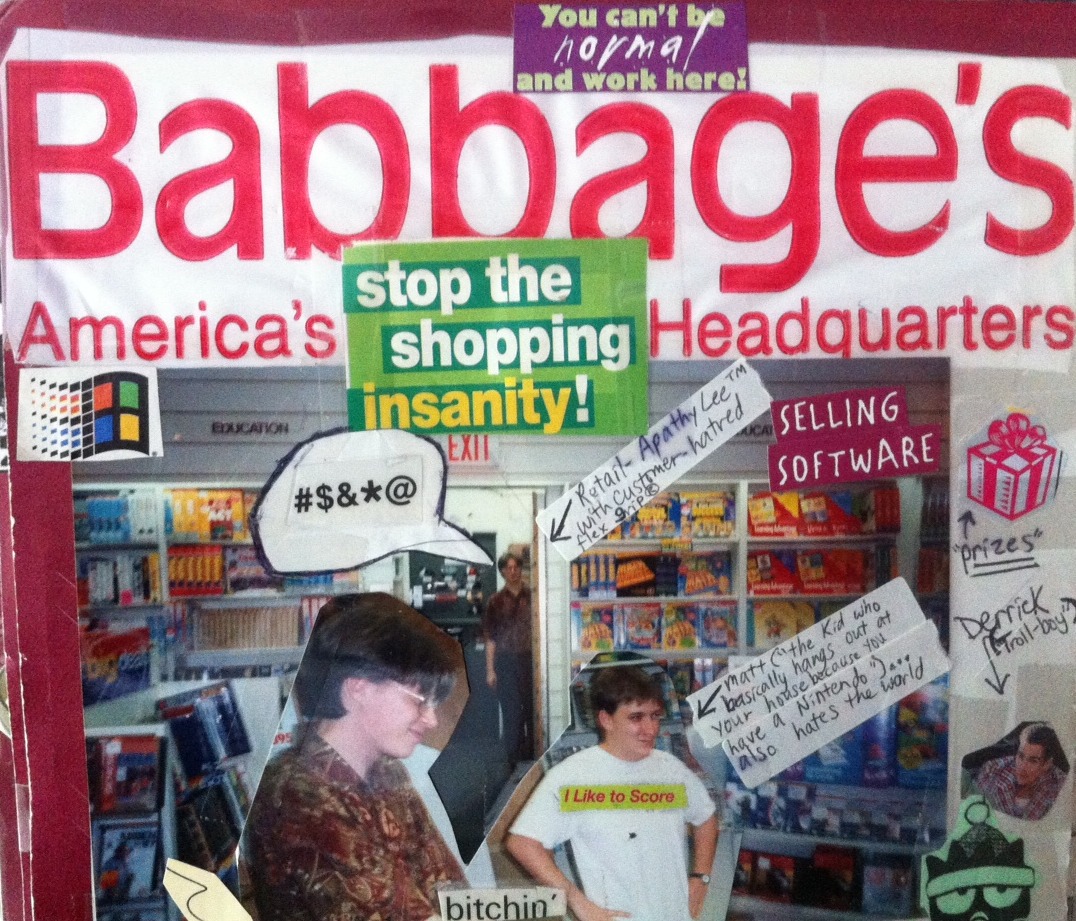
Oh, the places we went. Credit: Lee Hutchinson
Oh, the places we went. Credit: Lee Hutchinson
The parking lot is full—unusual for the small strip mall where I sell video games. It takes me a while to park my car, and when I make it into the store, chaos greets me: a line at the counter, the cardboard remnants of a FedEx drop shipment scattered everywhere, my harried-looking manager matching names from a printout to real customers standing in line, then doling out colorful boxes to the mob as quickly as she can. An unattended toddler knocks over an endcap display and starts crying.
I hurry to the back of the store to grab my name tag. When I return, a customer at the front of the line exclaims, “Bullshit, lady! I got the preorder slip right here. I want the damn jet ski game, not just the Mario one.” The other customers in line begin to stir angrily. My manager looks over at me as though I might be able to sort out the mess.
It is September 1996, I am 18 years old, and I am the “keyholder” at Babbage’s store no. 9 in Houston. This is the North American launch day for the Nintendo 64, which makes it the third major 1990s console launch I am lucky (or “lucky”) enough to work. As the yelling escalates, I wonder if I’m going to make it through my shift without getting punched in the face.
But let’s start at the beginning.
Sega Saturn
In August 1994, I began working at Babbage’s as a minimum wage sales associate earning $4.25 per hour—which, having just turned 16, I was thrilled to have. By the time the whole operation came to a crashing close three and a half years later, I was an older but wiser man who had worked through not one, but three separate console launches that would together bring “modern” consoles to the world. For younger or newer gamers, those who have seen console launches only in the last few years, those mid-1990s launches may sound like they took place in a different country. And in many ways, they did. The retail landscape around video games felt little like it does today, and the launches themselves were not quite the truly mainstream events they have become in the years since—but for store employees, they were just as crazy.
It was a heady time to be a gamer. No “Nintendo 64” existed at that point, though gaming magazines were abuzz with news that the console developer was working on something called “Project Reality.” If EGM and GamePro were to be believed, this new platform would deliver some kind of virtual reality gaming experience that would be like a mash-up of The Lawnmower Man and TRON and uploaded directly into our brains, where it would redefine the future of video gaming while melting our faces right off.
But first, before the face-melting could begin, came the Sony Playstation. And before that came the Sega Saturn. And before all three came the oldest gaming activity of them all: arguing that the system you had purchased had been the best possible choice.
Babbage’s had two other part-time sales associates when I arrived, and both of them seemed 12 feet tall in my young eyes. Todd, the most senior, had won a 3DO in a magazine contest; the other, Jeff, owned an Atari Jaguar. These two systems defined state of the art in the middle of 1994. The 3DO was a god-like machine of mythical capabilities with a price to match. Retailing at $699 at launch, it played hardware-accelerated, smooth-as-butter video from CD-ROMs, and its games looked amazing. Todd waxed rhapsodic when he described FIFA Soccer or Road Rash or, most incredibly to me, Crystal Dynamics’ port of Star Control II, which featured full-motion video and speech.
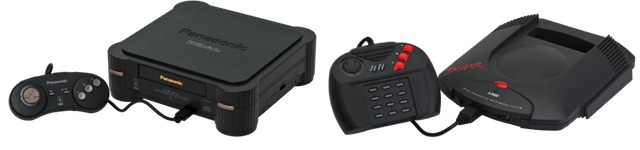
The Panasonic version of the 3DO, left, and the Atari Jaguar, right. Credit: Wikimedia Commons
But my coworker Jeff at every opportunity talked up the superiority of his Atari Jaguar. In addition to being more affordable to mere mortals, the Jaguar touted itself as the first “64-bit” gaming console. This was mostly a marketing-based claim, as the technical details behind it were a bit hazy, but it didn’t stop either Atari or Jeff from shouting about it from the rooftops.
Unfortunately, Jeff’s Jaguar suffered from a sad dearth of titles. The system itself had a neat visualization mode where it would display trippy graphics with a music CD inserted, and the copy of Cybermorph it came with was weirdly fun, but it never had a huge number of games.
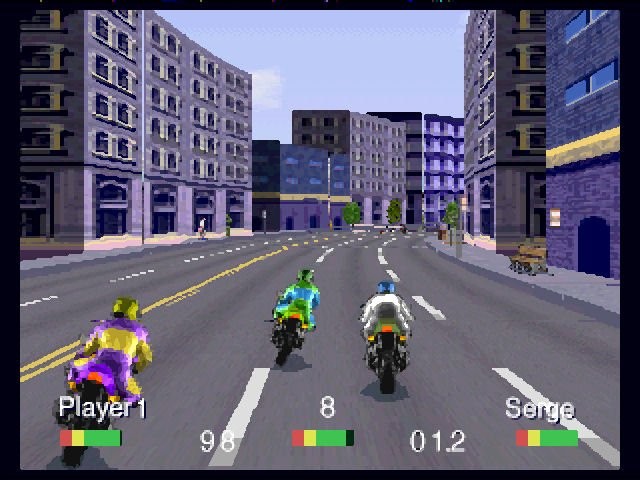
Road Rash on the 3DO. These graphics were awesome in 1994. Credit: Electronic Arts
However, the Jaguar did have one thing that no other system did: Aliens vs. Predator. In 1994, years before the stunning awfulness of Alien Resurrection, this was the freshest Alien franchise item you could get your hands on (well, it was either this or a Laserdisc player with a copy of the Criterion Collection Aliens special edition, but normal people didn’t own stuff like that). Aliens vs. Predator was mind-blowing: you could play as an alien or as a Marine or as a Predator! I devoured the AvP box’s pictures and copy, and I listened rapturously to Jeff’s telling and retelling of his gameplay experiences. Many times over my first year at Babbage’s, I almost sunk three or four entire paychecks into that console and a copy of AvP—but I could never quite commit.
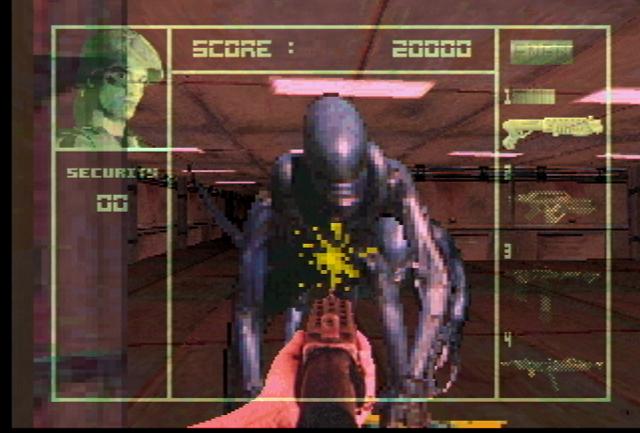
Aliens Vs. Predator on Jaguar. I wanted to play this SO BAD. Credit: Atari Corporation
Increasingly, however, it became clear that both systems belonged to the past. The 3DO vs. Jaguar in-store holy wars continued, but 1994 closed with us all eagerly anticipating the launch of the Sega Saturn, which went on sale in Japan around Thanksgiving 1994 and was slated to come to the US for at the end of the third quarter of 1995. My buddy Jason, an anime connoisseur and ardent lover of all things Japanese, predicted that the Saturn would lead to a renaissance in video gaming; Sega’s laughable Genesis add-on, the 32X, was sitting on our store’s shelves like a thing already dead, unselling and unsellable. Never mind Sega’s misstep with the 32X, though; the Saturn, Jason predicted, would make up for all past sins and destroy the 3DO and Jaguar both.
The Sega Saturn certainly looked like it would be impressive. From a technological point of view, it had a CD-ROM drive and more than a half-dozen processors scattered around inside of it. More importantly, though, was its pedigree. In the beginning of 1995, console gaming was something of a two-party system: you had Nintendo with the SNES on one hand, and Sega with the Genesis on the other. Sure, there were other options—the 3DO and the Jaguar were two, of course, along with more fringe consoles like the TurboGrafx 16, or the even more rare Neo Geo and its $200 cartridges—but most folks were either (R) Nintendo or (D) Sega.
Nintendo still cultivated a family image, where Sega went edgier, both in games and in advertising, and so the Saturn seemed to appeal to a hardcore gaming audience. Its launch price of $399 was a little nutty compared to how much a Genesis or SNES cost (though not as stratospherically absurd as the 3DO’s $699), but when we began taking preorders in anticipation of the September 1995 US release, sign-ups were brisk.
Sony was busy playing up its own entry into the home console market, too. The implosion of a partnership with Nintendo to produce a CD-ROM add-on for the SNES led directly to the development of Sony’s Playstation console, which launched in Japan less than a month after the Sega Saturn and which was targeted to follow the Saturn to market in North America, and at only $299, undercutting Sega’s console by a hundred dollars.
In many ways, the Playstation was less technically impressive than the Saturn. Rather than a tour de force of two CPUs and an array of co-processors, the Playstation had a far less complex traditional architecture, with a single CPU and a single GPU. Judging by the quality and type of titles, the Saturn was especially good at moving around sprites and art; the Playstation looked better at pushing polygons. Fighting game purists put their money on the Saturn, since the most popular 2D sprite-based titles would look and play best there.
Sneaky Sega
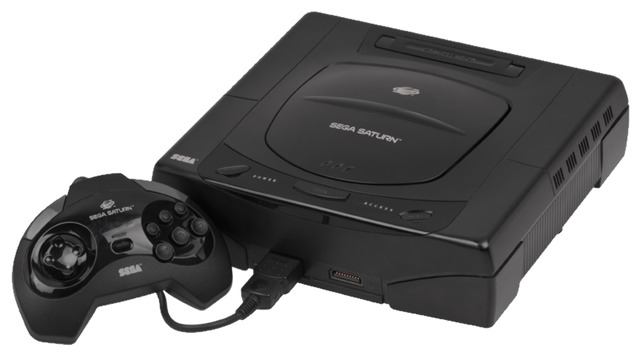
The Sega Saturn in North American launch colors. This bad boy cost $399 when it launched. Credit: Wikimedia Commons
Today, with the remnants of Babbage’s, Software Etc., and Electronics Boutique all gobbled up by the slavering used-game-powered beast that is GameStop, it’s hard to remember just how different things used to be. Babbage’s, for example, had an actual return policy. When I started, you could return anything—console game, PC game, productivity application—within 30 days of purchase for a full refund or exchange, so long as you had saved your receipt.
People rarely abused the privilege. We tracked returns and exchanges, and if someone was going crazy, we might stop letting them do returns, but we had few issues. If anything, the policy boosted sales because it let folks take chances on titles. After all, if it sucked, you could always take it back!
We sometimes wore ties then, we sales associates, and we knew what we were talking about. Uncommissioned, carrying no quota, and encouraged to be honest, we were trusted friendly faces. If you wanted cheap video games, you went to Walmart, but if you wanted actual expert advice on what to buy and a gold-plated return policy, you went to Babbage’s.
It was a great job—the best a young geek could ask for. In order to ensure that we stayed current on our knowledge, we were encouraged to check out games, keeping them for a day or two in order build familiarity. We received regular visits from game company reps, who would appear in the store and dole out demo copies of hot titles so we’d be able to sell their wares more effectively.
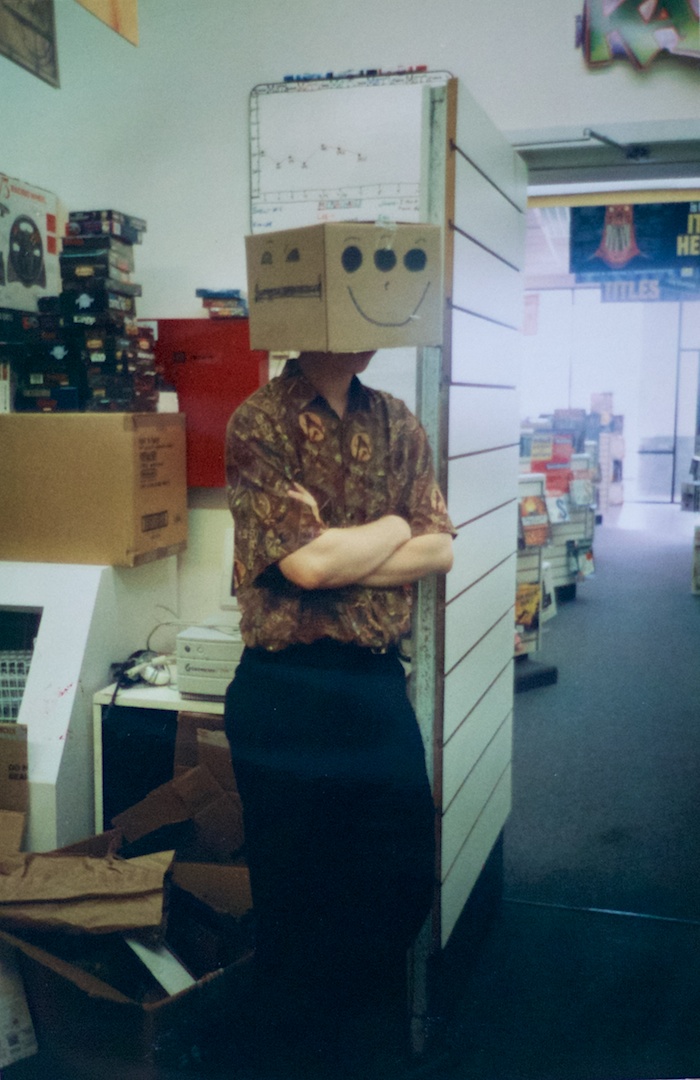
The author, guarding the back room with box on head. In my shirt’s defense, it was the 1990s. Everyone dressed like this.
Credit: Lee Hutchinson
The author, guarding the back room with box on head. In my shirt’s defense, it was the 1990s. Everyone dressed like this. Credit: Lee Hutchinson
The atmosphere was collegiate, joyous, ridiculous. Our manager, Anna, was in her late 20s and as goofy as the rest of us. Pranks abounded. A running informal contest challenged employees to package the largest and most complex items possible using the shrink-wrap machine in the back. One evening, I shrink-wrapped my manager’s office chair (this is a lot harder than it sounds). We would have shrink-wrapped each other’s cars if we could have gotten them into the back room.
But things got serious around launch day, especially with the Saturn, because Sega pulled a fast one in May. It struck a blow against Sony by unexpectedly releasing the Saturn months ahead of schedule in the US. We got a drop-shipment of Saturns and games the morning of the announcement, and we busily started selling the things. Although, after the pre-order folks had picked their units up, we found ourselves with a back room full of Saturns and not many interested buyers.
Some of the launch title choices were odd for a North American audience. Virtua Fighter sold best, followed closely by Daytona USA, but the other two titles were more difficult. Clockwork Knight was a platformer with pretty graphics but child-like box art that no one purchased; Panzer Dragoon appeared to be about riding on a dragon and blowing things up, but it resonated even less with customers than did Clockwork Knight.
The Saturn’s price was its biggest stumbling point, though. A September launch date might have encouraged folks to splurge on the expensive system for the holidays; it also would have given Sega some more time to cook up some additional launch titles. At the start of summer, though, without a holiday in sight, no one was going to drop $400 on a console and $50 each on top of that for some weird-looking games. The Saturn rotted on our shelves.
Sony played its cards well, holding fast to its own late 1995 release date and lower $299 price. We took far more Playstation preorders than we did for the Saturn, and the year crawled toward September with a growing realization that the Saturn was dead in the water—that was what it looked like to us retail pukes on the ground, anyway, with sales circling the drain even within a few months of launch.
Sony Playstation
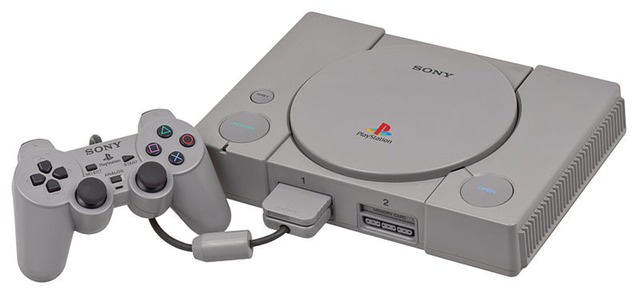
Sony’s original Playstation—the little gray box that could. Credit: Wikimedia Commons
Babbage’s had employee turnover, but not as much as you might think. The core group of folks at my store stayed relatively stable for several years, and we got to be friendly. The store became a comfortable place, and I found myself hanging out there even when I wasn’t working. My buddy Matt and I would swing by after classes and spend hours shooting the breeze with the other part-timers, hogging the demo systems and avoiding homework.
There was time to goof off even on the clock, too. I often worked the all-day noon-to-six-o’clock Sunday shift with Bob, and one long and lazy weekend day we conducted the first (and so far only) Babbage’s Olympics. It consisted of three events: Software Stacking, Speed Shrinkwrapping, and Receipt Paper Roll Tossing. It pains me to say that Bob defeated me in both Software Stacking (my tower of software boxes collapsed before it reached his spire’s height, due to my poor choice of weak boxes at the base) and Receipt Paper Roll Tossing (wherein we flung a roll of receipt paper down the long hallway connecting all of the strip center’s back rooms—Bob’s roll unrolled far longer than mine due to his larger stature and mightier arms). However, I claimed the champion spot in Speed Shrinkwrapping, encasing my ten items in plastic at a far speedier pace than Bob.
Things got more serious around the holiday season, with temporary hires and extended hours. It was fun—dash into the store when your shift starts and then spend the next four or six or eight hours on your feet, bouncing from customer to customer like a pinball. There was always something to do—we straightened and organized and scrubbed the shelves, and cleaned the bathroom until it sparkled, and organized the backroom, and kept the skater bois from the parking lot from spending too much time on the demo systems at the front of the store.
When September 1995 arrived and Sony’s Playstation roared out of the gate, things immediately felt different than they did with the Saturn launch earlier that year. Sega dropped the Saturn $100 to match the Playstation’s $299 debut price, but sales weren’t even close—Playstations flew out the door as fast as we could get them in stock.
The launch games had a lot to do with this, and the Playstation’s extra time in the oven meant that it began life with more North American-friendly titles than Sega had managed. Battle Arena Toshindin was a huge seller, as was NBA Jam Tournament Edition; I also remember selling tons of copies of Ridge Racer.
The Playstation steamrolled its way through Christmas. For months and months, we never had more than a few extra systems in stock; the games were hot and a solid new release schedule lasted through 1995 and 1996. The Playstation picked up a number of sports titles (including NBA Live 96) that the Saturn didn’t have; Sony also launched the Resident Evil series on the Playstation.
We sold more Saturns than we were selling 3DOs or Atari Jaguars—a system which was still struggling to come out with its own CD-based add-on—but only just.
Then my store changed managers. Anna, who had hired me on and then run the store for years, was moved to the much more profitable Houston Galleria Babbage’s, and during 1996 we went through a series of temporary managers while corporate tried to find us a permanent one. I graduated from high school in May and worked nearly full-time during the summer, filling in for management as a keyholder—I was empowered to supervise part-timers and open and close the store on my own.
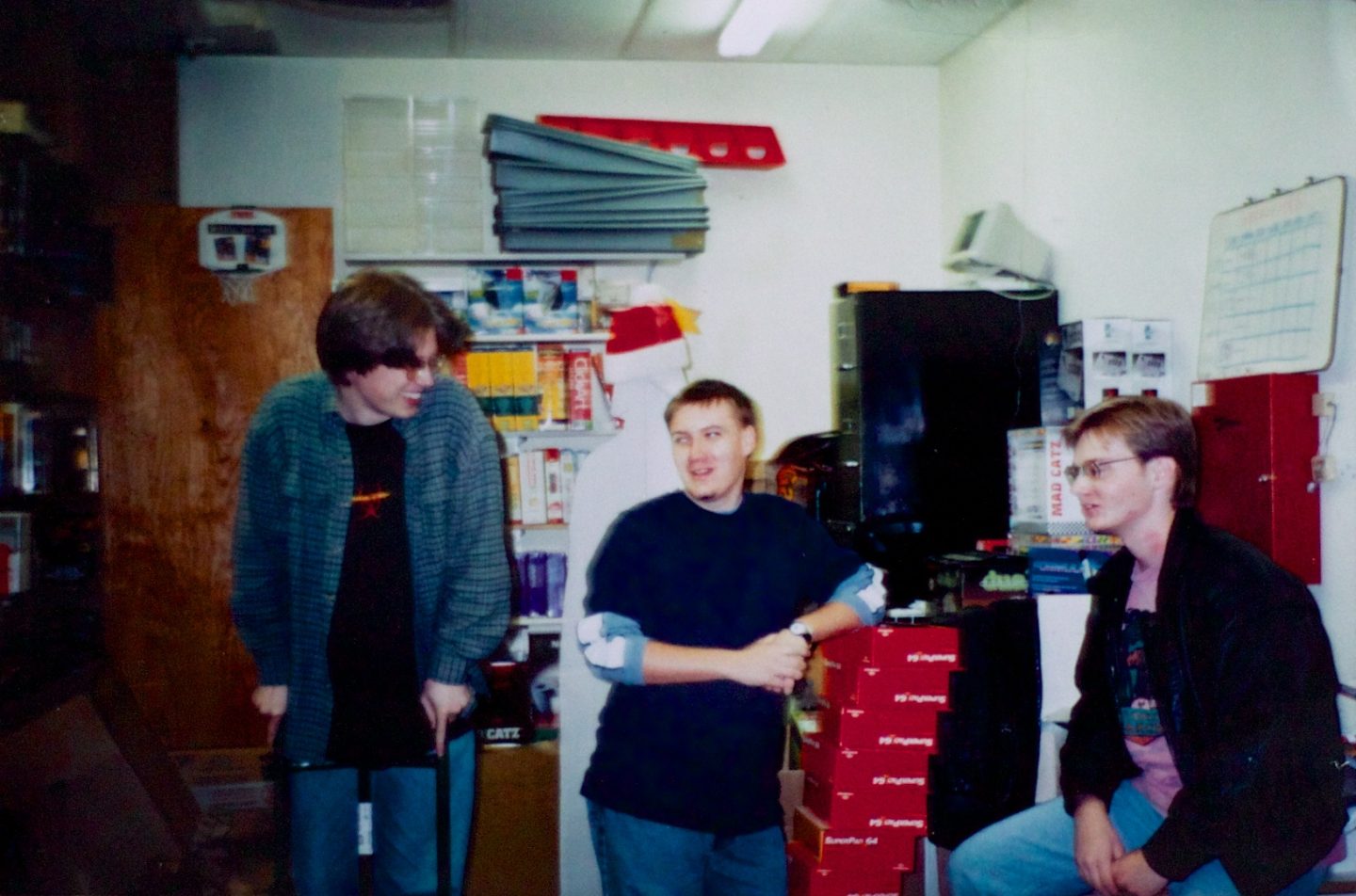
The author and his buddies Matt and Steve, hanging out in the Babbage’s back room circa 1997. Facing the wall behind Matt is the Darth Vader cardboard cutout.
Credit: Lee Hutchinson
The author and his buddies Matt and Steve, hanging out in the Babbage’s back room circa 1997. Facing the wall behind Matt is the Darth Vader cardboard cutout. Credit: Lee Hutchinson
This was awesome. Babbage’s became my friends’ second home. There was a security camera monitoring the front, to catch shoplifters; it was hooked up to a VCR in the back of the store and recorded at about half-speed, in order to fit an entire day onto one video tape. We would frequently line up in front of the camera and dance around or do other ridiculous things, then pull the security tape and play it on the demo VCR at the front of the store to watch ourselves running and dancing around in Benny Hill-style fast motion. We once caught an epic-scale marshmallow fight on camera; my buddy Matt took up position behind a life-size Darth Vader cardboard cutout and walked it around the store, launching projectiles and software boxes at everyone else. When re-watching this on the security camera, it appeared that Darth Vader himself was floating around the store, force-throwing marshmallows and software.
What could make this better? Nintendo’s long-rumored “Project Reality” becoming, at last, a reality.
Nintendo 64
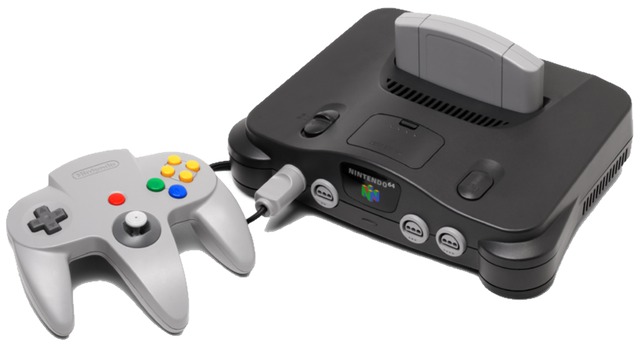
The Nintendo 64, known before launch as the “Ultra 64.” Credit: Wikimedia Commons
Nintendo’s new console, now with a real name, would be arriving in North America in September 1996, just in time to catch the entire holiday season. If our preorders were any indication, it was going to crush sales records.
The console’s name changed before launch, becoming the much more pedestrian “Nintendo 64,” but preorders continued to accelerate. The console launched in Japan at the beginning of summer and news of Super Mario 64‘s game-changing, world-altering gameplay quickly saturated the press. We had videotapes chock full of juicy footage we ran over and over and over again; customers would stare at Mario’s 3D antics for hours.
The biggest news about the system was its price. Where the Saturn had launched at what had clearly been too high a price, Sony had things dialed in pretty well at $299. Nintendo, though, announced that its system would go on sale for $249, undercutting the competition and forcing Sony and Sega both to cut hardware prices. The Nintendo 64 was a complex, cartridge-based beast, but Nintendo had a long history of controlling its entire console and gaming manufacturing vertical, using its position to squeeze extra marginal dollars out of its systems and first-party titles in ways Sony and Sega couldn’t manage. Nintendo brought that same pressure to bear with the Nintendo 64.
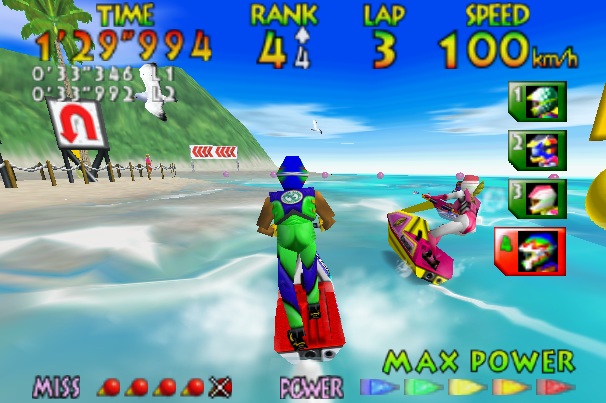
Wave Race 64 and its amazing (at the time) water graphics. Credit: Nintendo
The flip side of that strict control was a troublingly small number of launch titles. Initially, we were told the system would hit North America with just three games—Super Mario 64, Pilotwings 64, and Wave Race 64. Interest was huge for all three—if the gaming press was to be believed, Super Mario 64 was going to be the greatest game ever released anywhere, and it might also cure cancer and feed the world’s starving children. Pilotwings 64 was a refresh of the SNES classic title, while Wave Race 64 was supposed to have the most realistic water simulation ever to be released in a video game.
Delays in the development of Wave Race 64 meant it wouldn’t make it as a launch title, however, and so the N64 would hit North America with only two games available to buy. The preorder pace stayed high, but in late-night bull sessions in the back room, we wondered if the system would have legs. We had already seen that a success in Japan wouldn’t necessarily translate into a success in North America—witness the Saturn—and Nintendo didn’t really look like it was bringing its A-game. Plus, cartridges? Hadn’t Sony proven that cartridges were dead?
Ha. Ha, ha, ha.
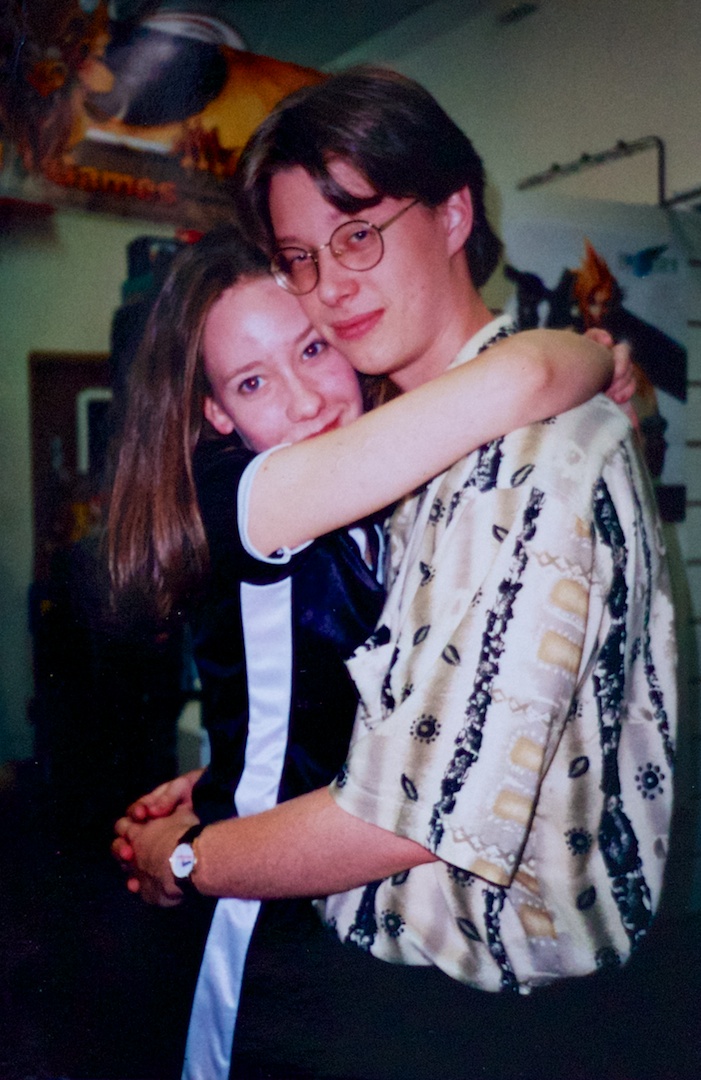
The author and his main squeeze, circa 1997. I had hair straight out of Mallrats.
Credit: Lee Hutchinson
The author and his main squeeze, circa 1997. I had hair straight out of Mallrats. Credit: Lee Hutchinson
The Japanese launch of the Nintendo 64 was ridiculous by any measure of success, and Nintendo revised the pricing for the North American launch down to $199 to steal momentum from Sony and Sega. A tidal wave was building, and when it hit Houston, I wasn’t keen to be the working the launch.
But there were compensations. One came when my new manager, Kim, poked me in the ribs. “You are staring,” she said.
“I am not staring,” I replied, turning my attention away from the willowy girl walking across the parking lot toward the store and fixing my eyes firmly on the price tagger and stack of software on the counter in front of me.
“You’re staring at her,” jibed Kim. “You liiiiiiiiiiiiike her.”
Into the store walked Laura, who was applying for a job. “Have you met Lee?” Kim asked sweetly, and I look up. To this day, I can’t recall if I managed to speak any words; the only thought running through my head, over and over again, was, “I am going to marry this girl.”
Kim, perhaps sensitive to my love-struck plight in spite of my protests, gave Laura the job. Laura proved unable to resist my many charms, and we began dating shortly after she was hired; at that point, 80 percent of the store’s employees were dating each other (the lone exception was Bob, who was older than us and already engaged besides, so we didn’t feel compelled to rush out and hire him a girlfriend).
Mario’s strong shoulders
The actual launch of the Nintendo 64 was like nothing I’d ever experienced. Lines. Screaming people. Arguing customers. Threats of violence. Not everyone had gotten the memo that their Wave Race 64 preorders weren’t going to come in at the same time the system launched—I apologized profusely to more than one blustering red-faced customer demanding to know why he was getting a system without “the damn jet ski game.”
The lack of launch titles proved to be no impediment at all to sales—Super Mario 64 carried the day almost entirely on its own. The rule that a console must have a broad spectrum of launch titles to appeal to the North American audience was generally true, but Nintendo found the exception: a single amazing title, with well-implemented 3D gameplay that most console players had never experienced, could bear the weight of the entire system on its shoulders.
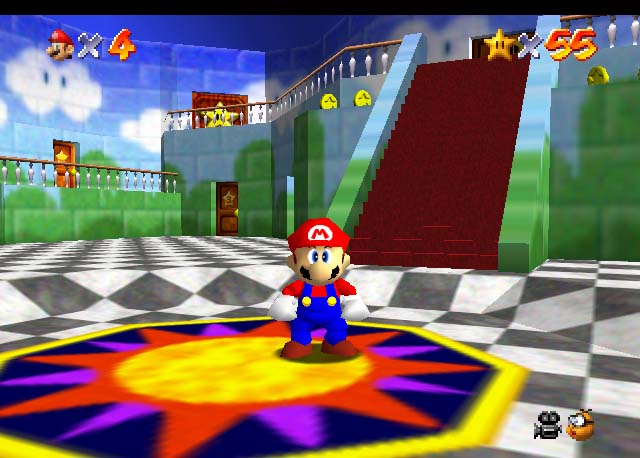
Super Mario 64, which could have been subtitled Mario Wins Every Video Game Award Ever. Credit: Nintendo
Looking back, it’s easy to criticize SM64 for some glaringly huge failings. The camera controls, frankly, suck. The limited amount of storage on the cartridge means that the textures laid over the game’s polygons are blurry and often hideously ugly. In more than one level, 3D is abused far beyond reason, and playability is sacrificed for the sake of “gee whiz, look at that!” moments.
It didn’t matter. We sold out. Forget merely selling out of consoles as they came in, like the Playstation did for a while—we pre-sold weeks of deliveries in advance. We sold out of consoles and games and controllers and accessories and strategy guides and even magazines that mentioned the Nintendo 64. Drop shipments of consoles were preordered and sold before they even arrived, and things got even more ridiculous as the end of the year drew closer. It was the Christmas of the Nintendo 64. Sony? Sega? Who were they?
And then, suddenly, the whole experience came to an end.
The end of all things
The console wars continued around us as Laura and I romanced. Panasonic and Goldstar eventually discontinued their separate versions of the once-mighty 3DO, and its successor imploded. Atari did eventually release a CD-ROM add-on for the Jaguar console, but it wasn’t enough to save the big cat, and the Jaguar was quietly discontinued. Sony hung onto a solid position on the strength of its licensing deals; Nintendo rode its early dominance into strong sustained sales, and its reliance on cartridges never proved the detriment everyone thought it would be. Sega, sadly, was relegated to a distant third place.
Sega further complicated things for itself by announcing its next generation system, the Dreamcast, and promising that this would fix everything wrong with the Saturn. This had the unfortunate effect of further weakening Saturn sales in the near term (the Dreamcast did eventually come to market in 1999, but it was too late to save Sega at that point).
It was also too late to save my store or my job, though I didn’t know it until Kim held up a printout while we worked on Christmas Eve 1997. The paper contained an e-mail from corporate—a “B-mail,” we called them.

Kim, our manager, who had the foresight to hire my future wife and to whom I will always be profoundly grateful.
Credit: Lee Hutchinson
Kim, our manager, who had the foresight to hire my future wife and to whom I will always be profoundly grateful. Credit: Lee Hutchinson
“We’re closing,” Kim said.
“Closing early?” I said, taking the tractor-fed paper from her and scanning it.
“Closing permanently. The store is closing.”
I looked up in shock. “When?” I managed.
“A few days,” she said. “It’s all there in the B-mail. I just found out.”
My good friend Jason, now a store employee and Kim’s boyfriend, was at the front of the store—he was off, but came in anyway to noodle around on the Playstation demo system, doggedly working on his Tekken 2 techniques. Laura was scheduled to start work in an hour, at 3pm, but she was already there, hanging out behind the counter with Kim and me. The store closed on Christmas Eve at 6pm, and we had no customers. I looked at Kim, and she looked at me, and we looked at the door.
“Jason,” she called out, “pack it up. We’re shutting down early today.”
“We are?”
“We are,” I confirmed, jumping the counter and locking the front door. I had no idea what I was going to do with myself—my job of three and a half years was suddenly gone. Kim counted down the register and I powered through the end-of-day paperwork. The phone rang. No one answered it.
We left a few minutes later with a “Closed Early!” sign on the door. We headed to a park and hung out on the jungle gym there, three of us looking incongruous in our work clothes—well-dressed teenagers occasionally swinging upside-down from the monkey bars. And that was it.
Best. Job. Ever.
In the end, the console wars of the late 1990s were won by Nintendo, which built on the momentum of the Nintendo 64 by launching the GameCube in 2001, along with an arsenal of handheld systems. Nintendo’s one massive misstep, the Virtual Boy, quickly passed unlamented into history without many people even noticing.
Sony’s Playstation did everything right, and the follow-on Playstation 2 did tremendous sales, but at no point did they capture the pure rabid screaming consumer demand that the N64 generated. The closest they came, in my experience, was with the North American launch of Final Fantasy VII. Out of every game that appeared for the Playstation while I worked at Babbage’s, only this one came close to inspiring the same amount of consumer madness that accompanied Nintendo game launches.
Many more consoles have launched since Babbage’s store no. 9 closed—the wildest was undoubtedly the Nintendo Wii, with its multi-year production shortage that stretched from Christmas season to Christmas season. Microsoft is a player now, too, which would have drawn a snort and a laugh from me back in 1995.
Working the launch of three major consoles is something that I hope to never have to do again; I’m no teenager anymore and I don’t have enough politeness left in me for retail work. The software and gaming retail landscape today has changed, with its hyper-focus on used games; we didn’t even start buying used games until the last year I was at Babbage’s. The Internet, too, has radically altered how folks get information. In 1994 when I started at the store, the best places to go to get your learn on about games were magazines and the store clerks themselves; by 1997, nascent gaming Web sites like Voodoo Extreme and Operation 3dfx were beginning to spring up (neither of which exist in any recognizable form today, though the picked-over skeletal remains of Voodoo Extreme are still around) and the need for brick and mortar game and software stores began to wane.
Babbage’s itself no longer exists as a separate brand; the company had merged with Software Etc. in the early 1990s, right around the time I hired on, and survived bankruptcy and bailout and ownership changes through the mid- and late 1990s (our own store made it through the famous year-end 1996 harrowing, though it only bought us an extra year). The Babbage’s Etc. parent company eventually rebranded all of its properties as GameStop, then began absorbing its rivals; Babbage’s biggest competitor in the software retail space, Electronics Boutique, was bought by the expanding GameStop juggernaut in 2005.
I’ve had jobs since, but none have captured that same mix of joy and newness like the very first one. The three console launches I was lucky enough to work through were crazy highlights, but the job itself was amazing: I went in expecting to earn some pocket-money and came out with friends, memories, and a soul-mate (Laura and I married in 2003). As high school jobs go, I hit the jackpot.
Listing image: Lee Hutchinson

Lee is the Senior Technology Editor, and oversees story development for the gadget, culture, IT, and video sections of Ars Technica. A long-time member of the Ars OpenForum with an extensive background in enterprise storage and security, he lives in Houston.