But it’s also becoming increasingly clear that hydrogen does have a future in decarbonizing transportation. Battery EVs have made significant strides in the past decade and a half for light vehicles, but as you scale up to heavy-duty vehicles, they start to make less sense because battery weight begins to have a deleterious effect on the payload. Here, hydrogen fuel cell trucks have an advantage.
“Most battery trucks on the market are 3,000 to 6,000 pounds [1,361–2,721 kg] heavier than us. And so it’s a material revenue and profitability difference when you’re talking about hauling with our truck versus a battery truck,” said Parker Meeks, CEO at Hyzon Motors. The company recently delivered Performance Food Group its four hydrogen fuel cell class 8 trucks, the start of a pilot with the food distributor that currently operates a nationwide fleet of 7,000 trucks.
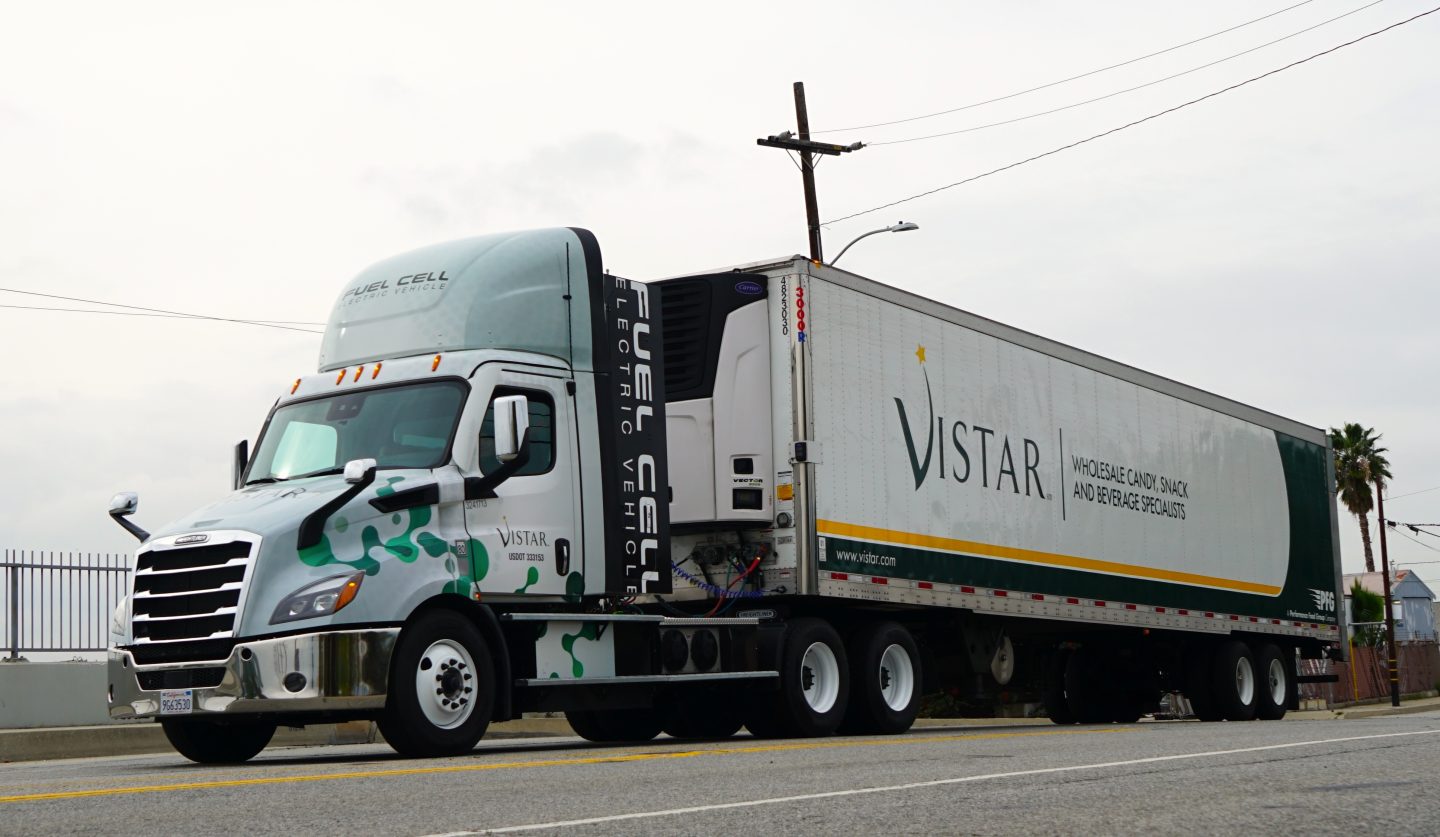
One of four class 8 trucks powered by Hyzon’s fuel cell powertrain, delivered to PFG in California.
Credit: Hyzon Motors
One of four class 8 trucks powered by Hyzon’s fuel cell powertrain, delivered to PFG in California. Credit: Hyzon Motors
Those first four trucks use Hyzon’s current class 8 fuel cell powertrain, which combines a 110 kW fuel cell with a 110 kWh lithium titanate battery. Assuming all goes well with these initial trucks and testing of Hyzon’s new 200 kW power cell, PFG may acquire as many as 45 of the more powerful machines.
“Whenever you look at our pipeline, the number of fleets we have and each stage of development, we are prescreening fleets. Not every place is just like PFG, but this is the profile: back to base nature of operations, large warehouse, trapped demand for fueling infrastructure,” Meeks explained.
Hyzon also just signed a joint development agreement with New Way Trucks to develop fuel cell garbage trucks for the North American market, having already piloted the approach in Australia. “The payload penalty for a battery garbage truck is almost 50 percent,” Meeks explained.
Predictable routes, like those operated by drayage trucks, delivery trucks from distribution warehouses, or garbage trucks, mean you can sensibly plan where to place hydrogen infrastructure. After all, there’s no need for a station every few miles if you know you’ll always return to base and refuel at the end of the day.
“Most of these fleets have diesel white hose overnight service, meaning a diesel truck comes in and they pump the hose and refuel all the trucks overnight. So for the operators, their primary fueling method is not truck stops. Which actually is good for all of us. They want on-premise dispensing,” Meeks told me.