“A great example is the Port of LA and Long Beach,” he said. “They have three parallel railroad tracks coming out of that port. It’s trenched, so there are no grade crossings, no road intersections. It runs at less than thirty percent of capacity [pre-pandemic]. And there are two reasons: The port doesn’t have enough real estate to assemble the trains—that would mean they have to store the cargo, sort it, queue it, and put it onto the trains. The other reason is most of that cargo first wants to go about 70 miles to the Inland Empire, to San Bernardino where it gets transloaded.”
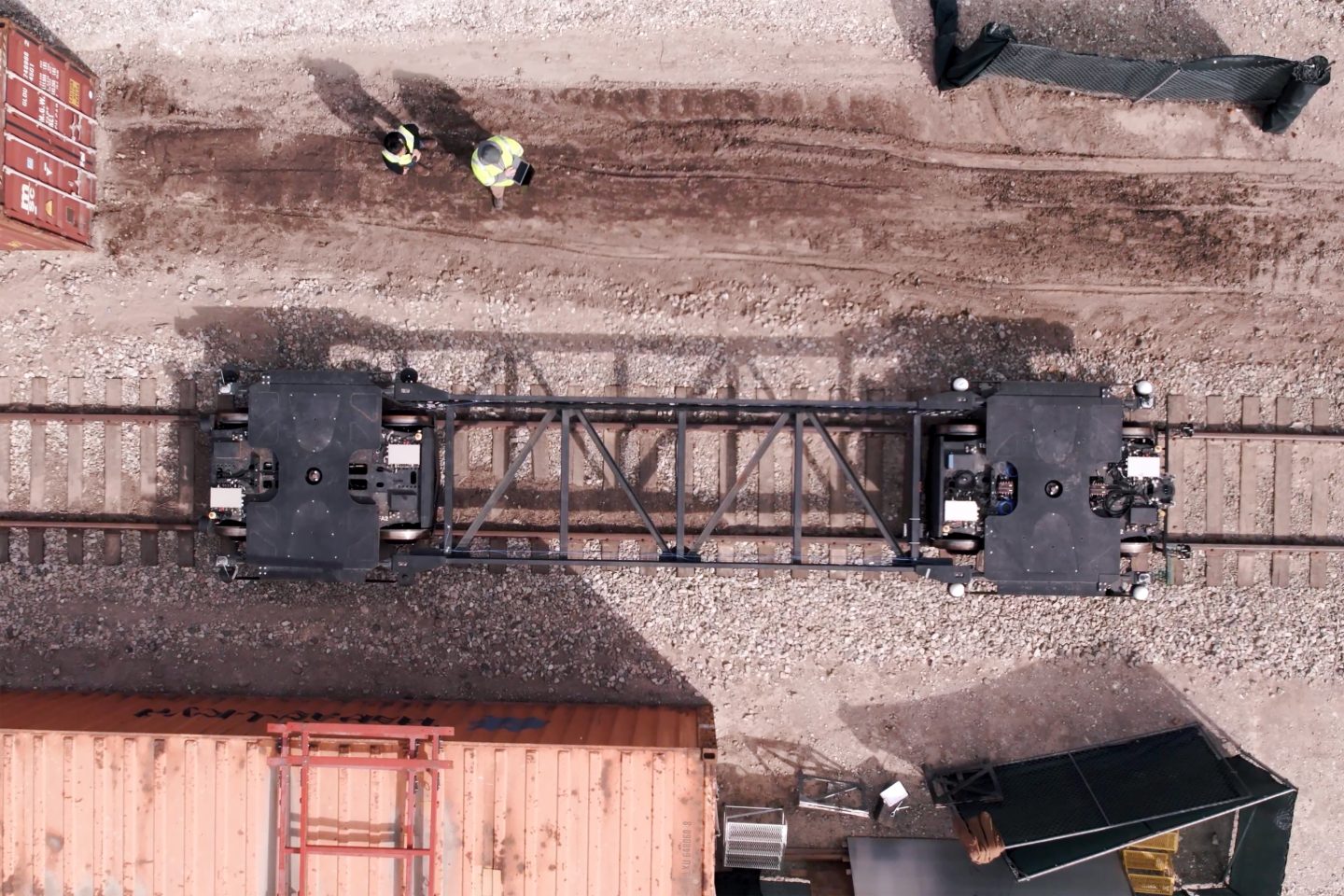
A top-down look at the second-generation Parallel Systems rail vehicle. The biggest change is the spanning section between the two trucks.
Credit: Parallel Systems
A top-down look at the second-generation Parallel Systems rail vehicle. The biggest change is the spanning section between the two trucks. Credit: Parallel Systems
That 70-mile journey happens by truck because it makes no economic sense to assemble a conventional train for the trip. But Parallel’s rail cars don’t need to be hooked up together and assembled before making the trip, and they work in concert with a control system that optimizes traffic.
That should take a lot of trucks off the road, particularly around highly polluted areas like ports. And Parallel’s electric rail cars are about four times more efficient than an electric cargo truck, the company says.
Last year, the Department of Energy’s Advanced Research Projects Agency-Energy program awarded Parallel $4.4 million, and today, Parallel introduced its second-generation vehicle, which it will use to start testing the rail car’s ability to operate on the existing rail network.
The most significant visual change to the first-generation system (which Ars looked at last year) is a spanning structure that connects what were previously two individual truck assemblies. So far, Parallel has built three second-gen rail vehicles, with another three in build now. They’ve been in testing since November of last year at Parallel’s test track in Southern California, but in 2024, Parallel will start track-worthiness testing with MvX Rail (the Association of American Rail’s R&D subsidiary) in Pueblo, Colorado.