We try the electroskeptical automaker’s first purpose-built battery-electric vehicle.
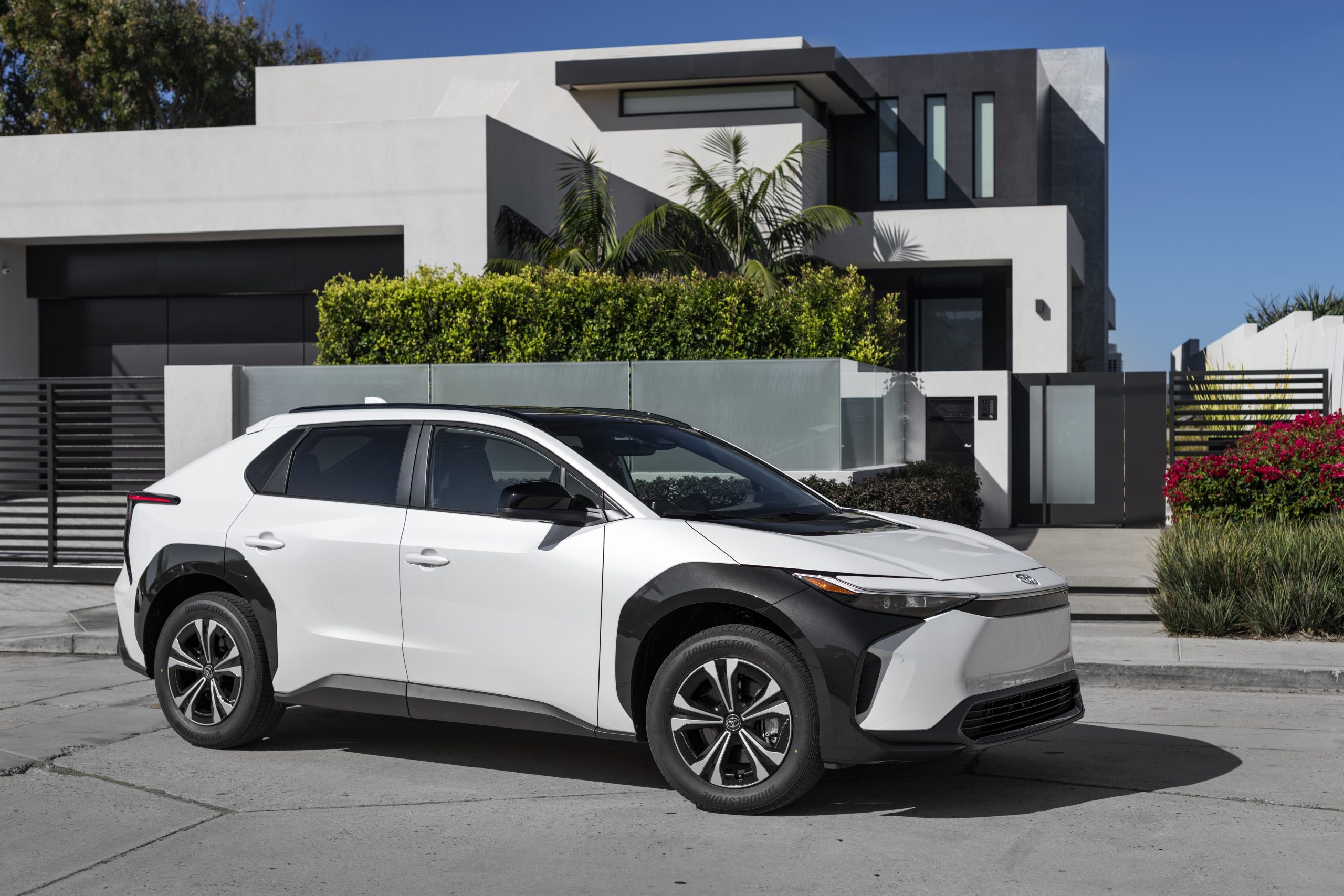
Toyota took better photos of the bZ4x than I did, so I'm using its photo in this article. Credit: Toyota
Toyota took better photos of the bZ4x than I did, so I'm using its photo in this article. Credit: Toyota
A few weeks ago, we reviewed Lexus’ new battery-electric vehicle and came away underwhelmed. Today, it’s the turn of its Toyota cousin, the closely related (and unfortunately named) bZ4x. The electric Toyota had a troubled launch last year when the cars had to be recalled due to wheels that might fall off. That’s all solved now thanks to new bolts, washers, and wheels, so we finally spent a week with the bZ4x. Given this EV’s initial reception, I was prepared to be disappointed, but by the end of the week, I was pleasantly surprised. The Toyota isn’t particularly flashy, but it is more efficient than I was expecting.
Let’s start with the name, because it’s a little weird. But there’s a reason behind the alphanumeric jumble. Toyota’s plan to reach carbon neutrality is called Beyond Zero, so the EVs it’s building to get there adopt the bZ moniker, thus bZ4x. You may want to call it Bizzyforks as at least one friend of mine does—no one will stop you if you do.
Like the Lexus and the Subaru Solterra, the bZ4x uses Toyota’s e-TNGA platform; I mistakenly wrote in that Lexus review that it was an existing platform—it’s actually not. It’s roughly the same size as the Lexus, too—the wheelbase is an identical 112.2 inches (2,850 mm), but it’s a bit shorter (184.6 inches/4,689 mm), a bit narrower (73.2 inches/1,859 mm), and slightly taller (65 inches/1,651 mm).
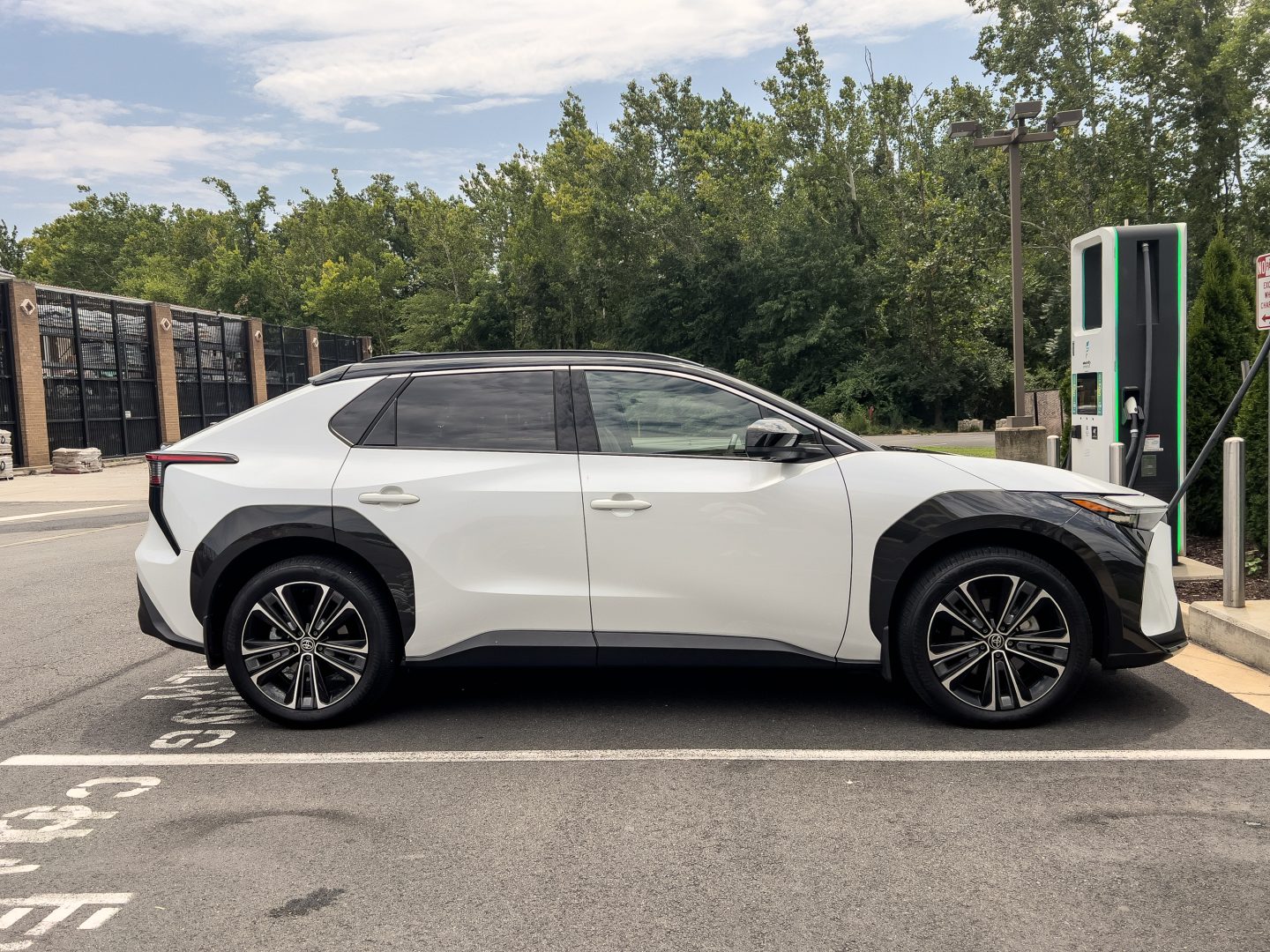
I am so used to having to call EA to get them to make the chargers work that I was a bit stunned that the bZ4x just charged with no complications. Which is a damning indictment on the state of EV charging…
Credit: Jonathan Gitlin
I am so used to having to call EA to get them to make the chargers work that I was a bit stunned that the bZ4x just charged with no complications. Which is a damning indictment on the state of EV charging… Credit: Jonathan Gitlin
The entry point into the bZ4x range is the $42,000 front-wheel drive XLE; our test car was a 2023 bZ4x FWD Limited, which starts at $46,700, and you can get all-wheel drive versions of either XLE or Limited trim for an additional $2,080. Ours arrived in a two-tone theme, mixing pearl white paint with glossy black, something that always brought to mind pandas when seen from the front aspect.
At 4,398 lbs (1,995 kg), the bZ4x is no featherweight, especially compared to the similarly sized RAV4 (even the hybrid or Prime). Consequently, Toyota has fitted rather stiff springs and dampers, and the ride can get a bit bouncy over expansion gaps on the highway.
The single motor driving the bZ4x’s front wheels provides 201 hp (150 kW) and 196 lb-ft (266 Nm), powered by a 71.4 kWh battery pack. (AWD versions use a completely different 72.8 kWh pack in addition to having differently rated motors.)
On the road
That was actually more than enough torque to chirp the front wheels away from a traffic light, even on part throttle, suggesting low rolling resistance from its tires. Not that the FWD car is particularly fast by the standards of the 21st century—0–60 mph in 7.2 seconds in real numbers is more than peppy enough for city life or merging onto a highway, however.
What it gives up in acceleration, it makes back in efficiency. The FWD bZ4x is rated by the EPA at 242 miles (390 km) on a single charge, 10 miles (16 km) down on the XLE mostly due to 20-inch wheels instead of smaller 18-inch ones. (Opt for AWD and you can expect much less range—222–228 miles/357–367 km.)
I actually exceeded the combined EPA efficiency of 3.3 miles/kWh (18.8 kWh/100 km), averaging 3.5 miles/kWh (17.3 kWh/100 km) over the course of a week.
A full slow charge at 6.6 kW takes about nine hours. A DC fast charge should take about 30 minutes to restore the battery pack to 80 percent state of charge at a maximum of 150 kW. In practice, I charged from 36 to 84 percent in 32 minutes, peaking at 116 kW. And I should call out the bZ4x for fast-charging with no complaints or problems when I plugged it into a nearby Electrify America station—not every EV can claim to be pain-free in this regard.
There’s decent visibility from the driver’s seat, but the steering wheel easily blocks the instrument display if you’re short. Toyota
If you’ve driven a new Toyota Prius, the view from the driver’s seat will be somewhat familiar, as both cars use the same multifunction steering wheel and small main instrument display. Like with the Prius, I find I have to position the wheel as low as possible—basically in my lap—for the rim not to block my view of that display. And like the Prius, that engenders a somewhat relaxed driving style.
I’m not really a fan of this design of multifunction wheel, but I do like the fact that there is a dedicated physical button on the center console to toggle one-pedal driving on or off. That one-pedal mode is well-calibrated for city driving but will not bring you to a complete stop like some other EVs; once you get down to about 4 mph (6 km/h), you will need to use the brake pedal.
As day-to-day transport, the bZ4x exceeded my expectations—horror stories of it being as bad as the Vinfast VF8 were definitely lurking in my thoughts, as was the fact that I was less than enamored with the Lexus version. But its easy-driving nature and not-terrible efficiency went a long way toward winning me over, as did the painless charging experience.
Listing image: Toyota

Jonathan is the Automotive Editor at Ars Technica. He has a BSc and PhD in Pharmacology. In 2014 he decided to indulge his lifelong passion for the car by leaving the National Human Genome Research Institute and launching Ars Technica's automotive coverage. He lives in Washington, DC.