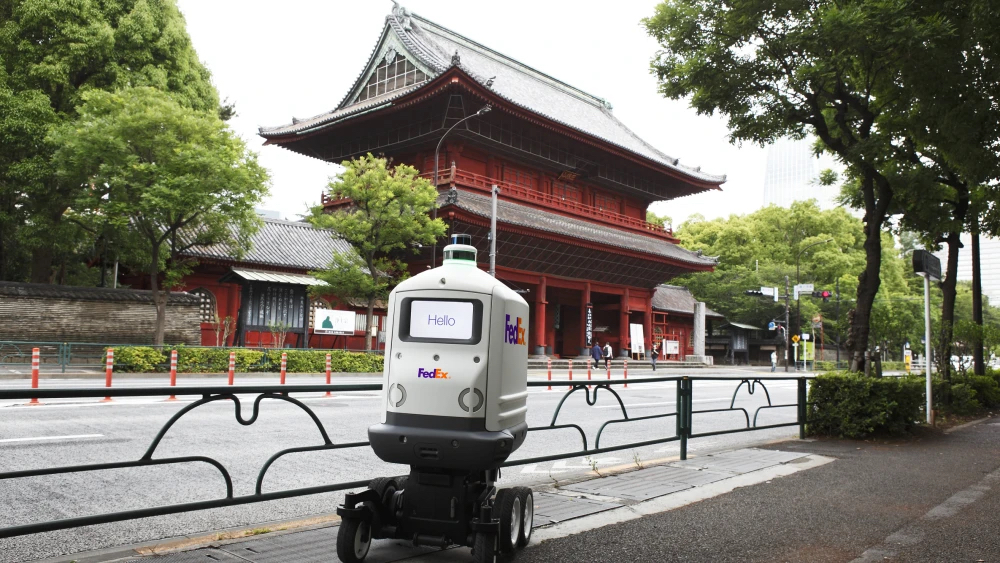
In July 2021, Roxo visited Japan.
Credit: Fedex
In July 2021, Roxo visited Japan. Credit: Fedex
FedEx has been testing Roxo in the US in Tennessee, New Hampshire, and Texas—and even as far afield as the United Arab Emirates and Japan. But a clue to Roxo’s precarious position can be seen in the robot’s FAQ on FedEx’s site, which notes that “because autonomous last-mile delivery is one of the priciest and most complex parts of the delivery process, we are aiming to make this a cost-effective solution.”
Companies are interested in last-mile delivery robots like Roxo because they can replace more expensive deliveries by humans. Those financial concerns exist alongside a corporate desire to reduce carbon emissions and traffic congestion, according to FedEx.
“We are immensely proud of our role in working with DEKA to advance this cutting-edge technology that has put it on the path to future implementation, and we remain committed to exploring last mile innovations that align with our business strategy,” FedEx said in a statement.
Roxo isn’t FedEx’s only foray into new technology. It has also been conducting trials of drone deliveries with an Alphabet company called Wing in the town of Christiansburg, Virginia—whether this project survives FedEx’s new corporate strategy remains unknown. I expect to see its delivery drivers using BrightDrop’s EP1 electric pallet, which can carry up to 200 lbs (91 kg) of packages from the delivery vehicle to the customer. A new General Motors company, BrightDrop, has also developed an electric delivery van for which FedEx was the first customer.
Roxo isn’t the only delivery bot to disappoint in testing, either. According to the Verge, Amazon is scaling back its Scout delivery bot program, which had been doing last-mile deliveries in suburbs outside of Seattle, as well as in Southern California, Georgia, and Tennessee.