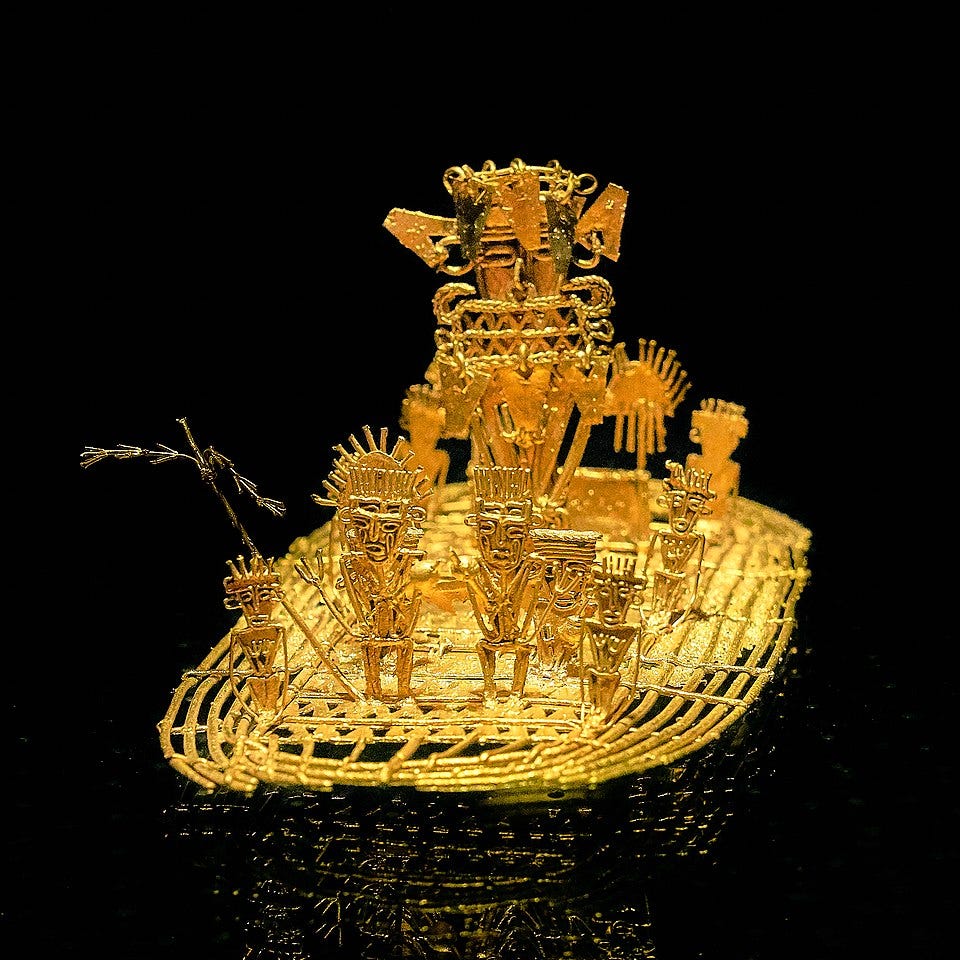
This past March, I travelled to Colombia with a group of friends for vacation. I didn’t have much on my bucket-list besides art museums, a coffee farm tour in Medellin, and the Zenú Gold Museum in Cartagena. I had very little knowledge of the pre-Hispanic history of Colombia before the trip, but seeing the wealth of gold ornaments and artifacts, as well as distinct styles of anthropomorphic pottery, sent me on a deep dive into Zenú (or Sinú) archaeology.1 This article has been a few months in the making because I decided to read a thesis on the subject and some other supporting articles. (Between finals, thesis research, and fieldwork, moments for side-research were few and far between).
Through art and history museums, conversations with taxi drivers, waiters, and local fast-friends, I learned about Colombia from past to present. It was a refreshing dose of experiential learning that was more dynamic, and perhaps more honest, than a wikipedia page or a textbook. Museums commemorating those lost in La Violencia2 and art exhibits on colonization, violence, and warfare, were impressive and impactful. Archaeological research was greatly impacted by political unrest in Colombia over the latter half of the 20th century. One thing often overlooked about archaeology is how political climate and recent history affects our view into the more ancient past— environmental preservation and research investment shape and bias archaeological visibility.
Looting and amateur archaeology has produced many of the gold artifacts in Colombia’s museums. Burial mounds dug up not for the value of the artifacts themselves but for the gold material which could be melted and sold. Family traditions of grave robbing and looting date back to the 1800s, and archaeologist Granda notes in her thesis that looters often had more experience and financial backing than archaeologist in the early 20th century. Starting in the 1930s the Banco de la Republica, which owns Colombia’s Gold Museums, built its collections by purchasing looted artifacts.3 Though this may have led to more looting and amateur excavations, it also saved valuable pieces of history from being destroyed. It also means that most artifacts are unprovenianced, or that the location and context of their excavation is unknown. Such is the case with artifacts in museums across the world. In fact, at a LACMA4 exhibit recently there were many pre-contact Mexican artifacts of unknown (probably looted) origins. Some diggers were more amateur archaeologists than looters, and the thesis I cite throughout this article used amateur excavation notes in its research.
Originally, I was worried no one would be interested in this topic, especially since my most widely read piece is on gender and womanhood in Paleolithic Europe. Lo and behold, feminist archaeology is very relevant to Zenú gold. The role of women in pre-contact Colombia is a fascinating and under-researched topic (especially since archaeological evidence and research is very limited, for reasons soon to be discussed!) A majority of information in this article comes from “The Status of Zenú Women: A Study of Gender Relations in Ancient Colombia,” a graduate thesis by Rita María Cristina Granda from 1996.
*note to reader: when referring to South American history before European contact I use the terms pre-Hispanic and pre-contact rather than pre-Columbian to avoid confusion. I know pre-Columbian is the most used term but saying “pre-Columbian Colombia” sounded redundant*
In the Caribbean lowlands of Northern Colombia where river complexes converge and flood the landscape, the Zenú region flourished with towns of goldsmiths, craftspeople, and agriculturalists. This wetland region, bounded by major rivers, experiences extremely dry and wet seasons. Despite the intense climate, with wet seasons lasting 7 months of the year, people thrived in this region for millennia. Life was a cycle of flood and drought, and agricultural fertility was paramount.
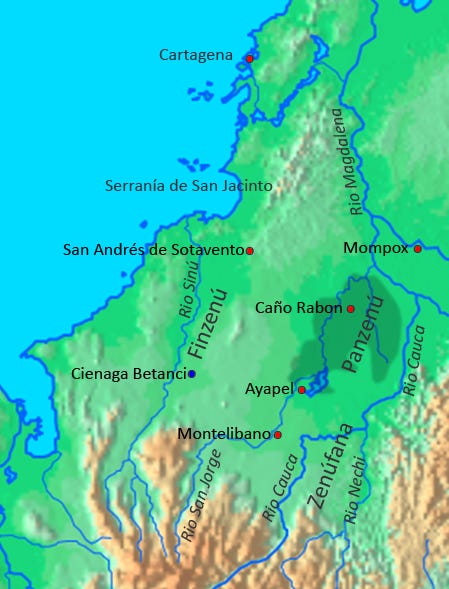
When the Spanish arrived in the 16th century there were communities of chiefdoms supporting relatively large populations and toted gold ornaments like nose-rings, earrings, and pectoral plates. Archaeologically, the thousands of years of chiefdoms in the Zenú region represent the oldest decentralized chiefdoms in the world.5 Some of the most highly respected chiefs also happened to be women. Historic accounts of women chiefs, coupled with a wealth of female ceramic figures, has led to speculation that the Zenú were a matriarchal society. However, what exactly do we mean by matriarchy, and is there enough evidence to support this theory? Before we dive in, I wanted to specify that the cultural designation “Zenú” is from the point of contact, as recorded in the 16th century. Human occupation in the Caribbean lowlands spanned thousands of years with various regional manifestations.
The earliest evidence of human occupation in the region dates to the Terminal Pleistocene (around 12,500 BCE) with sites like Tibitó in the Bogotá savanna, which yielded bone and stone tools associated with mastodons and equines. One of the oldest ceramic traditions in the Americas in San Jacinto date to 5900 years ago. Nomadic hunter-gatherers created this ceramic tradition and pottery likely served a ceremonial rather than utilitarian function. These vessels were ornately decorated using different techniques such as incision, modeling, and impression6.
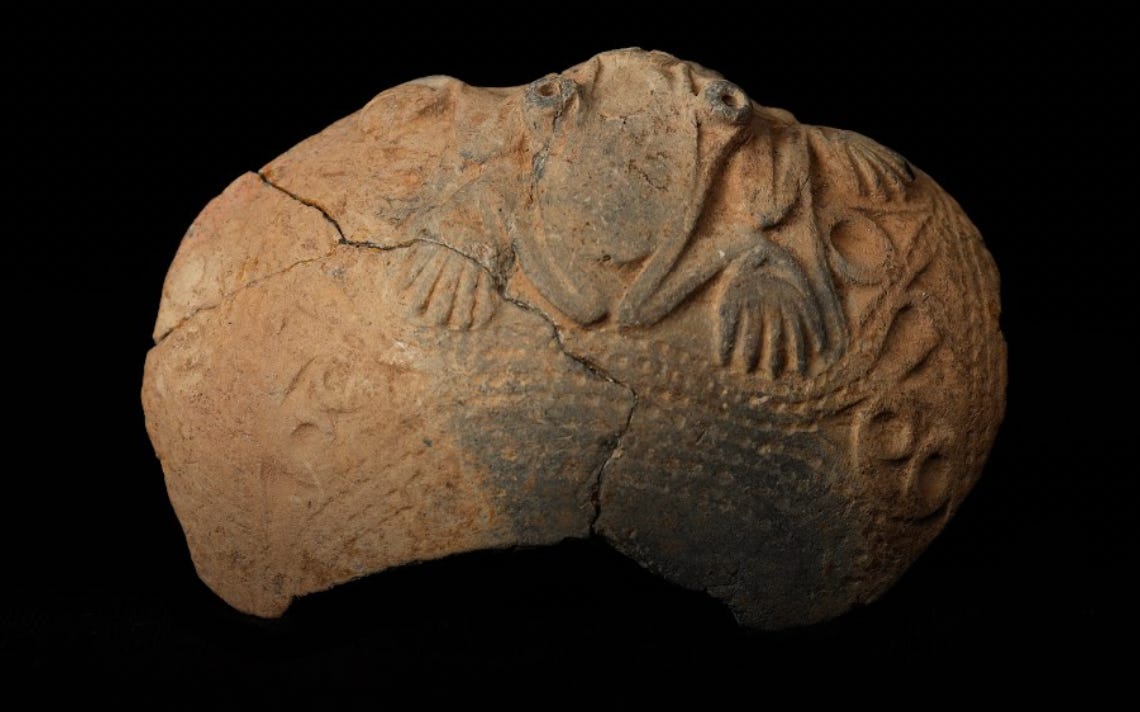
Archaeologist use ceramic or lithic technology to create cultural chronologies (known as seriation)— since these materials survive in the archaeological record. Ceramic sequences in Colombia are used to this day to understand regional-temporal groups. The Formative Period, distinguished by incised pottery, is divided into the First and Second Horizon with the First Horizon spanning from 4000-1000 BCE. The earliest evidence of plant domestication in Colombia also dates to this period from 4000-3000 BCE. In the San Jorge region, the first man-made waterways and artificial channels, terraces, and platforms, were built during the 2nd millennium BCE. This labor intensive land management strategy supported agricultural intensification in the region. During the Second Horizon of the Formative Period (1000 BC-500 CE), people began constructing and living on artificial platforms between 2000-14,000 square meters in size. Burial mounds were often placed at the end of these platforms. The emergence of manos and metates (grinding implements) and storage vessels for chicha7 marks a shift from root-crop to seed-crop agriculture, or a shift from manioc to maize.
Hydraulic technology fluoresced between 200-800 CE and continue into the Regional Period (500-1000 CE), leaving a lasting archaeological imprint on the landscape (see images below). Systems of canals and ridges were designed in perpendicular, fanning, and fishbone patterns, with housing and agricultural platforms protected from seasonal floods. These monumental systems controlled water run-off and collected nutrient-rich sediment for agriculture. Spanning over 500,000 hectares, the Zenú hydraulic system was the largest of its kind in the Americas. Gold smithing likely began during this period and there was a shift in material culture from incised ceramics to modeled and painted wares. During the Late Period from 1000-1500 CE, settlements moved upriver, abandoning the San Jorge region. Burial mounds in the middle river region were constructed on high ground rather than on the ends of living platforms.
“The salient characteristic of the Zenú region is its amphibious nature,” says archaeologists Granda in her thesis on women’s roles in Zenú culture. At the Museo del Oro Zenú, the same word amphibious is repeated throughout the exhibit. I had never heard the word used to describe people before. Granda uses the term to emphasize how the everchanging landscape erodes the boundary between land and water. The environment is dynamic and life-giving, transporting aquatic resources, precious minerals, people, and ideas. The valuable fauna of this environment like fish, reptiles, amphibians, and birds, are reflected in gold ornaments. The museum actually organized its exhibit based on groups of animals, and I cannot forgot to mention these unique crustacean figures worn as pendants (images below).
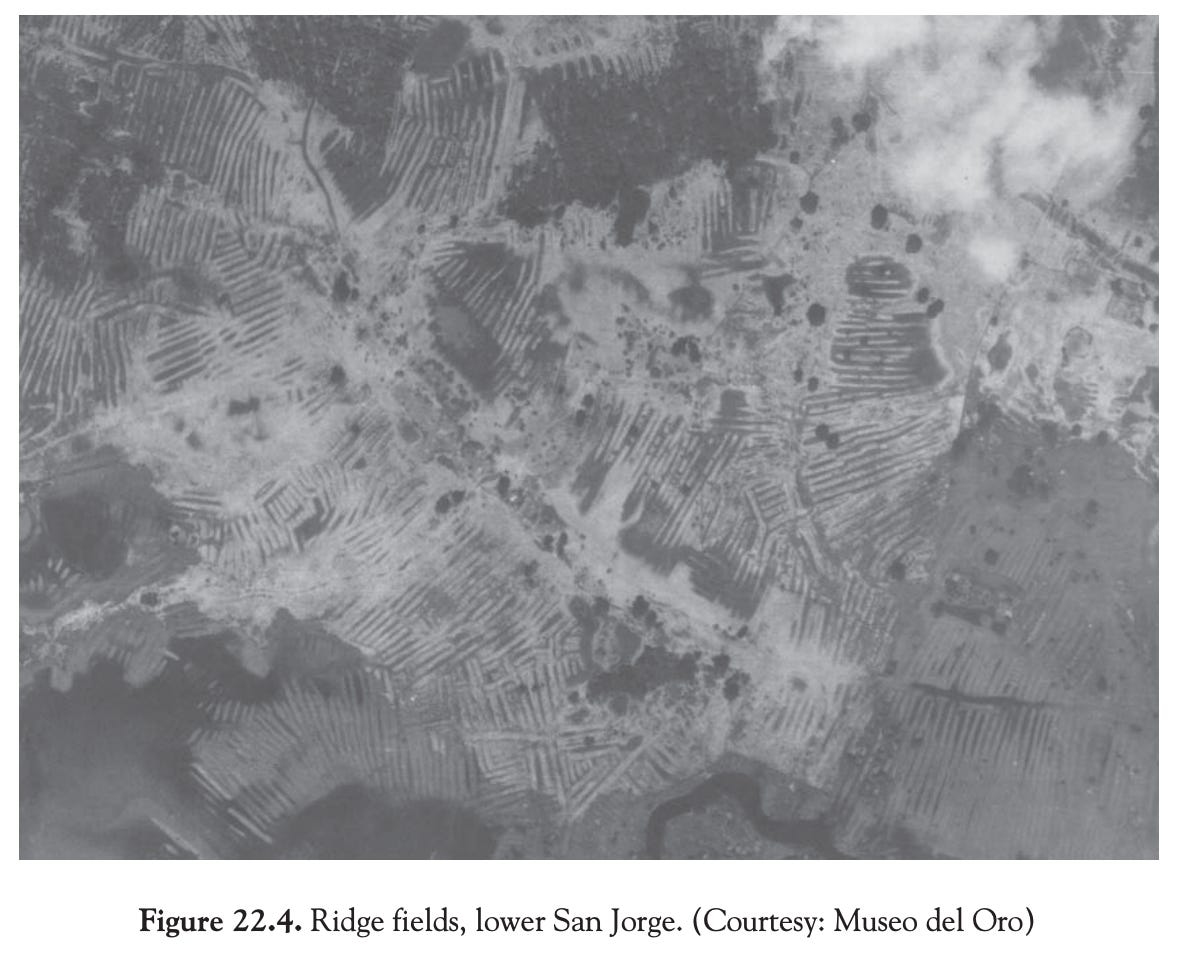
A video on the hydraulic systems in the region (in Spanish)
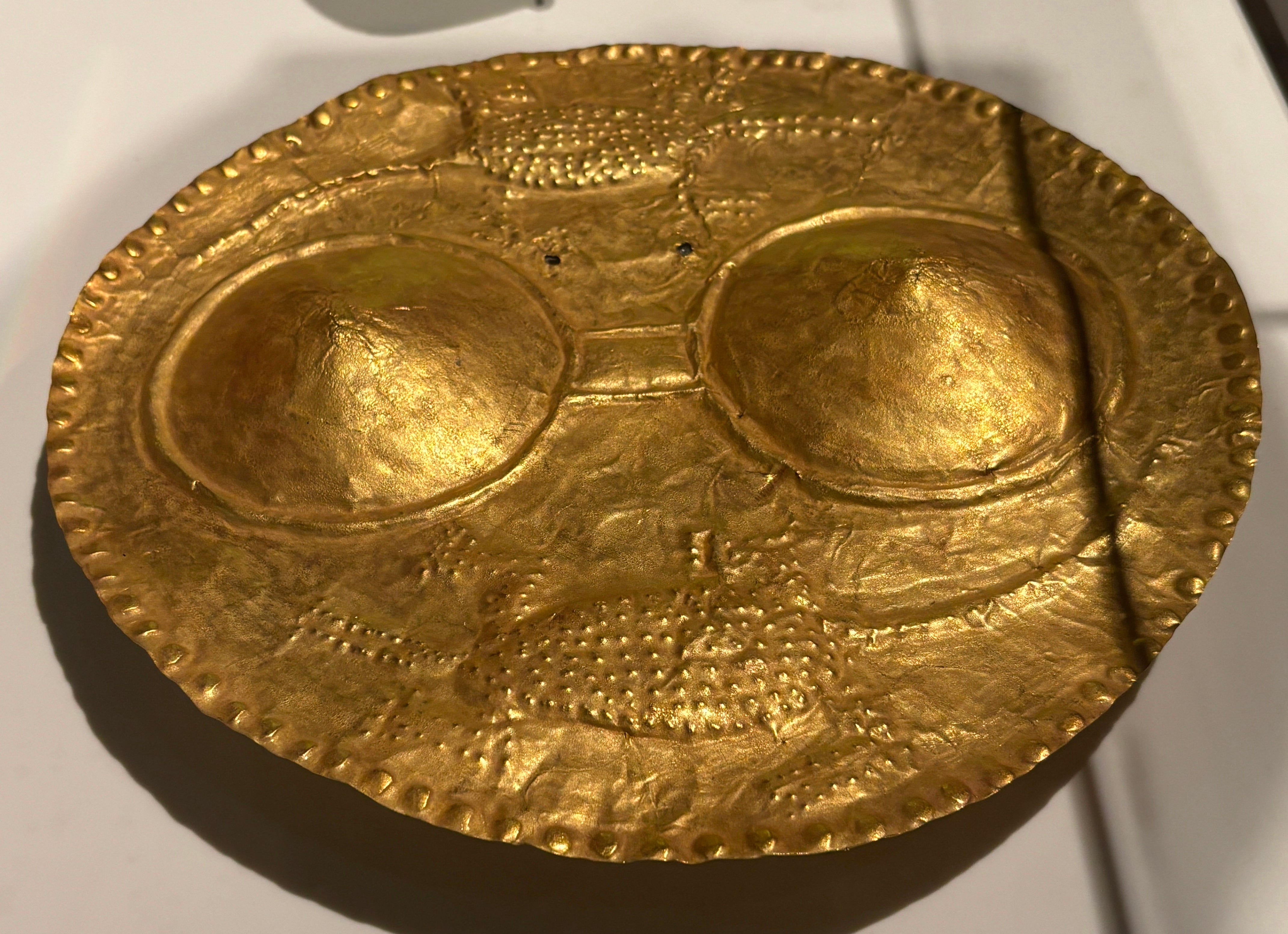
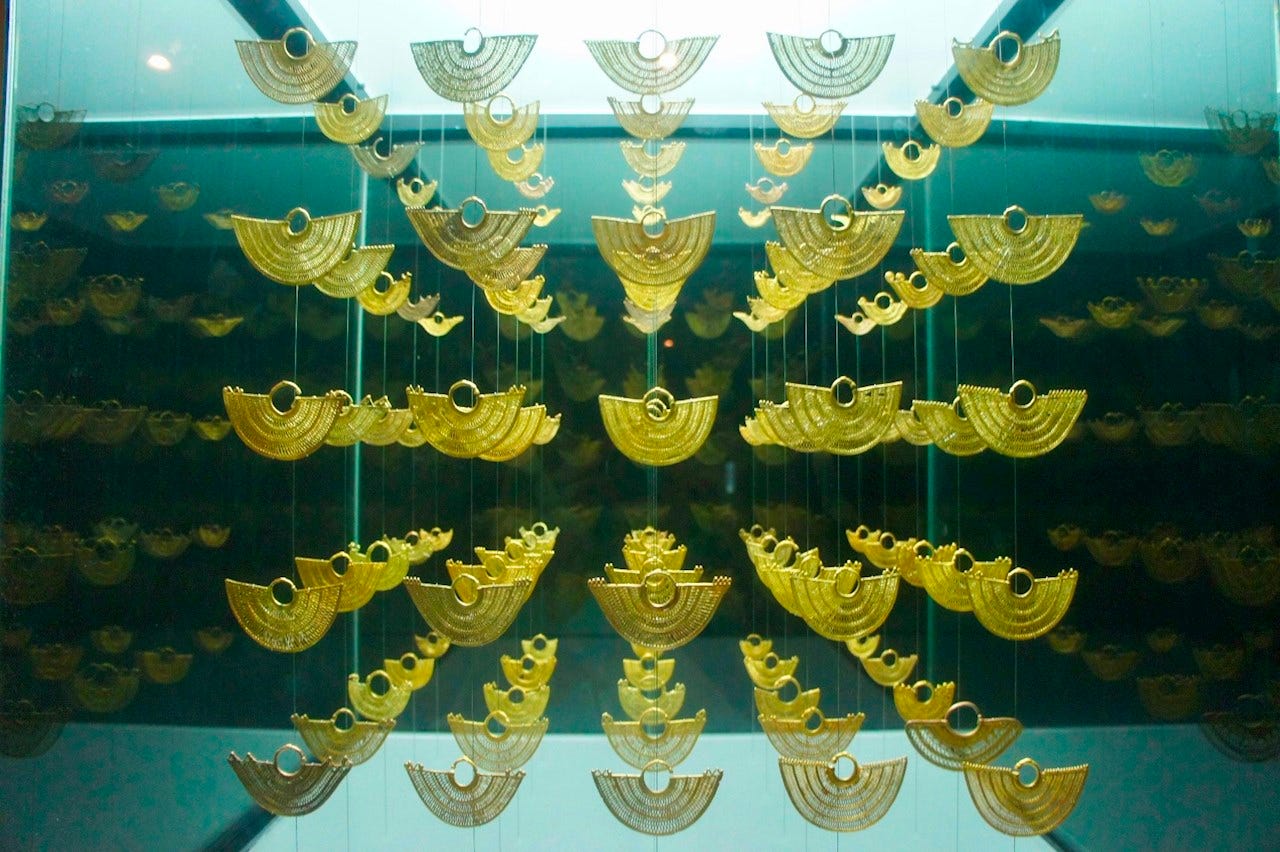
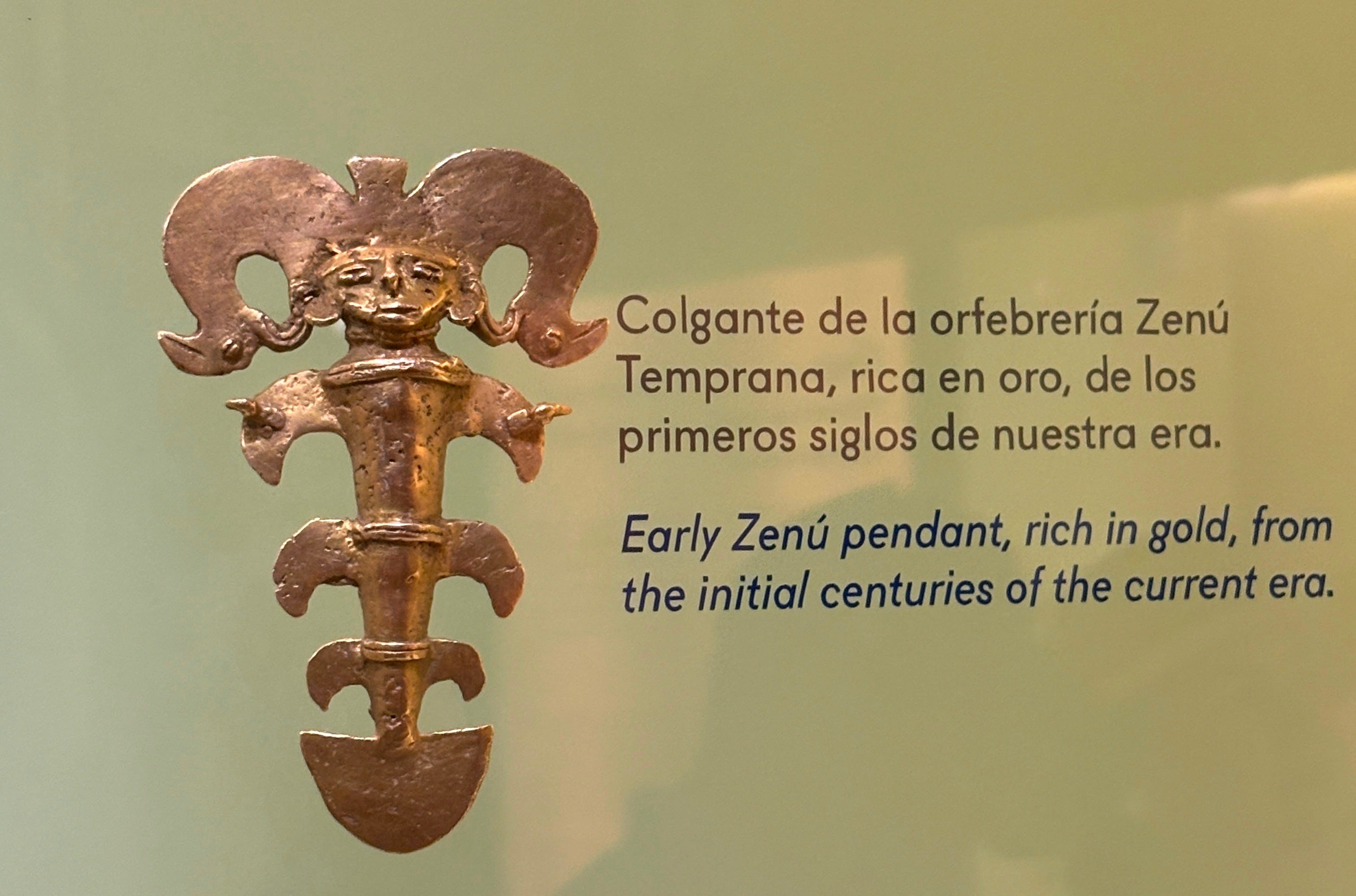
Zenú art and culture is of course well known for its goldwork. Along with zoomorphic pendants and ornaments, nose rings, earrings, pectorals, and penis sheaths were found largely in burial mounds. There was a whole class of craftspeople specializing in goldwork and ceramics. The Zenú used both lost wax casting and false filigree techniques to create beautifully detailed gold jewelry. Breast plates and necklaces were hammered and embossed to create designs like the caimans on the breastplate below. The mounds on breastplates are also thought to represent burial mounds where gold objects were deposited, transporting wealth between worlds. While early Zenú metalwork employed gold rich alloys, later periods used a copper rich alloy known as tumbaga8. Earring styles varied regionally by material and decorations, but the iconic semi-circular shape remained prevalent for 2000 years. In fact, this style of earring is all over gift-shops and jewelry stores in Colombia. The various sizes of earrings suggest they were worn by all ages and perhaps across social classes. Like ceramic styles, goldwork can also be grouped by culture-area and time period.
“Ethnohistory is the study of past human behavior through written documents,” states archaeologist Granda in her research on the Zenú. She cites the writing of Spanish explorers, chroniclers, and missionaries from the 16th and 17th centuries. Some of these documents record evidence of women chiefs, though the social role of women is largely overlooked in historic documents. Granda addresses the limitations and biases of these Spanish authors, writing from a European, Christian, and patriarchal perspective. The earliest evidence of decentralized chiefdom societies comes from the Zenú region, and the political structure of Zenú society is recorded in these texts.
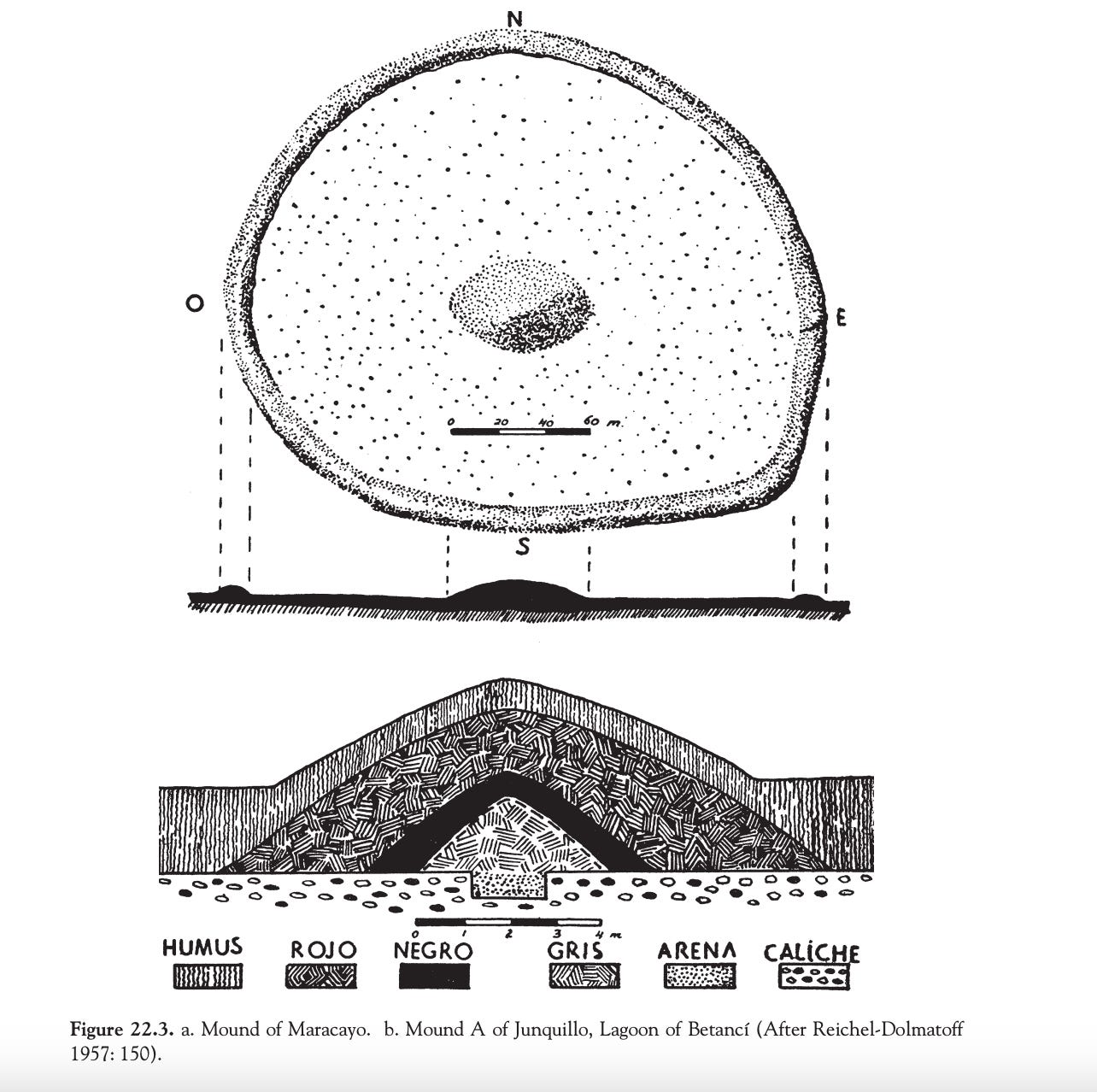
There were three main political regions in the 16th century— Zenúfana, Finzenú, and Panzenú. Tota, the woman chief of Finzenú, was the most respected of her peers, and would purportedly walk on the backs of her female slaves to get out of bed (quite an intense hierarchy!). When traveling long distances, elite women and men were purportedly carried in hammocks by a team of servants. Chiefs like Tota lived on a large house platforms with 20 secondary chief houses. Each chief house had 4 smaller dwellings for certain domestic tasks and crafts. Chiefs were buried in large earthen mounds surrounding an even larger mound dedicated to a god. The size of a chiefs mound reflected not only his or her wealth but the amount of time and labor his subjects would dedicate to construction. These mounds, like the many canals and terraces of the waterways, were no easy task. Red soil was sourced from distant (and unknown) locations to create these burial mounds where gold, ceramic, and shell goods were also deposited. The chief of Zenufana, Chief Tota’s brother, ordered all chiefs to be buried in her region, and if not their bodies, half of their wealth would be buried in a mound. Claims of Zenú matriarchy are based on the record of Chief Tota and the purported 1000 year presence of woman chiefs.
The Spanish also recorded, rather scantily, the role of regular women and division of labor in Zenú society. At the point of contact, women and men shared agricultural labor and military duties. Women young and old were recorded as skilled archers, though poison darts were also crafted by slave women who often fell ill from exposure. In terms of kinship structures, the Zenú were matrilineal— meaning daughters brought husbands into their homes while sons were married off. Consequentially, daughters were valued for bringing labor and wealth into the family home. Granda also discusses the rights of divorce and abortion as evidence of women’s social power and agency. Women purportedly had choice in their marriages as well as who they had children with and the Spanish recorded how Zenú women used certain herbs to stimulate abortions.
There is very limited ethnographic research on the Zenú people since a majority of the population was killed during Spanish colonization. Disease also devastated communities and explorers as early as 1515 recorded sparsely populated settlements. Native populations from Panama and other regions of Colombia were forcibly displaced into the present day Zenú reservation, so present populations represent a mixture of ethnic backgrounds. Granda discusses ethnographies from nearby groups, the Cueva and the Cuna, for inferring the role of women in Zenú society. In these neighboring communities, girls were highly valued and careful attention was paid to their physical health and beauty. Young girls received nose and ear piercings and were adorned with jewelry, while young boys received much less attention. All life-cycle events centered around women’s development while boys did not enjoy puberty or life cycle rites.
An account from Gonzalo Fernindez de Oviedo y Valdes (1478-1557) of women warriors in the region of Cartagena:
In that land, the women that do not want to get married are used to carrying a bow and arrows like the men, and they go to war with them, and they guard their chastity, and they can kill without penalty any Indian man who demands of them their body or virginity.
…and an Indian girl, 17 or 18 years old, came out of the hut full of Indians and stood amongst the Christians with a bow and her arrows . . . And before they could capture her, she wounded four Christians. imitating those warlike and fierce Amazons, whose strength and bravery Justino and many other authors mention. Therefore. amongst these Indians, many women have been seen as well trained and brave in war as the men.
How do we interpret women’s roles in archaeological societies with limited evidence? Human remains do not preserve well in the moist soils of the Caribbean lowlands, therefore there is no direct evidence from women’s bodies for bioarchaeological analysis. Furthermore, there is limited ethnohistoric and ethnographic research on the Zenú— a cause of violent colonization. The accounts we do have of Chief Tota and other politically important women have been extrapolated into evidence of Zenú matriarchy.
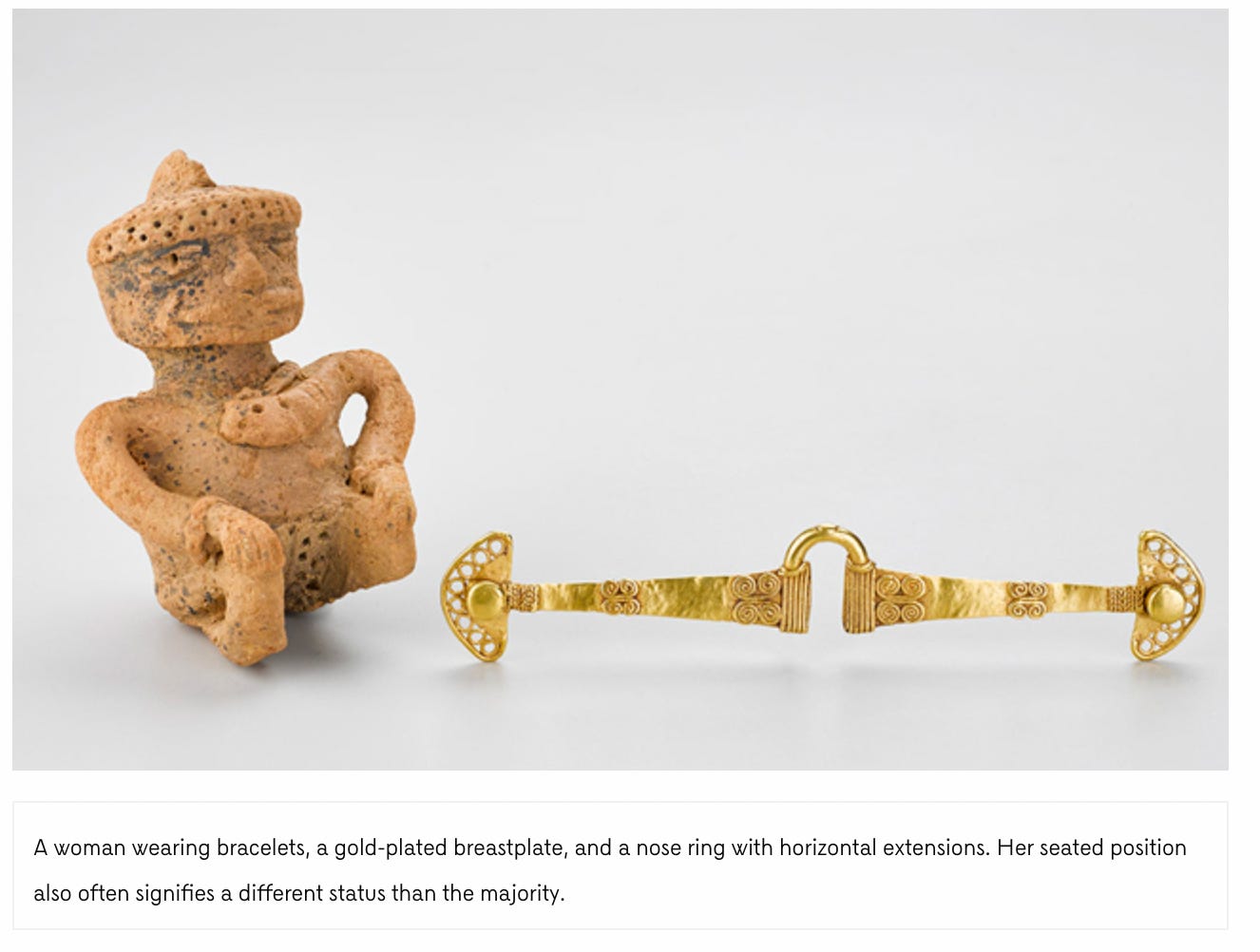
With limited ethnographic, ethnohistoric, and archaeological evidence, Granda analyzes the representation of women in ceramic figures. The prevalence of these figures throughout the Zenú region begs the question— were women respected and highly valued members of society? Unlike female figurines from Paleolithic Europe which, I covered in a previous article, feminine features are not emphasized in these figures— which is more often than not interpreted as representing fertility (like literally it seems like whenever archaeologists see artistic representations of women, its like BOOM fertility symbol). Instead, heads are often enlarged with eyes and genitalia stylized as slits, or genitalia is absent. Incised designs also represent textures, body hair, and jewelry, or figures were adorned with actual gold ornaments. Though female representations are habitually interpreted as fertility symbols, Granda wonders if large heads emphasized the intellectual faculties of women. An interesting claim, though difficult to substantiate.
Granda also discusses how male and female figurines are not always distinguishable, though there are significantly more females than males represented. Both genders have similarly stylized features like large heads and exaggerated limb proportions. Granda suggests that perhaps gender differentiation was more fluid, and that the Zenú may have had a relaxed or flexible attitude towards gender.
But if matriarchy means the mirror of patriarchy, we may expect to see artistic representations of women showing dominance over men. Of course, feminist theorists recognize that conceptualizing matriarchy as an inverse of patriarchy (like Marija Gimbutas) is problematic. Our reading of past matriarchy depends on which definition of matriarchy we subscribe to today: some feminist scholars subscribe to an egalitarian model where there is gender balance rather than domination. Granda’s research and analysis of ceramic vessels does not substantiate the claim of female-dominated society. The Zenú were likely matrilineal, with women enjoying political authority and sharing military, agricultural, and domestic tasks with men.
Though matriarchy is an attractive buzzword, we should be cautious with its application. I appreciate Granda’s care with defining matriarchy, matrilocal, and matrilineal social structures in her thesis. She also discuses some alternative theories like Rian Eisler’s “gylany”, which is the equality of sexes. But of course, there is also this:
David S Temper ( 1992: 101) recently questioned the assumption of a Zenû matriarchy. He asks: Do the apparent smiling women on Sinú vessels reflect a degree of male-female equality in chiefly affairs or men's greater power and ability to promote an art style disguising inequalities?
I would love to dive even further into the theoretical nuances of this subject, but I have been working on this article for too long, and I need to publish it before I lose my mind!
I will be writing more on Colombian archaeology focusing on the practices of the Gold Museums and Michael Taussig’s ethnography on the subject.
In the works I also have:
A piece of Feminist Archaeology
Backyard Ethnobotany
Archaeolog #4 on shell artifacts I like, Thor Hagerdahl’s expeditions and crazy theories on hyper-diffusionism, palm fiber weaving of contemporary indigenous Colombians, and FAKE artifacts sold at art galleries!
Anyway, thanks for reading if you made it this for. The final edit of this was made with an espresso martini in hand and this may be like awful and full of typos im sorry. Much love!!!!
Works Cited:
Granda, Rita Maria Cristina. 1996. “The Status of Zenú women: A Study of Gender Relations in Ancient Colombia.” M.A. Thesis, Trent University, Peterborough, Ontario Canada. 1997.
Pratt, Jo Ann F. 1999. “Determining the Function of One of the New World’s Earliest Pottery Assemblages: The Case of San Jacinto, Colombia.” Latin American Antiquity 10 (1):71–85. https://doi.org/10.2307/972212.
Oyuela-Caycedo, Augusto. 2008. “Late Pre-Hispanic Chiefdoms of Northern Colombia and the Formation of Anthropogenic Landscapes.” In Handbook of South American Archaeology, edited by Helaine Silverman and William H. Isbell. Springer New York. https://doi.org/10.1007/978-0-387-74907-5