The main reason the Digital Markets Act exists according to the European Union is to lower costs for consumers. For App Store customers, developers didn't bother to cut prices.
The Digital Markets Act (DMA) is how the European Union (EU) and its European Commission (EC) were able to fine Apple $570 million over allegedly treating consumers unfairly. It's how the EU could fine the company $2 billion for purportedly abusing its monopoly position and again doing so to the detriment of European users.
Now Apple is saying more specifically that the DMA is failing to achieve the price cuts for consumers that it set out to do. A new study examined App Store prices before and after Apple lower its fees to developers, and saw practically no difference.
"This study therefore demonstrates that commission savings as a result of the DMA have not led to price decreases for customers," concludes Jane Choi, writer of the report, which is available now. In summary, her report for the Analysis Group consultancy, says that over the period of the report:
- App Store rates typically fell around 10%
- Developers therefore saved around $23.3 million
- 90% of developers kept prices the same or raised them
- 9% of developers did lower prices, but no more than usual
That last point concerns how developers alter pricing on the App Store anyway, and the price changes fit previous patterns. The study claims that this "suggests that the bulk of the observed price decreases are unrelated to the reduction in fees."
The study also says that it doesn't matter whether developers have to pay Apple's Core Technology Fee or not. This fee applies to apps with over a million first installs in the last year, and the report does say that fewer than 20% of apps studied qualified.
But it also says that those developers who are due to pay the Core Technology Fee were virtually the same as the overall result. Specifically, where the developer pays the Core Technology Fee, 91% of apps stayed at the same price or increased.
Similarly, 9% did decrease prices. The report does not explicitly say whether or not this is down to typical pricing variations, though.
It could be argued that the DMA should be benefiting developers in the EU, as developers are also consumers. But this report also says that this just is not happening.
"In addition to developers keeping most of the commission savings for themselves," it claims, "the overwhelming majority of those savings — more than 86% — went to developers outside the EU."
So the claim is that EU users are not benefiting, and nor are EU-based developers.
The report was produced by the Analysis Group, and supported by Apple. The Analysis Group previously advised Apple on App Store rates.
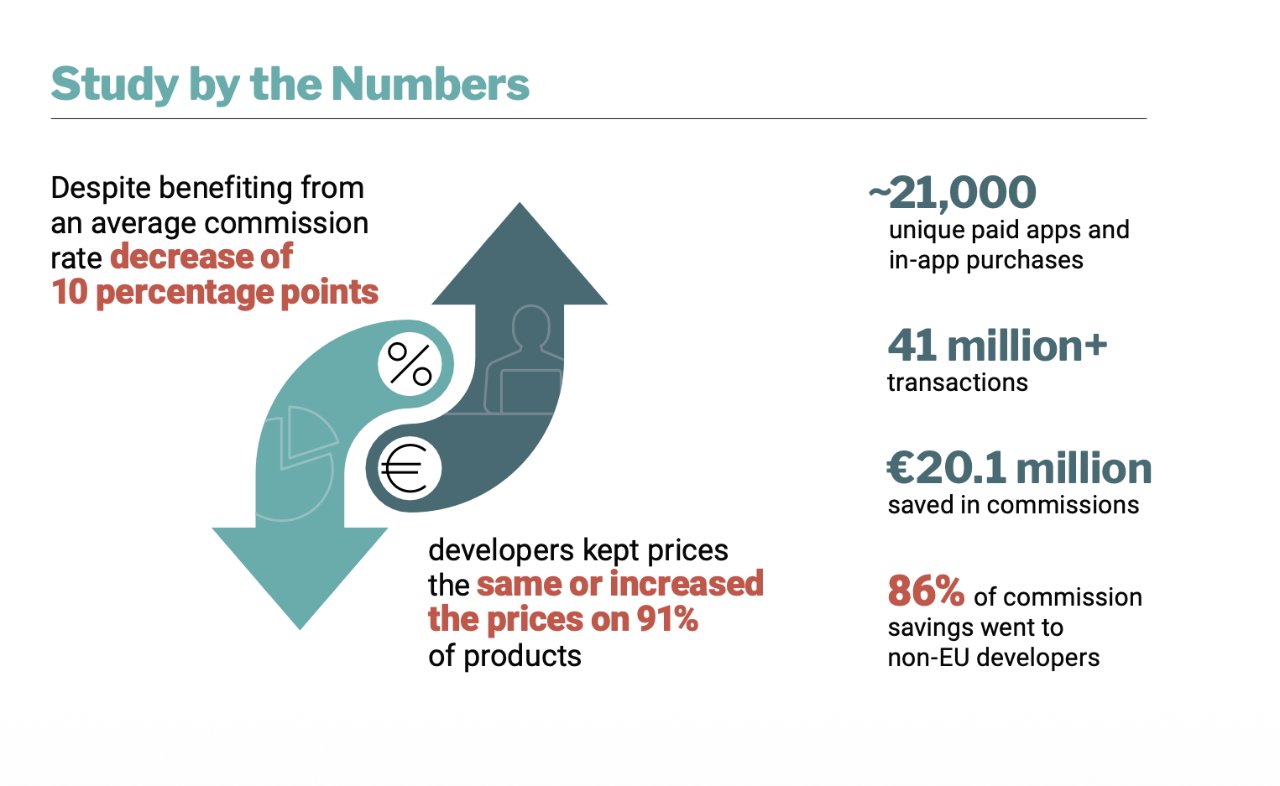
Detail from the new report, summarizing its findings — image credit: Apple
This new report, "What Happens to App Prices when Developers Pay Lower Commission Fees?", runs for 3,000 words and is based on data from March 2024 through September 2024. It examined roughly 21,000 apps on the EU-based App Stores, which saw over 41 million transactions during this period.
Apple's stance on the findings
Apple did not tell AppleInsider whether it was the sole sponsor of the report. However, it is the only credited one, and Apple did say that it was at least a significant sponsor of it.
What they did tell us is that it was unsurprised by its findings. Apple said that while it didn't examine this data before, as it had no need to, the results fit what it has seen anecdotally for years.
It also said that in its opinion, this is more proof that the DMA and the EU's enforcement of its regulations, are flawed. Apple believes that the DMA is not bringing consumers better value — and that it is also harming their privacy.
The issues over privacy and security are separate, and the new report does not mention either. But Apple is seeing this study as more ammunition in its ongoing disagreements with the EU over how, it says, bureaucrats do not understand technology.
Keeping up the offensive
The report is new, but its findings match what Apple has been publicly protesting about for the last year or more.
"Regulators claimed the DMA would promote competition and give European consumers more choices," Apple has said before. "The law is not living up to those promises. In fact, it's having some of the opposite effects."
Specifically, Apple contends that the DMA is why it has not released iPhone Mirroring in the EU, and the new AirPods Pro Live Translation feature has been delayed.
"[According] to the European Commission, under the DMA it's illegal for us to share these features with Apple users until we bring them to other companies' products," says Apple. "If we shared them any sooner, we'd be fined and potentially forced to stop shipping our products in the EU."

Live Activities on the Mac is another feature that won't be released in the EU
Speaking to AppleInsider, Apple said that the EU was forcing it to provide its technology to rivals without any of the user privacy safeguards it uses itself.
According to Apple, that's at least an unreasonable and potentially an impossible burden on its engineering teams. It's also, though, something that Apple claims no other company is required to do.
That claim is 100% accurate, and so is how Apple believes that third-party rivals want it to basically continue innovating on their behalf. Rivals want Apple to keep on developing new features, then hand them over for free.
EU and Apple both say consumers are key
At the heart of both the EU's DMA demands and Apple's rebuttal of them is the claim that they are all working in the interests of the consumer. Apple is of course concerned with its business, and the EU is concerned with its consumers.
But even though this report is Apple-sponsored, it is genuinely compelling evidence that the DMA is failing at its core ambitions.
The EU is currently in the process of reviewing the DMA, although that is a legal requirement rather than a consequence of any criticisms of it. Based on the EU's response to Apple during the review, it's also extremely unlikely to make any changes.