
Hey,
Summary of this email:
Did you know that the air you breathe during sleep or work can easily be too high in CO2 (carbon dioxide)? A recent trial quantified how elevated CO2 hurts sleep quality and cognition in real world scenarios.
I came up with a corny acronym to make it more likely that you’ll remember and act on this issue: FOCUS (Focus on Oxygen and CO2 Uptake for Sleep). I stuck oxygen in there too because 80% of Americans with sleep apnea don’t know they have it and are subconsciously gasping for oxygen each night. 😮💨
This email will mostly cover the CO2 part of the equation, giving a quick primer of the research and introducing potential fixes.
Note that these longer emails take more effort than usual to research and write. If you find this email valuable, don’t be shy to reply back and let me know, so we can carve out a little more time to do these. And if you have friends or family with sleep issues, feel free to forward this email to them!
I have a simple homework assignment for you:
Take two deep breaths. Allow the air to go in and out through your nostrils.
Did the air you inhale “seem” more fresh or more stale?
I did it. Now what?
If you’re currently outside or in a well-ventilated room, it’s probably fresh. Otherwise, there’s a high likelihood of stale air. The air you exhaled was about 16% oxygen and 4% carbon dioxide (CO2). There’s 100 times more CO2 going out than coming in, meaning your body’s trying hard to get rid of a lot of CO2, which is mostly a metabolic waste product but also has a few physiologic uses in small amounts. On the flip side, oxygen is so critical for the brain’s energy production that a few minutes without it would lead to you not being able to read any more Examine emails ever again. You might think that the body would keep CO2 levels within a tight range. Like how our bodies very tightly regulate pH levels, so you don’t have to worry about eating an ultra-alkaline diet to keep your body at an “optimal” pH. But for a variety of reasons, our bodies are okay with moderate hypercapnia (high CO2) and hypocapnia (low CO2) even though these states are bad for your health and wellbeing. Thus, many people do actually have to worry about the indoor air they breathe. Now you should be starting to understand some of the rationale behind The average adult spends around 21.5 hours of the day indoors. In the winter, this can get closer to 23 hours or even more. Since there’s no wind indoors unless there’s a lot of farting going on (just checking to see if you’re still paying attention), air isn’t moving around much. Speaking of farting (sorry, last attention check), dilution of noxious particles is much easier in the vast expanse of the outdoors than in, let’s say, an elevator. Now apply that same thinking to CO2. What starts out as indoor air with 0.04% carbon dioxide (CO2) can quickly shoot way up as more CO2 is added to the mix without sufficient ventilation.
The air you inhaled was about 21% oxygen and 0.04% carbon dioxide (CO2).
What’s wrong with indoor air?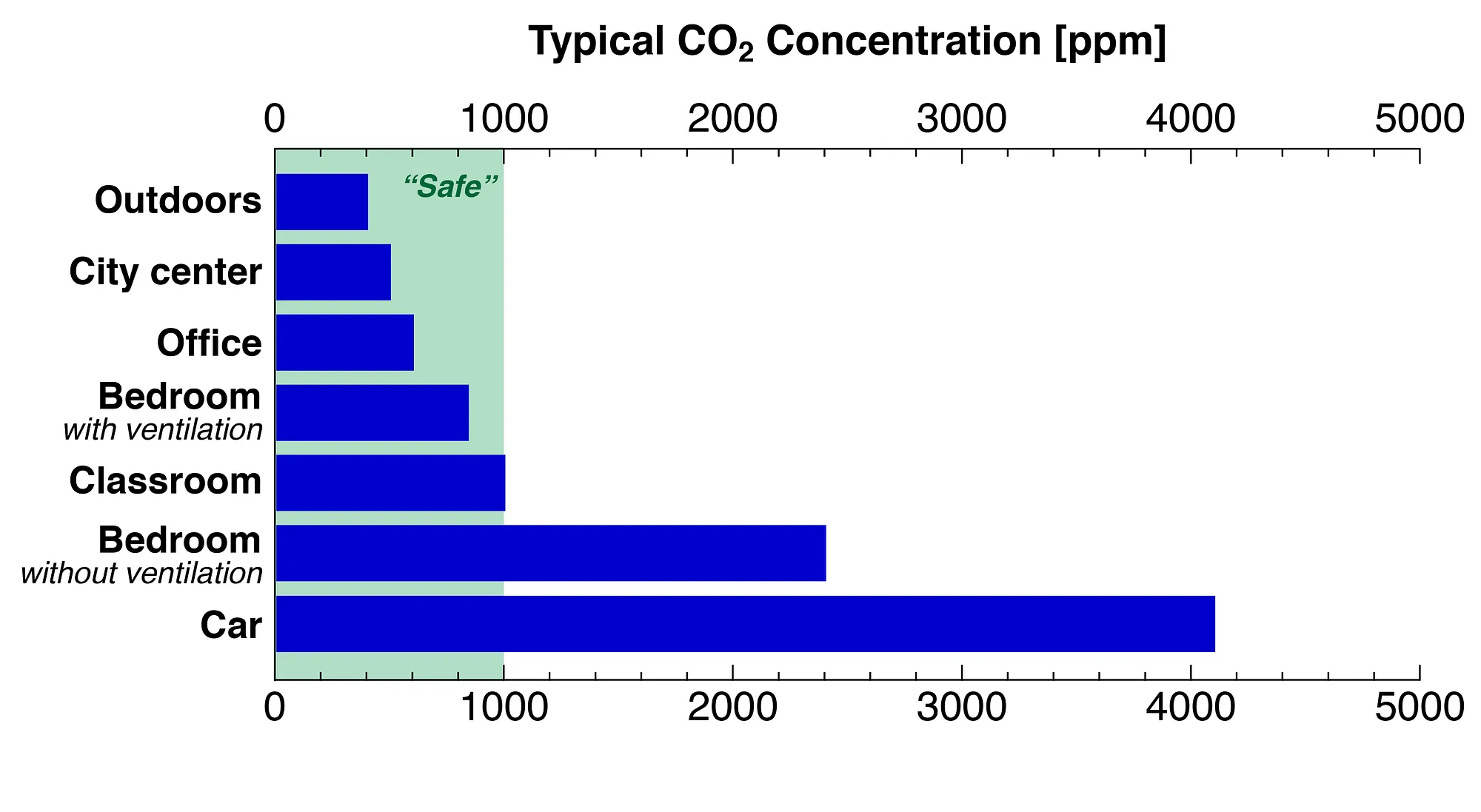
Source: Alhinawy, 2024
What all adds CO2 to the mix?
Really common things!
Having more than one person in the room. Two adults means roughly twice as much CO2 if ventilation is low.
Having one or more dogs or cats or babies in the room. Just because they don’t contribute to GDP doesn’t mean they don’t contribute to CO2.
Being in a smaller room. Small apartments contain much less air than bigger houses, so there’s less dilution.
There’s also a sneaky reason why we have to pay more attention to CO2 now than our parents’ generation did. Every few years, new buildings are built with tighter and tighter building regulations designed to control the air leaking in and out of them. In a way, this is great, since it reduces mold growth and improves energy efficiency by storing up heated air in the winter and air conditioned air in the summer. But with fewer and fewer unintentional air leaks, we have to be more and more conscious of ventilation, otherwise CO2 and indoor air pollution (e.g. VOCs) can easily build up. Some buildings have ventilation systems in place that reduce that need, but many do not, or have less effective ventilation systems. Regardless, more ventilation is typically a good thing, because unpleasant effects can be felt even at moderately elevated CO2 levels: 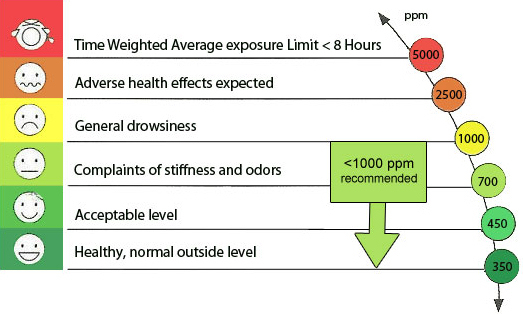
Source: Sung, WT and Hsiao, SJ, 2021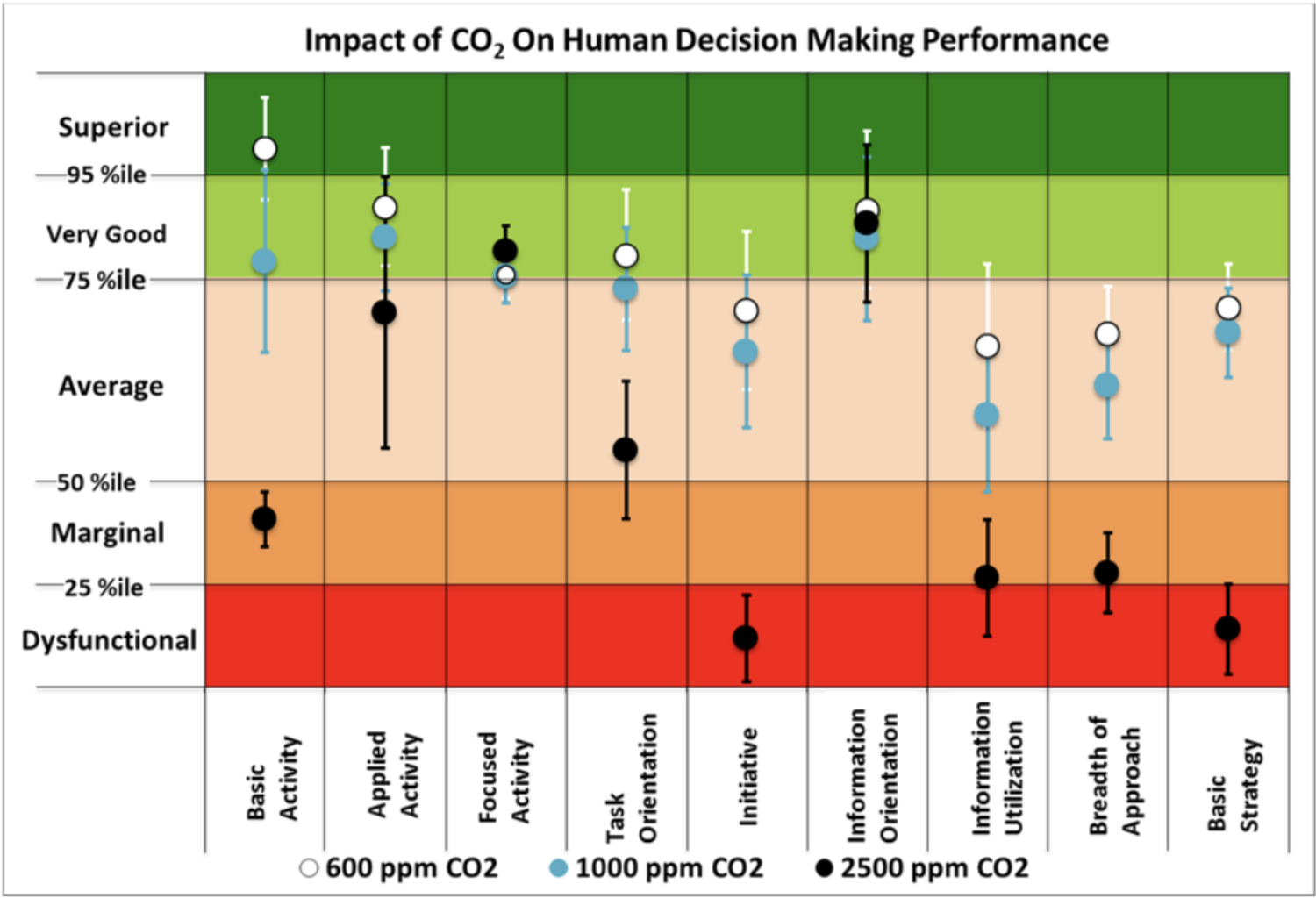
Source: Fisk et al., 2013
How do I know what my room’s CO2 levels are?
I hate advising you to spend money. So if you have a friend with a CO2 monitor gadget, ask them if you can borrow it.
If you’re really concerned about this issue, CO2 monitors have become MUCH cheaper and more commonplace since COVID started. Nowadays, the cheapest monitors using the more accurate NDIR sensors are only around fifty bucks, while the most rock-solid and reliable NDIR-equipped ones are between $100–$200. If you get one, take it with you everywhere you spend time for a day or two. But keep it a few feet away from you, or else it will read artificially high CO2 levels from your breathing! If you spend time in rooms with CO2 concentrations over 1,000 parts per million (ppm), it’s definitely time to take action. If it’s often over 750 ppm, it’s probably time to take action, according to the latest evidence. Both the 1,300 ppm and 1,000 ppm groups had worse sleep than the 750 ppm group, and those participants with worse sleep performed worse the next day in cognitive performance tasks.
In 2024, researchers conducted a trial in which participants were split into three groups. One group slept in a room with a healthy 750 ppm CO2 level, one slept in a room at 1,000 ppm (which is considered the maximum “okay” level according to some guidelines), and the last group slept in 1,300 ppm.
Sleep apnea is a huge topic that I can’t fit into this already long email. Over 80% of people with sleep apnea have obstructive sleep apnea, which is when the lungs can’t get enough air because of an airway blockage, resulting in blood oxygen levels dipping too low frequently throughout the night. I currently know relatively little about sleep apnea, even though I authored For now I’ll just say this: at least several hundred of the people reading this email (hi!) have sleep apnea and have no idea that they have it. Go to a sleep medicine doctor if you can’t figure out why your sleep sucks or why you don’t feel refreshed in the morning.
That’s the “C” part of the acronym, but what about the “O” (oxygen) part?
Even a big indoor plant would only absorb 5–15 milliliters of CO2 per hour, compared to a human exhaling 20 liters of CO2 per hour. So 2,000 times less. So unless this guy is your roommate, you need other options:
Can I fix elevated CO2 levels by growing indoor plants?
No. It’s a myth that putting plants in your room will substantially improve air quality, including reducing CO2. Even though plants consume CO2, they’re just too puny and hence typically lower indoor CO2 levels by less than 1%. 
Oops! A few years later I found out there’s little to no evidence supporting many of the video’s claims, and pretty decent contradicting evidence. Indoor plants can have minor effects on air quality (though so minor as to often border on negligible), and moderate-to-major effects on mental wellbeing. But that’s an email for another day … There are two main things you can do. First is to crack a window or door open long enough to exchange CO2-laden air out and fresh air in. In order to know how long is required, you’ll need a CO2 monitor to n=1 experiment with your specific situation. The other main thing you can do is run fans in your house or apartment to circulate air around. The goal is to fast-forward the air exchange process that would normally take way too long via slow diffusion. You want to eliminate stale air zones surrounding you sooner rather than later. Relatedly, keeping bedroom or office doors cracked or even fully open during the day can help prevent CO2 buildup. I always kept my door shut my entire life, so I have to actively try to train myself not to nowadays. Last thing: if you have a gas stovetop, especially in a smaller space like an apartment,
Funny story: 16 years ago, I watched a TED talk by another guy named Kamal. He touted the air cleaning capabilities of three specific indoor plants. Naturally, I was excited for Team Kamal and mentioned the video to others.
I’m convinced, but need more ammo to convince other people I know …Over 20 years ago I had to write a short paper on something called Sick Building Syndrome. The syndrome has to do with health issues like headaches, lethargy, or eczema flairs stemming from an indoor environment but without a specific cause. I’m not sure why this doesn’t get more attention. Maybe because there aren’t many easy ways to study it? Or more cynically, to make money from it? Outside of the ennui caused by being cooped up inside (see Severance on Apple TV or Office Space from 1999), the list of potentially harmful effects from indoor environments is long: mold, VOCs from cheap furniture, CO2, methane that leaks from gas stovetops Before spending money on supplements or expensive treatments, it can be useful to do a mini audit of your surroundings. Which persistent factors might be harming you? Which things can you remove or clean, and which things might you keep or add that spark joy? (Thanks Marie Kondo!)
Fewer people are well versed in the effects of CO2 on sleep. Examine doesn’t make any money from sharing this information. We just have a sincere desire to help you feel better because we’re also regular people who try things to feel better, so we know what it’s like. Bottom line: if you have sleep issues or think you might have elevated CO2 levels in your living space or workspace, remember to
Proper sleep hygiene is pretty straightforward: have a consistent sleep schedule, don’t play on your phone, avoid caffeine in the hours before sleep, limit blue light exposure and ambient noise levels.
Sincerely,
Kamal Patel
Co-founder, Examine
P.S. After almost two years of development, we're getting ready to launch Examine Pro! Examine Pro is designed to help health professionals give better, safer, and faster advice, all backed by the latest evidence. Click here to be notified of the launch date and get an extra discount.