Discover the cosmos! Each day a different image or photograph of our fascinating universe is featured, along with a brief explanation written by a professional astronomer.
2026 August 30
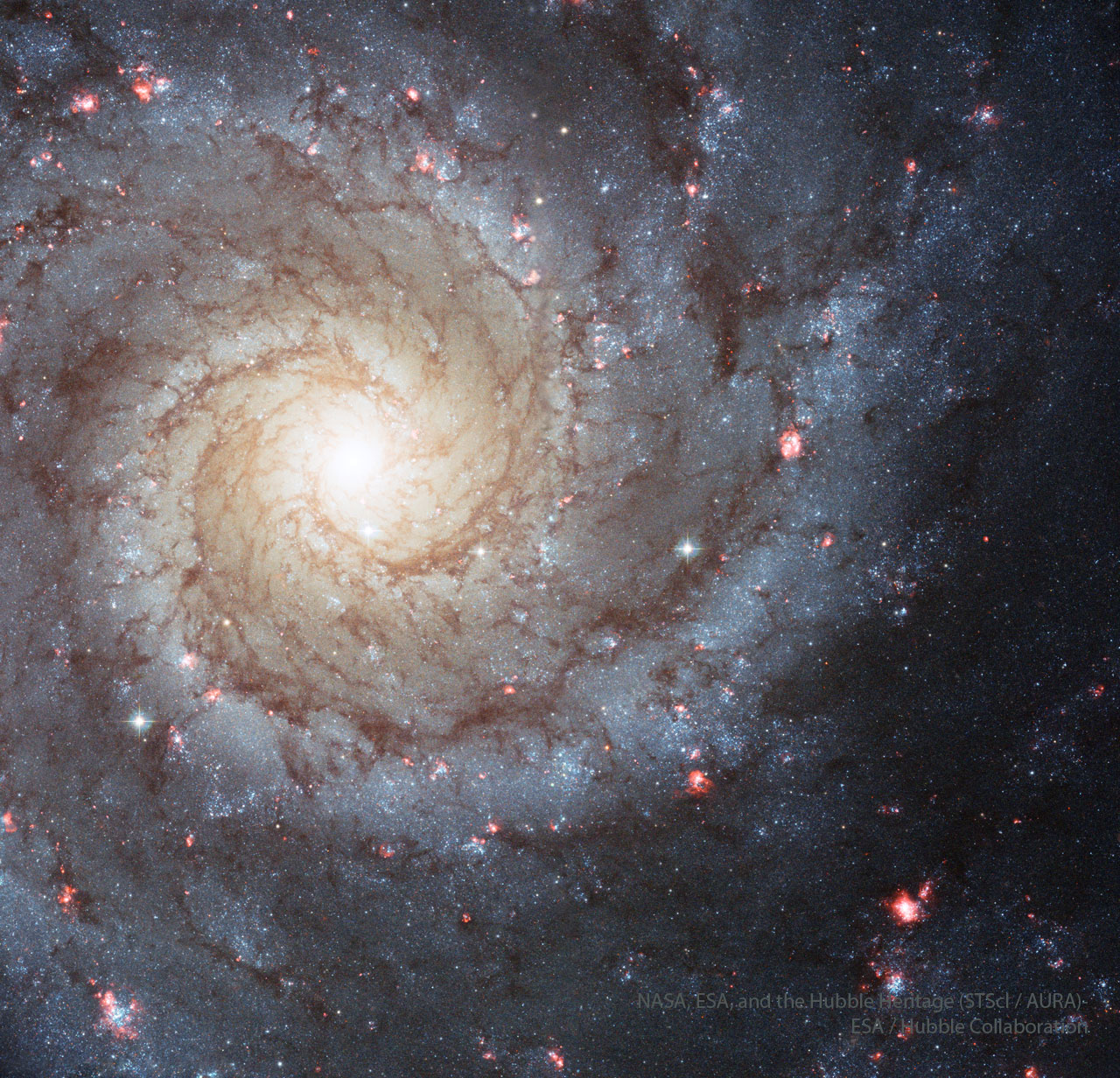
Image Credit: NASA, ESA, and the Hubble Heritage (STScI / AURA)- ESA / Hubble Collaboration
Acknowledgment: R. Chandar (U. Toledo) & J. Miller (U. Michigan)
Explanation: If not the most grand, then this spiral galaxy is at least one of the most photogenic. An island universe of about 100 billion stars, 32 million light-years away toward the constellation Pisces, M74 presents a gorgeous face-on view. Classified as an Sc galaxy, the grand design of M74's graceful spiral arms are traced by bright blue star clusters and dark cosmic dust lanes. Constructed from archival images, this sharp composite is from the Hubble Space Telescope. Spanning about 30,000 light-years across the face of M74, it includes exposures recording emission from hydrogen atoms, highlighting the reddish glow of the galaxy's large star-forming regions.
Tomorrow's picture: new space telescope
< | Archive | Submissions | Index | Search | Calendar | RSS | Education | About APOD | Discuss | >
Authors & editors:
Robert Nemiroff
(MTU) &
Jerry Bonnell (UMCP)
NASA Official: Amber Straughn
Specific rights apply.
NASA Web Privacy,
Accessibility,
Notices;
A service of:
ASD at
NASA /
GSFC,
NASA Science Activation
& Michigan Tech. U.