“The objective form is the most subjective in matter. Man is least himself when he talks in his own person. Give him a mask, and he will tell you the truth.”
- Oscar Wilde

Authenticity… Authenticity… Authenticity…
Performative… Performative… Performative…
“Slop” won the Merriam-Webster word of 2025, but “Performative” came in third or fourth (or something like that). Not only that, it’s a word that if you type into X search, TikTok, or basically anywhere, you’re bombarded with takes, tweets, memes, whatever, of people calling things “Performative.”
The Performative Male. The Performative “Creator.” Performative Politics. The Performative Matcha Order. Performative Fashion. Performative Reading. The Performative Book Collection. Performative Vibe Coding. Performative Founders. Performative Anime Fans. Performative Cynicism. “Performative Slop” (an elite combo of #3 and #1 most popular words of 2025).
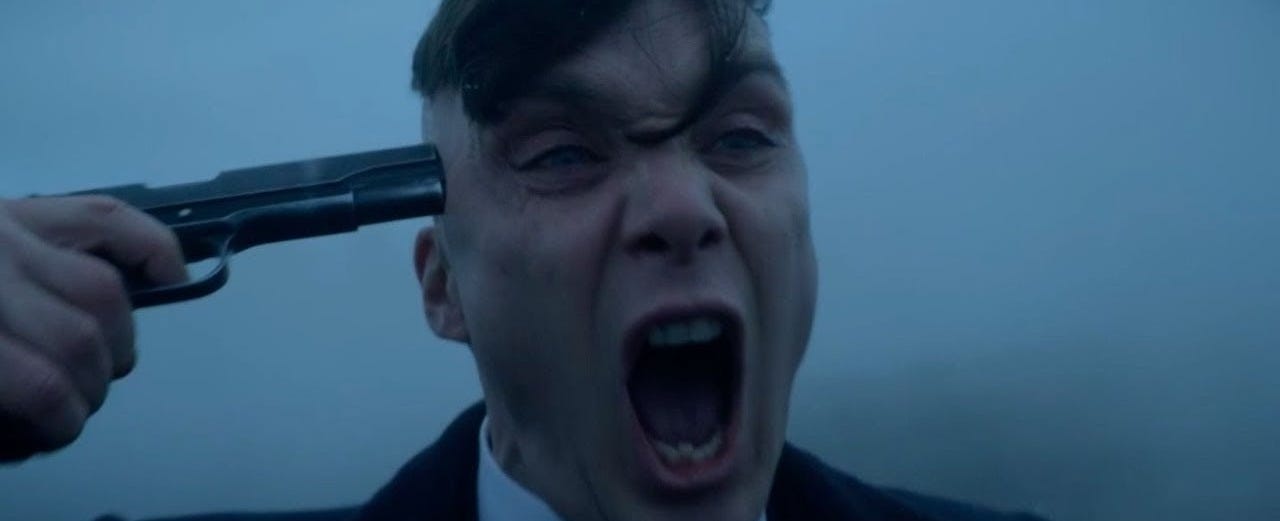
Performative Guy Who… Performative Girl Who…

Performative… Performative… Performative…
“In the age of social media, where all the world’s a cellphone-sized stage, the steep rise in lookups of ‘performative’ resulted not from any particular news item, but instead from the pervasiveness of what it describes. Performative means ‘made or done for show (as to bolster one’s own image or make a positive impression on others).’”
- Merriam Webster

What’s funny, though, is this has also given rise to the “Authenticity” approach, and the “you just need to be Authentic, bro, be more Authentic.” Not realizing that the Push of Authenticity is just a somewhat different form of “Performative.”
The uptick in “Slop” and “Performative” is signaling something. But I don't think it's signaling what people think it's signaling.
To me they’re the local top signals that signal exhaustion on attention as currency… the “need to go viral!”… the output… the optimized content wheels that creators, brands, whatever all hum now in the name of the Almighty Algorithm. The incentives have been fully revealed, face up, and much of the audience now is left to surmise if someone is being “performative” or if something is Real.
The consensus take is “we need more Authenticity!”, like this just solves the problem. As if there even is such a thing as real “Authenticity” online. For example, you’re reading some words from a washed dude behind a Rengoku manga pfp with the pseudonym “apewood” on the internet. Is that authentic? I’m behind a mask, you don’t know who I am, what I’m about. It’s technically not “authentic.”
So, the real distinction isn't this is bespoke, feel-good blanket distinction of "Performative vs. Authentic." Authenticity is somewhat of a trap, and can in and of itself be somewhat Performative (more on that later). The real distinction is Literalism vs. Gusto.
Some level-setting semantics definitionally:
Literalism: From "literal". Adhering to the exact letter, the surface, the face-value meaning. Biblical literalism takes scripture word-for-word. In art, literalism means rendering things exactly as they appear, technically correct, no interpretation, no feeling. The literalist painter copies the scene precisely. The literalist creator follows the template precisely. Both execute at the surface level without genuine engagement underneath.
Literalism is doing exactly what works, exactly as prescribed, and nothing more.
Gusto: From Italian/Spanish, meaning "taste”, relish, zest, enthusiasm. Hazlitt used it in his 1816 essay "On Gusto" to mean "power or passion defining any object." Titian had gusto because his paintings looked like it could actually feel… the artist's genuine engagement transferred into the work.
Gusto is the felt. More alive. Making something because you're absorbed in the making, because you have something you need to say, because you'd do it even if no one was watching. The output is incidental to the love of the input.
Culture has always swung between these poles, between Collectivism and Individualism, between Optimization and Expression, between fitting the template and breaking it. Between Literalism and Gusto.
The Romantics rebelled against Enlightenment rationalism. The Renaissance rebelled against medieval scholasticism. Punk rebelled against prog rock. Every era of hyper-optimization eventually exhausts itself, and the pendulum swings back toward something more alive. From literalism to gusto.
We’re at that moment now. The attention economy has been optimized to death. Literalism has topped, and “Performative” is the word people reach for when they feel it but can’t name it.
So what does this mean, and what happens next?
Kind of a lame mini history lesson yes but bear with me. Can also read tops of the waves here but tried to Trader Parallel it as well so it connected.
The TLDR is social media started as a closed chamber with you and your friends doing shit you liked. More Individualist, more Gusto (imperfection, didn’t “optimize”). Then, the algorithms changed. And it changed again.
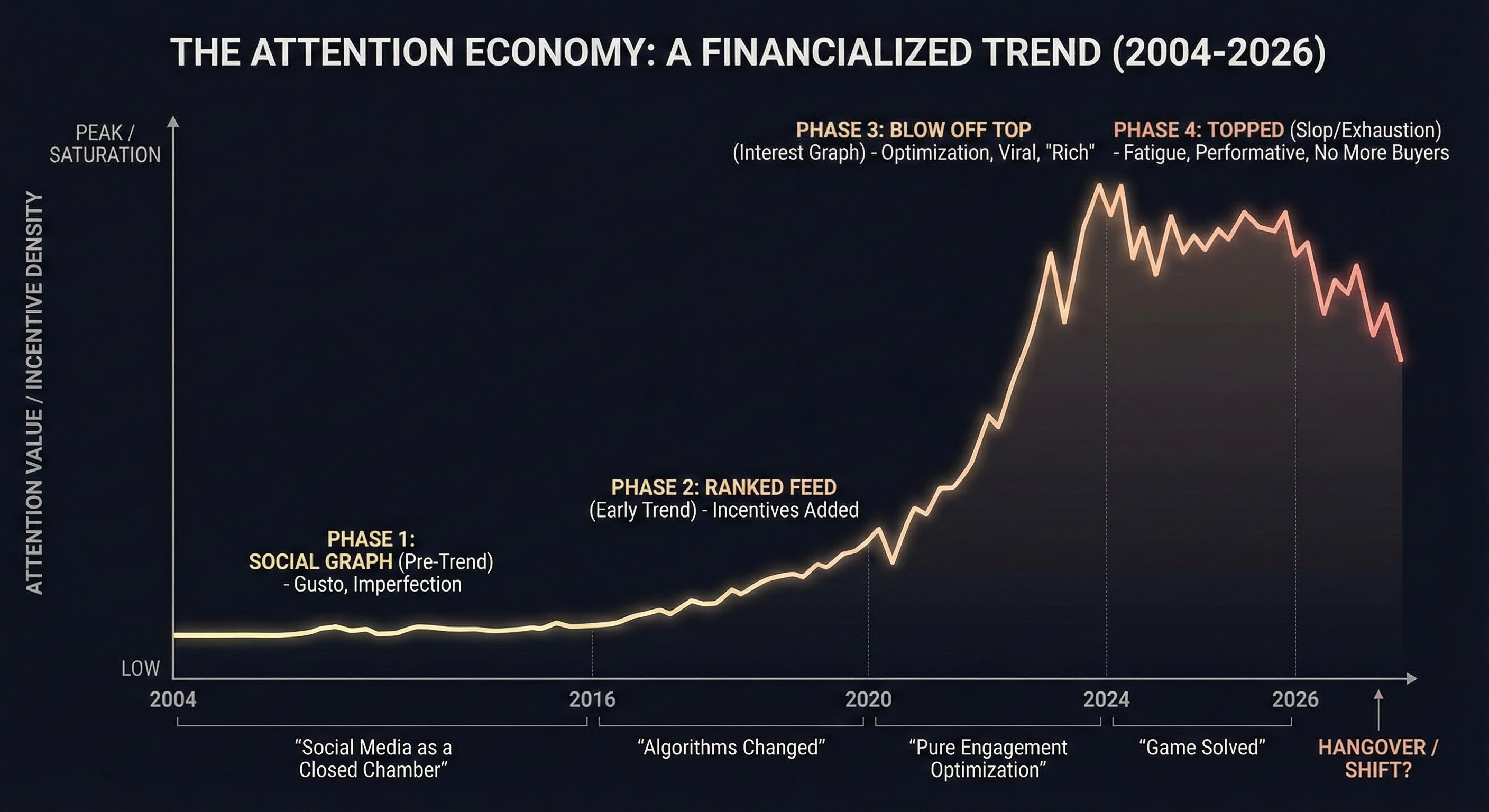
The Trend of sharing online became incentivized to “Creating” —> HTF uptrend for attention began in 2016 —> blow off the top in 2020/2021 with COVID —> fatigue, AI proliferation, template and trend following topped the trend in 2025 (exhaustion signs with “slop” and “performative” taking over the primary online vernacular for the year).
The incentives that drove the blow off the top popularity of the Creator Economy became face up. Any hurdles to creation were basically gone, anyone could be a “creator.” Combo’d with no more marginal “buyers” of Attention (even late adopter boomers are now mindlessly scrolling short form video slop).
The top of Collectivism / Literalism on the internet —> and the beginning of the shift back to Individualism / Gusto again perhaps.
People in bubbles tend to talk about the nostalgia of early periods. “Oh the early online poker days.” “Oh the early memecoin days.” “Oh the early NFT days.”
“Oh the early Internet days” is somewhat synonymous.
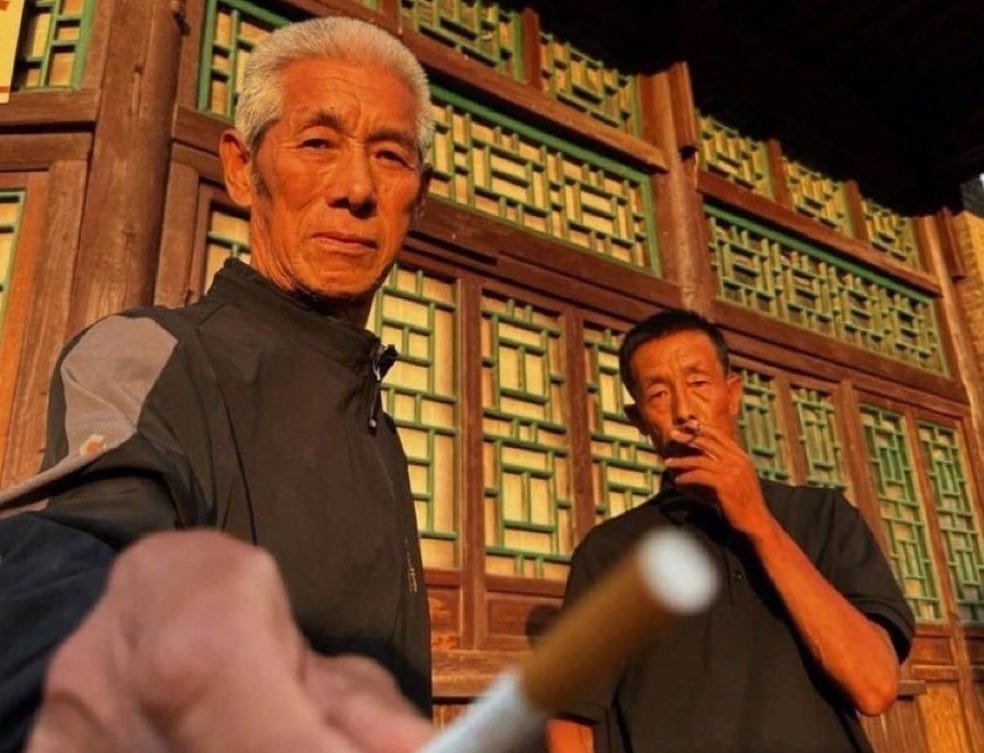
PHASE ONE: THE SOCIAL GRAPH (~2004-2016) | PRE-TREND
In the early Internet, the early social platforms, people were just hanging out, trying to meet new people, rank friends. Facebook used a social graph: a network based on who you know.
Your feed was chronological, showing what your friends posted in the order they posted it.
The outputs (likes, followers, views) existed, but they were incidental. You were posting stuff you liked, to your friends, and posting was a byproduct of sharing with your friends. MySpace pages were ugly as hell and nobody cared because you were decorating your own space and just wanted to be in the friends list (Note: yes I’m an unc but I didn’t have a MySpace was a bit before me). Facebook you just wanted the girl in the other class to see your weekend flick. YouTube was people filming stupid stuff in their backyards.
The inputs were the point. No real incentives to push the game, just you and your friends. Still gusto since it wasn’t about perfection nor optimization.
Pre-trend. Pre-bond. However you want to think about it chart or financialized comparison but you get the gist.
PHASE TWO: RANKED FEED (~2016-2020) | EARLY HTF TREND
Things changed algorithmically in 2016. Twitter launched its algorithmic timeline in March, Instagram switched from chronological to ranked feeds in June. For the first time, the feed was organized by what the algorithm predicted you'd engage with. And for the first time, you could see what performed.
The first real incentives were added to the game. The very beginning start to HTF uptrend for “Attention as Currency.”
The Algorithm was unsaturated early, and people were still posting and doing much of the same stuff they had been doing in Phase 1 that felt organic, but the reach was improved. Dobrik and Vlog squad, Logan Paul. The dopamine began to flow from being a creator and going viral.
It’s interesting because many look back on 2016 with a sense of Nostalgia. I think this is the case because it was the very start of the trend. The very start to the Attention Uptrend where it’s new, novel, awesome, fun. Not too dissimilar to the “early days” of NFTs or memecoins or online poker or even vibe coding now… whatever latest trend that gets hyperfinancialized in a short time frame. The shift from the niche, “love of the game” Closed Thing to Opening the Game is fun at the beginning. Good Vibes in the new, unexplored.
To b16z’s Megachurch parallel, social media was still a bunch of parishes with different pastors. A new world where settlers set up shop and began colonizing. Influencers beginning to build their Churches, their followings.
And so, this marked the first inning of the solved game. Start of trend, chart starting to move up and to the right. Fun because some people started making money (attention), content was still “good” because we were still so early trend that the majority didn’t see nor notice the incentives at play, stakes still pretty low. Not much trying to sell you anything. No real blow off the top yet.
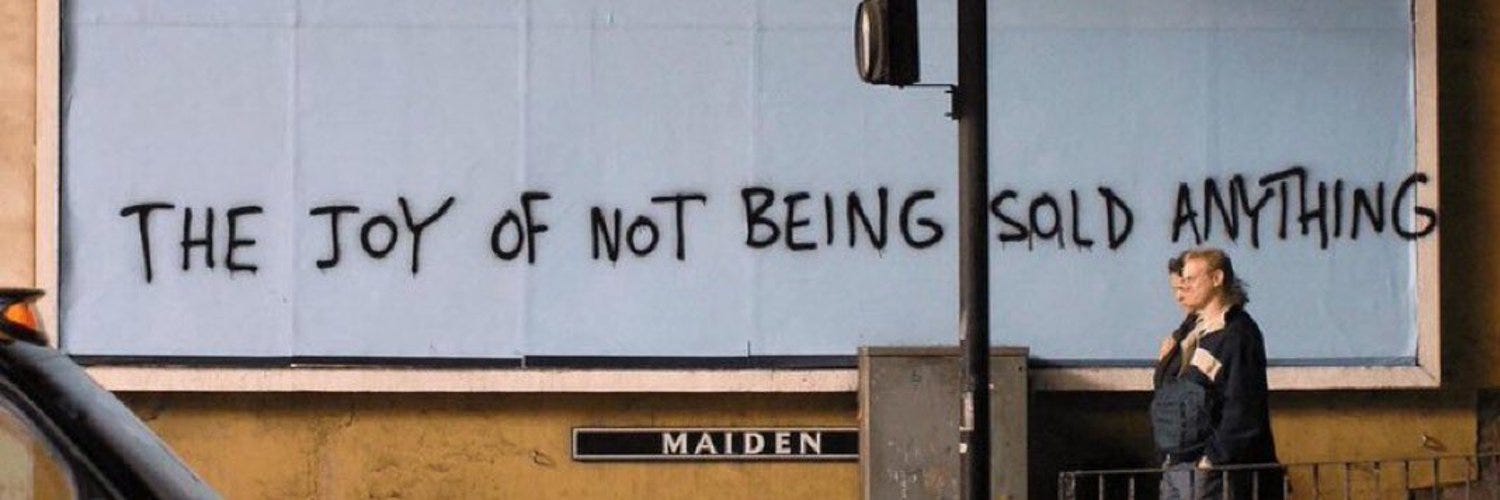
PHASE THREE: INTEREST GRAPH (~2020-PRESENT) | BLOW OFF THE TOP
Then TikTok exploded during COVID with the For You page, and everything changed again. Blow-off the top moment. TikTok’s algorithm didn’t care who you followed, it showed you what you engage with. Content can go viral from accounts with zero followers. Attention became the currency and the only game. More about the trend and the content and less about the individual.
The social graph (who you know) was replaced by the interest graph (what you watch). Pure engagement optimization, and it was so much more addictive that every other platform had to copy it. Instagram launched Reels. Facebook started showing “recommended” posts from strangers. Twitter became “For You” first.
The pastor meant less than the sermon. And many churches began to Coalesce around the same message, beginning to shift into the final form Megachurch.
The interest graph won. The sermon won. The Literalism Supercycle started because it didn’t necessarily matter who you were or even what you said, but if you played into the Algorithm well, you could go viral. Trends… dances… formats… templates. This is when the game was solved, with edge corrosion. Incentives were in full swing because people made A LOT of money from social media, and selling started to happen almost everywhere. Up only chart, blow off the top, everyone is rich, happy, confident, cocky even. “Attention is the new currency.”
The only thing that mattered was what performed. And once everyone can see what performs, everyone largely starts producing the same thing. Different Churches aggregated into one Megachurch, the Almighty Algorithm. Trend life cycles became faster. And faster. And faster.
Now in 2026, the audience feels and senses the “performative.” Doing things for a trend, for an output, with the intention “to go viral.” The congregation feels the “slop” or lack of care. Feels the lack of having something interesting to say, grasping at straws to stay relevant with the Almighty Algorithm (forced attention).
The interest graph trained a generation to be literalists, because literalism (copying trends, focusing only on the output) was all that mattered. No need for gusto because it was sub-optimal and didn’t fit within the parameters of optimization.
PHASE FOUR (~2024-PRESENT) | TOPPED (LOCAL)
Templates. Hooks. Frameworks. UGC to seem “authentic.” Views. Views. Views.
Everyone studying what worked, everyone producing content calibrated to the Almight Algorithm, everyone converging on the Same Thing. UGC “agencies”, growth “agencies”, Output Output Output.
You need to “go Viral” because… well… you need Attention!
The game was solved.
It’s the same thing as all financialized trends we’ve seen over the past. Online poker became solved and ran out of fish to play the game. Sneaker botting and reselling… became solved with better tools. Memecoins, “the trenches”, whatever you want to call it, got solved with people bundling and selling and sniping earlier and earlier with new tools. NFTs became solved with zero fee marketplaces leading a race to zero in what was always an unsustainable model. There were no more buyers… no more “edge”… no more expansion… topped.
This article from X account “Washed” overviews the feeling well in his article “Short Degeneracy.”
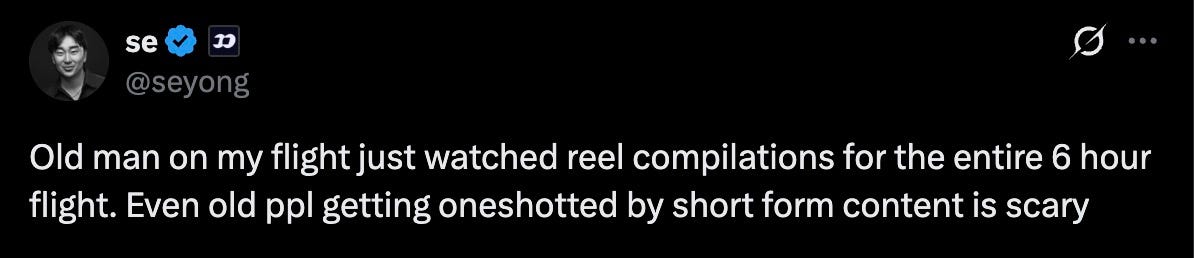
And we’re basically here with “attention” as currency. At least locally topped. Boomers and late adopters of technology are mindlessly scrolling instagram reels. Laughing at AI content slop. There are no more “buyers.” No “new” marginal bidder. No more untapped audiences waiting to be captured by the Optimization playbook.
Every template, every formula, every proven framework, it's all largely been absorbed. Sure the templates maybe change week to week (you’re starting to see these things even change day to day and "marketing” people focus their entire jobs on this alone) and you can squeeze views, but the entire addressable market is already inside the Megachurch, already watching the same feed, focused on generally the one thing that captures all the outsized viral returns for that day.
Exhaustion, Attrition, the “Hangover”
You know how when markets top, at least, locally so, and there’s that Hangover period where you look back and think “man wtf were we thinking with this shit…”. Kind of the pain, well, not pain, but just true Attrition and Fatigue of looking back and realizing, “damn, well, that was unsustainable.” More fatigue and the overall expression of feeling over it.
Think that’s showcasing with “Slop” and “Performative” being the two most trending words of last year.
The people who have grown up on the internet and who largely “matter”, or who set trends know what optimized content looks like. Know when something is Performative because the incentives are basically face-up now.
Everyone knows about payouts for posting on social media.
Everyone knows about UGC creators and “yeah, that’s just an undisclosed ad.”
Everyone knows “oh yeah they’re trying some hook that someone else used.”
Everyone assumes everyone is performing.
Everyone does this line break every other line format to help you read slop format (and that I’m doing right now).
We know creators sell out. We know politicians sell out. We know people are bought and paid for. We know that post you see with the subtly included product is probably an undisclosed ad. We know those accounts posting “UGC” content are largely mercenaries willing to “sell” basically anything for $, all in the name of looking “authentic” or “organic.” We've all internalized the templates. We've all seen the hooks.
When something goes viral or breaks out of a chamber, the first instinct is no longer "wow, this is cool", it's "hmm is this real?" The assumption is things are performative, slop, because the incentives have been revealed and made face up.
And the performance isn't believable because we’ve grown to be cynical, and assume everything is a performance in the name of the incentives of the game.
Exhaustion point. No more “real” buyers or expansion via “growth” or hacking the algo (diminishing marginal returns to optimization), diminishing value and fleeting time in the limelight for a “viral moment” before the next trend lands. The hamster wheel has reached feverish pace that it’s impossible to keep up with the Jones’s, and that’s why there’s the exhaustion in the social media arena.
Topped. At least, locally so, on “attention as currency.”
And the pendulum begins the swing from Collectivism to Individualism. From Literalism back to Gusto.
There's a concept from an English essayist William Hazlitt, writing about painting in the 1820s, that largely explains why the Creator Economy feels hollow, why online interactions feel Empty, why “Authentic” still feels Performed. Hazlitt was comparing two painters named Claude Lorrain and Titian.
Claude Lorrain produced technically flawless landscapes… perfect perspective, accurate color, every rule followed… but the paintings felt completely dead.
“Claude saw the atmosphere,” Hazlitt wrote, “but he did not feel it.”
Contrast this with Titian, whose colors were technically wrong by academy standards but whose art was “sensitive and alive all over.” Titian captured what experience actually feels like. And Hazlitt called Titian’s quality Gusto.
In this way, “Gusto” is effectively loving the inputs and the process more than the outputs. Creating a feeling.
And some of you might read that and be like “yeah that’s a you gotta love the journey ahhhh take”, and you’re probably right.
But Titian was painting because he was obsessed with the canvas, with light, with the way color could make something feel alive. The output, the painting that hangs in a museum, the reputation, the status, was all largely incidental. The input was the thing. He loved the doing more than the having done.
Love of the Game.
Claude Lorrain was the opposite. He was technically perfect, optimized for the standards of the Academy, producing paintings that looked like what successful paintings were supposed to look like. Output-oriented. The inputs… the actual craft, the actual seeing, were just means to an end. He “saw the atmosphere but did not feel it” because feeling it wasn’t the point. The point was the output.
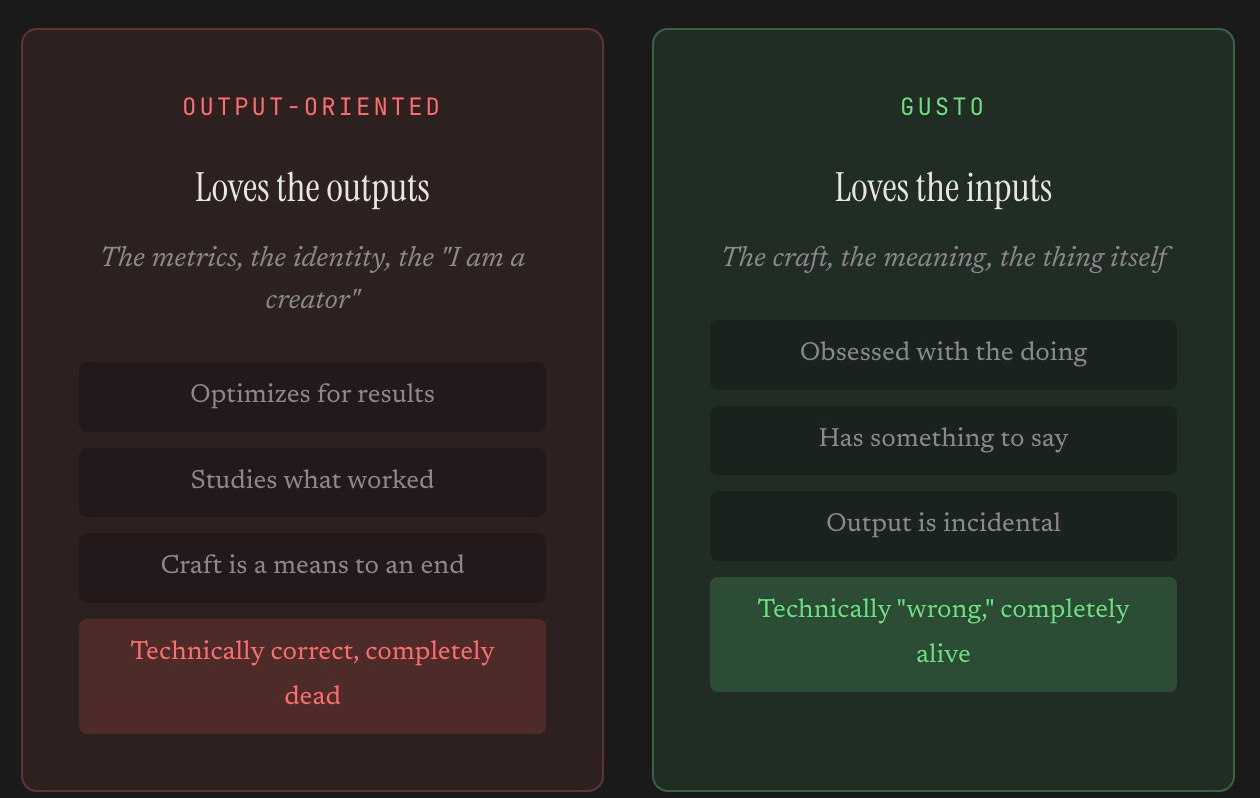
Fast forward 200 years, and we have a Creator Economy, a “Builder” Economy that is an Output Optimization Engine. People study what goes viral and try to replicate it… because, well, they need to go viral! The output is everything.
Many want to be creators. Few have something interesting to say. Many want to build. Few are passionate about the thing they’re building. Many want the outputs. Few love the inputs.
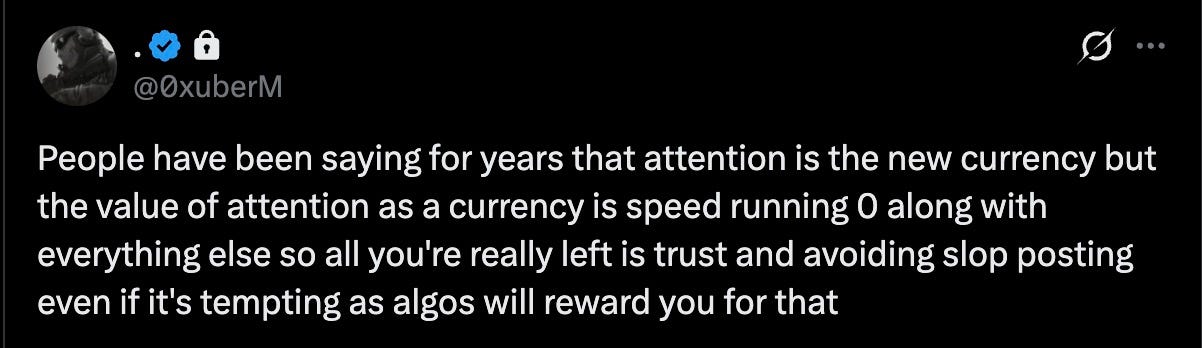
The literalist trend is exhausted because we’ve created a sociological belief that the output is all that matters. That it’s the attention, the views, the downloads, the ARR, whatever that matters. But the paradigm shift comes soon when AI can commoditize outputs. Attention as currency gets inflated and devalued.
Gusto can’t be optimized. It can’t be templated. It can’t be faked… or rather, when you fake it, people can tell. That’s why “Performative” became the insult of the year. People are pattern-matching on the absence of Gusto… they can sense when someone is going through the motions, when the inputs are just means to the output, when there’s no actual love for the thing.
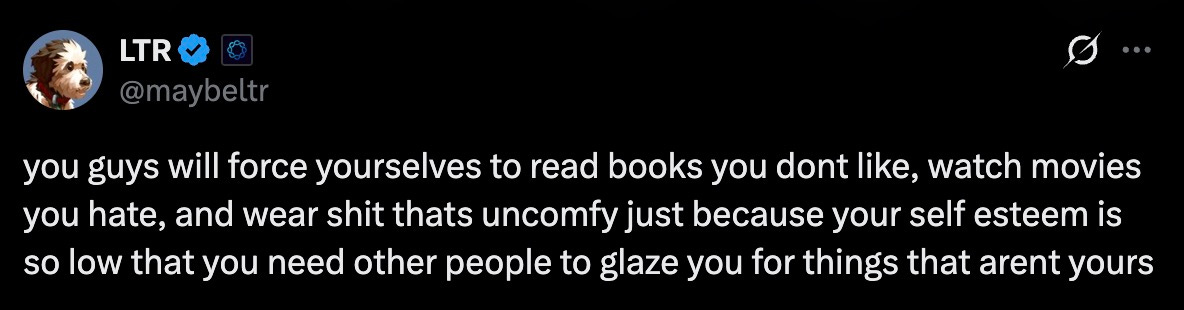
And in a world where every output has been templated, where AI can produce infinite optimized content, where everyone is running the same playbook, gusto is the only moat.
The only thing that makes someone stop scrolling and think: this person actually gives a shit.
The logical antidote to “Slop” and “Performative” is “Authenticity.” Kind of mid-curve though and I’m definitely Guilty of thinking this. The Performance of Not Performing, or “being Authentic,” is still a performance…
And many people are using it almost to optimize reach. I mean, UGC as a trend really started because it felt more “Authentic.” Now, it’s been kind of bastardized and templated to the point where it’s a clear Performance to Sell Something.
Worse… when we say “Just be Authentic!”, that doesn’t really mean anything. As in, there's not really an Authentic Self to be Authentic to. The idea is innately flawed.
The word "person" comes from persona… Latin for “mask.” Every version of yourself you've ever presented is at least a little bit of a Performance. Performative. Different Arcs you go on in life, different things you want to Showcase to people, different things you want to Hide from others, different things you want to Convey.
This sounds like Nihilism but it’s meant to be Liberating. If there’s no Real Authentic Self, then you’re not failing to be real. There’s no real to fail at. The question was never “performative vs. authentic.” Everything is somewhat performative.
The question is whether you love the performance for what it lets you do, or whether you’re just chasing what it gets you. Is the mask a vehicle for Becoming, or just a tool for Attention?
Inputs vs. outputs. That’s the only distinction that matters. Gusto vs. literalism. Imperfect Performance for the Self vs Optimized Performance for Others.
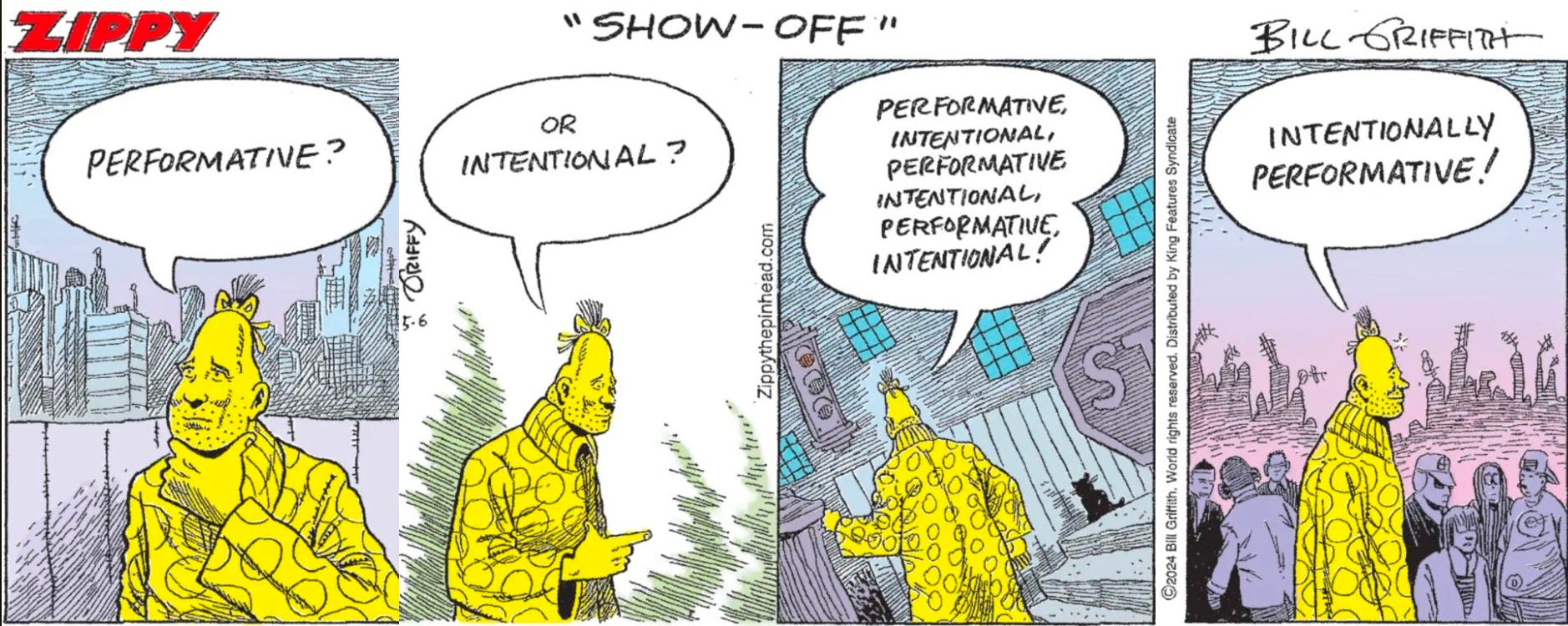
Like most things in society today, we over-index the gravity of “Just How Bad” things are because we refuse to look to History for parallels. The reality is the Performative has always existed, and it’s not some New Phenomenon. In fact, they’ve usually been more prominent during transitions from Collectivist, Literalist regimes into Individualist, Gusto-driven cultural shifts.
The Romanticism, for example. Lord Byron was absolutely Performative. The brooding Romantic poet, the club foot, the vinegar and potatoes diet, the affairs, the exile, the death in Greece fighting for independence, he was curating an Image, constructing a Mythology, performing a Self. And he knew it.
But in this Performative mask, he also wrote poetry that mattered, actually went to Greece, actually believed in the Causes he attached himself to. The Performance was Real because the Inputs were Real.
Oscar Wilde was Performative. The wit, the epigrams, the aesthetic pose, the green carnation, the fur coats… all performance. All constructed. He said it himself (the quote at the onset of this paper): "Give him a mask, and he will tell you the truth."
The mask was how he Became the real Wilde. The performance was the vehicle for the thing he actually cared about: the writing, the ideas, the art of being alive.
The Romantics were Performative. The Renaissance artists were Performative. The Medicis were bankers but Performed as art patrons. Warhol was Performative. Bowie was Performative. Every interesting cultural figure constructs a Persona, plays a Role, performs a Self.
And these shifts of Performative usually happen when the scale tips too far to the Literalist regime, too far Collective where collective Exhaustion begins to push pendulum back the other way… towards individualism and gusto.
So, the “Performative” isn’t really the problem. Performance is just the medium. The question is what kind of performance.
Literalist performance: wearing a mask for what it gets you. The outputs are the point… The “mask” is a tool for attention, status, metrics. When the mask stops performing, you drop it and find a new one. There’s no love for the mask itself. No transformation. Just optimization and selling something.
Gusto-enabled performance: wearing a mask for what it lets you do. The inputs are the point. The mask is a vehicle for the thing you actually care about… the craft, the ideas, the creation. You commit to the mask because the mask is how you Become. The performance transforms you.
Byron’s persona let him write poetry and live out Romantic ideals. Wilde’s persona let him surface truths through wit. Bowie’s personas let him explore identity and push music forward. None of these people were from 2025.
In 1798, a German philosopher named Friedrich Schlegel largely figured all this out.
Schlegel was part of the early Romantic movement, grappling with a question that haunted post-Enlightenment thinkers: if we're self-aware, if we know all our beliefs and poses are constructed, how can we believe in anything? How can we commit to anything? Ironic detachment sees through everything but creates nothing. Naive sincerity commits to things but gets demolished by awareness. Both positions are traps.
First, off… this thought is pretty resonant of modern-day society and nihilism at large. How can we believe in anything? How can we commit to anything? Naive sincerity (this whole idea that the Optimist is naive and delusional vs. the Cynic is wise and smart)…
These are questions that we think a lot about today and are driving forces culturally. But again, were grappled with over 220 years ago. Anyways, aside over…
Schlegel's answer was the Transcendental Buffoon.
The term comes from the Buffo, the “Clown” in Italian commedia dell’arte. The Buffo wears a mask, commits completely to the role, plays it with total conviction. But throughout the performance, he winks at the audience, breaking the fourth wall and signaling that he knows it’s a performance. He’s not trapped by the mask because he knows it’s a mask. But he’s not detached from it either…
He’s fully committed, fully present, fully alive inside the role.
The "transcendental" part is worth highlighting too. The knowing… the awareness that it's a performance, is precisely what sets you free to commit fully. You hover above your own performance while simultaneously being completely inside it. Self-creation as its own art form.
Three moves at once:
1. Aware it’s a mask (the Wink)
2. Commits fully anyway (the Conviction)
3. Uses the mask to Become (the Transformation)
The Transcendental Buffoon loves the Inputs. The Role. The commitment to the Craft, to the doing, to the Thing itself.
The Wink is knowing that the outputs (status, metrics, identity) are games. You can play the games, but you don't confuse them with the point… The Point is what the mask lets you Do and Become.
Timothee Chalamet has been basically on a god run in 2025, and I think he’s the epitome of the Transcendental Buffoon. The SAG Awards speech was the wink:
"I know the classiest thing would be to downplay the effort that went into this role, but the truth is, this was five and a half years of my life… I'm really in pursuit of greatness. I know people don't usually talk like that."
- Timothee Chalamet
He's aware of the performance with that last line. And the "I want to be one of the greats”… that’s the heart & commitment. He's not hiding the ambition behind false modesty. He's not claiming authenticity. He's showing you both layers at once: yes I'm performing, and yes I mean it. The performance is how I become the thing I'm performing.
And it shows through his works and his popularity right now. He has Gusto.
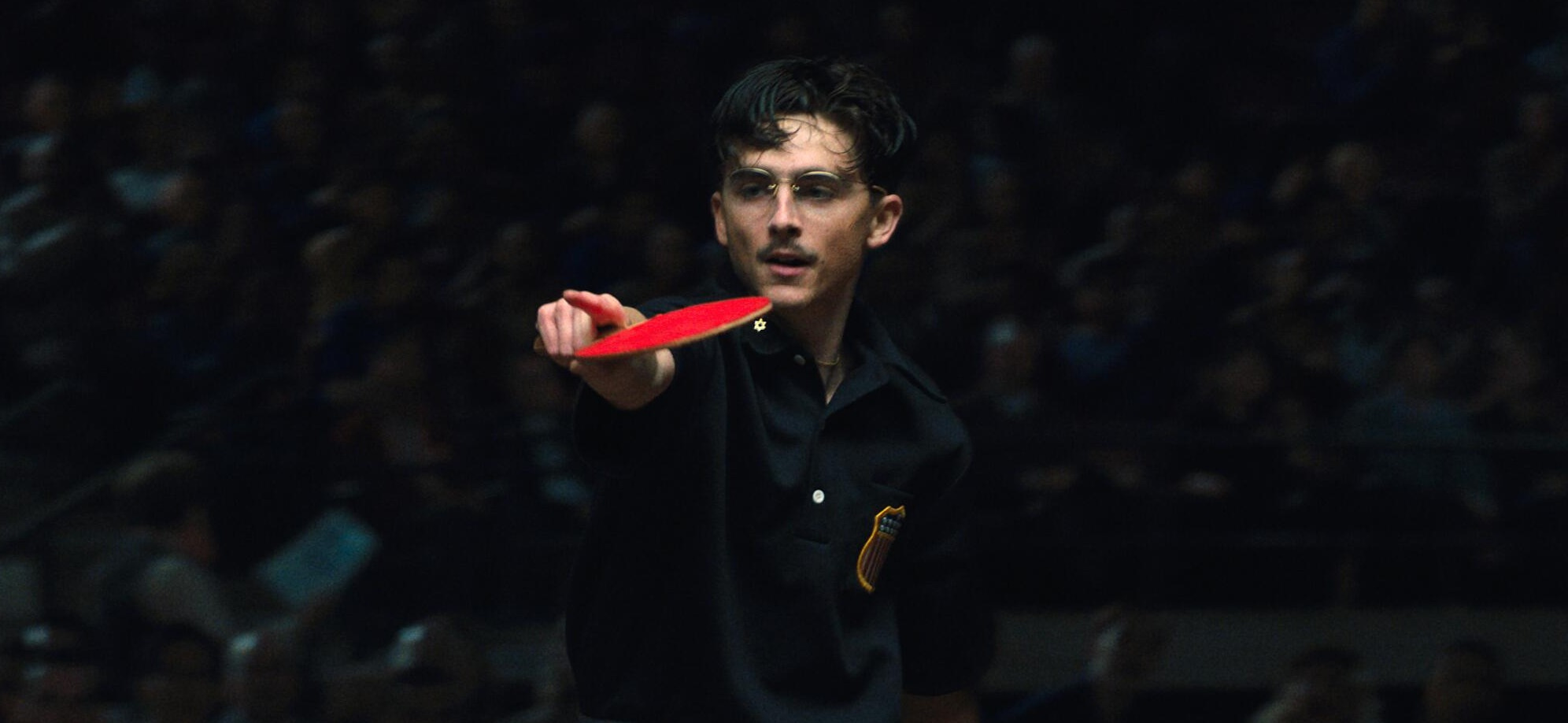
A Gusto Guy.
The death of literalism. The rise of the Transcendental Buffoon.
Attention and Optimization games are largely solved. The rise of “Slop” and “Performative” are Exhaustion Signals that this wave is ending, and the “Value” behind marginal Virality is next to zero.
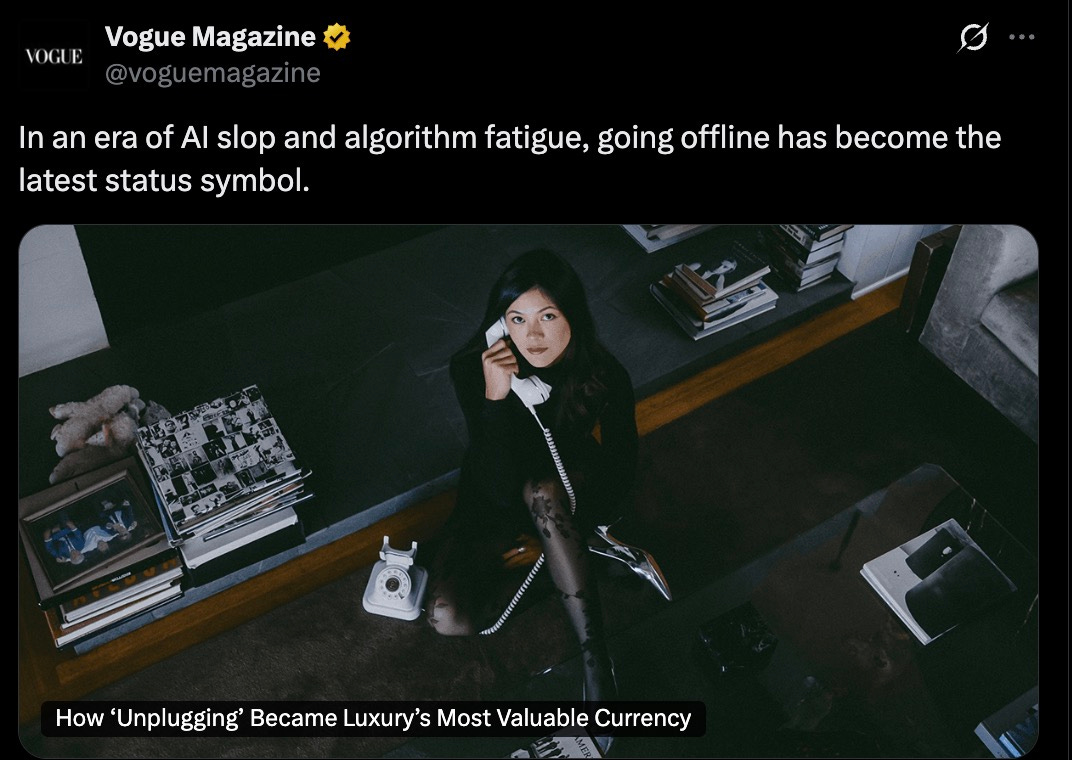
We’re in a bit of a Hangover period where people desire something new, a break from the fatigue of endless content, optimization, hacks, etc. This desire for a reset to Analog. Tradition. Some members of the Congregation are growing tired of the Megachurch. Social media collectivism/literalism top.
I had this take a bit ago, last fall, saying we would see the “Death of the Performative.” And I think it’s the right approach, wrong framing. We’re seeing the death of Literalism, not Performativism (not a word?).
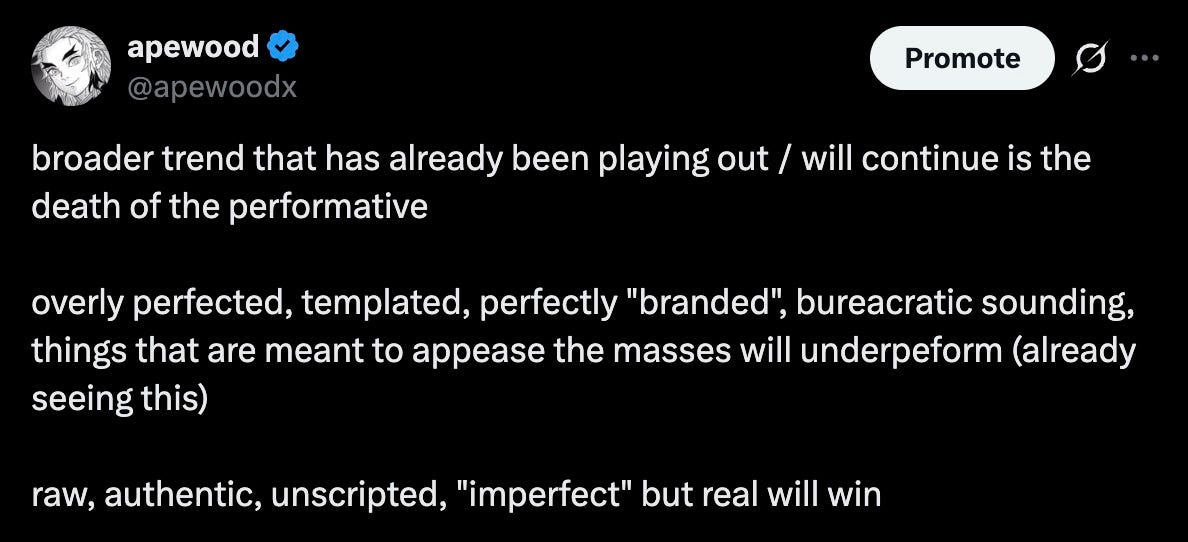
People desire this shift back to “Authenticity”, but that misses the point. There is no real “Authentic” as humans. It’s something we say to feel good and to feel “ourselves.” But even “Authentic” is a Performance.
The real shift is back to Gusto. The Transcendental Buffoon who knows it’s a performance, but commits to it because they love the game. Has something compelling to say and says it. Has something they want to do, and commits to it.
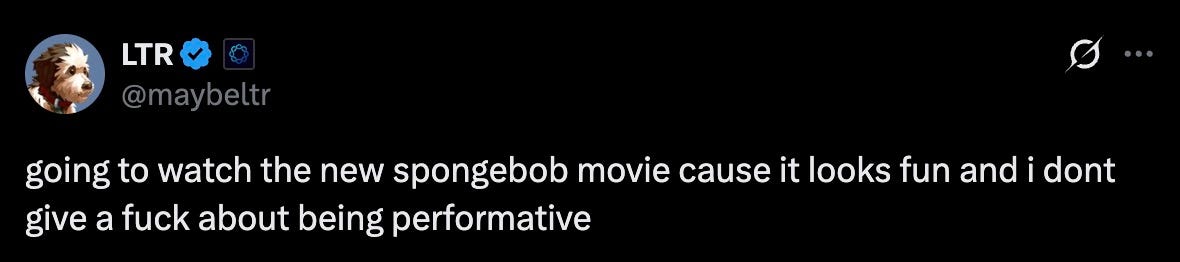
Also, I don’t think Attention nor Virality are ever going to Perma Top. It’s kind of like the hyper-gambling thesis, is somewhat structurally up only, but impact-wise the volatility decreases over time.
The idea that is that it’s kind of just reached a critcal mass plateau for now and the game is extremely Fatigued. Not too dissimilar from how Gambling hit escape velocity and now many are looking for other things. It’s just the Easy Game is over, and that’s the “Game” most people are still trying to play online (insert Japanese soldier still fighting meme).
And yes, I’m aware this whole essay itself can be labelled Performative. Some guy behind a Rengoku pfp with a Substack title “heart & commitment” writing >4,000 words about Performativity. The irony. But I had something I wanted to say… so I was going to write it… whether anyone reads it or not doesn’t really matter. That’s the whole point.
Gusto. The guys with heart & commitment.
