Some dude on the internet who calls themself a designer vibe-coded a “tool” that lets you export visuals from small algorithmic generators. Although the website doesn’t mention it was created using AI, the whole UI reeks of it. The cream colored background, the bland font, the presence of features no one really needs, and the absence of any distinct design choices give it away easily. But the UI isn’t the only thing drowned in ‘vibes’; I don’t think the author wrote a single line of code for any of the algorithmic generators on offer. What most likely happened is that the person behind the site copy-pasted images of other artists and designers into a chatbot, using a prompt to turn them into generative tools.
One of my sketches was probably among those images. I found out because someone made a reel about this tool, and I immediately recognized one of the outputs as derived from my work. By now, this reel has gotten over 200k views, and despite my comment pointing out that the tool copies other artists’ work, the video is still up. The comments show a lot of enthusiasm from people who want to use the site.1


I made a quick reaction video, and the responses I got actually made me quite happy and optimistic. Very quickly, several people identified the person behind the tool; someone else identified another generator as a copy, and one person even found the tool’s GitHub repository. For the majority, the repository contains commits made by Claude. On the file that is based on my work, the last commit message reads “Sampler: a new default palette”, timestamped several hours after I published my video, which is interesting, because the palette was one of the distinct features that made me recognize the image as a rip-off immediately and without doubt. None of the other generators got an update on their default palette that day. Which leads me to speculate that the person behind the tool saw the Tweet a friend of mine made calling them out on their slop2, and instead of doing anything else, decided to ask Claude to update the generator’s default palette. In the inline comments, Claude even alludes to a reference that was provided to make the generator.
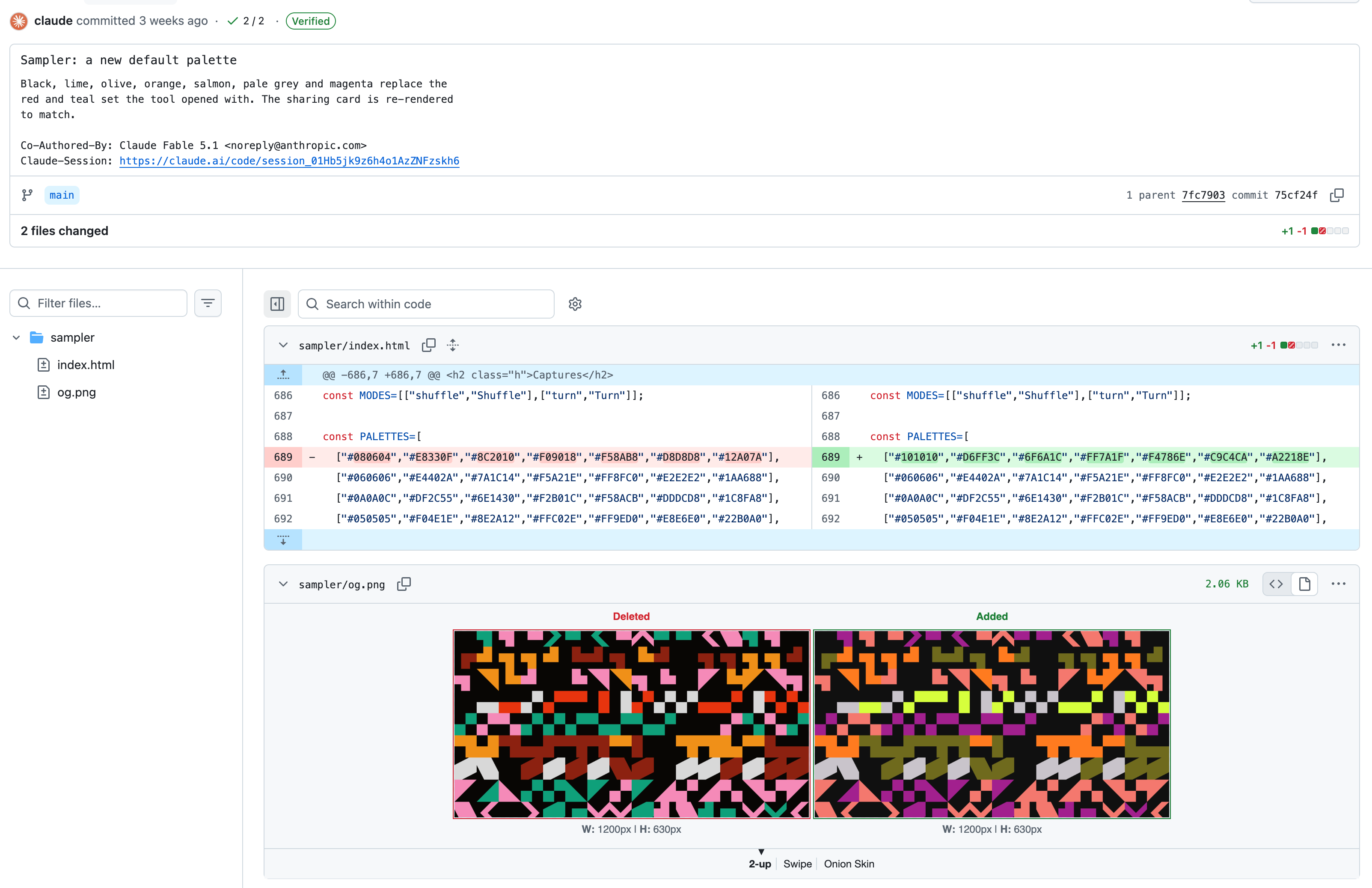
Now, I intend to come across as snarky (and hopefully a bit witty), but don’t mistake that for me having any crystal-clear idea of what happened. Right now, my thoughts run in two directions. How do I relate to creating with the assistance of AI? And how do I think of copying the work of other creators in general? I’ll explore the latter further because I don’t feel like talking about AI today.
I don’t mind people copying my work3, but there is a way to do it well. I know that nothing I have ever made is a true original; I take, borrow, steal, and copy parts from other places and reassemble them all the time. Any decent person who makes things will quickly admit that. And I’m sure anyone who makes things has, at times, felt that uneasy doubt, wondering whether what they made was still too close to the reference material. Or maybe you’ve experienced being on the other end of it. Seeing something someone made and wondering whether it’s not awfully similar to something you’ve made before. It’s two sides of the same coin, questioning: was this theft or inspiration?
I don’t think there is a clear line between when you are stealing someone else’s idea or work and when you have been inspired by something. I think it’s more like a decision tree that you have to meander through, questioning with every step whether you are still on the right path. These are the things that I often consider along the way.
Am I using a known method or copying a work? Techniques belong to no one. To use generative art as an example, no one owns flow fields or placing tiles on a grid. If you reverse engineer how I built up my sketches for your own ends, it will make me happy that my work inspired you to go and learn something for yourself. Copying a work is something else. It’s the particular combinations of choices that make an image readable as coming from a specific person: the proportions, rhythm, palette, etc. If you can recognize the source in a second while scrolling, you probably didn’t only copy a technique.
But sometimes it can also be fine if your work still looks very close to the reference material. Because learning (a craft) involves copying from reference material and doing the same thing over and over again until you get it right or get a feel for it. If you are just starting out with generative art, go copy Mondriaan to learn about subdivision. It’s a great exercise.
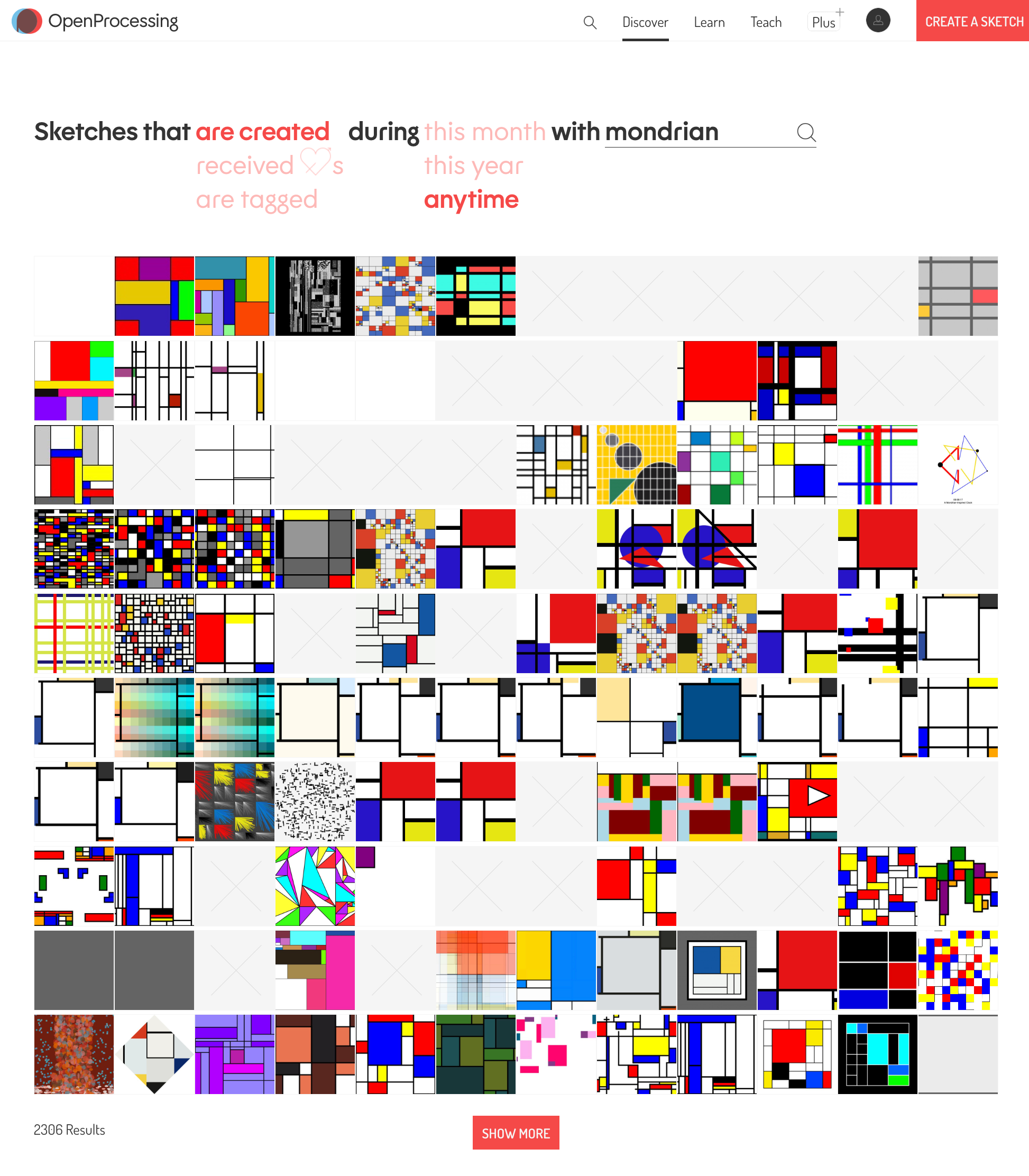
This example also ties into the question: who are you copying from? A student redoing a work from a famous artist takes nothing away from the original work, and no one will think it was anything more than a study. However, evaluate the power dynamics at play when you look at your mood board. A big brand or account copying the work from a small creator for their products or marketing is problematic. Because perhaps the first question you should actually ask yourself is: How am I benefiting from copying this work? Or is hiring the original creator for a commission also an option?
And how are other people benefiting from what you are making? Is the original creator benefiting? A small attribution when you share a sketch goes a long way. But furthermore, did you add something new? Or is what you made only a derivative of the source material? Which, again, is fine when you are practicing; most of the work we make will not expand the cultural material available in any big strides, nor should we have those expectations of our work. Sometimes even a small step outside of the available bounds is worthwhile; try to make that step.
![Design 3-1. Data 4, 5, 6, 6, 6 [Design 1-4. Data 1, 2, 3, 3, 3] | ZKM](https://substackcdn.com/image/fetch/$s_!FNIs!,f_auto,q_auto:good,fl_progressive:steep/https%3A%2F%2Fsubstack-post-media.s3.amazonaws.com%2Fpublic%2Fimages%2F6ccb2e31-621b-48c5-b591-b3bbbd049bd7_1024x1505.jpeg "Design 3-1. Data 4, 5, 6, 6, 6 [Design 1-4. Data 1, 2, 3, 3, 3] | ZKM")
What made me sad and angry about the tool that copied my work is not that it happened to my work. I don’t relate to my work as something that belongs to me and can be stolen or taken away. What got me is that a human didn’t care. They weren’t interested enough to look at an image and wonder for a second why they were drawn to it, what about it was interesting, and how that might find a way into something of their own. They looked at it only as content to consume to benefit their own agenda. No inspiration transpired, nothing was learned, nothing worthwhile or interesting was added.
Please take my work and figuratively or literally cut it up and paste it back together; make it smaller, bigger, weirder; make it out of plastic, metal, or fungi, I don’t care. But consider the questions I posed above; add your own considerations; and transform it with your creativity and curiosity; make the work your own, and share it with the world again.