
American medicine very rarely produces the following type: a credentialed insider — tenured, published, taken seriously by the institutions that matter — who decides to say out loud what his colleagues whisper privately. That the evidence base undergirding much of modern oncology and drug approval is far weaker than the public has been led to believe. That pharmaceutical companies have learned to game endpoints, manufacture excitement around surrogate markers, and convert that excitement into accelerated approvals before the harder question — does this actually help patients? — is ever adequately answered. The academy’s incentive structure is almost perfectly designed to prevent this person from existing. Funding, promotion, guideline committee seats, speaking invitations — all of it flows more reliably to those who work within the consensus than to those who challenge it.
Vinay Prasad is that rare exception. His arrival at the FDA’s Center for Biologics Evaluation and Research (CBER) in 2025 represented something genuinely unusual: a committed critic of the system being handed a position inside it. What happened next tells you everything about the difference between critiquing a machine and trying to fix one.
The Early Academic Insurgency
Prasad built his reputation not through the conventional academic path of grant acquisition and guideline committee membership, but through a sustained and often withering critique of how cancer drugs get approved and how clinical trials are designed. Based at UCSF, he published prolifically — not just in journals but in op-eds, Substacks, and eventually a podcast — arguing that oncology in particular had developed a troubling tolerance for evidence that was technically publishable but practically meaningless.
His core argument, laid out across dozens of papers and summarized in his book Malignant: How Bad Policy and Bad Evidence Harm People with Cancer, was straightforward: the FDA had become too permissive with surrogate endpoints. Drug companies had learned that if they could demonstrate a tumor shrank, or that a biomarker moved in the right direction, they could obtain accelerated approval — even if no one had demonstrated patients actually lived longer or felt better. The incentive structure rewarded the appearance of efficacy over its reality.
This critique was not universally welcomed. It earned him genuine respect from a cohort of evidence-minded academics who had long felt the same unease but lacked his willingness to say it in public. It also made him enemies — specifically among the academic trialists who depended on pharmaceutical relationships for funding, and among the companies themselves whose business models rested on the regulatory permissiveness he was attacking.
He was, in the parlance, not a team player. Which is another way of saying he was honest about what he saw.
The COVID Inflection Point
If the first phase of Prasad’s prominence was defined by oncology statistics, the second was defined by a far more politically charged domain: the COVID pandemic.
Beginning in 2020, as the academic and public health establishment coalesced around a set of positions — indefinite masking including in children, vaccine mandates, school closures, booster doses with limited supporting data — Prasad became one of the few credentialed voices willing to examine those positions with the same evidentiary skepticism he applied to cancer drugs. His argument was not that the vaccines were bad or that the pandemic wasn’t real. It was that the evidence for many of the specific interventions being mandated and celebrated was far weaker than the confident institutional consensus suggested.
This was not a comfortable position. The political valence of the pandemic had sorted people rapidly and brutally: to question masking mandates or third and fourth booster doses was, in the eyes of many academic colleagues and essentially all of legacy media, to side with the wrong tribe. Prasad’s critics began conflating his evidentiary skepticism with political sympathy for views he didn’t hold. His defenders — a growing audience of physicians, researchers, and intellectually honest laypeople who had found the institutional messaging increasingly difficult to square with the data — made him something closer to a public intellectual than a typical academic.
The audience he built during this period was large, politically heterogeneous, and united primarily by a shared frustration with elite institutions that seemed to have abandoned intellectual honesty in favor of narrative management. He wrote about it, debated about it, and was punished professionally for it in the ways that apostates from institutional consensus typically are.
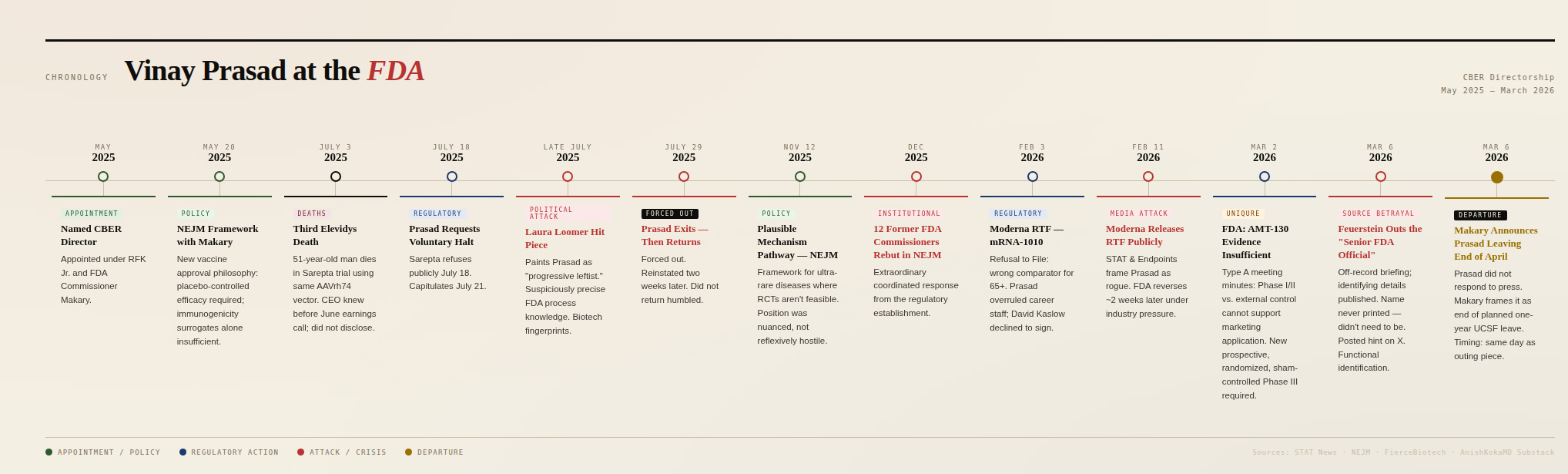
By the time the Trump administration took office in 2025 and began remaking the regulatory apparatus, Prasad had the profile, the credentials, and the track record that made him an obvious candidate for a senior FDA role. He was appointed to head CBER — the division overseeing vaccines and biologics — and took up the position in May 2025 with what appeared to be a genuine mandate to do what he had spent his career arguing for: raise the evidentiary bar.
Prasad’s regulatory philosophy, as he laid it out across multiple NEJM op-eds and public writings in the period surrounding his appointment, was not nihilistic about the FDA’s mission. He was not interested in deregulation as an end in itself. His argument was more precise: that the FDA had developed different and inconsistent standards for different domains, and that both the too-permissive and too-restrictive ends of that spectrum were harming patients.
His NEJM paper with FDA Commissioner Martin Makary, published May 20, 2025, laid out the new framework explicitly, arguing that the U.S. had adopted the world’s most aggressive “one-size-fits-all” booster program and that the benefit of repeat COVID vaccine doses for healthy, low-risk individuals was uncertain. The new philosophy, they wrote, represented a balance between regulatory flexibility and gold-standard science.
On Vaccines: Hold the Line
For vaccines — particularly the COVID vaccines and their derivatives — Prasad’s position was that the FDA had substantially relaxed standards that existed for good reasons. The traditional requirement for randomized, placebo-controlled efficacy data before licensure had given way, in the COVID era, to a framework where immunogenicity data (antibody titers) could substitute for demonstrated clinical outcomes. His NEJM pieces argued that this was a mistake — that antibody levels are a proxy, not a guarantee, and that the public’s trust in vaccine recommendations depended on those recommendations being backed by robust evidence. Twelve former FDA commissioners disagreed in a December 2025 NEJM rebuttal, arguing his proposed changes posed a threat to evidence-based vaccine policy.
His refusal to file on Moderna’s mRNA-1010 flu vaccine application — which I have written about in detail — was a direct expression of this philosophy. Moderna had designed a Phase 3 trial comparing their vaccine against Fluarix, a standard-dose vaccine that the CDC’s own advisory committee explicitly does not recommend as a first-line option for adults over 65. The FDA had warned Moderna before the trial to use an appropriate comparator. Moderna declined. Prasad’s letter said, in effect: you designed a flawed trial, and a flawed trial does not become acceptable because you spent money on it.
On Rare Diseases: Calibrate, Don’t Capitulate
On the other side of the ledger, Prasad was not in favor of imposing randomized controlled trial requirements in every conceivable situation. In November 2025, he and Makary published a second NEJM piece introducing the “Plausible Mechanism Pathway” — a framework for approving bespoke therapies for ultra-rare diseases where traditional RCTs are simply not feasible. The framework acknowledged the legitimate difficulty of running placebo-controlled trials in rare diseases with small patient populations, devastating prognoses, and no existing treatment options. Where a specific genetic abnormality is identified, a biologically coherent mechanism exists, and consecutive patients demonstrate meaningful clinical improvement — Prasad and Makary argued approval could proceed without a full Phase 3 program.
What he was not willing to accept was the use of rarity and desperation as a reason to approve products that didn’t work by any reasonably objective standard. The argument that “patients have no other options” — deployed relentlessly by rare disease advocates and company CEOs alike — did not, in Prasad’s view, convert a failed trial into evidence of efficacy. It was an emotional appeal, not a scientific one. And he believed the FDA’s credibility, and ultimately patients’ welfare, depended on holding that line.
What Prasad encountered when he attempted to apply this philosophy at the FDA was a well-developed, highly resourced, and largely unconscious playbook that rare disease biotechnology companies had refined over the previous decade.
The playbook works as follows.
A small company — often publicly traded, often with a single product in development, often with a market capitalization that exists almost entirely as a function of the probability the FDA will approve that product — runs an early-phase trial. The trial generates data showing that some biological marker improved. The company issues a press release. The press release uses language calibrated to generate excitement in the rare disease community: “unprecedented,” “transformative,” “paradigm-shifting.” Patient advocacy organizations, many of which receive funding from the company either directly or through affiliated foundations, amplify the message. Families who have been told their child or spouse has no treatment options read these press releases and feel, for the first time, something resembling hope.
Then the Phase 3 trial runs.
It fails, or produces ambiguous results, or demonstrates improvement in a surrogate endpoint that the FDA has determined is not validated as a predictor of clinical benefit. The FDA, as it is designed to do, asks for more evidence.
At this point the playbook enters its second phase. The CEO — almost always with a background in finance or business development rather than medicine — gives interviews to STAT News, Endpoints News, and the Wall Street Journal. The narrative is constructed: a rogue regulator is standing between desperate patients and a potentially life-saving therapy. The FDA’s scientific concerns are not described as scientific concerns. They are described as bureaucratic obstruction, ideological rigidity, or the arbitrary preferences of a single official who has, suspiciously, not been named.
The rare disease patient community, understandably and heartbreakingly, mobilizes. Parents post on social media. Letters go to Congress. The FDA official, whoever they are, becomes the villain in a story where the company is the hero.
Prasad ran into this machine three times in rapid succession.
Sarepta and Duchenne Muscular Dystrophy
To understand what Prasad walked into at CBER, you have to understand what his predecessor Peter Marks had already done there — and what Marks’s predecessor Janet Woodcock had done before him. The Sarepta story is not one bad decision. It is a decade-long institutional pattern of FDA leadership overruling its own scientific staff to approve drugs that didn’t work, under pressure from patient advocates that the companies themselves helped organize and fund.
It starts with Exondys 51 (eteplirsen), approved September 19, 2016. Sarepta applied for accelerated approval based on the claim that the drug increased dystrophin expression in boys with a specific Duchenne variant. The FDA scientific advisory committee reviewed the data and found it inadequate — voting 7-3 against full approval and 7-6 against even accelerated approval. Reviewers cited poor quality biopsy data, no adequate controls, no evidence of clinical benefit, and a dystrophin expression assay that was later independently debunked by the FDA’s own analysts. Committee members also noted on the record the “intense and near-incessant pressure from a large public audience” packed with patient advocates, all of whom testified in favor of approval. Janet Woodcock, then Center director, approved the drug anyway. FDA reviewers responded by filing a formal complaint — a virtually unprecedented act — noting this could be “the first time a Center Director has overruled a review team on a question of whether effectiveness has been demonstrated.” FDA Commissioner Robert Califf issued a 126-page report acknowledging the problems but declined to overrule Woodcock, instead mandating a confirmatory dose-finding study using the North Star Ambulatory Assessment as primary endpoint, which he said would settle the question of whether the drug worked.
That study, the MIS51ON trial, was started in 2020 and as of this writing remains active with no results reported — a decade after the drug was approved. But here is the detail that makes the entire exercise even more farcical: MIS51ON has no placebo arm. It compares higher doses of eteplirsen against the already-approved 30mg/kg dose. It cannot, by design, answer whether eteplirsen beats placebo. It cannot confirm clinical benefit. When it eventually concludes, the foundational question Califf said would be settled — does this drug actually work? — will remain exactly as unanswered as the day Woodcock approved it. Exondys and three successor drugs remain on the market, all approved substantially on the basis of dystrophin protein expression levels. Whether any of them meaningfully alter the natural history of Duchenne muscular dystrophy remains, in the precise scientific sense of the word, unknown.
As I documented in detail, this is the context in which Catherine Collins stood up at a 2024 patient conference and confronted a Sarepta representative directly: five drugs on the market under accelerated approval, confirmatory trials years overdue, a $3.2 million-per-injection gene therapy being promoted on the basis of a failed primary endpoint trial. “You don’t think you can do a little more effort, and give us a little bit more information?” she told them. “You’re just... taking money.” The video is worth watching.
Elevidys was rinse and repeat. The Phase 3 EMBARK trial — the definitive test of whether the gene therapy actually improved motor function — failed its primary endpoint. North Star Ambulatory Assessment scores showed no significant improvement over placebo. FDA staff again recommended against approval. Peter Marks, who had taken over CBER from Woodcock, overruled them, granting accelerated approval in June 2023 based on micro-dystrophin expression as a surrogate. He then expanded the approval in June 2024 to include all patients four and older, ambulatory or not — including older, non-ambulatory teenagers who had been explicitly excluded from the original trial that formed the basis for that approval.
Then boys started dying.
The toxicity should not have come as a surprise. The AAVrh74 adenoviral vector used to deliver the therapy was known to be highly immunogenic, triggering immune responses that caused severe liver injury requiring heavy steroids and immunosuppressive agents. Two of the teens who died were older, non-ambulatory patients — precisely the group Marks had added to the label on the thinnest of evidence, and precisely the group excluded from the trial. A third death, a 51-year-old man in a separate Sarepta trial using the same vector, was reported to the FDA on July 3, 2025. CEO Doug Ingram had known about it before the company’s June 16 earnings call. He made no mention of it. When later asked why, Ingram explained the death was “neither material nor central to the topics at hand.”
Prasad, now running CBER, responded on July 18 by requesting that Sarepta voluntarily halt Elevidys shipments and pause trials. Sarepta refused — publicly, in a letter stating it saw “no new safety signal in the approved population” and attributing the deaths to “unique patient conditions.” They eventually capitulated on July 21. But behind the scenes, the machine was already in motion.
Laura Loomer — the MAGA influencer who had previously claimed the scalps of several Trump administration officials for insufficient political loyalty — published a hit piece painting Prasad as a “progressive leftist” sabotaging the “Make America Healthy Again” agenda. She cited his past public admiration for progressive politicians and accused him of obstructing Right to Try. The piece arrived with suspiciously precise timing and suspiciously detailed FDA process knowledge for someone with no obvious reason to be tracking CBER’s drug review calendar. The fingerprints of biotech interests protecting a $3.2 million-per-injection franchise were not difficult to find.
The irony was almost too rich: the same MAGA ecosystem that had spent years insisting mRNA COVID vaccines were dangerous gene-modifying experiments was now furious that a regulator was asking hard questions about an actual gene therapy linked to multiple deaths in young boys. Prasad was forced out in late July 2025. Commissioner Makary reinstated him two weeks later. He did not return humbled.
Moderna’s Broadside
The Moderna episode deserves more than a passing mention because it illustrates the playbook just as clearly as Sarepta — and because the underlying science was just as straightforward, and just as thoroughly ignored by the coverage.
Moderna was seeking approval for mRNA-1010, their mRNA-based annual flu vaccine, targeting adults 50 and older. The foundation of any vaccine trial is choosing a fair comparator. For adults over 65, the CDC’s own ACIP committee preferentially recommends three specific flu vaccines — high-dose Fluzone, Flublok, or Fluad — because studies going back to 2014 showed these vaccines meaningfully outperform standard-dose shots in that age group: a 24% relative risk reduction for high-dose Fluzone and 43% for Flublok. Moderna chose none of them. They compared mRNA-1010 against Fluarix — a standard-dose vaccine ACIP explicitly does not prefer for adults over 65. Fluarix’s own package insert shows its clinical efficacy was demonstrated in adults aged 18–49; in the 50–64 group the confidence intervals are so wide the vaccine may not work at all. For adults over 65, it was never tested against placebo — approval for that age group rested entirely on antibody titers in a 606-person immunogenicity study. So the comparator Moderna chose has no demonstrated clinical efficacy in the very population Moderna was targeting.
The FDA had warned Moderna before the trial to use an ACIP-preferred comparator for the 65+ population — or at minimum, to tell participants that better options existed. Moderna declined. There was also no Special Protocol Assessment, which would have made FDA guidance binding. Moderna chose not to pursue one. So when Prasad’s refusal-to-file letter arrived, it was not a surprise to anyone who had been paying attention. The trial was built around a weak opponent by design.
What was notable about how it happened internally: David Kaslow, the head of the FDA’s vaccine office, reportedly wrote a detailed memo arguing in favor of advancing the application and declined to sign the RTF letter. Prasad put his own name on it instead — a highly unusual step for a Center Director. This is worth noting not because it vindicates Moderna’s position, but because it illustrates something important: Prasad was willing to own his decisions publicly in a way that FDA leadership rarely does. Under the previous regulatory culture, a decision like this would have been laundered through staff review. Prasad signed it himself.
Under mounting pressure from the pharmaceutical industry and parts of the scientific community, the FDA reversed course approximately two weeks later and agreed to review the application with an earned promise from Moderna to run a post approval trial. Whether that reversal was a reasonable accommodation or a capitulation to industry pressure is itself a question worth asking — but it came after the media environment had done its work.
Moderna’s response was to release Prasad’s letter publicly — a calculated act, not a lapse in judgment. The goal was to generate press coverage framing the FDA as chaotic and Prasad as a rogue actor. STAT News and Endpoints News ran the coverage Moderna was hoping for. As I documented at the time, the scientific merits of the comparator selection question were treated as a secondary concern at best — the story became about Prasad, not about whether Moderna had designed an adequate trial.
UniQure and Huntington’s Disease
The most recent episode, and in some ways the most clarifying, involved UniQure, a gene therapy company developing a treatment for Huntington’s disease. UniQure had run a randomized trial years earlier. It failed. Rather than redesigning the therapy or the trial, they constructed an analysis comparing their treated patients to an external control cohort — patients who had never undergone any procedure. The problem with such comparisons is elementary: patients who receive a brain injection believe they have received a brain injection, and report feeling better at rates that have nothing to do with the therapy’s pharmacological effect. As the FDA made clear on a media call, the placebo effect is well-documented in Huntington’s, which is precisely why the FDA has required sham-controlled studies for every Huntington’s drug in the past two decades — including previous UniQure trials.
Let’s be direct about what was actually being proposed here. Approving a $3 million-per-patient gene therapy that requires drilling into the skull and injecting directly into the brain should be based on... checks notes... a propensity score matched historical control arm. If you can’t appreciate the insanity of that sentence, you should probably sit out the debate about science and evidence entirely. That is precisely what the biotech and investor community, which cares so deeply about Huntington’s patients, was prepared to accept as the basis for approval.
And then comes the surrogate endpoint argument — the claim that certain biomarkers justify confidence even without clinical proof. It takes only a few minutes of reading to understand how extraordinarily flimsy that argument is in Huntington’s disease specifically.
Consider what happened to Roche and Genentech’s drug tominersen — a product you almost certainly haven’t heard of, because it failed. It was also considered very promising, because early data showed it reduced a key surrogate biomarker: mutant huntingtin (mHTT) levels in cerebrospinal fluid. The logic seemed airtight. Huntington’s disease is caused by mutant huntingtin protein. Reduce mutant huntingtin, help patients. When the Phase III GENERATION HD1 trial ran, however, lowering mHTT didn’t translate to any clinical benefit. The failure was particularly alarming because the surrogate actually worked — mHTT levels fell as predicted — but patients didn’t improve. In fact, patients receiving the drug at higher doses did meaningfully worse than placebo. The every-eight-week group showed composite function scores significantly worse than the control arm, trends toward worse total functional capacity, and elevated neurofilament light chain (NfL) in CSF — a marker of active neuroaxonal damage — suggesting the drug was injuring neurons rather than protecting them.
So mHTT is off the table as a validated surrogate. The biotech community has since pivoted to NfL. Neurofilament light chain is a marker of neuroaxonal damage and neurodegeneration — it rises when neurons are injured, it correlates with disease severity and progression rate across multiple neurodegenerative diseases including Huntington’s, MS, ALS, and Alzheimer’s. It tracks with known disease milestones. But it has the exact same problem as mHTT: it’s validated against disease activity, not against treatment response leading to clinical outcomes. We know high NfL means more neurodegeneration. We do not have robust proof that drug-induced NfL reduction translates into clinical benefit for the patient sitting across from you.
So of course the rational response, when someone asks you to actually run a randomized trial to verify that your brain injection is helping rather than harming people — and that $3 million is being spent on something real — is to run to the Wall Street Journal and call the regulator a monster.
UniQure’s own randomized data, at one year, showed no difference between treated and untreated patients. Their externally controlled data showed a 60–75% benefit. Both cannot be true. The FDA said so. UniQure’s answer was to go to the press to complain about a rogue regulator.
By early 2026, the daily volume of media coverage portraying the FDA under Prasad’s oversight as chaotic, arbitrary, and hostile to patients had become a significant institutional problem. Someone — the identity remains undisclosed — appears to have decided that the solution was to allow Prasad to speak to reporters off the record, specifically about the UniQure situation, in an effort to get the scientific counternarrative into the coverage.
The theory was that if reporters understood the actual science — why the external control comparison was invalid, why the placebo requirement existed, what UniQure’s own randomized data showed — they might write a more balanced story.
The theory was wrong.
Within twenty-four hours, Adam Feuerstein, writing for STAT News, published a piece about the FDA’s senior official handling the case that included details referencing that official’s prior career as a practicing hematologist-oncologist who missed his clinic, his teaching, his podcast, and speaking freely. Feuerstein did not print Prasad’s name. He didn’t need to. There was one senior FDA official with that background. Feuerstein then posted a link to the story on social media with a hint embedded in the framing: curious readers might find out who the official was.
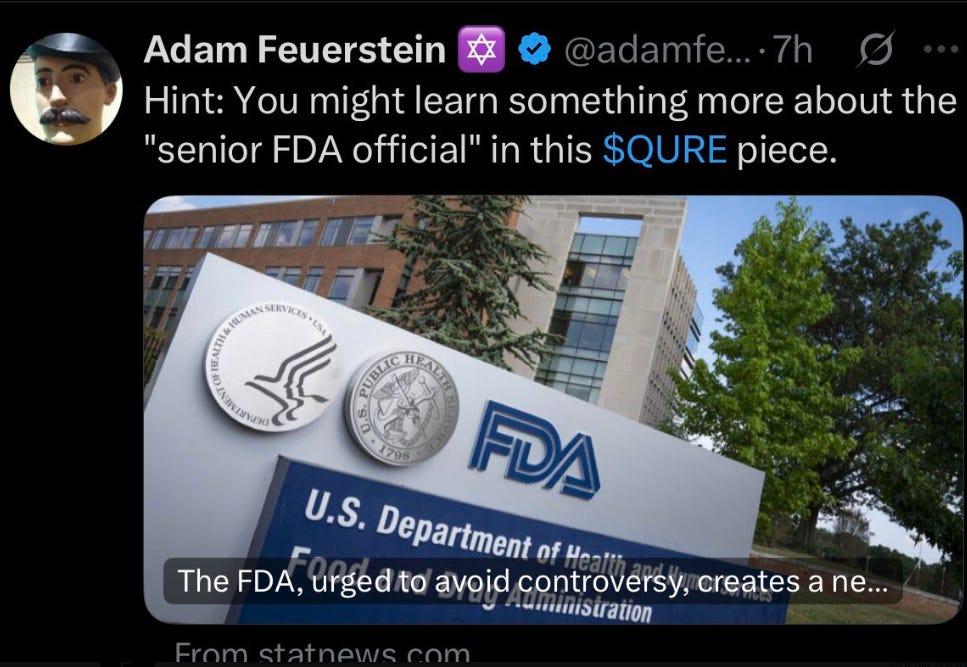
This was not inadvertent. It was a choice. And it was, by any reasonable standard, a serious breach of journalistic ethics.
The foundational obligation when a source speaks on condition of anonymity is not simply “don’t print the name.” It is don’t publish information that makes the person identifiable. The SPJ Code of Ethics, the AP Stylebook, and every major newsroom’s published standards say this clearly. There is a reason for it: the protection exists so that officials can speak candidly without fear that the speaking itself becomes a weapon against them. Journalism ethics boards and courts have long recognized what is sometimes called functional identification — the principle that publishing details that uniquely identify someone constitutes unmasking them regardless of whether the name appears in the text.
Feuerstein can accurately say he never printed Prasad’s name. What he cannot say is that he didn’t know exactly what he was doing. The identifying details were selected and placed to make Prasad recognizable to anyone paying attention — which, in the biotechnology industry and the rare disease advocacy community, meant everyone who mattered.
The ethical path, if Feuerstein believed the source was improperly using an off-record briefing to advance a regulatory position — a defensible concern — was to go back to the source, tell him he intended to identify him, and give him the opportunity to go on record or decline. There is no evidence that happened. What happened instead was that the identifying details ran, the social media hint ran, and the story Prasad was trying to prevent became the story that ran in his place. That is not whistleblowing on an abusive official. That is punishing a source for giving you a framing you dislike.
This matters beyond the individual episode because it reveals something about the media environment Prasad was operating in. A significant fraction of the reporters covering the FDA and pharmaceutical industry have developed, over years of access journalism, a set of relationships and sympathies that align them more closely with the companies they cover than with the regulatory mission they are ostensibly evaluating. Many of them also harbor a deep institutional antipathy toward the Trump administration and view their coverage, at some level, as participation in a larger contest. A principled FDA official holding the line against companies with failed products is not the story they want to write. A chaotic rogue bureaucrat destroying a promising therapy is.
Prasad couldn’t survive the combination. The rare disease advocacy community is not small, and it is not politically passive. The pharmaceutical companies funding the stories are not without influence. And the media infrastructure covering the beat has little institutional incentive to examine the science carefully when the goal is to take scalps of the enemy.
On the same day the Feuerstein piece ran, FDA Commissioner Marty Makary announced that Prasad would be leaving the FDA at the end of April. Prasad did not respond to press requests. Makary framed the departure as the orderly conclusion of a planned one-year leave from his faculty position at UCSF — the kind of thing that was always going to happen, nothing to see here. Whether that is true, or whether it is the version of events a Commissioner tells the press when he needs the story to go away quietly, is a question the timing makes difficult to answer charitably.
He came to Washington trying to do the job a regulator is supposed to do. The machine he ran into had been built, over many years, precisely to prevent that.
Anish Koka is a cardiologist that writes on medicine and health policy. He co-hosts a weekly medical / health policy podcast called The Doctor’s Lounge. Follow him on X : @anish_koka