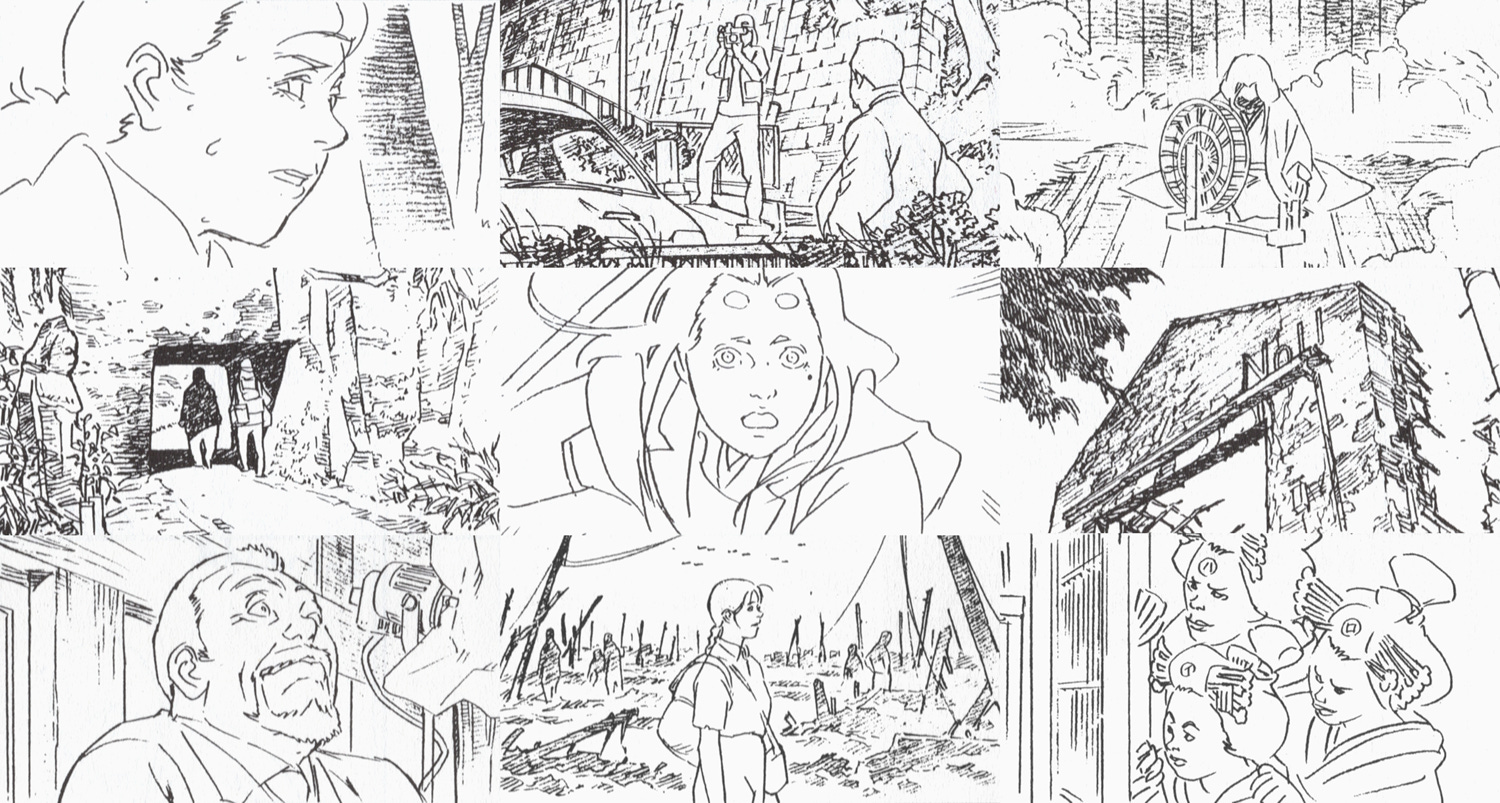
Welcome! Thanks for joining us today. Here’s the slate for this Sunday edition of the Animation Obsessive newsletter:
1) The drawings that made Millennium Actress.
2) An Indonesian movie takes off.
3) The week’s animation newsbits.
Now, let’s go!
Satoshi Kon is known for “editing space and time.” There’s an old Every Frame a Painting video with that exact title, in fact, which has spread awareness of Kon’s style — seen in mind-bending films like Perfect Blue (1997) and Paprika (2006).
Editing is a different process in animation than it is in live-action movies, though. Like Kon once said, “In the case of animation, editing is done first.”1 It happens at the storyboard stage.
Millennium Actress (2001) is one of Kon’s most ambitious experiments in cutting apart and reassembling time, space and story. He took on the task of storyboarding the thing himself — over 400 pages, usually with five drawings per page. The final product sticks close to this first pass.
Which is to say that Kon, in some ways, conjured Millennium Actress out of thin air and put it down on paper.
The concept for Millennium Actress came to Kon through an email, around April 1998. He was in his inbox — and the words “imaginary great actress,” contained in a message from a friend, struck him.
They reminded Kon of a music video, Jun Togawa’s Osozaki Girl (1985). There, Togawa jumps between eras and outfits — playing different movie characters from period dramas up through modern times. Kon was inspired to write this note:
An old woman who was once hailed as a great actress is supposed to be telling her life story, but her memories become confused, and the various roles she played in the past begin to mix together into it, creating a turbulent story.2
At the time, Kon was working with the studio Madhouse and an outside producer named Taro Maki, who wanted to do a project in the same vein as Perfect Blue. Maki compared its style to the painting genre damashi-e — optical illusions, and the construction of an image out of other images.3
That’s where Kon went with this new film. He loved to blur the line between reality and illusion. As he said, Perfect Blue explored that idea’s dark side via “confusion” and “horror.” Millennium Actress would take it from a “positive” angle — showing how a whole truth can emerge from a torrent of fiction.4
With his storyboard, Kon compressed the life of his “imaginary great actress,” Chiyoko, into a dizzying montage that follows the development of Japanese films and their millennium-spanning subject matter. In a way, Chiyoko exists in every era at once.
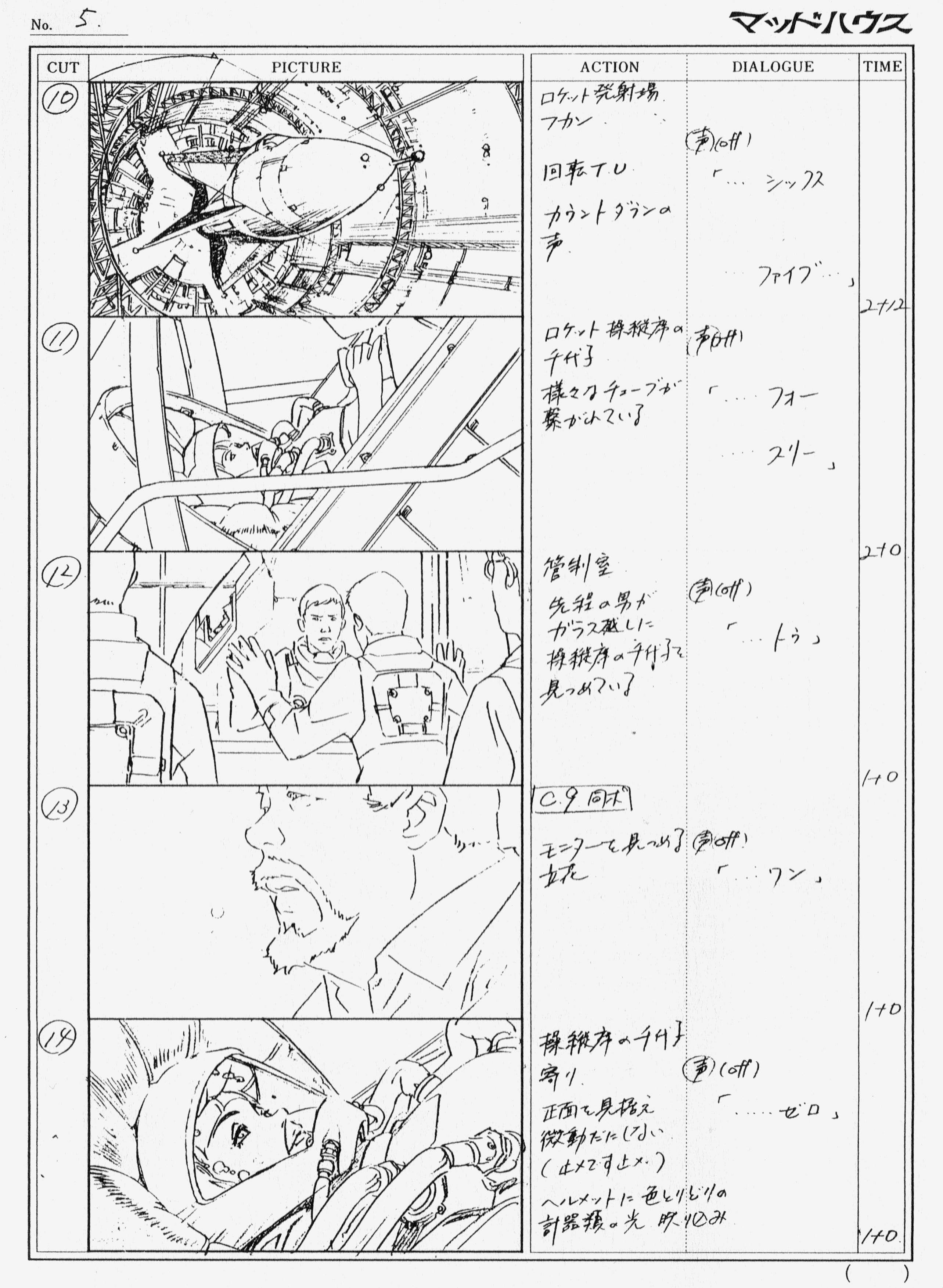
Kon’s editing made this a reality. In his favorite scene from Millennium Actress, Chiyoko rushes by horse, carriage, rickshaw and bicycle through different periods and visual styles across Japanese history. See the final shots beside his storyboards below:
Unlike Hayao Miyazaki, Kon didn’t start this project with storyboards right away. He had a screenplay. Sadayuki Murai (Perfect Blue) wrote the first and second drafts in late 1998 and early 1999. Then Kon revised it — and they batted the Millennium Actress story back and forth.5
Even so, “scheduling constraints” forced Kon to storyboard while the screenplay was still in progress. It was a sign of things to come: boarding Millennium Actress would be a constant battle to keep the project on schedule and on budget.
When he started the storyboards in April 1999, Kon studied the screenplay for “edit points,” marking up the pages as he went. He tried to mirror the flow of the action, and the emotional beats, implied by the words. Kon looked especially for moments of “stimuli” in the script (like character movement or “sudden increases in sound”) likely to grab viewers’ attention. Cutting in the middle of these disguised his edits, he said — they felt more natural.
Based on these “edit points,” he drew simple sketches to iterate on shot ideas, then expanded them into finished storyboard panels. He also cut down and refined the dialogue and pacing. Kon’s style at the time was to get more script than he needed — it loosened him up. Better to reduce an overlong screenplay while drawing, he felt, than to leave important context and flavor out of the words because he’d thought ahead to the images too much.
He divided the storyboards into three large blocks: A, B and C. At first, he planned to finish Part A by the end of April 1999. The other two were meant to follow in May and June. In reality, it took until late June to complete Part A, which represented just 24-and-a-half minutes of an hour-and-a-half film.
“I’m acutely aware of the very critical situation we’re in,” Kon wrote on his blog that August, with the boards around halfway done.
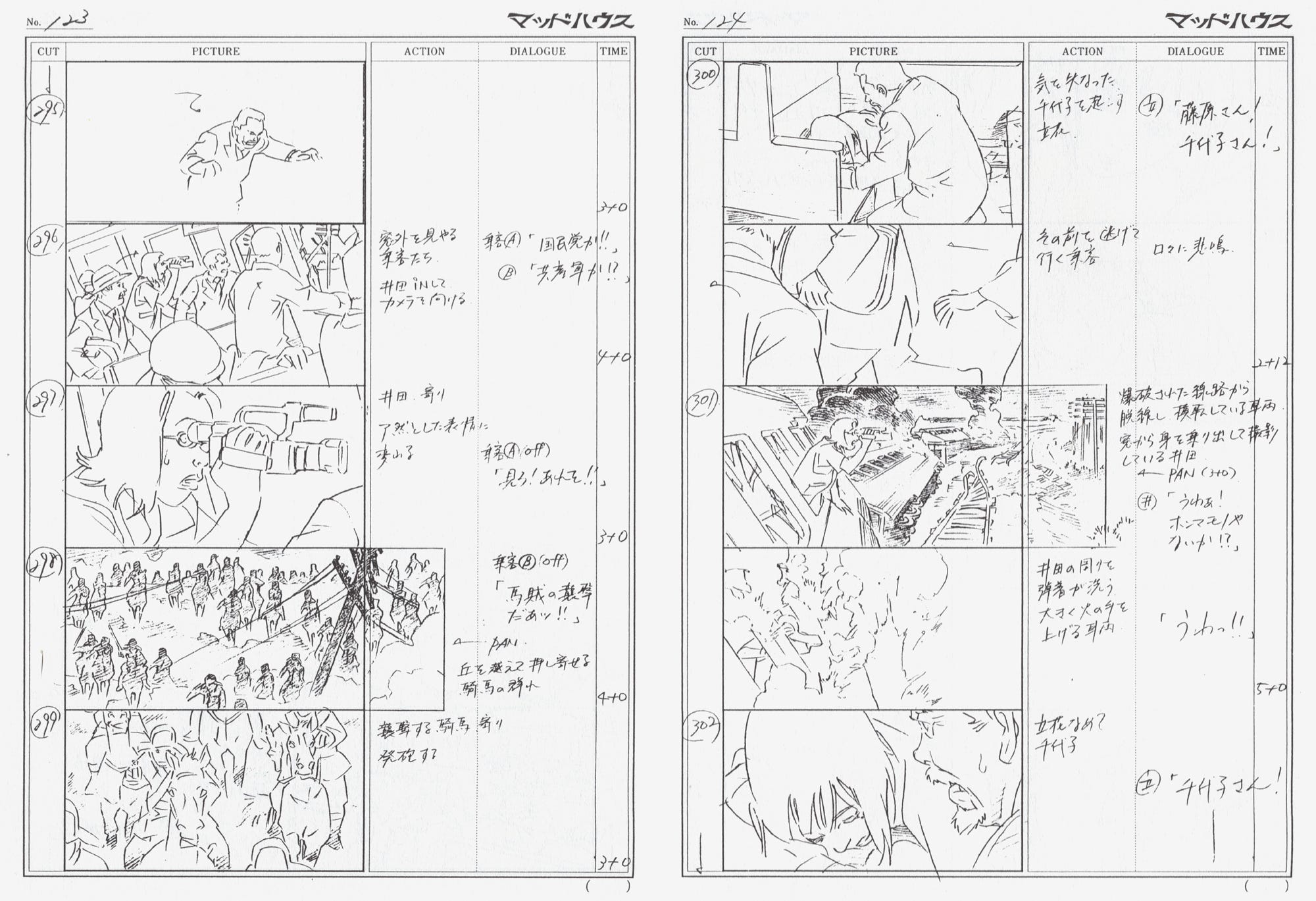
Kon was working as fast as he could. Despite his tweaks, he avoided big structural changes to the script in his boards. He had to be efficient — he even drew linearly to buy time for the script to be finalized. “I predicted that the opening would not change even if the manuscript was revised, so I drew it in order starting from the beginning,” he noted.
It came down to resources. Millennium Actress’s starting budget was 130 million yen — under $1 million today — and costs didn’t rise much above that. “In order to make it with a budget that is by no means large, it is necessary to shorten the production period,” explained Kon. The storyboards were his secret weapon. He dramatically increased their detail compared to his work on Perfect Blue, with two goals in mind.
First, Kon wanted to collapse the bulk of the location design (bijutsu settei) and some of the character design into the boarding stage. He designed a ton of the movie as he went. Second, he wanted his boards to be enlarged and used as the foundation for the layouts: the step between the storyboards and the backgrounds and key animation.
Layouts determine framing and staging, and Kon knew that they could cause problems. On Perfect Blue, when his boards were sketchier, layout corrections had cost serious time. So, he took more of Millennium Actress into his own hands for speed’s sake. As Kon put it, he could have drawn a rough storyboard in three months and worked with his location designer and layout artists to flesh it out. “If I had done that,” he said, “the resulting production time would probably have been twice as long.”
As it was, storyboarding took around nine months in all. Key animation began while Kon was still drawing.
Just as the budget-and-schedule trouble affected Kon’s drawing style, it affected the film language of Millennium Actress.
Kon composed most of the movie to look like it’d been shot with telephoto lenses. Wide, pulled-out shots were kept to a minimum. Again, a clear logic: the wider a shot, the more drawing it takes. The more drawing it takes, the more room it makes for mistakes, and for time lost to corrections.
But it needed to be a creative decision, too, as Kon said:
… if the idea was simply to ease the burden of drawing, the work would become too impoverished. In addition to making the drawing easier, I needed to feel confident that it was effective for this work. Otherwise, I’d feel like I’m cheating. So, I had to come up with a reason, even if it gets called quibbling.
As it turned out, Kon found his reason. He realized that he’d stumbled upon the only logical way to shoot the film. Chiyoko remembers the past as she’d experienced it — up close. When we’re thrown into her memories, we need to enter her version of the world.
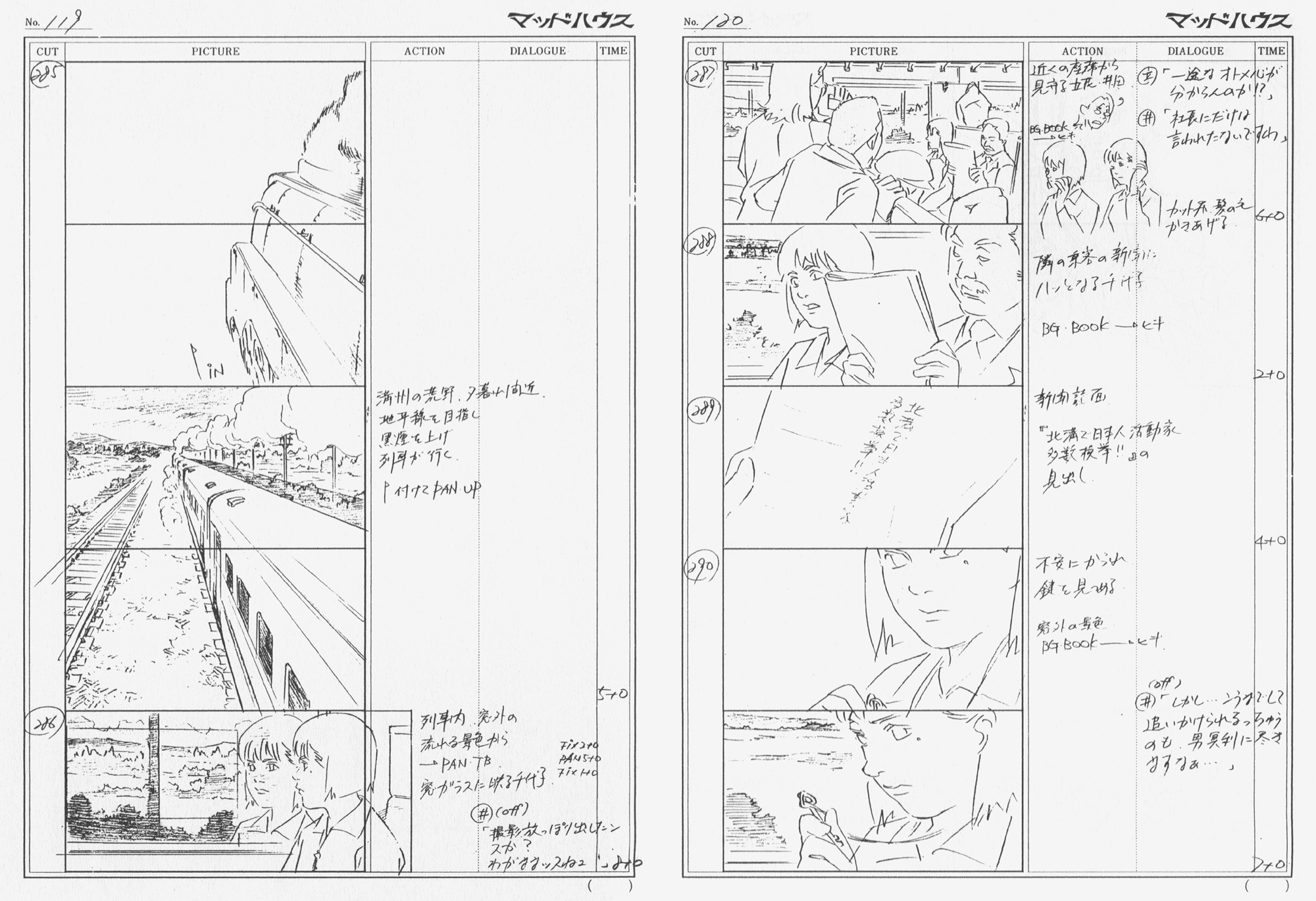
This level of attention filled Kon’s storyboards for Millennium Actress. Take the sequence embedded above, where Chiyoko reminisces about her first offer to act.
In an interview from the early 2000s, Kon discussed the thinking behind it. Chiyoko begins to tell her life story to the two journalists, Tachibana and Kyoji, who’ve come to her mountain villa. Kon’s boards order an “overlap” (O. L.) to dissolve Chiyoko into her teenage self. This is the moment when the journalists “enter Chiyoko’s world,” he said.
We arrive in the past, mid-conversation. A film studio’s managing director shouts, “Is there nothing I can say?!” Kon broke it down in terms of the four-part ki-sho-ten-ketsu plot structure (“start, development, turn, end”) common in Japan. The ki has been cut off here, Kon said: we come in at sho. There’s a sense that much has already happened.
The managing director wants Chiyoko to act in a “patriotic” film — this scene takes place in fascist Imperial Japan, during World War II. To match the feel of the era, the room was designed to rely on vertical lines, creating a stiff, closed-in feeling.
Then the editing pyrotechnics happen. A core part of Millennium Actress is that Tachibana and Kyoji appear as characters in Chiyoko’s flashbacks — a confusing idea that Kon knew he had to establish “as carefully as possible.” This is where he does it, and it happens subtly, almost imperceptibly.
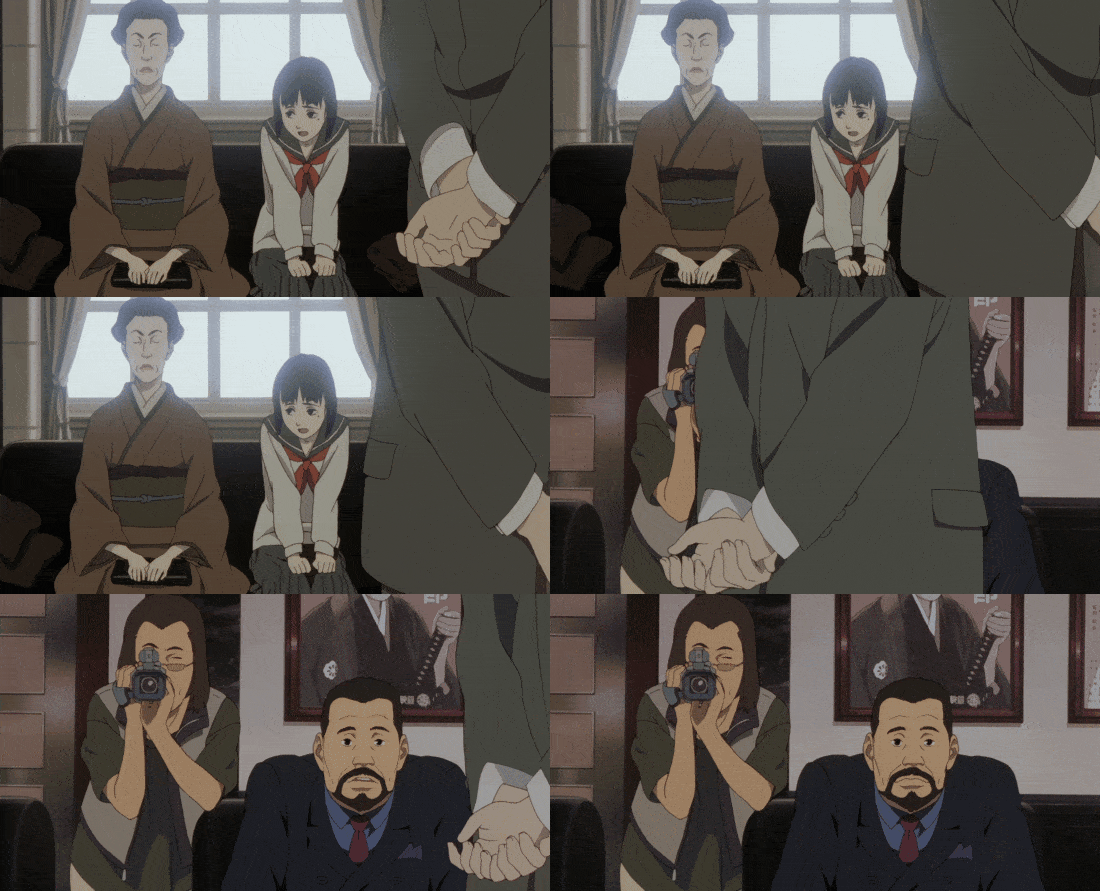
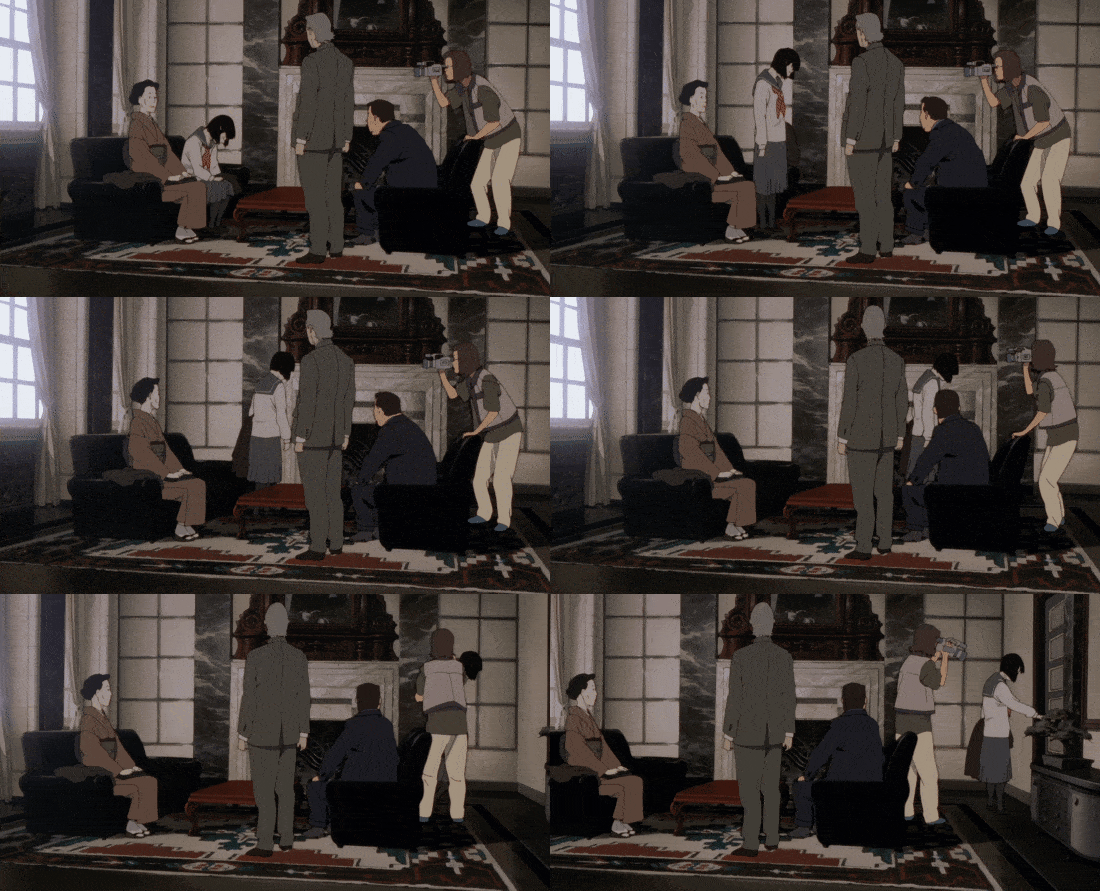
The director walks in front of Chiyoko like a wipe. Then we cut to the reverse shot: the director walks across the screen, and Tachibana and Kyoji emerge from behind him, wiped into the scene. The two are clearly present with the other characters, and “they appear naturally” to the viewer, Kon said. It’s a cross between a scene transition and a standard cut. A radically new element is here, but the same scene goes on as normal.
Then Kon gives us an “objective,” establishing shot that serves two purposes. First, it shows that Tachibana and Kyoji are sitting across from Chiyoko in the room. Second: it literally expresses the way that Chiyoko is caught between her mother and the director. Kon’s staging pins Chiyoko in, with her mother on the left and the director on the right. You see that repeated throughout the scene.
That is, until Chiyoko stands up and walks out the door. In that moment, she breaks the staging and escapes. Kon called it “a small expression of her will.”
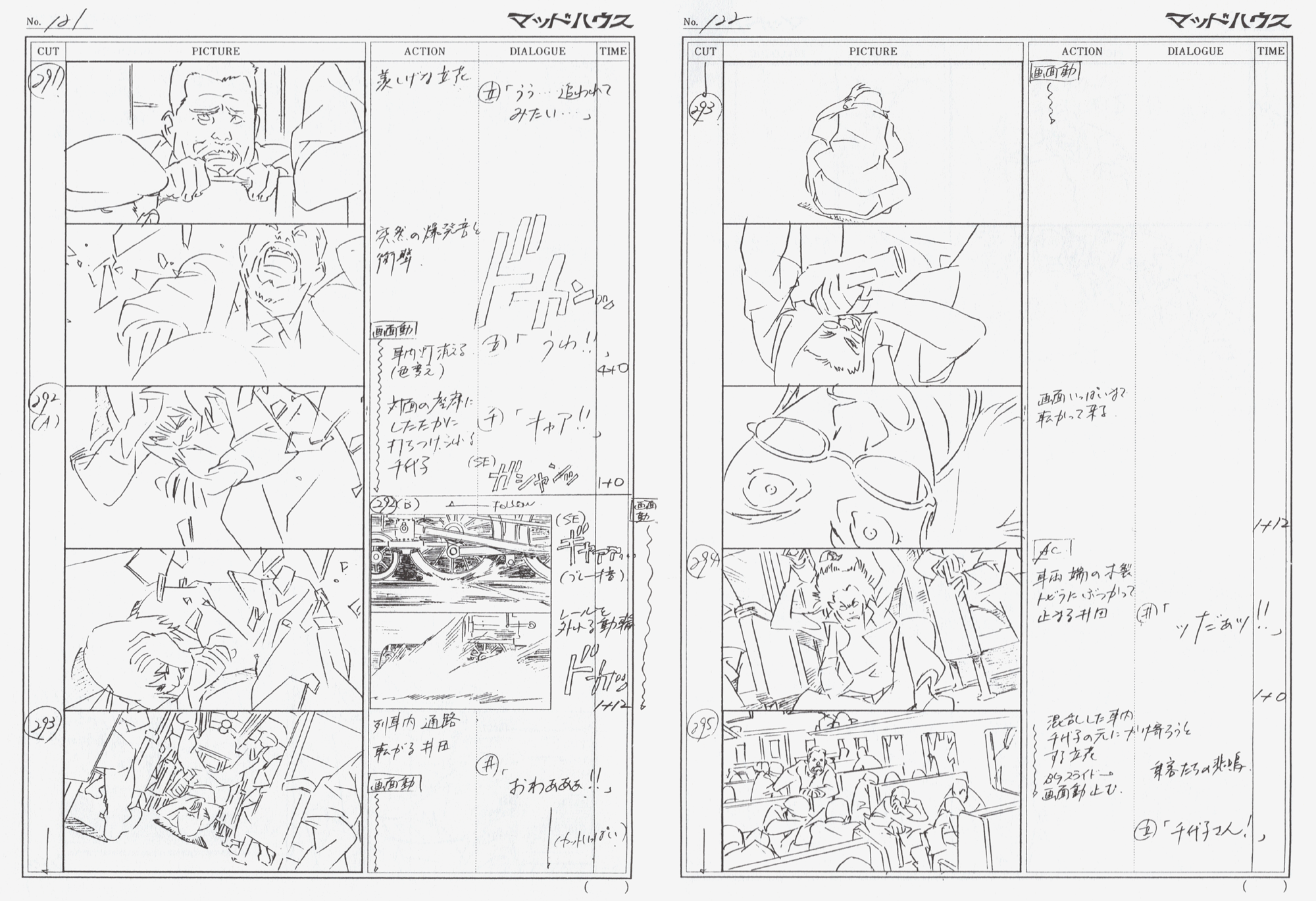
There’s more in-your-face manipulation of space and time in Millennium Actress, especially as the story goes on. See the sequence where Chiyoko’s train gets raided by feudal bandits on horseback, for example, included in storyboard form above. Throughout the film, without warning, eras and memories and movies collide.
But the reason that Millennium Actress makes sense as a viewing experience is the often-invisible care and finesse that Kon put into it, illustrated by that scene with the managing director. He was thinking of everything, the tiny connective elements that add logic to edits, even if the viewer doesn’t see them.
And he was doing it really quickly. Nine months isn’t a long time to storyboard a feature film alone, especially at this level of detail. The production was happening around him — animators started on his storyboards as soon as new drawings were done. Kon compared it to doing a serialized manga. He was entertaining his team:
I really wanted to liven up the production site. So, whenever I sent out a clean copy of 30 pages, I would intentionally end the last shot at a good spot [laughs] ... In manga, it’s a common practice to put an interesting panel at the end of a page so that the reader will turn the page with anticipation. Similarly, I wanted the final frame of the storyboard to have a panel where the characters notice something and go, “Ah!” [laughs]
When the storyboards were compiled into animatics (watchable here), Kon’s would-be manga became something else altogether: a blueprint. “If we attach music … we can see an almost accurate image of the film,” Kon said. Paired with placeholder songs and voices (“a luxury”), the team could watch this film that Kon had essentially pre-drawn and pre-edited. And they could proceed accordingly.
Kon called Millennium Actress, in terms of its budget, one of Japan’s lowliest pieces of feature animation. He had to fight tooth and nail against that limitation. But it had a flipside. It forced him and the team to find creative solutions — and those solutions were, he admitted, what made the film work.
This is a revised reprint of an article that first ran in our newsletter on November 9, 2023. It was exclusive to paying subscribers then — now, it’s free to everyone.
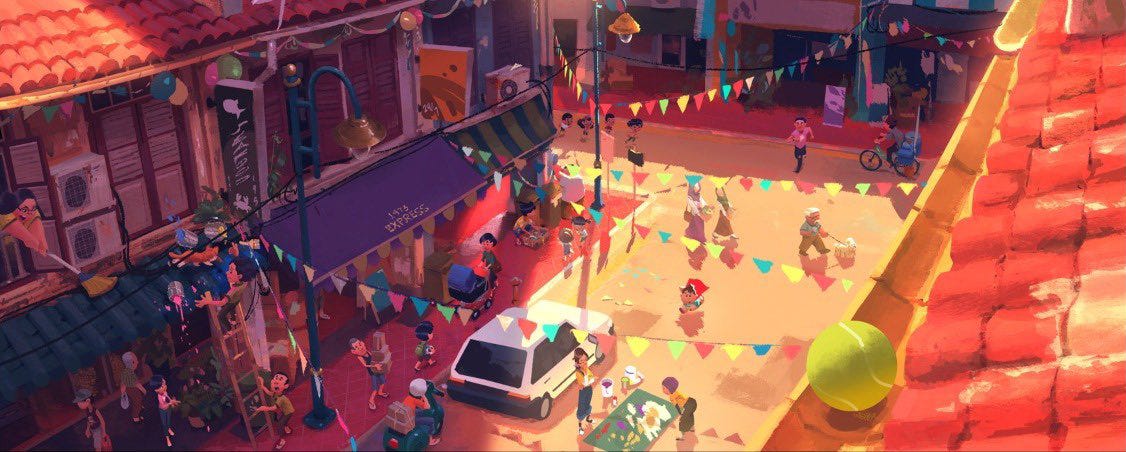
In Indonesia, animation is all over the headlines. It has been for weeks. The reason boils down to one word: Jumbo.
It’s an animated film — an hour and 40 minutes long. Within a week, it drew one million people to Indonesian theaters, more than any local animated movie ever has. (The previous record was just under 650,000 for Si Juki the Movie, around eight years ago.) Now, after two weeks, Jumbo’s viewership is reportedly over three million.
There are other impressive numbers tied to the film: five years in the making, some 400 crewmembers. It’s a big, ambitious project meant to put Indonesian animation up there with the likes of Pixar.
Indonesia’s government has endorsed that effort. The vice president attended a screening, and the Deputy Speaker of the House went to the premiere, joined by other members of parliament. “If in Japan there are Ghibli films,” said one official, “in Indonesia there is Jumbo.”
The film comes from Ryan Adriandhy, just 34 years old. He studied animation in the States, proving himself with Prognosis (2020) — a short he made for school. Jumbo is his first feature. It’s about an orphan boy, Don, who’s bullied for his weight. Things take a supernatural turn when he comes into contact with Meri, a ghost, and sets out on an adventure.
Adriandhy is a Ghibli fan himself. Asked recently about his three favorite animated films, he named Spirited Away first — followed by Chicken for Linda and A Town Called Panic, two European co-productions. Also very important to him is The Lion King, which he’s called his first experience with animation in theaters. It inspired Adriandhy to pursue this medium, which led to his studies at RIT in New York, and finally to Jumbo.
“I’m still speechless,” he wrote this weekend about his film’s success.
Jumbo only seems to be picking up speed right now, and it’s still a popular topic on social media. Variety reports that the film will hit other countries in June, although no word on a stateside release yet. Those curious to see Jumbo in motion can find the trailer on YouTube.
We lost animator Paul Fierlinger (89), an Oscar nominee and well-known contributor to Sesame Street.
The history of Polish animated films will be honored with a Blu-ray release, Essential Polish Animation. It’s due in July and features 27 restored pieces from the ‘50s through the ‘80s. (Thanks to Edge of Frame for bringing it to our attention.)
China announced plans to “reduce” American film releases in the country, as a response to America’s chaotic trade policies. (Meanwhile, Animenomics reports that those same policies may shake Japan’s anime industry.)
Artist Vincent Tsui shared more than a dozen pages of character exploration he drew for Common Side Effects, one of America’s most celebrated shows this year.
Also in America, Congress introduced a bill that would regulate AI deepfakes — including faked voices. It’s backed by SAG-AFTRA.
In the Netherlands, there’s “a new annual incentive to reward producers whose films achieve outstanding box-office results,” reports Cineuropa. Rewards go as high as €300,000. Among this year’s winners is the animated film Tummy Tom 2.
A cool bit of archival footage resurfaced: a clip of Fyodor Khitruk’s 1987 visit to America. It includes a discussion of his work by Frank Thomas and Ollie Johnston.
In Australia, Catriona Drummond is writing about her experience as the art director of Bluey. She’s serializing the story in her newsletter — parts one and two are out, with more on the way.
A French movie, Children of Liberty, secured half a million euros from the Eurimages fund. (See images here.)
Last of all: we looked at the early life and Disney career of Iwao Takamoto.
Until next time!