Note: This essay discusses conspiracy theories, so consider this a blanket content warning for genocide denial, anti-Semitism, and brief mentions of CSA. Also, I’m not going to get into the weeds about most of the topics I bring up. If you’re uninformed about any of the theories I mention here, do yourself a favour and just don’t look into it. You’ll be fine to live the rest of your life without learning any more about it.

I
Let’s start at the end, shall we?
Reptilians, or lizard people, or Anunnaki, are a theorized race of technologically advanced reptilian humanoids, variously hypothesized to be from another planet, a different/higher dimension, or a different time, who (according to some) dominate human affairs from behind the scenes.
Reptilian theorists claim that the lizard people have interfered in our societies since prehistory, and have possibly guided our evolution for hundreds of thousands of years. Most of the works of monumental neolithic architecture were constructed with the assistance of the reptiles’ advanced technology, and the ancients worshipped them as gods. Today, they walk among us, occupying positions of power and influence at the highest levels; many global elites, including George W. Bush and Queen Elizabeth II, have been accused of being reptilian shape-shifters.
The lizard people pop up in conspiracy theories of all stripes, serving as a kind of high-tech/supernatural deus ex reptilia that can tie together any inexplicable loose ends; my personal favourite conspiracy theory of all time claims that the reptilians used their UFO technology to help high-ranking Nazis escape into the hollow Earth through a concealed tunnel in Antarctica during the dying days of the Third Reich, where they apparently still lie in wait.
It’s also widely believed (by the type of people who believe this sort of thing) that the Lizard People’s main source of sustenance and power is energetic vibrations caused by human suffering, which explains their attempts to manipulate humanity into endless conflict. According to this theory, our best way to fight back against their tyrannical reign is simply to be happy.
II
The prevailing metaphor for people who become embubbled in conspiracy culture is that they’ve “fallen down a rabbit hole”. As somebody who’s gone through the process myself, I’d say that it’s more like getting lost in an enchanted forest. In such a fairy-tale environment, you might come across a trail of breadcrumbs and get hopelessly lost following them in the belief that they’re leading you towards something important, all the while certain that you can find your way back out again any time you want. Along the way, you may encounter glimpses and hints of fantastical beasts and creatures you’d never imagined before, thrills and horrors that would make you sound mad if you ever tried to describe them. Paths might seem to open up before you and then sputter out pointlessly, leaving you mired in a bog or trapped in a dense thicket. It’s easy to wind up walking in circles endlessly, thirsty and hungry and increasingly delusional, lured on by will-o’-the-wisps, forever convincing yourself that over this next hill or around this next bend, you’ll find your way through.
People who are lost in the woods generally have a single-minded, urgent focus on just one thing: getting out alive. Similarly, people lost in conspiracism myopically fixate on their quest for the hidden truth, the truth that has been (according to their research) deliberately and maliciously concealed from us by a malevolent and secret elite. In this pursuit, conspiracists venture further and further from the solid ground of consensus reality, until it’s difficult for them to have meaningful discourse with people who haven’t journeyed along with them.
So the fate of most people who get lost in the Forest of Conspiracism is that they stumble into one of the shanty-town settlements that other seekers of truth have set up there, and, overjoyed to find some fellow travellers who will understand what they’ve been through, they wind up putting down roots and trading stories, trying to make sense of all they’ve seen and learned. After all, life is interesting in the forest, full of fascinating characters, and there’s an incredibly affirming sense that you’re involved in something important, that together you’re eventually going to get to the bottom of the deep magic that’s put the woods under such a powerful curse.
III
In mid-March of 2026, Benjamin Netanyahu either was or wasn’t alive. Either way, he didn’t post on X for multiple consecutive days.
Staying off social media for a bit might seem like unsurprising behaviour from the prime minister of a nation engaged in a multi-fronted war of aggression against Iran, Lebanon and Palestine. It’s not at all unreasonable to think that he was probably just busy bombing hospitals or assassinating journalists. But Netanyahu, like Donald Trump, is known for being a prolific tweeter. (After the murder of fascist dirtbag Charlie Kirk, for instance, Netanyahu took time out of his busy schedule of avoiding arrest for war crimes and corruption to make multiple video posts on X lauding Kirk’s legacy and attempting to rebut conspiracy theories that Israel was behind the assassination.) In the early days of the US-Israeli attacks on Iran, Netanyahu was a constant presence on the timeline, insisting repeatedly in trolly video and text posts that Israel would triumph and urging the people of Iran to rise up against their government.
His sudden silence two weeks into the war, combined with a complete lack of public appearances and a series of successful Iranian missile strikes against Jerusalem and Tel Aviv, therefore prompted quick-spreading rumours that he was dead or badly wounded. It’s unclear whether these rumours were started by the Iranian government, or whether they were just happy to propagate them further, but as the speculation about his possible demise started to completely take over online discourse, the Office of the Prime Minister decided that they needed to respond quickly. They hastily released a video of Netanyahu addressing the nation from behind a podium, flanked by Israeli flags. However, this failed to convince literally anybody that he was alive, because in certain frames he appeared to have six fingers.


The next day, Netanyahu released a more candid video, filmed in a cafe, in which he held up his hands to let viewers count his fingers and jokingly said “I’m dead for coffee” (a Hebrew idiom roughly equivalent to the English “I’m dying for”). This too failed to dispel doubt, and the info-wars raged on. Eagle-eyed online sleuths found dozens of apparent signs that the whole thing had been AI-generated: the cafe’s register seemed to show a date from 2024, the coffee moved unnaturally in the cup as he transferred it between hands, a barista seemed to appear in the shot out of nowhere, and so on and so forth. Even Elon Musk’s pet chatbot, Grok, declared the video to be a deepfake.
This conspiracy theory was just plausible enough to grab my attention. After all, there was some precedent: just weeks earlier, in the opening days of the war, the government of Iran had loudly insisted that Ayatollah Ali Khamenei had not been killed by US-Israeli airstrikes for nearly twenty-four hours before finally admitting that he had in fact been assassinated. The anomalies and seeming glitches in back-to-back video posts on Netanyahu’s official account, while not slam-dunk evidence of anything, certainly raised questions that couldn’t be automatically dismissed. For a couple of days, I idly wondered if there was any merit to the idea.
For many, though, these minor fleeting details – which could plausibly be explained by AI upscaling of authentic video footage, among other things – were obvious and decisive confirmation of a conspiratorial cover-up. These true believers eagerly awaited the moment when Israel would be forced to shamefacedly admit that Netanyahu was dead, that the war was lost, that these posts had been desperate attempts to maintain the illusion of control. A few of them are eagerly awaiting that revelatory moment still, several weeks later, in the face of all the evidence in the world that they were wrong.


This is a prime example of what I’ve come to think of as a conspiracist viewpoint. Like most isms, conspiracism is part political ideology and part religious eschatology. For the conspiracist, secret plots and cover-ups are the rule, not the exception. The official story is almost always a fabrication, and the true source of every ill and evil is the same vaguely-defined shadowy cabal. Mountains of evidence supporting an official account can be written off as fake news, while the most tenuously supported wild speculation can be clung to as Gospel truth so long as it supports their prior beliefs and biases. And anything that catches their attention is almost certainly Part of a Plot of some sort. Whether it’s globalists or the Deep State or the Bilderberg Group or higher-dimensional reptilians or just the Jews, the conspiracist believes fervently that Somebody is in control of just about everything, that every narrative is manufactured by Them, and that nothing of consequence happens without Their approval and active participation.
IV
Writing in 1981, post-structuralist philosopher Jean Baudrillard commented on the transmogrification of history into stupefying legend (pp. 43-44):
History is our lost referential, that is to say our myth...The great event of this period, the great trauma, is this decline of strong referentials, these death pangs of the real and of the rational that open onto an age of simulation.
Simulation – the replacement of the real with the hyperreal – was a major preoccupation of Baudrillard’s work. Much of his classic text Simulacra and Simulation deals with the relation between historical reality and Hollywood, whereby the true past becomes forgotten through its hyperreal reproduction on the silver screen. We now live in the age of the reboot and the ret-con, where old myths are revised and reanimated and reimagined and repeated endlessly. Why not just declare the end of history and replace it with a simulation of humanity’s greatest hits?
Whereas so many generations, and particularly the last, lived in the march of history, in the euphoric or catastrophic expectation of a revolution – today one has the impression that history has retreated, leaving behind it an indifferent nebula, traversed by currents, but emptied of references. It is into this void that the phantasms of a past history recede...all previous history is resurrected in bulk...war, fascism, the pageantry of the belle epoque, or the revolutionary struggles, everything is equivalent and is mixed indiscriminately in the same morose and funereal exaltation, in the same retro fascination.
Mediated by screens, history is no longer experienced directly; it instead becomes a collage, a pastiche, a buffet from which we can sample, a Disneyfied nowhere-land that all blurs together. The Twin Towers collapse in slow motion, from a hundred angles; the President’s head is blown off, then the tape is rewound, then it’s blown off again; for just a moment, thirty years ago and right now, on demand, the Queen’s pupils flicker, appear to become vertical slits, crocodilian, inhuman; Benjamin Netanyahu, or the AI simulation of Benjamin Netanyahu, has five fingers, then six, then five again. What can the Truth possibly mean in such a timeless time?
V
The falsifiability of photos and videos, especially digital ones, is of course nothing new. But the ease with which any bullshit theory can be “supported” with AI-generated evidence, or with which any actual factual evidence can be undermined by spurious allegations of fabrication, essentially means that there is now always going to be a large amount of ideologically-motivated doubt and disagreement surrounding every single event of consequence, forever.
For instance, here’s an excerpt from a rant tweeted at Netanyahu on April 24, nearly six weeks after the initial Bibi-is-Dead theories and just hours after the Israeli government revealed that the Prime Minister had undergone treatment for prostate cancer, reigniting interest in the original claims and giving true believers some fresh meat to chew on.

This tweet features a classic of conspiratorial pseudo-logic: the unfalsifiable argument. “Assume a magic machine”, says the conspiracist, “and all of my claims make perfect sense.” It’s impossible to prove that the government has access to secret high-tech AI, and equally impossible to prove that they don’t. There is literally nothing that could change this person’s mind and convince them that Netanyahu is alive.
Conspiracism has always relied on unfalsifiable arguments. But secret high-tech AI is not especially far-fetched, as conspiracy theories go, and if it doesn’t exist yet, it very well could soon. What happens when all evidence-based claims become essentially unfalsifiable? Does every claim about reality become a conspiracy theory?
VI
My journey into conspiracism started, embarrassingly, with Alex Jones. I stumbled across his documentary films around 2009 or 2010, at a time when I was desperate for meaning, for certainty, for a sense of purpose. I was depressed and aimless after graduating from university into the weakest economic conditions in decades. Disillusioned and isolated, I was an easy mark for simple narratives that ascribed intent and meaning to the structure of history, and Alex Jones was happy to provide it.
This was long before Jones became notorious for his attacks on parents of the Sandy Hook school shooting victims, his promotion of the bafflingly intricate QAnon conspiracy theory, or his endorsement of Donald Trump. In the 00s, Jones was best known for his promotion of the 9/11 Truther movement, and he was able to credibly position himself as a populist who despised both parties. His websites, Infowars.com and PrisonPlanet.com, served as hubs for discussion of conspiracies of all sorts. He was strongly and vocally opposed to the invasion of Iraq, and was an early critic of the continuities between the Bush and Obama administrations, especially Obama’s broken promises to end the war and close Guantanamo Bay.
I actually first encountered Jones in Richard Linklater’s classic 2001 indie film Waking Life, although I had no idea who he was at that time. In the film, Jones plays himself for one brief but memorable scene, driving through the streets of Austin, Texas, bellowing angrily out his window about the dehumanizing effects of propaganda and the liberatory power of a belief in humanity’s essential goodness, a speech that it’s hard to imagine him making today.
I say all this not to justify being taken in by Jones. The man is a hateful charlatan who’s done immeasurable damage to the world. Although his most monstrous and vile words and deeds were still ahead of him when I started watching him, I could have and should have known better. I just want to provide some context for how a young leftist could watch Jones’s content and come away feeling positively about the man.
Because there was a time when I quite liked Alex Jones! I didn’t agree with all of his positions, and I found his preoccupation with Ron Paul kind of off-putting, but some of his work really resonated with me. So I kept paying attention. I read “news” on Infowars. I checked out his latest releases, and then looked into people who featured in his documentaries, and then “started doing my own research”.
I became familiar with most of the landmarks of the Forest of Conspiracism – the Grassy Knoll, the Bohemian Grove, the farmers’ fields outside Roswell, New Mexico. I learned the shibboleths, the names of declassified intelligence programs and secret societies and theorized alien lifeforms. I watched endless documentaries and read incomprehensible forum posts and discussed the Illuminati with a straight face. I didn’t believe everything I heard or read or saw there, but nobody does, not really. That’s not how radicalization works.
The story-book version of radicalization is that people are exposed to progressively more extreme ideas and soak them up as they go – starting maybe with some doubts about the JFK assassination and ending up a hollow-earth Holocaust denier ranting about the lizard people. That’s not usually how it goes, though. Radicalization more typically occurs when one is exposed to lots of fringe ideas, some more extreme and some less, constantly and repeatedly, in mundane or positive contexts, until they lose their shock value and become part of a possible spectrum of acceptable belief and opinion. Gradually, your willingness to at least seriously consider any position stretches to encompass all sorts of absurdities and abominations. Then one day, nothing seems more implausible than the official account of historical and current events. The notion that there’s a world outside of the enchanted forest, a world that you once lived in, begins to sound absurd.
VII
In a possibly futile effort to preserve my dignity, I want to stress that I never actually believed in the lizard people. But I knew enough about them to have coherent conversations (well, as coherent as conversations about the lizard people can get). I knew people who believed in them – I lived on a hippie farm almost entirely populated by conspiracists for about six months, right around the time my personal conspiracism peaked – and I teased them about it, gently, because while I never really went in for the more paranormal theories, I subconsciously knew that they were maybe just one or two steps beyond the outlandish ideas I’d bought into myself.
Odds are you probably know some people who buy into these ideas as well. Belief in reptilians is surprisingly widespread – a 2013 poll found that one in twenty-five Americans believed in the existence of lizard people, a number that has certainly increased over the last thirteen batshit crazy years.
It’s hard to pinpoint exactly when it started, but conspiracism has become an inescapable force in contemporary political life, from Gamergate to Pizzagate to Russiagate to QAnon to the Plandemic to microchips-in-vaccine delusions to #StopTheSteal to the growing ubiquity of the fascist Great Replacement Theory. Conspiracy theories used to be reserved for major, generation-defining historical events – the Holocaust, the assassination wave of the 60s, 9/11, the 2008 financial crisis – along with paranormal happenings like UFOs or Bigfoot, or the deaths of prominent celebrities like Elvis or Kurt Cobain. But now, hypercharged by the algorithmic drive for ever more shocking and provocative content, contemporary conspiracists draw on the narratives and patterns of their forebears while applying their paranoid logic to literally every aspect of life. Along the way, the scope and urgency of the claims becomes increasingly urgent and all-encompassing, and every minor blip in the news cycle becomes more confirmation of the existence of a Master Plan.
It’s now impossible to create or maintain a consensus about literally any claim. Every official narrative instantly spawns dozens of counter-narratives, and vast plots seem to lurk behind the most innocuous events. Just in the last few months, I’ve run into theories that Jim Carrey has been replaced by a clone, that carrots are toxic, that MTV and the CIA conspired to promote hip-hop and push rock music out of the mainstream in the late 1990s, and that Jeffrey Epstein is alive and living in Palm Beach under the name of Pete.

More seriously, there have been multiple thinly-sourced presidential medical scares, competing claims about the true motivations behind the death of Charlie Kirk, renewed interest in the idea that the Trump assassination attempt in Butler was staged, and long-running (entirely unfounded) Zionist allegations that evidence of genocide in Palestine is staged and created by actors in what they call Pallywood.
Combined with this conspiracist zeitgeist, AI is an explosive technology, akin to putting a tin-foil hat in the microwave. The very fact that anything we see or watch online might conceivably be fake is profoundly undermining all of our assumptions about the relationship between the camera and reality. If we can no longer trust the evidence of our eyes and ears, we’re all ripe for manipulation.
VIII
It makes sense that people fall for conspiracism, though, because shit, look at the world. Look at New Orleans left to drown after Hurricane Katrina, look at the cheapness and flimsiness of the lies that launch wars that kill millions, look at the mobile morgues set up in the world’s major cities in the early days of the pandemic, look at the market going up up up and life getting harder for damn near everybody, look at the dreams we had for the future and the nightmare that got handed to us. As a species, we want things to happen for a reason, we want things to make sense. A world like the one we’re living in today just sort of happening is profoundly unsatisfying, offensive to any sense of justice, and absolutely terrifying in terms of our long-term survival prospects. Better by far if the current state of things is the aberrational result of a nefarious plot, or even if some of the terrible things we see on our screens are actually lies. Better by far if we can overcome our sorrows and misfortunes by dedicating ourselves to the purifying pursuit of the Truth.
In actuality, though, conspiracism necessitates a turning away from reality. Conspiracism may present itself as the Quest for Truth, but really it’s the pursuit of a comforting lie: that the bad things that happen to us have meaning, are part of a greater plan, and aren’t our fault. Stripped to its essentials, conspiracism is just magical thinking applied to history and current events - the belief that everything means something, that it’s all connected, and that your individual suffering is part of a grand battle between Good and Evil.
In this struggle for redemption against the wicked elites controlling us, the forces of Good have almost none of the power, but they do have the Truth on their side. In fact, it’s the only weapon of consequence in their arsenal. It’s therefore imperative (from their perspective) to pursue the exposure of the Truth doggedly and unceasingly, until one day, the public Revelation of the true order of affairs will bring the power structures of the Evil-doers tumbling down and usher in an age of Justice.
The Christian end-times undertones of this ideology are not exactly subtle. In this sense, arguing with a conspiracist is a lot like arguing with a missionary. Almost nobody who’s caught up in conspiracism can be talked out of their beliefs with facts and logic, because that’s not how they got there in the first place. And as anybody familiar with end-times theology will know, the failure of repeated predictions of the apocalypse never weakens the faith of true believers one bit.
Conspiracists have been warning for decades, in increasingly dire terms, that the New World Order is on the precipice of instituting a One World Government, stripping away your rights, confiscating your guns, and putting true patriots into prison camps. While the rain forests burn and Gaza is turned into rubble by AI-driven algorithmic bombing campaigns and millions needlessly die from pandemics and preventable diseases and the US government sets up literal concentration camps and expands the power of the police to make warrantless searches and arrests, conspiracists dismiss all of that as false flags and distractions, and they stay laser-focused on the apocryphal Doomsday warnings of false prophets, convinced that the true threat to humanity’s future is some cryptic hidden plot carefully kept from the masses by some Secret Board of Shadowy Figures that they heard about on Telegram.
IX
In The Obama Deception (2009), Alex Jones very accurately pointed out the gap between the lofty transformative rhetoric of Obama’s 2008 presidential campaign and the harsh reality of his Wall-Street-friendly, status-quo-preserving administration. Some aspects of his depiction of the early days of Obama’s presidency hold up well – especially his critiques of the bank bailouts and Obama’s finance-industry-heavy cabinet appointments – but the documentary goes off the rails in its diagnosis of the underlying cause of this corporatist agenda: Obama, according to Jones, was a plant, groomed from early adulthood by the true ruling class and foisted upon an unsuspecting public via a wall-to-wall propaganda campaign in order to implement their secretive plots for a new world order.
After a long tangential interlude on the Kennedy assassination and some breathless hand-cam footage of an unsuccessful attempt to infiltrate the hotel where the Bilderberg Group was meeting, Jones concludes the documentary by painting a paranoid picture of a totalitarian plot while images of Obama rallies are interspersed with Nazi soldiers marching past a saluting Hitler:
In summation, Barack Obama is a Madison Avenue-created fad. All of the crazed Obama worship being pushed by the corporate media is scientifically designed to capture the public in a net of peer-pressured mass euphoria...If the New World Order can just distract the public for just a few more years, the elite can finish constructing their deep-state control grid.
It’s often said that conspiracists get the feelings right but the facts wrong, and The Obama Deception is a great example of this. In the sixteen years since this documentary was released, it would be impossible to argue that the power of the elite has diminished in any respect, but there has been no singular decisive instant in which brave patriots had their final chance to challenge elite globalist tyranny. That’s because there is no secretive cabal plotting a power grab.
There is a conspiracy against the common people, though; it’s called capitalism. Capitalism is why we can’t get change we can believe in through elections; capitalism is why the government betrays its people in the service of the financial sector; capitalism is why the system feels rigged against us. No shadowy cabals are necessary. It’s just not that deep, bro.
X
Conspiracy theorists were once figures of humorous scorn, but not many people are laughing these days. By destroying the possibility of a consensus narrative, widespread conspiracism is doing (and will continue to do) unimaginable damage to our societies and communities. When you and your opponents live in parallel narrative realities, how can you possibly find common ground and resolve your disagreements?
It’s important to stress that this narrative drift is not random. Conspiracism has always relied on bigotry, xenophobia, and religious intolerance. In the uncomplicated world of cartoon villains plotting to take over the world, the bad guys are typically an easily-defined group of people who are (or can be made to seem like they are) irredeemably evil and undeniably Not Like Us, people who hate “our” way of life and want to destroy it. For a lot of conspiracists, groups like Jews, immigrants, queer people and Muslims fit the bill perfectly.
The scapegoating of these marginalized groups was a pervasive but plausibly deniable feature of conspiracy culture fifteen years ago, when I was deep in it, and having dipped my toes back in those waters this month to research for this essay, boy howdy has it gotten waaaay worse.
For instance, remember the X account I quoted who was (fairly reasonably, I said) hypothesizing that the Israeli government had advanced AI technology? Here he is explaining why the Israeli government would go to all the trouble of covering up Netanyahu’s death in this way:

This is a fairly tame example in the grand scheme of Twitter these days. Explicit Holocaust denial used to exist on the fringes even of conspiracy culture, but it’s literally everywhere now.
That’s a big part of why I’m trying not to take too sympathetic of a tone in this essay towards conspiracists. I do feel sympathy for them – I used to be exactly where they were, and I think that most people who wind up lost in that dark forest are ultimately just in search of comfort and belonging and a sense of purpose – but also, you can’t spend ten minutes in conspiracist spaces these days without coming across naked Holocaust denial, or the vilest most odious racist pronouncements, or preposterously misinformed and violent queerphobia and misogyny. Anybody who’s still camping out in the Forest of Conspiracism at this point knows exactly who they’re hanging out with. They’ve picked a side. The useful idiots of fascism may have tragic backstories that explain how they got where they are, but I hope you’ll forgive me if my sympathies lie much more strongly with the victims of their hateful ideologies.
XI
Something that seems obvious when you’re outside of conspiracist culture is that the theories are incoherent, incomprehensible, and impossibly elaborate. The amount of fallacious argumentation and sheer fabrication of evidence involved in most conspiracist explanations of events is staggering. Internally, however, these are not the glaring flaws that they are to external observers, and to understand why, we have to examine the foundational fallacy of conspiracism:
the motte and bailey argument.

A motte-and-bailey setup was a common design for medieval European settlements, where a large tower on a hill (or motte) was situated adjacent to a large fenced area (or bailey). Inhabitants of the settlement lived in the bailey, but if they came under attack, they retreated to the more easily defended motte.
In a motte and bailey argument, someone puts forth claims that they are incapable of defending against strong attacks (the bailey), and then retreat to more defensible forms of those claims whenever they’re challenged (the motte). This shift in positions is often quite subtle, and it can be difficult to keep your eyes on what is actually being argued for. A strong defence of the motte might trick people into thinking that you’ve proved the claims laid out in your bailey.
For instance, a conspiracy theorist may claim that the Bush administration deliberately engineered the 9/11 attacks in order to launch wars for oil and take away Americans’ rights under the pretense of fighting terrorism. But when challenged to support their claims, the conspiracist will fall back to a much more easily defended assertion: that the government’s account of the attacks is implausible, inconsistent, or incomplete.
How is it possible, they demand, that an inexperienced pilot guided a passenger jet in a technically challenging tight downward 330-degree turn to precisely strike the walls of the Pentagon? How can we be expected to believe that one of the hijackers’ passports was found undamaged amid the rubble of the World Trade Center if the wreckage of the airplanes was burning at a temperature sufficient to compromise the integrity of the buildings’ steel support columns? What exactly is in the redacted sections of the 9/11 Commission Report, and why has the government of Saudi Arabia been so intent on keeping that information from the public?
Meanwhile, the original claim of an attack deliberately planned and executed by the American government against its own people has been abandoned, or at best weakly defended with suggestive insinuations and vague hand-waving. (Is it just a coincidence that George W. Bush’s brother, Marvin, was on the Board of Directors for a company responsible for providing security services to the World Trade Center?) The plausibility of the speaker’s bolder claims is indirectly enhanced by their ability to defend the weaker form of their argument (especially through selective quotation, motivated reasoning, and other fallacious arguments), and before long, their case for the weak form of the claim begins to convince many people that the stronger form of their claim has merit.
The motte and bailey argument is a tough-to-spot fallacy, but that’s not why it’s the most indispensable tool in the conspiracist’s toolbelt. They rely on it so heavily because conspiracists generally don’t actually have a firm grasp on what they believe. Ask ten truthers to articulate a positive, detailed theory of what exactly happened on 9/11, and not only will you get ten different answers, you’ll be absolutely inundated with hypotheticals and conditionals and hedges. Maybe the government let it happen, and maybe they made it happen. Maybe controlled demolition explosives were placed in the elevator shafts of the towers. Maybe Bush knew in advance, and maybe his handlers kept it from him. Maybe the US colluded with the Saudis, or with the Israelis, or with the Illuminati. Maybe the airplanes were actually missiles disguised as planes using hologram technology. Maybe maybe maybe maybe.
Conspiracists are quite simply incapable of defending a sustained attack on any of their specific positions, and so it’s essential that they be able to pivot, to shift the grounds on which the argument is taking place. In fact, most truthers will happily admit that they don’t know what happened that day, but that doesn’t in any way stop them from believing that 9/11 was an inside job, because conspiracism doesn’t require any degree of certainty that you have your facts straight. The only unconditional, non-negotiable tenet of conspiracism is its motte, its unassailable position of strength: the truth is being hidden from us.
XII
It has to be said, though: some news is fake news, deliberate disinformation or corporate-state propaganda. Some conspiracy theories are true. Governments, corporations and powerful people absolutely do lie and deceive and cover things up, and they’ve been caught doing it time and again.
The big oil companies have known about climate change for over fifty years, and they hid that knowledge from the public for as long as they could.
The pharmaceutical companies knew about the dangers of Oxycontin, and they pushed it anyway.
Under the FBI’s COINTELPRO program, agents infiltrated and disrupted organizations like the Black Panther Party, the American Indian Movement, and student-led anti-war groups, including by “neutralizing” their leaders through assassination and imprisonment.
Lyndon Johnson’s government fabricated a North Vietnamese attack on American ships in the Gulf of Tonkin and used the non-existent “incident” as justification for escalating US military involvement in Southeast Asia.
The CIA sponsored an endless string of coups and assassinations against leftist Prime Ministers and Presidents from Guatemala to Congo to Iran to Chile, and propped up of dictatorial regimes that are friendly to Western capital all around the world.
The British government under Tony Blair was fully aware that American claims about Iraq’s weapons of mass destruction program were completely unfounded months before the US war against Iraq began, but they continued to push for invasion under that pretense anyway.
Barack Obama’s Justice Department collaborated with mayors of (mostly Democratic) cities across the United States to violently raid and disrupt encampments related to the Occupy movement.
Richard Nixon really did order Republican thugs to burglarize the Democratic Party’s headquarters at the Watergate Hotel.
The Reagan government really did illegally traffic weapons to Iran and use the proceeds to fund the right-wing terrorist Contras in Nicaragua.
The Catholic Church really has attempted to conceal widespread sexual abuse of children by its priests and bishops and shield the perpetrators from legal consequences.
The Justice Department really is trying to hide the full extent of Jeffrey Epstein’s personal connections to hundreds of economic, technological, academic and political elites, including the current President, at least one former President, and the King of England’s brother.
When we contemplate this well-documented legacy of governments and corporations conspiring to hide their crimes, launch unjust and unprovoked wars, and destroy their ideological opponents, it’s impossible not to feel radicalized. Taken together, this pattern of events looks like nothing more than a ruthless decades-long conspiratorial campaign to help American imperial capitalism dominate the globe, culminating in the ascendant power of the fascist billionaire class that we are attempting to endure today.
But then there’s the other side of conspiracy theories, the side that looks silly at first glance until you find out how deadly serious its proponents are. You know the type: the moon landing was a hoax; the Earth is flat; the Earth is hollow; climate change is a plot to take away your rights; mass shootings are actually staged events featuring crisis actors; hurricanes and earthquakes are deployed by the government against their political enemies using secret advanced weather-control technology; fluoride and chemtrails and vaccines are tools to weaken and track the population; and everyone I don’t agree with is a paid agent of the Illuminati.
Though superficially these theories seem to support the same narrative – that the government is lying to us to hide its crimes and increase its power – there’s a fundamental difference. Instead of arguing that the ruling class opportunistically and ruthlessly promotes and defends its interests, this conspiracist worldview instead posits a kind of infallible super-villain class with a detailed roadmap and blueprint for a future all-controlling world government, directing the course of human history by manipulating every aspect of our lives. The conspiracist worldview leaves no room for class or anti-imperial analysis; history is instead conceived of as a conflict between a scheming cabal and the oblivious and trusting masses of sheeple, between uncritically-defined Freedom and Tyranny.
It’s not even accurate to call these conspiracy theories false. They don’t exist in relation to standards of evidence or the burden of proof. I’d argue they’re more accurately understood as hyperreal, a blending of truth and fiction experienced in a simultaneous, tangled, overlapping stream of images and ideas and associations. Conspiracists are not convinced of the truth value of the propositions put forth by these theories in the way that a scientist or a historian may become convinced by a novel theory in their fields. Instead, they are drawn in to a simulation of a distorted imitation of reality, fixating on what the post-structuralists would call a simulacrum of history, an object which “bears no relation to any reality whatsoever” and yet which could be understood to exist as a superficial reflection of the real.
XIII
How did I find my way out of conspiracism? I don’t have a very satisfying answer, unfortunately. I do remember exactly what my rock-bottom moment was, and thanks to the wonders of the internet, I was able to dig it up: this six-minute video “theorizing” that Barack Obama is a clone of an ancient Egyptian king.

Watching it again after a decade and a half, it’s exactly as stupid as I remembered it being, featuring such poorly-articulated arguments as:
obamas wife. .she is also a clone from old egypt

and:
prince william mayb is a clone to. . .
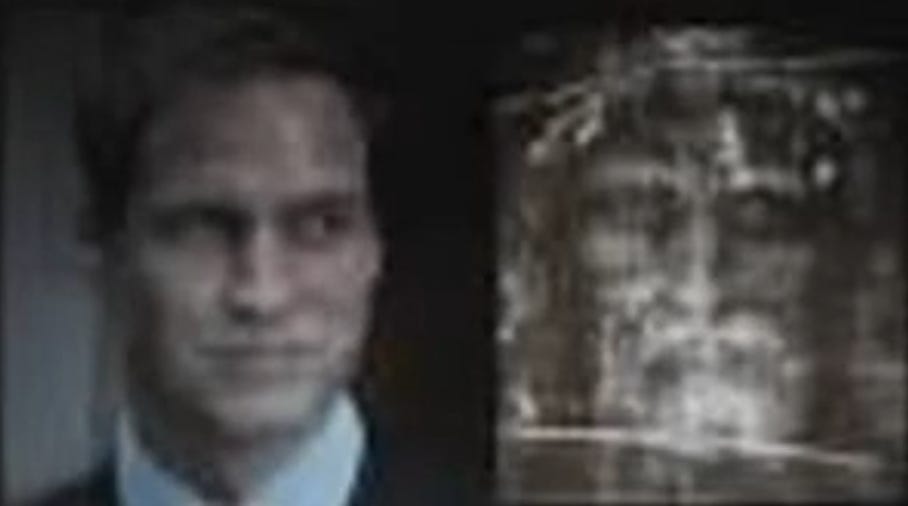
and:
also rapper 50 cent. . . a clone from old egypt. . .
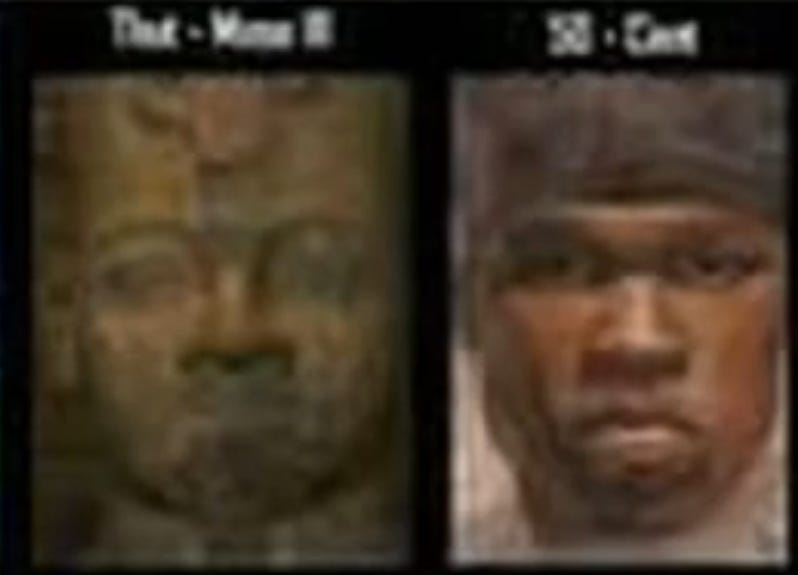
(To be clear, those are the best examples provided for each argument, and that’s as high-resolution as any of those images get.)
I was a heavy consumer of conspiracist content at this time, but this video was my first exposure to conspiracy slop, and – credit where it’s due – it was way ahead of its time in that respect. The jump from “this looks like it could be true” to “it is true” is made with absolutely zero argumentation. Superficial resemblance + bold assertion = the Truth. And that was not the kind of Truth that I’d spent so long wandering in the woods looking for.
Every conspiracy theorist knows that there are some people in the community who are a little too far gone to be taken seriously, attention-seeking egomaniacs and shills who are spouting nonsense for clicks or delusional schizophrenics pushing pure paranoid fantasy. (I even came across a theory once that Alex Jones was himself a CIA plant who was trying to steer people away from the real truth.) But what keeps people in the game is the conviction that the truth is out there and that they’re part of a community of truth-seekers who are really on to something.
In this Obama-as-reincarnated-Pharaoh video, I suddenly saw the mask pulled back on the whole enterprise. Beyond a desire for the truth, there’s also a perverse need for the truth to be weird, and complicated, and shocking. A straightforward and simple explanation is considered dubious by conspiracists just because it’s simple and straightforward. It’s not enough for Obama to be a puppet of Wall Street, secretly obeying the dictates of the Trilateral Commission and propped up by a sophisticated CIA mind-control propaganda campaign. He also needs to be a reincarnation of an ancient Egyptian king. And why? Idk man something about pyramids and the Illuminati and the Jews – oh did I mention the completely unexplained shots of Obama in a yarmulke at the Wailing Wall interspersed with the side-by-side comparisons of the President and statues of ancient Egyptian lookalikes?

I wouldn’t say that this video cured me instantly of conspiracism, but it was never the same for me after that. They argued their point so poorly that I started to doubt the entire edifice of conspiracism. Over time, I found myself caring less and less about who really shot JFK. I got involved in the Occupy movement and grew some class consciousness. I spent some time outside riding my bike. Honestly, I think it was just luck and circumstances that turned me aside from the path I was on. I wish I had a better explanation, some advice to give to people or something, but I’ve got nothing. Nothing except a cautionary tale.
XV
Let’s end where we began – with the lizard people.
On Christmas Day 2020, a Nashville resident named Anthony Warner blew up himself, his RV, and dozens of buildings, motivated in part by a desire to expose the secret reptilian power structure. “They put a switch into the human brain so they could walk among us and appear human,” he wrote just days before his self-immolation.
Warner also camped regularly in Montgomery Bell Park, west of Nashville, a pastime that fed his conspiracy obsessions — he considered the park to be prime ground for hunting alien reptilians.
He described struggling to spot them with an infrared device, believing they could adjust their body temperature to the surrounding environment, and warned that bullets would just bounce off. “If you try to hunt one, you will find that you are the one being hunted,” he wrote.
In letters to friends, Warner touched on a wide array of conspiracy theories, writing that “The moon landing and 9-11 have so many anomalies they are hard to count.” (Again the focus on dismantling the official narrative rather than providing a thorough and detailed alternative account!)
He went on to say that “The knowledge I have gained is immeasurable. I now understand everything, and I mean everything from who/what we really are, to what the known universe really is.” In his letters, he elaborated on his belief that the entire political class was composed of reptiles from the fourth dimension who were only able to sustain their human forms through regular infusions of the blood of children and infants.


It’s easy to write this off as the ramblings of a madman, but I can personally guarantee that the first time this man heard about the lizard people, he had the same reaction that you did when I described them at the beginning of this essay, the same reaction I did the first time I heard about them. There was a time when Warner would have read something like the letters he wrote and said they were ridiculous. But he hung around in the kinds of spaces, online or in real life, where he would keep hearing more about the reptilians, no doubt as part of his own personal pursuit of The Truth. Then eventually, there was some kind of turning point when he said to himself, “Wait, there might be something to this Lizard People thing after all.”
Even after that, I’m sure there were times, as he fought through the dense undergrowth of the Forest of Conspiracism, when he thought about going back, when he was sure he’d made a wrong turn, but for reasons we can only imagine he pushed on and on, deeper and deeper, right up until the moment he pushed the detonator. The endless quest for hidden truth will fuck you up in ways you can’t imagine. Turn back before it’s too late.
Thanks for reading! I decided to try out a more experimental structure this month – I hope it contributed to the immersion in the subject matter.
If you’re interested in learning more about this topic, here are some video essays that have helped shape my perspective over the years:
In Search of a Flat Earth – Folding Ideas. Probably the best exploration of that particular conspiracist subculture I’ve encountered, and the twist half-way through the video is not to be missed.
This Black Person Is Not Real – Pillboy. Incredibly well-written and edited piece on how generative AI replicates and amplifies racial stereotypes and conspiracy theories.
Who’s Afraid of Gender – PhilosophyTube. Contains a great explanation of phantasms, a concept I briefly alluded to.
The Video That Made Me a Feminist – Lily Alexander. Lily discusses her flirtations with the early manosphere as a teenager and the event that snapped her out of it.
The Nightmare World of TikTok Conspiracy Slop – Miniminuteman. Milo Rossi is great on archaeology conspiracism generally.
Internet people lie about fluoride – Angela Collier. Because small conspiracy theories keep people stuck in conspiracism, it’s important to debunk them thoroughly and ruthlessly.