The UK government recently formed a group to address the nation’s drought. The group offered some ways everyday people can save water:
HOW TO SAVE WATER AT HOME
Install a rain butt to collect rainwater to use in the garden.
Fix a leaking toilet – leaky loos can waste 200-400 litres a day.
Use water from the kitchen to water your plants.
Avoid watering your lawn – brown grass will grow back healthy.
Turn off the taps when brushing teeth or shaving.
Take shorter showers.
Delete old emails and pictures as data centres require vast amounts of water to cool their systems.
Obviously the last one caught my eye. Innumerate statistics about data center water use have now been shared by a major government.
This may seem like a silly one-off mistake, but it’s blowing up and now being recommended as a top way to save water by the Times, the Telegraph, the Independent, and Metro. Notice that none of these articles include any specific estimates of how much water deleting emails and photos saves. They just hand wave at the fact that data centers use water.
The group failed to compare how much water each choice saves. Once you do that, it becomes clear how ridiculous this advice is. I did the math. I’ll share the results and then how I got them.
I don’t know how to get accurate estimates for all of the recommendations on the list, so I’m sticking to the ones I can get clear numbers for:
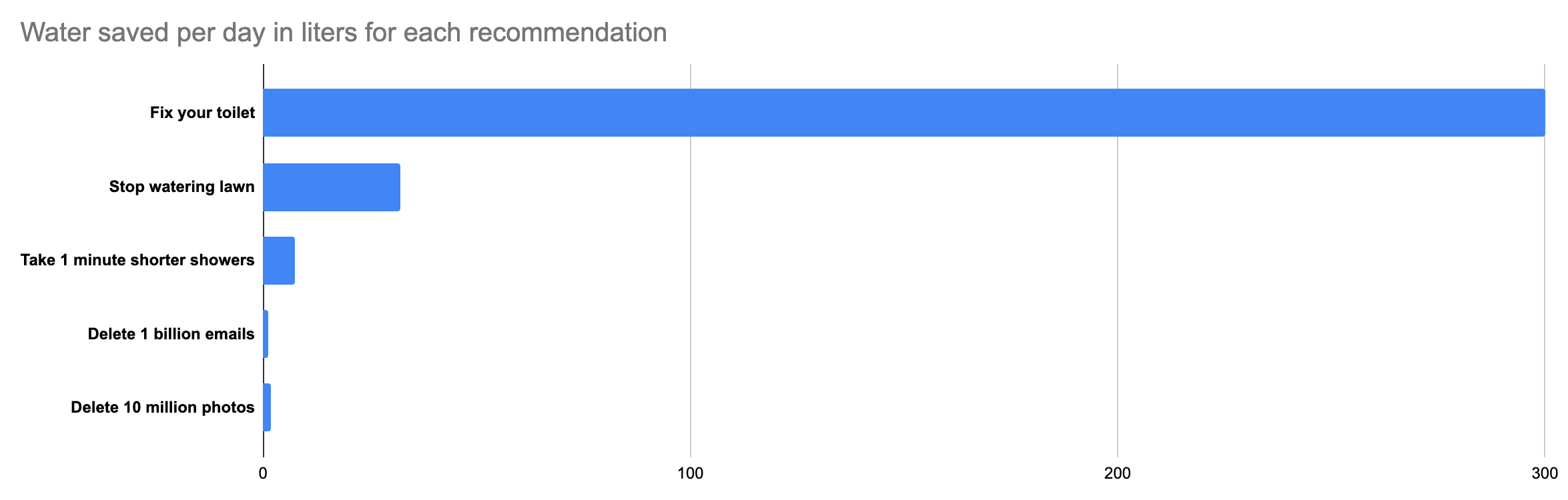
To save as much water in data centers as fixing your toilet would save, you would need to delete 1.5 billion photos, or 200 billion emails. If it took you 0.1 seconds to delete each email, and you deleted them nonstop for 16 hours a day, it would take you 723 years to delete enough emails to save the same amount of water in data centers as you could if you fixed your toilet. Maybe you should fix your toilet…
If the average British person who waters their lawn completely stopped, they would save as much water as they would if they deleted 170 million photos or 25 billion emails. A typical lawn needs about 2.4 L of water per square foot per week to stay healthy, and each square foot has about 2000 blades of grass. The average person seems to have about 2000 photos saved. Let’s assume they’re all backed up. If someone deleted all their photos, the water they would save could support 2 blades of grass on their lawn.

If you could gather 1000 people together and convince them to delete every last photo they have stored, together you could save enough water as it takes to maintain a single square foot of lawn.
If you stop showering 1 minute early every day, you would save as much water as deleting 38 million photos or 5.8 billion emails.
If someone took 100 photos every single day they were alive from age zero to age 80, and at the end wanted to store all those photos in a data center, the water they use in the data center could be saved if they just stopped each shower 5 seconds earlier than normal.
Here’s a graph of how much water each recommendation saves. You have to delete huge amounts of photos and emails before you come close to any of the other recommendations:
I can’t find good stats for how many photos the average person has saved on the cloud. The average person has around 2000 photos on their phone. Let’s assume these are all backed up on the cloud. This means that each year, the average person’s photo storage uses 1 mL of water in data centers. The average British person uses about 51,000 L of water per year in their home. So the water they use for photo storage represents 0.0003% of their annual water use. That’s a 300,000th of their water use. Here’s 300,000 dots (you have to click the picture and really zoom in to see one). If you want to delete every last picture you have saved, you will remove one of these 300,000 dots from your daily water use.

To put this in perspective, if you make $100,000 per year, saving the same percentage of that money would mean saving 30 cents per year. It’s like the UK government has issued an advisory that to help with the national debt, all UK citizens should spend one fewer dollar every 3 years, or buy one single fewer dinner out over the course of their whole lives.
A reader points out in the comments:
Most cloud service put files in a virtual recycle bin for 30+ days. After that, whether they actually delete the files or just permanently hide them from you is anyone's guess. So in the short term, literally nothing happens. In the medium term... who knows?
Drives don't use less power if they contain less data. At least not unless they were completely "emptied" and spun down, but everything is designed to avoid that ever happening. Since users aren't assigned contiguous physical space, deletion would at most cause myriad tiny "gaps" to appear, ready to be filled up by new data (or not). No actual drive would ever use less power.
Email, specifically, is usually "snapshotted" at regular intervals to recover from catastrophic failure or ransomware. Corporate email is often never truly deleted at all, for regulatory reasons. For many organizations, cold email storage just grows indefinitely, no matter what you yourself delete.
Since storage and demand for storage are constantly growing, all that this deletion might accomplish is to slow down the rate at which new drives are spun up a few months from now. That is, assuming they are spun up "as needed", and not just on a schedule, or by the thousand when a threshold is triggered (I have no idea).
Given how "spiky" CPU and GPU power consumption is, both with peaks two orders of magnitude that of a single drive, with wildly fluctuating day-night usage cycles and presumably safety margins to cushion all these spikes, I seriously doubt that a change in the number of drives would even indirectly impact the water intake of a data center. Yes, water intake is regulated dynamically, but I find it it hard to believe it would respond to a change of a tenth or a hundredth of a percent in total power consumption.
On top of this, the water costs of deleting photos and emails are probably much higher than the costs of storing them for a little while, because deleting them also takes energy and water in data centers, as well as energy and water in the power plant providing electricity for your computer. To be maximally charitable, I didn’t include that water cost, but I suspect it’s extremely high compared to the cost of storage.
Data centers might also be about 10x as water efficient as the numbers I’m using, so the real numbers might actually be 10x as ridiculous.
I think it would be really sad if people deleted lots of pictures that were important to them in the mistaken belief that this will help them conserve water.
Major governments should really know better than this. They should feel pressure to just run the numbers before publishing this stuff. Climate and the environment are serious problems and being silly with numbers like this erodes public trust.
Everything I’m doing here is super simple. If you see crazy claims like the original report, you should also try your best to debunk them using publicly available data. We need more people setting the record straight on these wild misconceptions.
Some reporters are already defending the original recommendation. Notice that in this article the reporter correctly notes that data centers are using a lot of water, and that emails are stored in data centers. But he never bothers to actually run the numbers to see exactly how much water your emails are responsible for (it rounds to zero). I think in general journalists should be held to a higher standard than this. Climate and the environment are too important, and the numbers we have are too clear and accessible, to justify being so sloppy.
Computing is basically the most efficient thing we do. Storing photos in data centers is way way way more energy efficient than taking physical photos. We should see data centers as a huge environmental win for data storage compared to past systems.
If you take a pipette and let a single drop of water drip from it, that drop will contain about 0.05 mL of water.
That single droplet of water is the water cost of storing 100 emails in a data center for a full year.

You would need 10,000 droplets like that to fill a typical plastic water bottle. You would need 2,780,000 droplets to get to the amount of water that the average British person uses every day.
Here are the relevant numbers to estimate how much water stored photos and emails use in data centers:
Here’s information on one of the most up-to-date drives data centers use for longterm information storage. These use about 5.5 Watts of power to store 18 TB of data. 5.5 Watts * 24 hours in a day = 132 Watt-hours per day. 132 * 365 = 48.2 kWh per year for 18 TB, or 1 kWh per year for every 370 GB of data stored.
To keep your data safe, data centers usually replicate it 3 times. So there are often 3 versions of each of your saved photos and emails in data centers.
The average data center uses 1.8 L of water for cooling per 1 kWh of energy its servers use.
We can combine the water and electricity stat to say that data centers use about 1.8 L of water every year for every 370 GB of data stored.
The average photo you take with your phone requires 5 MB of storage. Multiplied by 3 gets us 15 MB per photo in data centers.
The average email size worldwide is 59 KB. Multiplying by 3 gets us 177 KB per email in data centers.
So we can now make the final conversion from data used to water used.
It costs 1 liter of water per year to store about 14,000 phone-quality photos in data centers.
It costs 1 liter of water per year to store about 2,090,000 emails in data centers.
I don’t know how to get reasonable guesses for some of the statistics, so I’ll only look at the recommendations with clearer numbers:
Fix a leaking toilet – leaky loos can waste 200-400 litres a day.
Avoid watering your lawn – brown grass will grow back healthy.
Take shorter showers.
Let’s average this to 300 L per day. 300 L/day * 365 days/year = 109,500 L per year.
109,500 L * 14,000 photos/L = 1,533,000,000 photos
109,500 L * 2,090,000 emails/L = 228,855,000,000 emails
I can’t find great data on how much water lawns use. I asked ChatGPT for a botec and this is the best I’ve got. Let me know if you find better numbers! I’ll stick with the lower end of 12,000 L per year.
12,000 L * 14,000 photos/L = 168,000,000 photos
12,000 L * 2,090,000 emails/L = 25,080,000,000 emails
I’ll assume the average person showers for 8 minutes and uses 16 gallons of water in total. Cutting your shower by 1 minute saves 2 gallons of water per shower.
2 gallons = 7.6 L. 7.6 L * 365 = 2774 L.
2774 L * 14,000 photos/L = 38,836,000 photos
2774 L * 2,090,000 emails/L = 5,797,660,000 emails