Epistemic status: A speculative but phenomenologically compelling modeling proposal. And goodness knows we desperately need new ideas to model awakening.
Most people who’ve done serious meditation or high-dose psychedelics have had some version of the “Big Experience.” “White light.” “Everything everywhere all at once”. The conviction that you’ve touched the Ultimate.
Someone comes to you wide-eyed: “I experienced something incredible: I felt we were all one! Have you ever...?” And the honest answer, if you’re phenomenologically precise, and honest, and not too concerned with phatic communication, should generally be: I need a lot more information to know what you’re talking about.
Was your experience calm or highly excited? Localized or boundaryless? Did it have a center? How long did the afterglow last? And even these questions need to be clarified significantly. Perhaps to an extent that nobody, currently, would be able to diagnose with real knowledge (in the sense of justified, true, belief!). There’s a whole family of experiences that feel ultimate to the person having them, and from the outside, the task is actually really tough, in proportion to the level of exposure and epistemic ceiling of the person making the inquiry.
Drug-induced peaks tend to be noisy and high-energy. Meditative peaks tend to be more refined and steady. Both can feel like the One Ultimate State. But there are families of such things, don’t forget that; their specificity may not be introspectively accessible in the moment (think about how people may confidently assert “this is the best restaurant, ever!” and, if truly believed, will usually reflect an internal failure of contextualization rather than a grounded judgment).
An analogy would be a powerful sense of (real!) insight that comes from learning F=ma and really grokking it. You may feel like you’ve understood physics. F=ma is real and profound, but there’s a whole curriculum after it.
People who systematically investigate low-entropy states describe categories of increasingly refined experience. For example, prominently, the Jhanas as a system of practice, categorization, and navigation.
Maps disagree, but there are remarkable similarities: the states are repeatable, and they typically come in a sequence of degrees of refinement. Each may, in turn, feel like “the most refined/purified state of consciousness you’ve ever experienced” but then the next one shows you the previous one was still subtly turbulent and “coarse”.
So what is actually changing? What makes Fourth Jhana more refined than First Jhana in a way you could formalize?
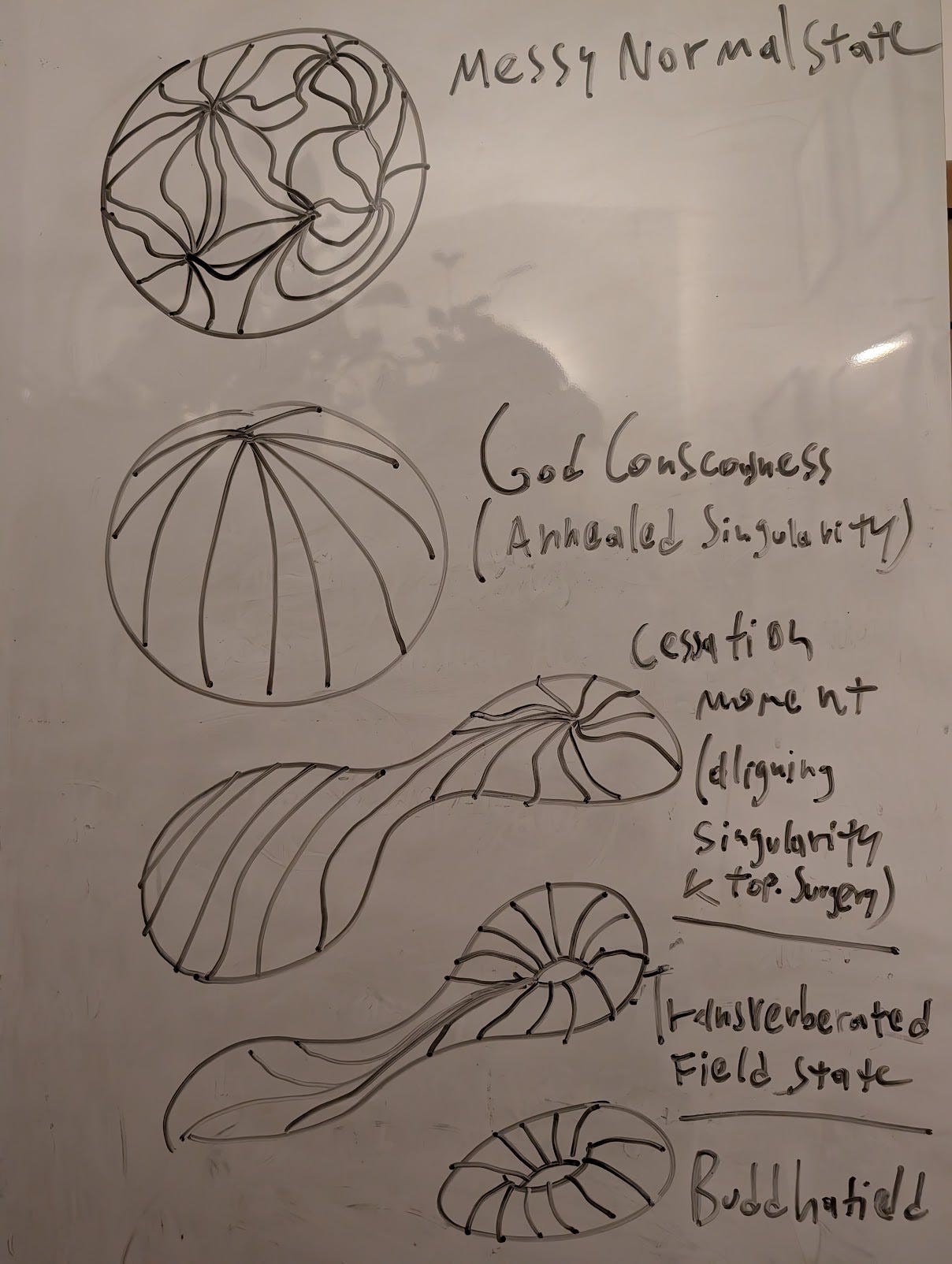
Since HEART 2023, I’ve been thinking about a hypothesis that emerged during our conversations and peak experiences. Not only is each moment of experience a topological pocket, but it also has internal topology that constrains which configurations are possible. Liberation might involve changing the topology of the moments of experience our mind-brain generates.
If the relevant attention dynamics behave like a continuous tangent vector field on a closed surface (or a director field, or an XY-model phase field), then topology constrains the defect structure. On a sphere, you cannot globally eliminate defects. Enter the hairy ball theorem: comb a hairy sphere and you get at least one cowlick. Run an XY model on S² and you get vortices whose net topological charge is fixed by the Euler characteristic (see: 5-MeO-DMT: A crash course in phenomenal field topology by Cube Flipper).
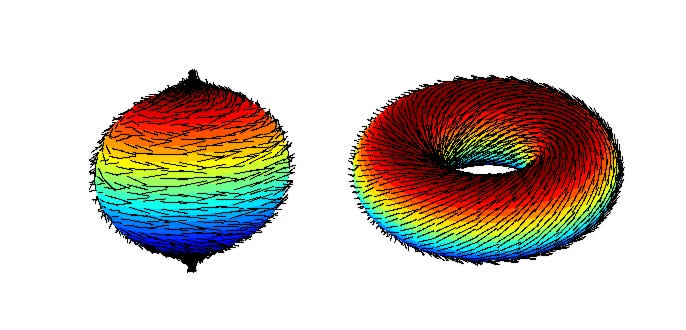
In the simplest picture, defects look like point vortices (see the North and South pole in the sphere above). The phenomenology we care about is likely higher-dimensional. When oscillators have multiple coupled degrees of freedom, defects need not be points; they can be lines, braids, and linked structures. Namely, topological structures that are long-lived (topologically protected) yet still annealable under the right dynamics.
Physics knows objects like this. One example, among many, is disclination lines (lines where molecular orientation becomes singular) in nematic liquid crystals (the same phase of matter used in LCD screens, where rod-like molecules align along a common axis). The image below, from Muševič’s review of topological defect dynamics in liquid crystals, shows what happens when an isotropic droplet (uniformly disordered) transitions into a nematic phase (ordered). At t=0, the droplet is uniform. By t=175ms, a tangle of disclination lines has formed: braided, knotted structures where the molecular orientation is undefined. These are topological defects, and they carry charge.
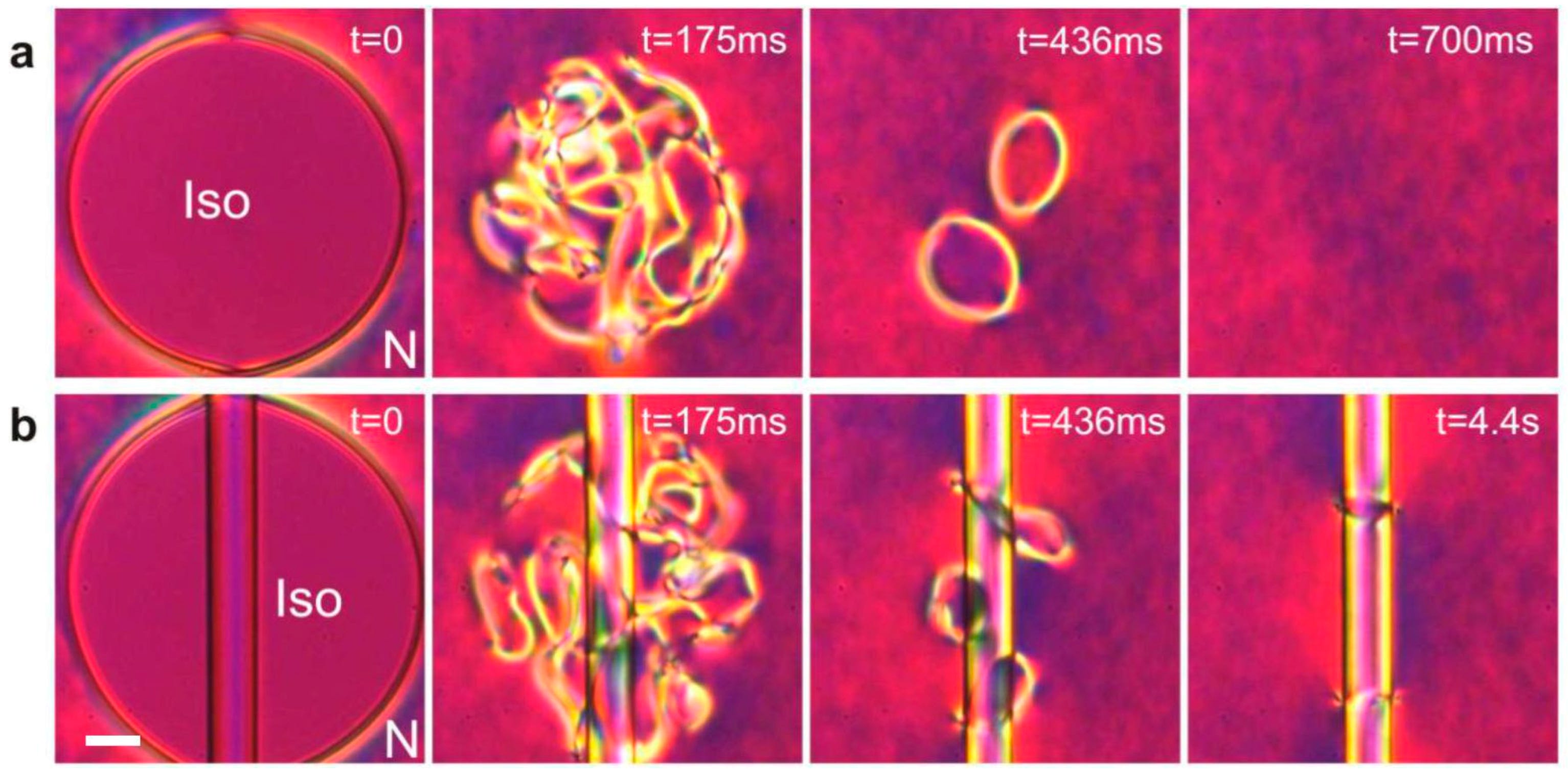
Watch what happens. In row (a), the tangle reconnects, simplifies, and by t=700ms has completely annihilated. The droplet achieves a defect-free configuration. In row (b), different boundary conditions (the vertical fiber) change the topology. The tangle partially simplifies but cannot fully annihilate. Defects persist even after 4.4 seconds. Even though it’s the material, as the topology evolves, its properties change.
Importantly, take note: defects can annihilate when topology permits. They cannot when topology forbids. The dynamics will try and have the system seek lower energy configurations. But if the boundary conditions or global topology require defects, defects will remain. They may simplify and redistribute, even become less tangled. But they won’t ever disappear.
There’s increasing speculation that liquid crystal structures in biology (e.g. microtubules and membrane organization) might be relevant to neural function in ways we don’t yet understand. Why couldn’t awakening at the cellular level involve topological transformations in these structures? Why couldn’t the “novel body” that contemplatives sometimes report be, in part, a reorganization of liquid crystal topology at scales below ordinary perception? I’m not claiming this is established, but I find the mathematical framework really generative and phenomenologically compelling.
If baseline phenomenology has sphere-like topology (for example) and attention flow follows something like a phase field on that manifold, then persistent defects are generically unavoidable. You can move them around and you may get the impression that you’re making progress, but in reality you cannot eliminate them all.
This offers one model for why ordinary consciousness comes with built-in tension. The topology doesn’t permit defect-free configurations. Perhaps the self is built atop a cluster of topological defects that are, ultimately, inevitable given the global topology!
This account also suggests something about chronic pain. Suppose a nociceptive/somatosensory subsystem contains a braided defect: a stable tangle in the multidimensional attention field coupling tactile, interoceptive, and affective channels. Because the structure is topologically constrained, local interventions change intensity but don’t ultimately resolve the knot. You can “blast” the pain and have it discombobulate for a while but the tangle will reform because the system hasn’t escaped, and can’t escape, its (topology-based) attractor basin. The relief would require topological annealing: a global reconfiguration that allows the braid to unwind.
If suffering is partly defect-structured, then effective compassion actually requires a very specific technical solution: learn the moves that truly dissolve defects by changing the global topology in the right way. Then the knot will dissolve on its own in time.
Gradient descent finds local minima by rolling downhill, but it can get stuck in local minima of tension. We’re doing it all the time already! Annealing, proper, does something harder: it allows the system, via a higher-energy, to explore alternative topologies and permit the twisted configurations to escape the local minima.
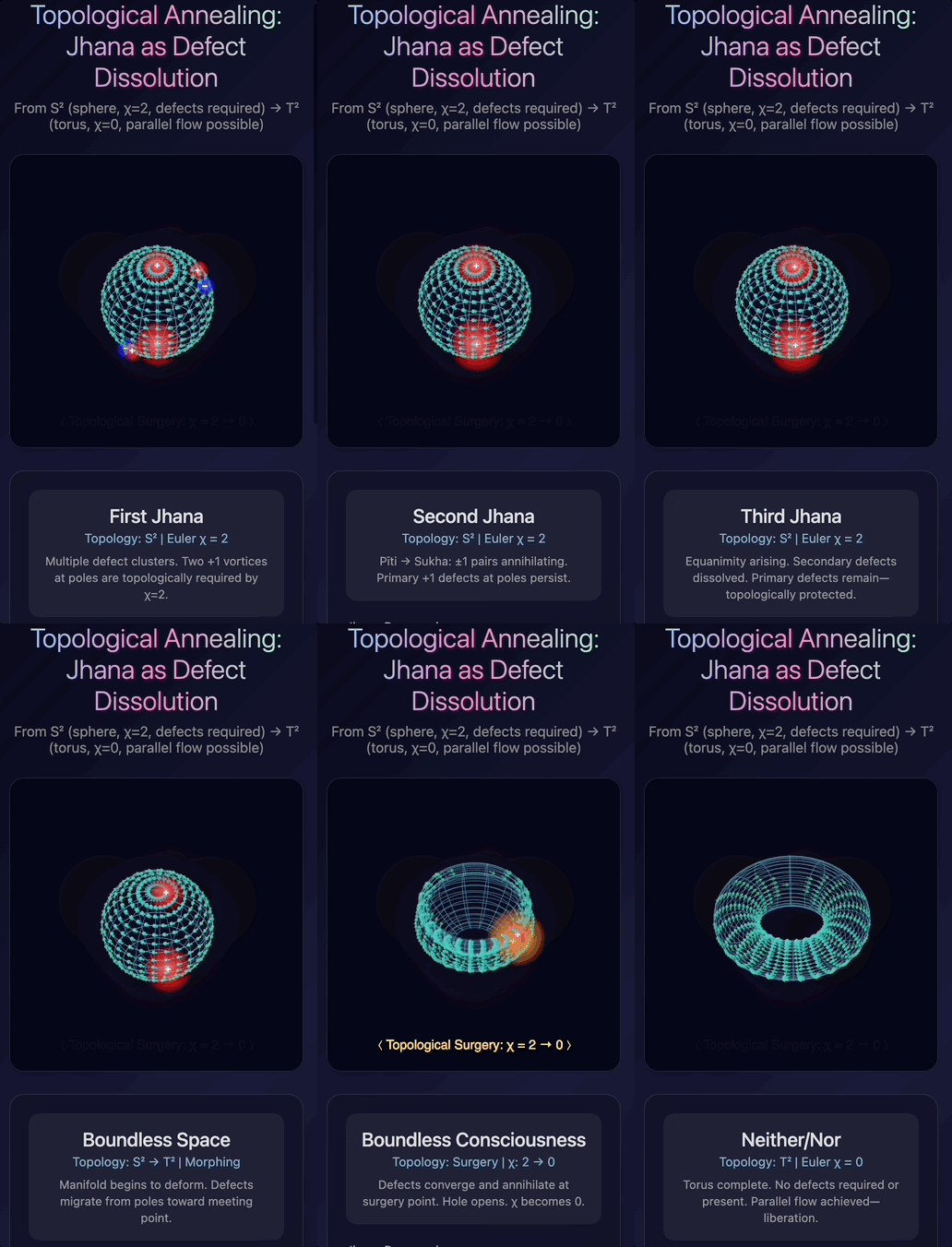
The Jhana might be interpreted through the lens of topological annealing stages. For example (schematically)
First Jhana: large synchronized regions, high amplitude, strong consonance. Still multiple clusters with vortices between them. In fact, often you get more twisted before you unwind, because you need to align and pack the braids together.
Second Jhana: when piti (body pleasure, in the model, a kind of bubbly braiding) turns into sukha, the coarse braids start to cancel out and release their stored energy in a smooth(er) field.
Third Jhana: you begin to untwist not only local regions of the sensory field, but also the overall sense of spatial regularity, giving rise to equanimity (settled field states) as a byproduct of the “topological fuel”.
Fourth Jhana: You settle on a configuration that has as few defects as the current topology permits. The remaining vortices are topologically protected. “You’ve optimized within S²”, to give you an intuition.
The formless Jhanas start to play with the topology itself. Boundless space, boundless consciousness, nothingness, neither-perception-nor-non-perception—these might be explorations of what happens as you relax the constraints that were holding the manifold in its familiar shape.
Recall the recent QRI piece, “Indra’s Net via Nonlinear Optics”. According to this model, the “screen” of conscious experience, the central workspace where everything appears, is being simultaneously broadcast to many semi-independent processing modules. Call it a beamsplitter architecture: one signal in, multiple copies out, each copy going to a different specialized subsystem.
Say, face recognition gets a copy. Motion detection gets a copy. Emotional evaluation gets a copy. Each module processes its copy independently, applies its specialized transformations, and then projects its edits back onto the shared screen.
The key insight here is that all the modules have access to the whole scene. Each one receives the full broadcast and has the ability to transform it according to its specialty, and contributes its transformed version back to the collective.
What you experience is the standing wave that emerges when all these transformed versions are superimposed back onto the shared screen. This is usually messy, if adaptive. But there exist configurations where every module’s edits are highly aligned with each other. The system has found an arrangement with genuine closure (think: Vulture Peak assembly in the Lotus Sutra, where beings from countless world-systems are arranged in a high-dimensional mandala, all witnessing each other without conflict. A metaphor for topologically annealing subagents who can finally see each other clearly through Indra’s Net?).
Inside a topologically bound pocket, there is no privileged camera. Every internal vantage point is part of the subject. “You” are the superposition of all internal viewpoints under mutual influence.
As a physical analogy, think about how the atomic orbitals are stationary eigenmodes of the Hamiltonian, shaped globally by boundary conditions and symmetry.
At the limit where topology permits perfect combing, all internal perspectives become mutually isomorphic, causing the “collapse of different points of view”, hence no distinguished viewpoint. At the limit where all viewpoints are perfectly identical and contentless, we might find what practitioners call cessation.
Along the way, the details of the remaining topological defects might be what distinguishes different types of “unity” experiences. Many “I AM GOD” states may be nearly combed configurations: the field is globally aligned, but one dominant singularity remains, so that a residual defect acting as a pivot centralizes the perspective. Subject-object structure is mostly gone, yet a single organizing center persists. Interestingly, as long as this isn’t ultimately cancelled out via a global topological change, it may actually feel ultimate and impossible to get rid of (enter “God is eternal, always existent, etc.” standard impressions that arise from these categories of peak experiences). That twist is experienced as cosmic centrality or an omniscient sense of agency.
Deeper emptiness states approach the further limit where even that last topological defect cancels out. This is past the “unity-with-a-center”, and it reaches into symmetry so complete that no viewpoint is distinguished enough to break the global symmetry.
A sphere-like regime (Euler characteristic, aka, χ, is equal to 2) forces defects. A torus-like regime (χ = 0) permits defect-free combing. Some oneness states may be “sphere but smoother”. High coherence without topology change! Cessations require something closer to a handlebody transition then mere combedness.
Daniel Ingram catalogs cessation phenomenology in the Three Doors chapter of Mastering the Core Teachings of the Buddha. Three patterns, each lasting “three or four moments” over roughly a quarter second.
Impermanence: The door has a “dat, dat, dat, gone!” quality, “as if all of space has stuttered three or four times in very rapid succession and disappeared.” It relates to “realizing what is between the frames of the sensate universe.” Ingram calls it “the fastest of the three and tends to be the most surprising.”
Speculatively, topologically: vortices require temporal stability to maintain their phase winding. Strobe the field fast enough and defects can’t cohere. The flicker dissolves them. (Dear advanced meditators reading this, do you think this is on the right track at least?).
Suffering: This door involves “dropping attachment like a hot coal that we finally realized we were holding” and “feeling the fundamental queasy tension in the illusion of duality for just a bit longer than we ever would normally.” The mind releases “its fixation on the whole of relative reality and allows the whole of it to fall away completely, meaning away from where we thought we were.” It “tends to be the most unsettling or wrenching of the three doors, the most death-like. It is always a touch creepy.” The experience “feels like something was violated or wrong with what happened, like something essential was torn from us.”
Topologically (again, speculatively!): that “queasy tension” is the energy sustaining the defect. Vortices are maintained by strain in the surrounding field. Release the tension and they can’t be sustained, and cancel out with their complement outside your topological pocket (cf. “On the Necessity of Inner and Outer Division for the Arising of Experience”).
No-Self: This door involves “staring back at yourself (or something intelligent regardless of whether it looks like you) with no one on this side to be stared at and then collapsing into that image.” Ingram describes it as “the collapse of awareness into the intelligence or cognition of the perceived.” It is “the opposite of the suffering door, in that everything comes this way (rather than everything going that way)” and “tends to be the most pleasant, easy, and visually interesting of the three.”
Here is where the topology story is most interesting and rich. In certain variants combining no-self with suffering, Ingram reports that “the universe becomes a toroid (doughnut-shaped)... and the image and this side of the toroid switch places as the toroid universe spins. It may spin sideways (horizontally), or it may spin vertically (like head over heels).” The rarest variant “involves reality becoming like a doughnut whose whole outer edge rotates inwards such as to trade places with its inner edge (the edge that made the hole in the middle)... and when they trade places reality vanishes. Fruition occurs when the two have switched places and the whole thing vanishes.”
Perhaps he is describing the process of global topological change directly. Or at least the process of getting there (and the optical artifacts that arise along the way). A sphere has an inside and an outside that cannot be exchanged without tearing. A torus permits continuous rotation between what was “this side” and what was “that side.” The observer-defect, which on spherical topology is topologically protected (it cannot be combed away), becomes eliminable once the manifold admits a handle. The “swap” completing is the moment the last defect annihilates.
Ingram experienced this without the mathematical frame. But perhaps, if we’re lucky, we can confirm this with visualized phenomenological modeling (cf. Oscilleditor). (See also: The three marks of existence and the Fourier uncertainty principle by Cube Flipper and Ethan Kuntz, for another promising, perhaps complementary, angle on this topic).
When a pocket is perfectly combed, there’s nothing to report. If the flow of attention is perfectly parallel it doesn’t have anywhere to land. The singularities were needed to report something: points where the flow of attention could converge on something. A full cessation having purely parallel field lines would be “phenomenologically silent”.
That said, silence is not not being. These pockets are regions of perfect valence. And they come in sizes!
A microcessation liberates a small pocket: one subsystem achieving local coherence while the rest remains turbulent. A large cessation like Nirodha Samapatti liberates a huge region. The total positive valence probably scales with the size/energy/information content being combed.
Shinzen Young describes an “additional awakening” twenty years after his initial breakthrough: constant cessation alongside his normal awakened state. A permanent chunk of silence attached to a functional world-simulation. I think this is topological surgery in his own pocket. Namely a handle that stays. Like attaching a piece of Nirvana to follow you around wherever you go. See him talk about his personal experience of “transverberation” or “God’s Arrow” going through him:
In Mahayana cosmology there are Buddha fields. Regions where enlightened beings dwell. What if they’re phenomenological descriptions? A Buddha land as a nirvana pocket, stabilized and expanded, large enough to constitute a world. The could still have interesting topology, and information processing, even intelligence (and evolution?) as long as it robustly prevents topological braiding from happening.
There would be nothing to report from inside, given the perfect symmetry and flow of attention, so in a sense, nothing happens. And yet: being. Vast being. In perfect valence!
At HEART 2023 we investigated whether 5-MeO-DMT could accelerate the attention changes that practitioners report on the path of insight (see Wystan’s writeup on the similarities between 5-MeO and samadhi, and my piece on using 5-MeO to accelerate insight practice).
The key observation is that 5-MeO dramatically reduces the number of attentional “buckets” while increasing their intensity. Other psychedelics tend to increase complexity, adding more “competing clusters of coherence” to the system. On 5-MeO you go from dozens of semi-independent attention metronomes to a handful of massive ones, and ultimately just a few or one.
Wystan notes that the phenomenology trends toward “formless dissolution and ultra-smoothness,” progressing through bodily boundary dissolution, self-other boundary dissolution, cessation of formed content, and potentially the dropping of subject-object structure entirely. Shinzen Young has called 5-MeO’s effects “vectorially correct” with respect to awakening.
5-MeO carries real risks. The God Realm (the Heavenly Realms of Buddhist cosmology, experienced as states of cosmic bliss and significance, cf. Traps of the God Realm from Opening the Heart of Compassion by Martin Lowenthal and Lar Short) can feed addictive patterns. Roger Thisdell pointed out at the retreat that as long as you are having “Super Fun,” you will not be motivated to work toward liberation. The God Realm has a tendency to not want to look at itself carefully, to stay slightly out of focus so as not to notice how even heavenly sensations are still impermanent, unsatisfactory, and empty of self.
But for internalizing very simple truths at a depth that might actually change topology, 5-MeO may be among the most powerful tools available.
What does the model suggest?
(Warning: do read about the possible drawbacks, side-effects, and considerations of this process before embarking on it. Strongly advised to read Ingram’s book, as well as diverse pragmatic dharma literature such as Seeing That Frees, by Rob Burbea, for detailed information on this and related topics; don’t take this blogpost too seriously, it’s a speculative research direction, not a detailed and calibrated manual!).
First, reduce defects. Annealing in the context of the path of insight might best be understood as a long process of topological defect cancellation across scales in one’s body/mind.
Second, approach cessation through whatever door works. Impermanence, suffering, no-self. Presumably there is a shortest path for different people. They lead to the same topological class endpoint, which might be a very efficient way of shedding topological complexity by restructuring one’s global field topology.
Third, allow topology change. Perhaps even sensitize yourself to it. We instinctively resist it, and local topological transformations might actually feel bad before they propagate all the way to an improved Euler characteristic for your field as a whole. Equanimity is a must. Repeated cessations, or deep enough cessations, seem to cause permanent change.
Fourth, expand the nirvana pockets. Grow the defect-free region and start to connect separate pockets of Nirvana. Extend the territory of stillness.
One interesting Buddhist tradition map to look through this lens is the fetters. Ten fetters, progressively abandoned across four stages of awakening: Self-view, doubt, attachment to rites and rituals, sensual desire, ill will, craving for fine-material existence, craving for immaterial existence, conceit, restlessness, ignorance.
Rob Burbea, in Practicing the Jhanas, talks about the hindrances as “poisoned darts out of which things grow.” That might correspond to the image of a topological defect: a singular point around which the field organizes and from which distortions propagate. The defects need to recruit more and more of the field to relieve the local tension, but in the process create complex braided patterns. The fetters might be the major braided structures at the core of our “being”. I.e. the stable tangles in the attention field that ordinary practice can modulate but not dissolve.
If that’s right, then the four paths are four stages of topological surgery. Speculatively: stream entry removes certain braids, once-returner loosens others, non-returner cuts more, and arahatship is the field finally achieving a topology that supports no fetters at all.
Novel topological surgeries might exist that the tradition hasn’t mapped, so states accessible via 5-MeO or other technologies that cut braids in different orders, or dissolve structures that classical practice leaves intact, might (soon?) give rise to entirely new paths of insight. May it be so, and may we let the defects, under the right conditions be eliminated. Rather than by fighting them, by intelligently (and knowingly) changing the topology of the shape of the space they live in.
Thank you for reading.
Infinite bliss!
Note on authorship: Core ideas developed at QRI HEART 2023, in discussion with Roger Thisdell, Wystan Bryant-Scott, Cube Flipper, and many more. A lot of recent ideation from personal Jhana retreats and 5-MeO-DMT exploration. Claude suggested ways of structuring the information and draft prose based on transcripts, notes, outlines, old drafts, and an original draft I wrote earlier today. Essay has been workshopped/edited heavily in the last 7 hours or so. Errors, including of reasoning, are mine. What do you expect? I’m posting once a day!