Ask a room full of people how they got their current job and you will hear a pattern. A former colleague mentioned an opening. A friend of a friend made an introduction. Someone they worked with years ago got in touch. A recruiter found them - which is to say, a professional whose entire job is being a node in other people’s networks found them. A minority will have answered an advertisement cold. In most rooms, it is a small minority.
We have known this formally for fifty years. In 1973 a young sociologist named Mark Granovetter published a paper in the American Journal of Sociology called “The Strength of Weak Ties”. It is, by most counts, among the most cited papers in the whole of social science, and it began with a survey question much like the one above. Granovetter asked professional, technical and managerial workers in a Boston suburb how they had found their jobs. Most of those who found work through a personal contact had found it through someone they saw occasionally or rarely - an acquaintance, a former colleague, a friend from an old chapter of life. Fewer than one in five had found their job through someone they saw often.
That finding, and the theory behind it, opened up a field that most HR practitioners, and I suspect many of my readers from psychology and economics, have never been formally introduced to: economic sociology - the study of how economic life actually runs on social structure. This issue is that introduction. I think you will find, as I did, that it explains things about recruitment that neither psychology nor economics can reach on their own - and that it has now passed one of the largest experiments ever run on a theory in social science.
To see why the sociology matters, start with the model it displaced.
The textbook picture of a market comes from the nineteenth-century economist Léon Walras, and economists still call it the Walrasian auction. Imagine an auctioneer standing between everyone who wants to sell something and everyone who wants to buy it. The auctioneer calls out a price. If more people want to buy than sell, the price rises; if more want to sell than buy, it falls. Eventually a price is found at which supply exactly meets demand, everyone trades, and the market clears. Nobody needs to know anyone. The goods are interchangeable, the buyers and sellers are anonymous, and the only information that matters is the price. If you took an introductory economics course, this is the machinery behind the supply and demand curves you drew: the curves themselves just record willingness to buy and to sell, and the auctioneer’s price adjustment is how the market is assumed to find the point where they cross.
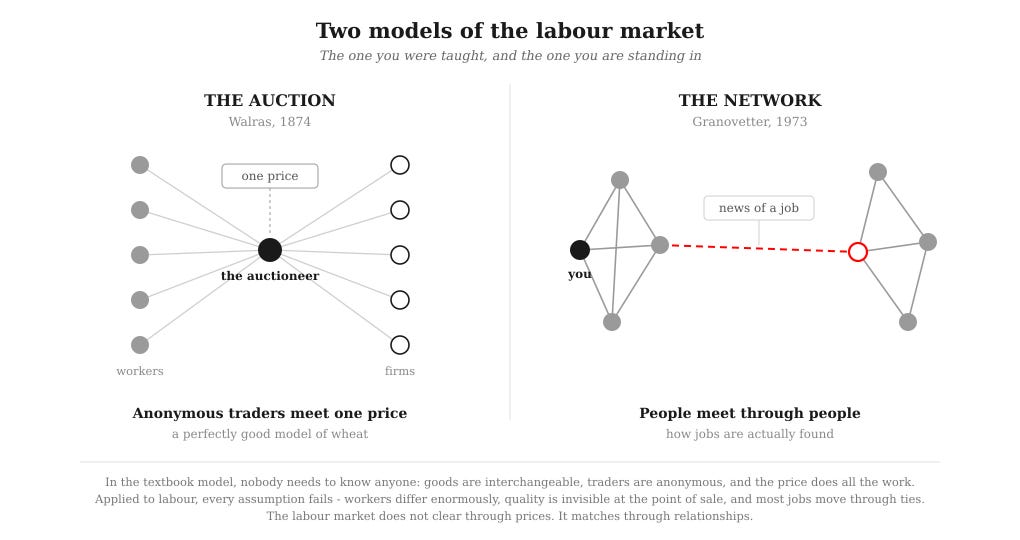
This is a perfectly good model of the market for wheat or copper - homogenous products. Applied to labour, it makes three assumptions, each of which this series has already spent an article dismantling. It assumes workers of a given type are interchangeable - but the productivity differences between people in the same job are enormous, as we saw in Issue 5. It assumes quality is visible at the point of sale - but every hire is a bet made in the dark, as we saw in Issue 6. And it assumes that a worker’s value is a fact about the worker - when a large component of productivity is match-specific: the same person is differently productive at different firms, in different teams, under different managers.
Add the plainest fact of all - that most jobs are filled through people rather than through anything resembling an auction - and the textbook model is not simplified so much as wrong in its architecture. The labour market does not clear through prices. It matches through relationships.
What I find striking, and what makes this a very Working Ideas story, is that two disciplines reached this conclusion independently and spent decades barely citing each other. Sociology got there through Granovetter and the study of networks: economic action, he later argued, is embedded in concrete social relations, not conducted between strangers. Economics got there through the study of search and matching - the recognition that when meeting is costly and quality is revealed slowly, the process by which workers and firms find each other matters more than the wage - work recognised in the 2010 Nobel award to Peter Diamond, Dale Mortensen and Christopher Pissarides, and, as we will see later, in the 2012 award to Alvin Roth and Lloyd Shapley for showing that matching processes can be deliberately designed. When two fields that do not read each other abandon the same model, the model deserves to stay abandoned. The Walrasian auction, as a model of the labour market, is that model.
Granovetter’s paper is worth understanding properly, because the reasoning is more interesting than the headline.
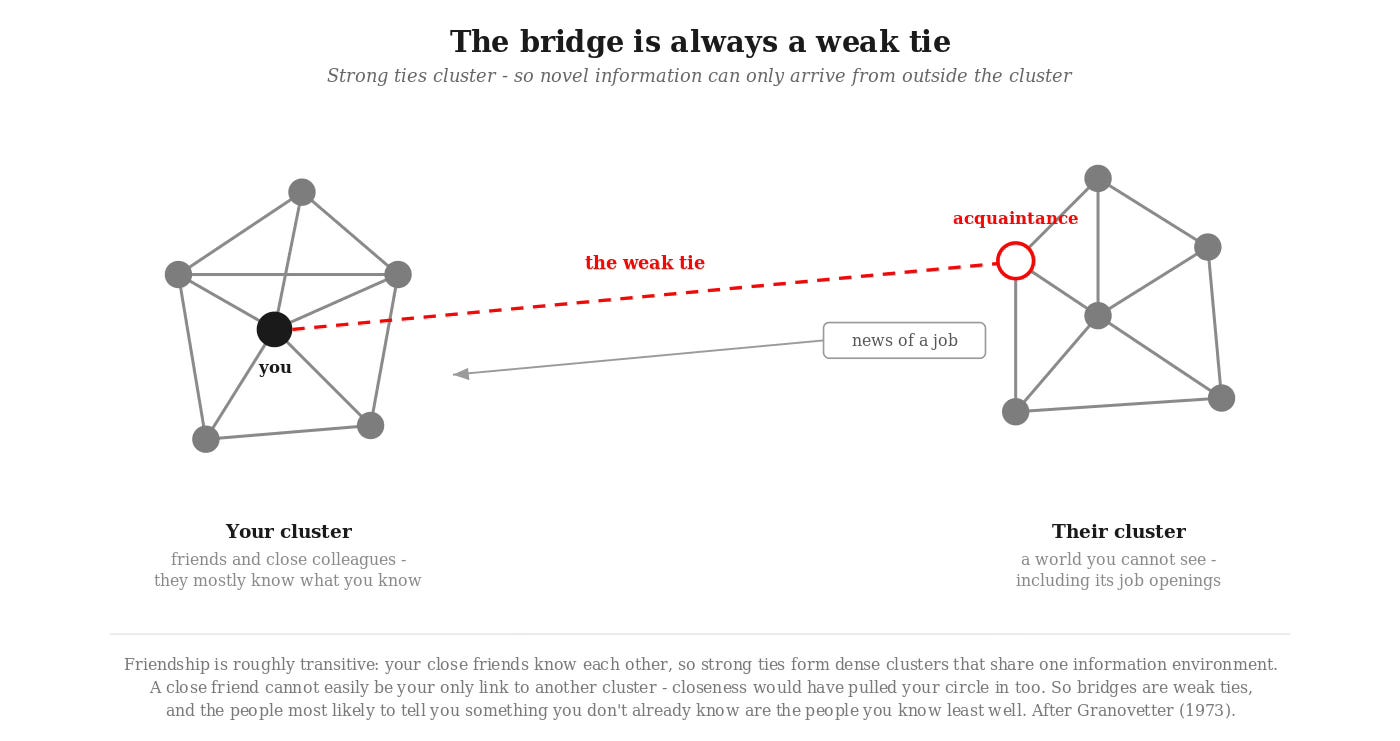
The argument has two steps. The first is almost geometric. Your strong ties - close friends, immediate colleagues - tend to know each other. Friendship is roughly transitive: if I am close to two people, the odds are good they are at least acquainted. Strong ties therefore form dense clusters. And that has a structural consequence: any bridge between two clusters is almost always a weak tie. A close friend cannot easily be your only link to a group of people, because closeness would have pulled the rest of your circle into contact with them too.
The second step converts that geometry into information. People who share a cluster share an information environment. Your close friends mostly know what you know - the same openings, the same gossip, the same opportunities. Novel information lives on the other side of the bridges, and the bridges are weak ties. So when Granovetter’s respondents reported finding jobs through acquaintances rather than friends, this was not a curiosity about American suburbs. It was the visible trace of network structure: the people most likely to tell you something you don’t already know are the people you know less well.
I want to underline what kind of explanation this is, because it is the gift sociology brings to this series. Psychology explains outcomes through properties of people - ability, personality, motivation. Economics explains them through incentives and information. Granovetter explains a labour-market outcome through the shape of the connections between people, holding the people and the incentives constant. Nobody in the story behaves differently; the acquaintance is not kinder or better informed as a person. They simply sit somewhere different in the structure, and position does the explaining. Once you have seen this move you start finding uses for it everywhere - and recruitment, as we will see, is full of them.
One clarification the popular version usually mangles: the mechanism is information reach, not favours. The weak tie is not exerting themselves on your behalf. They are simply relaying something your cluster could not see. This matters for practice, because it tells you what a network is for in a job search - coverage, not advocacy - and it sets up the modern evidence, which complicates the story in a satisfying way.
For most of its life the weak-ties finding was correlational. People who found jobs through acquaintances might differ in a hundred unobserved ways from people who didn’t. The claim also acquired a folk version - acquaintances beat friends, so network wide rather than deep - that the data never quite supported.
Two modern studies sharpened things considerably. Laura Gee, Jason Jones and Moira Burke, studying millions of Facebook users in a 2017 paper in the Journal of Labor Economics (with a companion study across 55 countries with Christopher Fariss and James Fowler), found what they called the paradox of weak ties: collectively, most job help does flow through weak ties, exactly as Granovetter said - but only because we each have vastly more of them. Any individual strong tie is more valuable than any individual weak tie. Both statements are true at once. It is a base-rate story, of the kind regular readers will recognise from Issue 7: the channel with the most total traffic is not the channel with the highest value per contact.
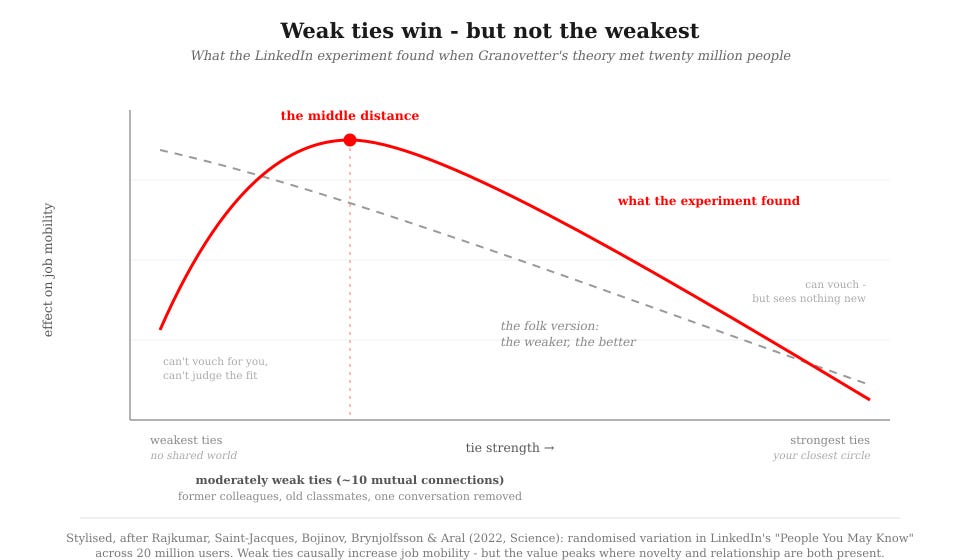
Then came the experiment. LinkedIn’s “People You May Know” algorithm was, for years, being A/B tested - different users were randomly shown different mixes of recommended connections. Karthik Rajkumar, Guillaume Saint-Jacques, Iavor Bojinov, Erik Brynjolfsson and Sinan Aral realised this amounted to a randomised trial of Granovetter’s theory at civilisational scale, and published the result in Science in 2022: twenty million users, five years, two billion new ties, six hundred thousand job changes. Because the algorithm randomly varied whether people formed weak or strong ties, the study could do what fifty years of surveys could not - establish cause.
The theory was validated, with a twist worth remembering. Weak ties do causally increase job mobility. But the relationship is an inverted U: moderately weak ties - roughly, people with whom you share about ten mutual connections - produced the most job movement, not the weakest ties. A contact with no overlap with your world can see openings but can barely vouch for you or judge the fit; a close contact can vouch but sees nothing new. The value peaks where novelty and relationship are both present. The folk advice fails in both directions: it is not depth, and it is not maximal breadth. It is the middle distance - the former colleague, the old classmate, the person one conversation removed.
There is a quietly important postscript. The experiment that confirmed the theory was run by a platform whose recommendation algorithm now shapes the very network the theory describes. The labour market’s wiring is no longer entirely organic; some of it is designed, by parties with their own objectives. Hold that thought - it returns at the end of this series.
So jobs travel through ties. The next question is what, exactly, is being discovered when a match is made - and here the economists take over the story.
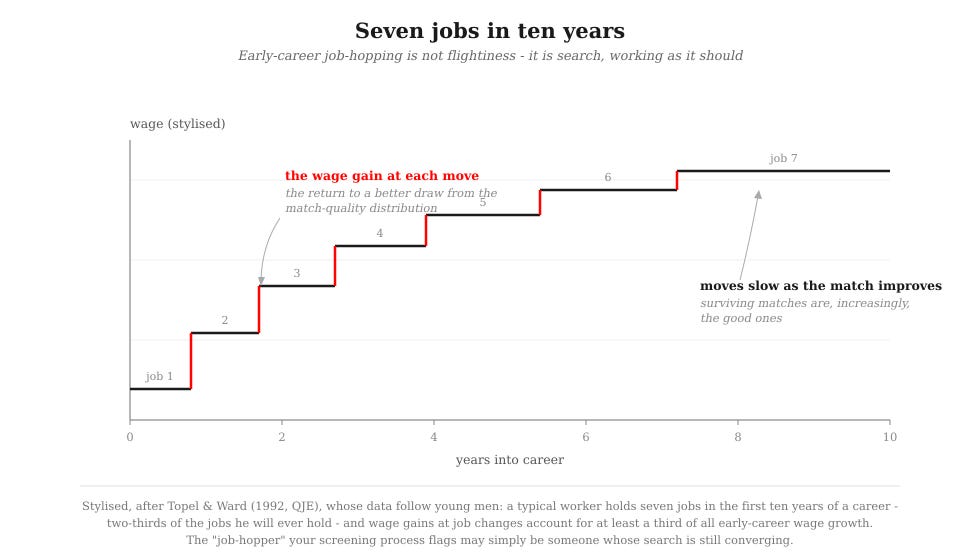
In 1979 Boyan Jovanovic published “Job Matching and the Theory of Turnover” in the Journal of Political Economy, formalising an idea that every experienced manager knows in their bones: how well a particular person fits a particular job is not knowable in advance. It is revealed slowly, through performance, after the match is made - an idea I covered in the earlier essay on information in recruitment. Economists would say the match is an experience good - like a restaurant, you learn its quality by consuming it - rather than an inspection good like a bolt of cloth, which you can assess before buying. From that single assumption Jovanovic derived the great empirical regularities of turnover: separations concentrate early in tenure (bad matches reveal themselves and dissolve), and quit rates fall as tenure lengthens (surviving matches are, increasingly, the good ones).
The model has a consequence that inverts a durable piece of recruitment folklore. If match quality can only be discovered by trying, then early-career job changing is not flightiness - it is search, working as it should. Robert Topel and Michael Ward showed this convincingly in a 1992 paper in the Quarterly Journal of Economics: a typical young worker - the data follow young men - holds seven jobs in the first ten years of a career, two-thirds of the jobs he will ever hold, and wage gains at job changes account for at least a third of all early-career wage growth. Each move is a new draw from the match-quality distribution, and the pay rise at the move is the return to a better draw. The “job-hopper” your screening process flags may simply be someone whose search is still converging - and the tenure you prize in later-career candidates is partly the result of good matching, not evidence of a loyal disposition.
How much of match quality can screening actually see in advance? Remarkably, we now have an estimate. In a 2026 working paper, Victoria Gregory, Guido Menzio and Giorgio Topa used German administrative data to ask whether a firm-worker match is closer to an inspection good or an experience good. Their answer: ordinary pre-hire screening - CVs, interviews, referrals, taken together - already resolves about two-thirds of the uncertainty about match quality before the contract is signed. The remaining third is discoverable only by working together. I read that number in both directions. It is a compliment to screening: the information problem of Issue 6 is real but substantially tamed by ordinary practice. And it is a ceiling: whatever a new assessment tool promises, it is competing for a share of the last third.
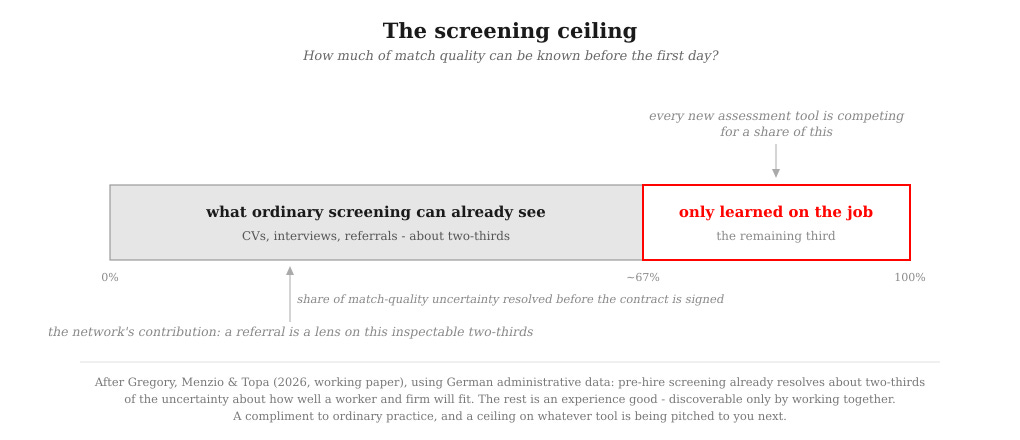
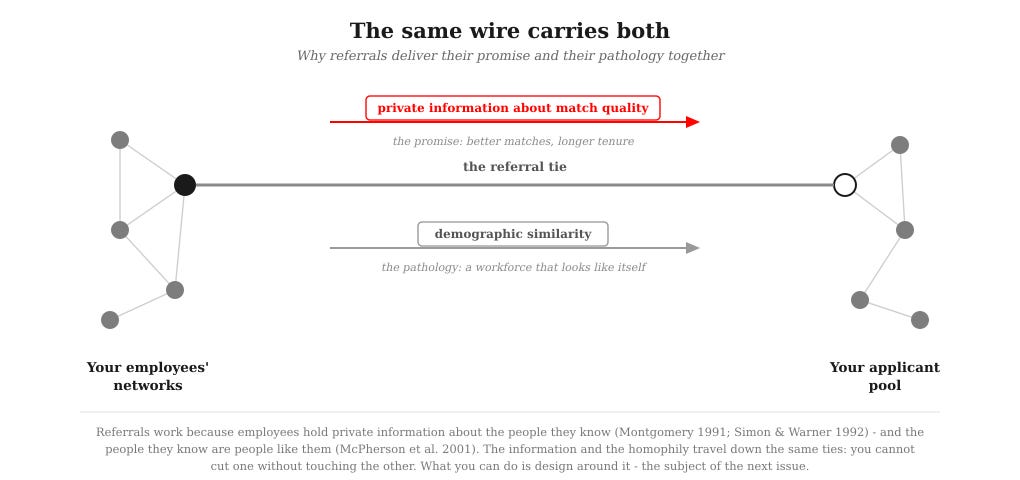
This is where the two literatures connect, and it is the sentence I most want readers to take away: the network is the labour market’s instrument for improving the pre-hire signal. A referral is a lens on the two-thirds that can be inspected; a weak tie extends how far the lens can see. James Montgomery made the economics explicit in a 1991 paper in the American Economic Review: your good employees tend to know other good people, so a referral from a strong performer carries real information, and firms rationally prize it. Curtis Simon and John Warner, in a rather wonderful 1992 paper titled “Matchmaker, Matchmaker”, took Jovanovic’s model and derived what should happen if referrals raise the precision of the pre-hire signal: referred workers should start on higher wages, see flatter subsequent wage growth (there is less left to learn about them), and stay longer. All three predictions held in their data. And Christian Dustmann, Albrecht Glitz, Uta Schönberg and Herbert Brücker, with matched employer-employee data covering an entire German metropolitan labour market, found the clean modern signature in 2016: referred workers earn more at entry and quit less - and both advantages fade with tenure, exactly as they should if the advantage is informational. Information depreciates as the truth comes out.
Referral schemes deserve, and will get, an article of their own next issue. For now the point is the mechanism: referrals work because they move private information about match quality across the network. Which brings us to what else moves with it.
Here is the flipside, and it is sociology’s second great contribution to this series.
The most robust finding in the study of social networks is called homophily - literally, love of the same. Miller McPherson, Lynn Smith-Lovin and James Cook’s 2001 review in the Annual Review of Sociology, titled “Birds of a Feather”, assembled the evidence: across every kind of relationship, from marriage to friendship to “people you discuss important matters with”, we connect overwhelmingly with people like ourselves - most strongly by race and ethnicity, then by age, religion, education, occupation and gender. Some of this is choice, but much of it is simply opportunity: you befriend the people your school, neighbourhood and workplace put in front of you, and those settings are already sorted.
Now put homophily together with everything above. If networks carry the best information about jobs, and networks are demographically sorted, then the labour market’s most efficient channel is also its most exclusionary one - and no one anywhere in the chain needs to intend the exclusion.
Montgomery saw the sting in 1991, inside the same model that explained why referrals work: workers with better-connected networks capture better outcomes for reasons unrelated to their own productivity. Antoni Calvó-Armengol and Matthew Jackson took the logic further in a 2004 paper in the American Economic Review, modelling what happens when job information flows through sorted networks. Employment becomes contagious: your chances depend on whether the people around you are working. Unemployment acquires duration dependence - the longer you are out, the less your network can do for you, because your network is out too. And a group that starts disadvantaged can remain so indefinitely, with no discrimination anywhere in the model, because the disadvantage is stored in the structure of who knows whomand the structure reproduces itself. We will meet this shape again in a few weeks, when this series turns to fairness: differences between groups that persist without a bigot in the loop. Here is the machine that maintains the base rates those debates take as given.
The empirical scale of this became visible in 2022, when Raj Chetty and colleagues published two papers in Nature built on the friendship networks of seventy million Americans. Their headline measure, economic connectedness - roughly, how many of your friends are from higher socioeconomic strata than you - predicts about two-thirds of the variation in upward income mobility across US communities, outperforming school quality, family structure and income inequality. Matthew Jackson’s 2026 synthesis draws the uncomfortable policy conclusion: financial redistribution, whatever its other merits, does not rewire networks. Money moves; the structure stays.
If you want to see the mechanism operating at the moment of decision rather than in the aggregate, read Lauren Rivera’s Pedigree. Rivera embedded herself in the hiring processes of elite law, banking and consulting firms and watched evaluators - decent, diligent people - select for candidates who shared their leisure pursuits, their self-presentation, their biographies, all under the honest banner of “fit”. Homophily is not usually a policy. It is a comfort, exercised one likeable candidate at a time.
The practical reading for recruiters is direct, and worth stating in one breath: your applicant pool is not a sample of the labour market; it is a shadow of your current employees’ networks. Source passively and you inherit their homophily. This is why referral programmes so reliably deliver both their promise (better matches, via private information) and their pathology (a workforce that looks like itself, via homophily) - the two effects are inherently linked, and you cannot cut one without touching the other. What you can do is design around it, which is Issue 11’s subject.
If matching is the thing that matters, a natural question follows: can a matching process be engineered? The answer is one of the more cheering stories in economics.
By the 1940s, the American market for medical residencies had fallen apart in a distinctive way. Hospitals, competing for the best students, made offers ever earlier - eventually to students two years from graduation, with hours to accept. Economists call this unravelling, and versions of it will be familiar to anyone watching graduate recruitment timelines creep ever deeper into degree programmes. The profession’s response was a central clearinghouse: students and hospitals submit ranked preferences, and an algorithm proposes the matches. Alvin Roth’s 1984 analysis in the Journal of Political Economy showed why it had endured where other schemes collapsed: the algorithm produced stable matches, in the precise sense David Gale and Lloyd Shapley had defined in 1962 - no doctor and no hospital would rather have each other than the partners the algorithm assigned them. No pair has an incentive to defect, so the market holds. Roth went on to redesign the match itself in the 1990s, and shared the 2012 Nobel with Shapley for the wider programme of market design- the branch of economics that treats a failing matching market as an engineering problem.
The transfer I want to make is inward. Every organisation owns a matching market it almost never designs: its internal labour market. Consider what internal mobility has going for it, on the evidence of this article. The information problem is largely solved - the firm holds years of observed performance on internal candidates, precisely the experience-good knowledge that no external screen can reach; an internal match starts far beyond Gregory, Menzio and Topa’s two-thirds. Yet in most organisations internal moves run on the informal network - whoever the hiring manager happens to know, which is homophily again, now operating inside the firm and dressed as talent management - or through posting systems with exactly the congestion and hoarding pathologies Roth documented, with managers blocking transfers the way 1940s hospitals raced to lock up students. The market-design lesson is that these are fixable properties of rules, not fixed facts of culture: transparent posting, protected application rights, and moving the match decision above the level of the blocking manager are small pieces of market architecture, and architecture is a choice.
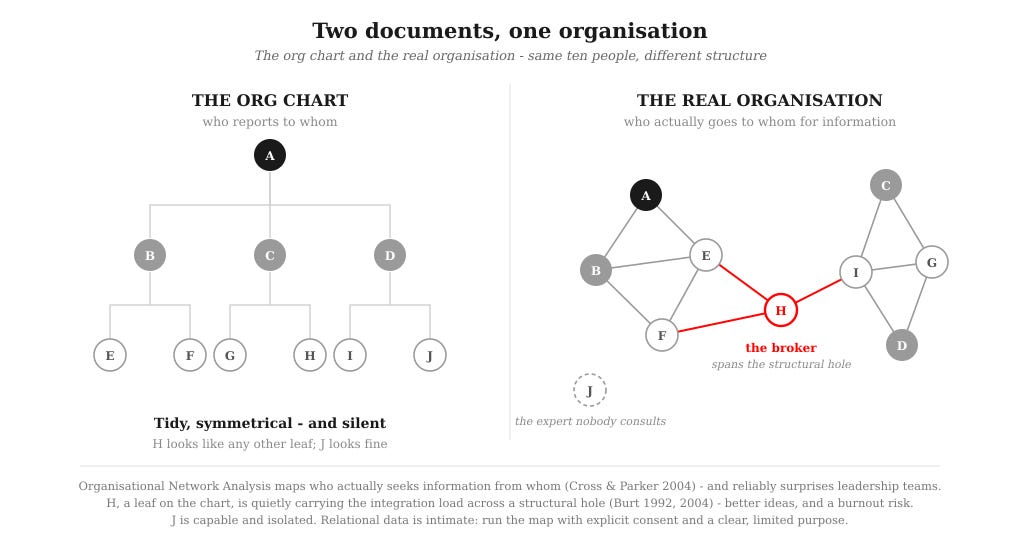
The same logic, one level down, applies to the network inside the organisation - and here sociology hands the practitioner a working toolkit. Ronald Burt‘s studies of managers, summarised in his 1992 book Structural Holes and a 2004 paper in the American Journal of Sociology, found that people whose networks bridge otherwise-disconnected groups - who span the “holes” in the structure - are consistently better paid, better rated, promoted faster, and, in the 2004 study, produce ideas judged more valuable. The mechanism is Granovetter’s, moved indoors: opinion is more homogeneous within groups than between them, so the people connected across groups can see recombinations the rest cannot. This is measurable. Organisational Network Analysis - ONA, given its practitioner form in Rob Cross and Andrew Parker’s The Hidden Power of Social Networks - maps who actually seeks information from whom, and reliably surprises leadership teams: the org chart and the real organisation are different documents. Where are the holes between functions? Who is quietly carrying the integration load - and how close to burnout? Which capable people sit isolated on the periphery? Even simple adjacency turns out to be a matching decision: Alexandre Mas and Enrico Moretti, with supermarket scanner data, found in 2009 that placing a highly productive worker within sight of colleagues raises those colleagues’ output - visibility, not proximity, drives the effect. One caution from the practitioner’s chair: ONA is built from relational data, which is intimate. Run it with explicit consent and a clear, limited purpose, or you will spend trust you cannot easily rebuild - a lesson the earlier issue on information in recruitment should make familiar.
Strip this essay to its central idea and it is this: the labour market is a network, and every sourcing decision is an intervention in that network with consequences that follow from the mechanism. Referrals buy information and import homophily, because both travel the same ties. Weak-tie outreach buys reach into pools your organisation cannot currently see - and the causal evidence says the middle distance, not the cold periphery, is where the value peaks. Internal mobility is the best-informed matching market you have access to, and probably the least designed thing in your organisation. ONA tells you where your internal structure is blocking the flow of information that match quality depends on.
None of this required a new tool, a new assessment, or a new platform. It required a discipline most of us were never taught. Psychology asks: who is this person? Economics asks: what will they do, given the incentives? Sociology asks the question the other two cannot: who do they know, and where do they sit in the structure? For thirty years, People Analytics has been built almost entirely on the first two questions. The third is where I would look next - and the next two issues will do exactly that, starting with the most widespread network intervention of all: the employee referral scheme.
The point is not that every organisation should now run an ONA project - many of you will have done exactly that. It is that the network lens belongs at the moment of sourcing, not just the moment of diagnosis: ONA applied the lens inside the organisation, and stopped there. The step most organisations have not taken is to point it outward, at recruitment itself.
Your labour market is a network, and every sourcing decision rewires it. The firms that get this right are not the ones with the best channels - they are the ones that know what each channel does to the wiring, and choose it on purpose.
Granovetter, M. (1973) - The Strength of Weak Ties. American Journal of Sociology
Granovetter, M. (1974/1995) - Getting a Job: A Study of Contacts and Careers. Harvard University Press / University of Chicago Press
Granovetter, M. (1985) - Economic Action and Social Structure: The Problem of Embeddedness. American Journal of Sociology
Gee, L., Jones, J. & Burke, M. (2017) - Social Networks and Labor Markets: How Strong Ties Relate to Job Finding on Facebook’s Social Network. Journal of Labor Economics
Gee, L., Jones, J., Fariss, C., Burke, M. & Fowler, J. (2017) - The Paradox of Weak Ties in 55 Countries. Journal of Economic Behavior & Organization
Jovanovic, B. (1979) - Job Matching and the Theory of Turnover. Journal of Political Economy
Topel, R. & Ward, M. (1992) - Job Mobility and the Careers of Young Men. Quarterly Journal of Economics
Gregory, V., Menzio, G. & Topa, G. (2026) - Firm-Worker Matches: Experience or Inspection Goods?. NBER Working Paper 35236 / Federal Reserve Bank of St. Louis
Montgomery, J. (1991) - Social Networks and Labor-Market Outcomes: Toward an Economic Analysis. American Economic Review
Simon, C. & Warner, J. (1992) - Matchmaker, Matchmaker: The Effect of Old Boy Networks on Job Match Quality, Earnings, and Tenure. Journal of Labor Economics
Dustmann, C., Glitz, A., Schönberg, U. & Brücker, H. (2016) - Referral-based Job Search Networks. Review of Economic Studies
McPherson, M., Smith-Lovin, L. & Cook, J. (2001) - Birds of a Feather: Homophily in Social Networks. Annual Review of Sociology
Calvó-Armengol, A. & Jackson, M. (2004) - The Effects of Social Networks on Employment and Inequality. American Economic Review
Chetty, R. et al. (2022) - Social Capital I: Measurement and Associations with Economic Mobility. Nature
Chetty, R. et al. (2022) - Social Capital II: Determinants of Economic Connectedness. Nature
Jackson, M. (2026) - Inequality’s Economic and Social Roots: The Role of Social Networks and Homophily. arXiv preprint, forthcoming Econometric Society World Congress volume
Rivera, L. (2015) - Pedigree: How Elite Students Get Elite Jobs. Princeton University Press
Rivera, L. (2012) - Hiring as Cultural Matching: The Case of Elite Professional Service Firms. American Sociological Review
Roth, A. (1984) - The Evolution of the Labor Market for Medical Interns and Residents: A Case Study in Game Theory. Journal of Political Economy
Gale, D. & Shapley, L. (1962) - College Admissions and the Stability of Marriage. American Mathematical Monthly
Burt, R. (1992) - Structural Holes: The Social Structure of Competition. Harvard University Press
Burt, R. (2004) - Structural Holes and Good Ideas. American Journal of Sociology
Cross, R. & Parker, A. (2004) - The Hidden Power of Social Networks. Harvard Business School Press
Mas, A. & Moretti, E. (2009) - Peers at Work. American Economic Review