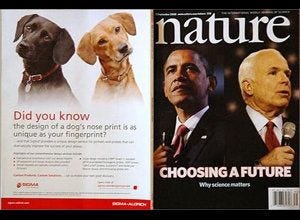
Above: Nature inadvertently demonstrating the independence of its news and marketing operations in 2008. How we laughed.
I have been advised to increase my subscription costs, which are currently a measly $5/month. I am thinking that over and may do so. In the interim, if you wish to support my writing here or my next book project you can upgrade your subscription by clicking the button below or tip me via Cash App.
Before I begin, a quick conflict of interest statement. I worked on the Nature news team between 2008 and 2014, first as deputy news editor, then as chief online editor.
Last week, Nature Human Behaviour, part of the Nature stable of scientific journals, published research (open access paper) by economist Floyd Zhang that suggested Donald Trump supporters who saw a snippet of Nature’s 2020 endorsement of Joe Biden did not change their opinion of Trump but did lose trust in Nature as a source of unbiased scientific information. They also rated US scientists as less well-informed and unbiased after seeing the endorsement compared to supporters who saw an ad promoting a redesign of the journal’s website and print offering. On the same day, in a Nature editorial commenting on the research, the journal doubled down on its right to endorse political candidates:
Considering the record of Trump’s four years in office, this journal judged that silence was not an option … We use our voice sparingly and always offer evidence to back up what we say. And, when the occasion demands it, we will continue to do so.
First, some background for those who may be surprised that Nature publishes news or comment at all. Nature has carried editorials more or less since its inception in 1869 and a news section, introduced by legendary editor John Maddox, for over half a century. Its American rival, Science, also has a news section and both journals produce some of the best and most thoroughly fact-checked science journalism in the world.
Many of those who write for Nature’s news and features section, and a good many who edit it, have PhDs but a fair few do not and some may never have seen the inside of a lab professionally at all. Those editing the ‘back half’, that is those in charge of handling research submissions, usually have a stronger track record and may have left promising research careers behind to pursue a new career at the giddy heights of academic publishing. But neither front nor back half journalists and editors can truly claim to be scientists since, in my opinion, you stop being part of that community more or less the instant you are no longer research active. As such, I don’t think Nature, owned by a private publishing firm, can truly claim to speak for science or scientists in the way that bodies accountable to their scientific membership, such as the Royal Society or the American Association for the Advancement of Science, can. Nature editorials are nonetheless influential — a by product of the highly cited research papers that the journal publishes.
It’s also worth saying that Nature’s endorsement of Biden was not the first time they had backed a presidential candidate. The journal endorsed Barack Obama over John McCain in 2008 , and all but endorsed him again in 2012 against Mitt Romney. In 2016, the journal came within a whisker of endorsing another Democrat, declaring ‘Hillary Clinton will make a fine US president’, a headline that someone at the publication should probably have noticed was a hostage to fortune (but let’s not write her off yet).
The problem is not that Nature has consistently supported Dems — its endorsements are in line with those of The Economist (where I have also worked), which is hardly known for being an ardent supporter of the Democratic Party. It is that the journal has endorsed presidential candidates at all. The Economist’s political proclivities are well known, firmly established over its 180-year existence and available for all to read on its own website or on Wikipedia. But what are Nature’s political views? We know that the journal is broadly ‘pro-science’ and presumably favours policy-making based on the best scientific evidence available. It has also acknowledged that political questions are under-determined with respect to the science and appears to understand that its core readership is politically heterogeneous.
That is good. Because it is obvious that no one votes for a Prime Minister or President solely or even principally because their candidate respects ‘the science’. At best, it is fairly low on a long list that is usually topped by the economy, health, crime, foreign policy, education and immigration. So one would not expect a Nature endorsement to sway voters much at all. This is exactly what Zhang’s paper found and if that is all it had found, there would be no reason to worry about Nature’s insistence that it will continue to endorse political candidates.
The problem is that along with this unsurprising ‘null result’, the paper found some very troubling signs that, for Trump voters at least, the journal’s endorsement of Biden was actually corrosive of trust not just in Nature but in the US scientific community as a whole.
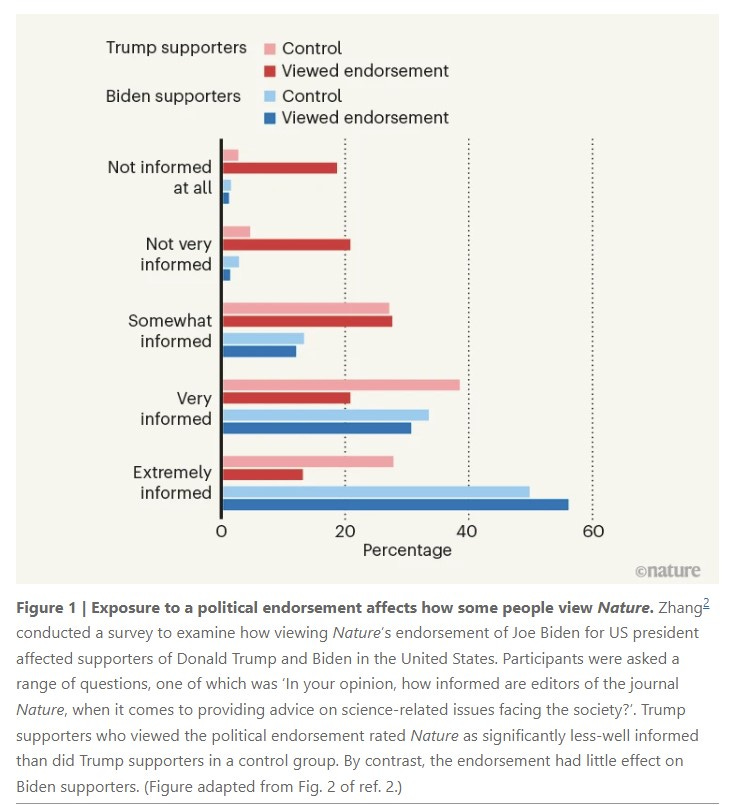
The paper also reported that trust in Nature’s impartiality slumped, with more than 40% Trump supporters who had seen the endorsement responding that they had ‘no confidence at all’ in Nature’s editorial board to provide unbiased opinions to the public on contentious issues. Only around 10% of those who viewed the formatting announcement felt the same way.
Perhaps most worringly, Trump supporters who had seen the endorsement were 38% less inclined to obtain information about COVID-19 from Nature. This was accompanied by a small but statistically significant decline in their trust in the expertise and impartiality of US scientists. In all cases, the effects were much greater for Trump voters who initially said they did not expect the journal to have made an endorsement in the 2020 election.
The overall picture is of a collapse in confidence in the scientific enterprise among Trump supporters, a group that was more suspicious of scientific expertise to begin with.
Share Confections & Reputations
Why should liberals and progressives worry about the views of a ‘basket of deplorables’? Maybe they shouldn’t. After all, Science’s editor-in-chief has praised Nature’s response to the findings…

Holden Thorp, Science EIC@hholdenthorp
In light of @Nature's excellent editorial about why it makes sense to comment on politics (all the way, in their case, to making an endorsement), this is the Pew finding that is most relevant. Following the admonition to stick to science is conceding 1/n

3:40 PM · Mar 21, 2023
48 Reposts · 223 Likes
…though he backtracked a little later.
Stuart Ritchie 🇺🇦@StuartJRitchie
Well, he deleted this without saying anything. I had a little read of his Twitter and it’s full to the brim with nakedly partisan politics, which I find so irregular and depressing for someone in such a powerful position in science. Our institutions, ladies and gents!

4:53 PM · Mar 23, 2023
3 Reposts · 23 Likes
I am less enamoured with Nature’s response than Thorp is. Politics today is more polarised than at any time this Gen Xer can remember. As Nature itself wrote in a feature earlier this month (entitled ‘How to tackle political polarization — the researchers trying to bridge divides’):
Animosity is running high right now. In a survey conducted last year by the Pew Research Center, a think tank in Washington DC, 72% of Republicans said that Democrats are “more immoral” than members of their own party, and 63% of Democrats said the same about Republicans — increases of 17% and 16% in just a three-year period. Similar trends have been seen in other countries. In Switzerland, for example, the degree to which people like their own party more than another has increased by about 60% since the 1980s. The pattern in the United States, however, is especially strong
Far from helping to ‘tackle political polarization’, Nature’s endorsement appears to have contributed to it and so poses a threat to the journal’s central role as a repository of trustworthy scientific facts. It is difficult to understand how the journal squares the findings with its own mission statement, which states that it strives “to ensure that the results of science are rapidly disseminated to the public throughout the world, in a fashion that conveys their significance for knowledge, culture and daily life” — a mission that is surely harder to accomplish if a significant proportion of the public ceases to believe or even read what it publishes!
According to Zhang, the paper’s author:
“The findings suggest that, if the objective is to shape public opinions and the political environment in a way that is conducive to scientific endeavours and evidence-based policies, political endorsements given by scientific journals may have substantial downsides and little upside.”
Those sentiments are echoed in an accompanying News & Views commentary piece by American political scientist Arthur Lupia, who warns that:
“The current study provides evidence that, when a publication whose credibility comes from science decides to politicize its content, it can damage that credibility. If this decreased credibility, in turn, reduces the impact of scientific research published in the journal, people who would have benefited from the research are the worse for it. I read Zhang’s work as signalling that Nature should avoid the temptation to politicize its pages. In doing so, the journal can continue to inform and enlighten as many people as possible.”
It is understandable that Nature wishes to defend its right to cover or opine on scientific issues with a political dimension, such as climate change. Its news team should be able to criticise policies and even individual politicians if they have ignored or distorted scientific evidence or undermined the scientific process. But that is very different from the outright endorsement of one candidate.
Nature’s editorial is a disappointing response to the serious concerns raised by Zhang’s paper, which should have prompted a degree of soul-searching rather than a justification of business as usual. By dismissing the alarming implications of this research, the journal is in danger of doing what it often accuses politicians of doing: ignoring the science.
If you enjoyed this post, give it a ‘like’. Comment on this post below or you can talk to me via email ananyo@substack.com or on Twitter @ananyo
If you loved The Man from the Future, enjoy what I’m doing here and want to help make my next project possible, please consider supporting my writing by paying something to subscribe.