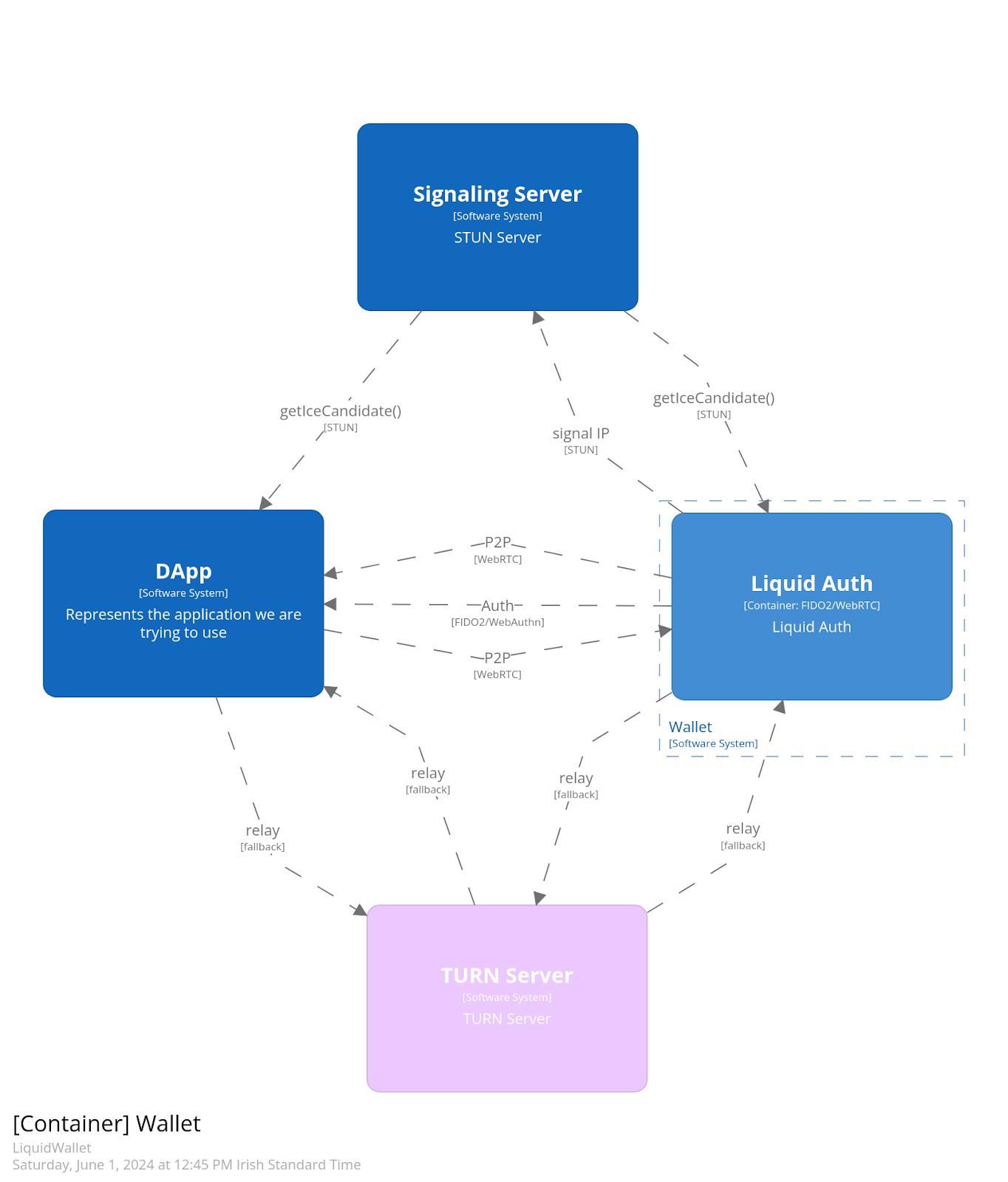
Digital wallets are a critical component of the Web3 ecosystem, enabling users to interact with decentralized applications (dapps) and manage their digital assets. Wallets can be used for a variety of purposes, including identity and credential management, payments, authentication, holding digital assets, and interaction with distributed ledgers where account and transaction management is required. Communication between wallets and apps One of the key challenges in the Web3 ecosystem is enabling secure and authenticated communication between wallets and apps. This is essential for ensuring that users can interact with dApps securely, privately, seamlessly, and in a manner where they retain control over their data, assets, and keys. Digital wallets lack standardization, and each ecosystem has its own custom standards for authentication and/or communication between apps and wallets. In the context of Web3, products are often adopted rather than open standards. Any party in the middle of the flow of information between wallets, apps, and verifiers has a lot of power and can potentially abuse it. WalletConnect is a centralized and permissioned solution that requires a server to relay messages between wallets and dapps. Over the years WalletConnect has become the de-facto standard for connecting wallets to dApps in the web3 ecosystem. However, WalletConnect is a product that is part of the flow of information between wallets and apps, and therefore should be considered critical infrastructure, and should be standardized and open. We should avoid it because it is: WalletConnect has actually proven that it fails to comply with the principles of decentralization. An example of this was the banning of certain IPs by the relayer. For the industry to mature and to be more attractive to serious integrators we should move away from centralized and permissioned solutions and adopt open standards for authentication and communication between wallets and apps. Web3—and specifically the blockchain industry—is in a technological bubble where custom standards, protocols, and products are being adopted rather than adhering to open standards. This is true for key management systems (which I've written about previously), authentication techniques, communication protocols, hardware wallets, etc. This is a problem because it signals a lack of maturity. Some of those components should be considered critical infrastructure and should be standardized and open. In the broader context of digital wallets, the industry and open working groups are working on adopting open standards for authentication and communication between wallets and apps. An example is the work currently being done by the Open Wallet Foundation, of which the Algorand Foundation is an associate sponsor. It is compiling a set of open-source tools, using open standards and protocols to build interoperable wallets. Part of this work is to define a set of standards for authentication and communication between wallets and apps. And this is where we introduce LiquidAuth. LiquidAuth is a decentralized and open-source solution that enables authenticated communication between wallets and apps in a peer-to-peer (P2P) manner. It leverages open protocols and standards such as FIDO2 / Passkeys, WebRTC, STUN & TURN servers. The conceptual architecture of LiquidAuth is designed to achieve authenticated communication between wallets and apps in a peer-to-peer (P2P) manner. It leverages open protocols and standards such as FIDO2/ passkeys and WebRTC. The architecture consists of the following main components: To establish a P2P connection, LiquidAuth utilizes a STUN server by default. The STUN server helps clients discover their public IP addresses and ports, enabling them to establish a direct connection. However, in cases where firewall rules block incoming traffic on the negotiated port, a TURN server is introduced. A TURN server relays traffic between clients that cannot establish a direct connection, making it useful for clients behind symmetric NATs or firewalls. Even though this was built initially for the Algorand ecosystem, LiquidAuth is designed to be context agnostic and can be used in any Web2, or Web3 application. It can be used for identity, payments and/or any other type of wallet. We have a common enemy in centralized infrastructure and first-mover products that have become critical infrastructure in the place of open standards and protocols. We invite other Web3 ecosystems to join us in the development of LiquidAuth and to adopt it as a standard for authenticated communication between wallets and apps. LiquidAuth is fully open source, with no custom standards. We currently have Algorand wallet, app samples and demos, but we are looking to expand it and make it open to be used in any context and any Web3 ecosystem. If you are interested in contributing to LiquidAuth, please visit: And let us know that you are interested in adopting, and developing in LiquidAuth. We can help you with the integration and provide support. Also, feel free to reach out to bruno.martins@algorand.foundation if you want to have a discussion around LiquidAuth. In conclusion, LiquidAuth is a cross-ecosystem proposal for a decentralized and open-source solution that enables authenticated communication between wallets and apps in a peer-to-peer (P2P) manner. And a proposal for us to live by the ethos of decentralization and open standards in the web3 ecosystem that we claim to support.Overview
Critical infrastructure inflow of information
WalletConnect
Blockchain technological bubble
Standardization and interoperability of digital wallets
Relevant open standards
Authentication
Communication
LiquidAuth
Design principles
Conceptual architecture
LiquidAuth agnosticism
An invitation to other Web3 ecosystems
How to get involved
Conclusion