Read at your own pace. Code execution, quizzes, progress tracking, and the AI tutor are available in the interactive view with JavaScript enabled.
Introduction/Arrays
This cheat sheet uses **Big O** notation to express time complexity. - For a reminder on Big O, see [Understanding Big O Notation and Algorithmic Complexity](/lessons/understanding-big-o-and-algorithmic-complexity). - For a quick summary of complexity for common data structure operations, see the [Big-O Algorithm Complexity Cheat Sheet](https://www.bigocheatsheet.com/).
Array
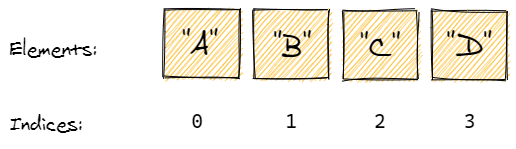
- Quick summary: a collection that stores elements in order and looks them up by index.
- Also known as: fixed array, static array.
-
Important facts:
- Stores elements sequentially, one after another.
- Each array element has an index. Zero-based indexing is used most often: the first index is 0, the second is 1, and so on.
- Is created with a fixed size. Increasing or decreasing the size of an array is impossible.
- Can be one-dimensional (linear) or multi-dimensional.
- Allocates contiguous memory space for all its elements.
-
Pros:
- Ensures constant time access by index.
- Constant time append (insertion at the end of an array).
-
Cons:
- Fixed size that can't be changed.
- Search, insertion and deletion are
O(n). After insertion or deletion, all subsequent elements are moved one index further. - Can be memory intensive when capacity is underused.
-
Notable uses:
- The String data type that represents text is implemented in programming languages as an array that consists of a sequence of characters plus a terminating character.
-
Time complexity (worst case):
- Access:
O(1) - Search:
O(n) - Insertion:
O(n)(append:O(1)) - Deletion:
O(n)
- Access:
- See also:
Arrays are a primitive building block in most languages, here's how to initialize them:
const arr = [1, 2, 3];
arr = [1, 2, 3]
int[] arr = {1, 2, 3};
int arr[] = {1, 2, 3};
int[] arr = {1, 2, 3};
arr := []int{1, 2, 3}
```js
// instantiation
let empty = new Array();
let teams = new Array('Knicks', 'Mets', 'Giants');

// literal notation
let otherTeams = ['Nets', 'Patriots', 'Jets'];

// size
console.log('Size:', otherTeams.length);

// access
console.log('Access:', teams[0]);

// sort
const sorted = teams.sort();
console.log('Sorted:', sorted);

// search
const filtered = teams.filter((team) => team === 'Knicks');
console.log('Searched:', filtered);

```
```py
# Python does not have a native support for arrays, but has a List data structure
# which mimicks the behavior of an array. The Python array module requires all
# array elements to be of the same type. We implement our own below.

class Array(object):
    """
    sizeOfArray: denotes the total size of the array to be initialized
    arrayType: denotes the data type of the array
    arrayItems: values at each position of array
    """

    def __init__(self, sizeOfArray, arrayType=int):
        self.sizeOfArray = len(list(map(arrayType, range(sizeOfArray))))
        self.arrayItems = [arrayType(0)] * sizeOfArray  # initialize array with zeroes

    def __str__(self):
        return " ".join([str(i) for i in self.arrayItems])

    # function for search
    def search(self, keyToSearch):
        for i in range(self.sizeOfArray):
            if self.arrayItems[i] == keyToSearch:  # brute-forcing
                return i  # index at which element/key was found

        return -1  # if key not found, return -1

    # function for inserting an element
    def insert(self, keyToInsert, position):
        if self.sizeOfArray > position:
            for i in range(self.sizeOfArray - 2, position - 1, -1):
                self.arrayItems[i + 1] = self.arrayItems[i]
            self.arrayItems[position] = keyToInsert
        else:
            print("Array size is:", self.sizeOfArray)

    # function to delete an element
    def delete(self, keyToDelete, position):
        if self.sizeOfArray > position:
            for i in range(position, self.sizeOfArray - 1):
                self.arrayItems[i] = self.arrayItems[i + 1]
        else:
            print("Array size is:", self.sizeOfArray)


a = Array(10, int)
a.insert(0, 1)
a.insert(1, 2)
a.insert(2, 3)
print(a)
```
```java
public class Main {
    public static void main(String[] args) {
        // Compiles and runs fine
        int[] array = new int[0];

        try {
            // Throws java.lang.ArrayIndexOutOfBoundsException
            array[0] = 1;
        } catch (Exception e) {
            System.out.println(e);
        }

        try {
            // Throws java.lang.NegativeArraySizeException
            int[] arr = new int[-1];
        } catch (Exception e) {
            System.out.println(e);
        }

        String[] suit = {
            "spades",
            "hearts",
            "diamonds",
            "clubs"
        };

        // Should print 4 in this case
        System.out.println(suit.length);
    }
}
```
```cpp
#include <iostream>
#include <vector>
#include <algorithm>

int main() {
    // instantiation
    std::vector<std::string> empty;
    std::vector<std::string> teams{"Knicks", "Mets", "Giants"};

    // literal notation (similar to instantiation)
    std::vector<std::string> otherTeams{"Nets", "Patriots", "Jets"};

    // size
    std::cout << "Size: " << otherTeams.size() << std::endl;

    // access
    std::cout << "Access: " << teams[0] << std::endl;

    // sort
    std::sort(teams.begin(), teams.end());
    std::cout << "Sorted:";
    for (const auto &team : teams) {
        std::cout << " " << team;
    }
    std::cout << std::endl;

    // search
    auto it = std::find(teams.begin(), teams.end(), "Knicks");
    std::cout << "Searched: " << (it != teams.end() ? *it : "Not Found") << std::endl;

    return 0;
}
```
```csharp
using System;
using System.Collections.Generic;

public class MainClass
{
    public static void Main(string[] args)
    {
        // instantiation
        List<string> empty = new List<string>();
        List<string> teams = new List<string>{"Knicks", "Mets", "Giants"};

        // literal notation (similar to instantiation)
        List<string> otherTeams = new List<string>{"Nets", "Patriots", "Jets"};

        // size
        Console.WriteLine("Size: " + otherTeams.Count);

        // access
        Console.WriteLine("Access: " + teams[0]);

        // sort
        teams.Sort();
        Console.WriteLine("Sorted: " + string.Join(", ", teams));

        // search
        bool containsKnicks = teams.Contains("Knicks");
        Console.WriteLine("Searched: " + (containsKnicks ? "Knicks" : "Not Found"));
    }
}
```
```go
package main

import (
	"fmt"
	"sort"
)

func main() {
	// instantiation
	var empty []string
	teams := []string{"Knicks", "Mets", "Giants"}

	// literal notation
	otherTeams := []string{"Nets", "Patriots", "Jets"}

	// size
	fmt.Println("Size:", len(otherTeams))

	// access
	fmt.Println("Access:", teams[0])

	// sort
	sort.Strings(teams)
	fmt.Println("Sorted:", teams)

	// search
	found := false
	for _, team := range teams {
		if team == "Knicks" {
			fmt.Println("Searched: Knicks")
			found = true
			break
		}
	}
	if !found {
		fmt.Println("Searched: Not Found")
	}
}
```
Dynamic Array
Dynamic array
- Quick summary: an array that can resize itself.
- Also known as: array list, list, growable array, resizable array, mutable array, dynamic table.
-
Important facts:
- Same as array in most regards: stores elements sequentially, uses numeric indexing, allocates contiguous memory space.
- Expands as you add more elements. Doesn't require setting initial capacity.
- When it exhausts capacity, a dynamic array allocates a new contiguous memory space that is double the previous capacity, and copies all values to the new location.
- Time complexity is the same as for a fixed array except for worst-case appends: when capacity needs to be doubled, append is
O(n). However, the average append is stillO(1).
-
Pros:
- Variable size. A dynamic array expands as needed.
- Constant time access.
-
Cons:
- Slow worst-case appends:
O(n). Average appends:O(1). - Insertion and deletion are still slow because subsequent elements must be moved a single index further. Worst-case (insertion into/deletion from the first index, a.k.a. prepending) for both is
O(n).
- Slow worst-case appends:
-
Time complexity (worst case):
- Access:
O(1) - Search:
O(n) - Insertion:
O(n)(append:O(n)) - Deletion:
O(n)
- Access:
- See also: same as arrays (see above).
```js
/* Arrays are dynamic in Javascript :-) */

// instantiation
let empty = new Array();
let teams = new Array('Knicks', 'Mets', 'Giants');

// literal notation
let otherTeams = ['Nets', 'Patriots', 'Jets'];

// size
console.log('Size:', otherTeams.length);

// access
console.log('Access:', teams[0]);

// sort
const sorted = teams.sort();
console.log('Sorted:', sorted);

// search
const filtered = teams.filter((team) => team === 'Knicks');
console.log('Searched:', filtered);

```
```py
# Python does not have a native support for arrays, but has a List data structure
# which mimicks the behavior of an array. The Python array module requires all
# array elements to be of the same type. We implement our own below.

class Array(object):
    """
    sizeOfArray: denotes the total size of the array to be initialized
    arrayType: denotes the data type of the array
    arrayItems: values at each position of array
    """

    def __init__(self, sizeOfArray, arrayType=int):
        self.sizeOfArray = len(list(map(arrayType, range(sizeOfArray))))
        self.arrayItems = [arrayType(0)] * sizeOfArray  # initialize array with zeroes

    def __str__(self):
        return " ".join([str(i) for i in self.arrayItems])

    # function for search
    def search(self, keyToSearch):
        for i in range(self.sizeOfArray):
            if self.arrayItems[i] == keyToSearch:  # brute-forcing
                return i  # index at which element/key was found

        return -1  # if key not found, return -1

    # function for inserting an element
    def insert(self, keyToInsert, position):
        if self.sizeOfArray > position:
            for i in range(self.sizeOfArray - 2, position - 1, -1):
                self.arrayItems[i + 1] = self.arrayItems[i]
            self.arrayItems[position] = keyToInsert
        else:
            print("Array size is:", self.sizeOfArray)

    # function to delete an element
    def delete(self, keyToDelete, position):
        if self.sizeOfArray > position:
            for i in range(position, self.sizeOfArray - 1):
                self.arrayItems[i] = self.arrayItems[i + 1]
        else:
            print("Array size is:", self.sizeOfArray)


a = Array(10, int)
a.insert(0, 1)
a.insert(1, 2)
a.insert(2, 3)
print(a)
```
```java
// Java has the ArrayList data structure that provides dynamic array functionality.
// It's utilized in the below example.

import java.util.ArrayList;

public class Main {

    public static void main(String[] args) {
        ArrayList < Integer > myNumbers = new ArrayList < Integer > ();
        myNumbers.add(10);
        myNumbers.add(15);
        myNumbers.add(20);
        myNumbers.add(25);
        for (int i: myNumbers) {
            System.out.println(i);
        }

    }
}
```
```cpp
// C++ provides the vector data structure for dynamic arrays

#include <vector>
#include <iostream>

int main() {
    std::vector<int> numbers; // Declaration
    numbers.push_back(10);
    numbers.push_back(15);
    numbers.push_back(20);
    numbers.push_back(25);

    // Iterating through the vector and printing the numbers
    for (int number : numbers) {
        std::cout << number << std::endl;
    }

    return 0;
}
```
```csharp
// C# has the List data structure which functions like a dynamic array

using System;
using System.Collections.Generic;

class Program {
    static void Main(string[] args) {
        List<int> numbers = new List<int>();
        numbers.Add(10);
        numbers.Add(15);
        numbers.Add(20);
        numbers.Add(25);

        foreach (int number in numbers) {
            Console.WriteLine(number);
        }
    }
}
```
```go
// Go has slices which provide the functionality of a dynamic array

package main

import "fmt"

func main() {
	var numbers []int // Declaration
	numbers = append(numbers, 10)
	numbers = append(numbers, 15)
	numbers = append(numbers, 20)
	numbers = append(numbers, 25)

	for _, number := range numbers {
		fmt.Println(number)
	}
}
```
Size vs Capacity
Dynamic arrays are easiest to reason about if you separate size from capacity.
- Size = how many elements are currently stored.
- Capacity = how many slots have been allocated in memory.
- When
size == capacity, the next append triggers a resize: allocate a larger block, copy existing items, then insert the new item.
Notice the key interview idea: most appends are cheap, but an occasional append pays the copy cost.

Dynamic Array Resize Trace
A dynamic array feels like it “just grows,” but the important interview detail is how: most appends write into unused capacity, while occasional appends trigger a full resize-and-copy.
In the visual, notice the split between size and capacity. The expensive step is rare, which is why append is worst-case O(n) but amortized O(1).

Linked List
Linked List
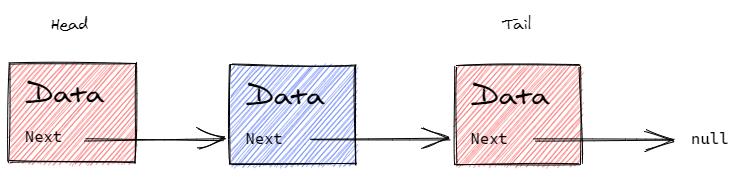
- Quick summary: a linear collection of elements ordered by links instead of physical placement in memory.
-
Important facts:
- Each element is called a node.
- The first node is called the head.
- The last node is called the tail.
- Nodes are sequential. Each node stores a reference (pointer) to one or more adjacent nodes:
- In a singly linked list, each node stores a reference to the next node.
- In a doubly linked list, each node stores references to both the next and the previous nodes. This enables traversing a list backwards.
- In a circularly linked list, the tail stores a reference to the head.
- Stacks and queues are usually implemented using linked lists, and less often using arrays.
- Each element is called a node.
-
Pros:
- Optimized for fast operations on both ends, which ensures constant time insertion and deletion.
- Flexible capacity. Doesn't require setting initial capacity, can be expanded indefinitely.
-
Cons:
- Costly access and search.
- Linked list nodes don't occupy continuous memory locations, which makes iterating a linked list somewhat slower than iterating an array.
-
Notable uses:
- Implementation of stacks, queues, and graphs.
-
Time complexity (worst case):
- Access:
O(n) - Search:
O(n) - Insertion:
O(1) - Deletion:
O(1)
- Access:
- See also:
```js
function LinkedListNode(val) {
  this.val = val;
  this.next = null;
}

class MyLinkedList {
  constructor() {
    this.head = null;
    this.tail = null;
  }

  prepend(newVal) {
    const currentHead = this.head;
    const newNode = new LinkedListNode(newVal);
    newNode.next = currentHead;
    this.head = newNode;

    if (!this.tail) {
      this.tail = newNode;
    }
  }

  append(newVal) {
    const newNode = new LinkedListNode(newVal);
    if (!this.head) {
      this.head = newNode;
      this.tail = newNode;
    } else {
      this.tail.next = newNode;
      this.tail = newNode;
    }
  }
}

var linkedList1 = new MyLinkedList();
linkedList1.prepend(25);
linkedList1.prepend(15);
linkedList1.prepend(5);
linkedList1.prepend(9);
console.log(linkedList1);

```
```py
class LinkedListNode:
    def __init__(self, value, next_node=None):
        self.value = value
        self.next_node = next_node

    def set_next(self, next_node):
        self.next_node = next_node

    def get_next(self):
        return self.next_node

    def get_value(self):
        return self.value


class LinkedList:
    def __init__(self):
        self.head = None
        self.tail = None

    def prepend(self, value):
        new_node = LinkedListNode(value)
        new_node.set_next(self.head)
        self.head = new_node

        if self.tail is None:
            self.tail = new_node

    def append(self, value):
        new_node = LinkedListNode(value)
        if self.head is None:
            self.head = new_node
            self.tail = new_node
        else:
            self.tail.set_next(new_node)
            self.tail = new_node

    def print_list(self):
        current_node = self.head
        while current_node:
            print(current_node.get_value(), end=" ")
            current_node = current_node.get_next()
        print()


if __name__ == "__main__":
    linked_list = LinkedList()
    linked_list.prepend(25)
    linked_list.prepend(15)
    linked_list.prepend(5)
    linked_list.prepend(9)
    linked_list.print_list()

```
```java
class Node {
    private int value;
    private Node next;

    public Node(int value, Node next) {
        this.value = value;
        this.next = next;
    }

    public int getVal() {
        return value;
    }

    public void setVal(int value) {
        this.value = value;
    }

    public Node getNext() {
        return next;
    }

    public void setNext(Node next) {
        this.next = next;
    }


}

class LinkedList {
    private Node head;

    public LinkedList() {
        this.head = null;
    }

    public void insert(int val, Node next) {
        Node newNode = new Node(val, next);

        if (this.head == null) {
            this.head = newNode;
        } else {
            Node current = this.head;
            while (current.getNext() != null) {
                current = current.getNext();
            }

            current.setNext(newNode);
        }
    }

    public Node getLastNode() {
        Node current = this.head;

        if (current == null) {
            return null;
        }

        while (current.getNext() != null) {
            current = current.getNext();
        }

        return current;
    }

    public Node find(int val) {
        Node current = this.head;

        if (current == null) {
            return null;
        }

        while (current.getNext() != null) {
            if (current.getVal() == val) {
                return current;
            }
            current = current.getNext();
        }

        return null;
    }

    public void print() {
        Node current = this.head;

        while (current != null) {
            System.out.print(current.getVal() + " ");
            current = current.getNext();
        }
    }

    public int length() {
        int count = 0;
        Node current = this.head;

        while (current != null) {
            count++;
            current = current.getNext();
        }

        return count;
    }

    public Node getHead() {
        return head;
    }

    public void setHead(Node head) {
        this.head = head;
    }


}

public class Main {

    public static void main(String[] args) {
        LinkedList ll = new LinkedList();
        LinkedList list = new LinkedList();

        list.insert(1, null);
        list.insert(2, null);
        list.insert(3, null);
        list.insert(4, null);
        list.insert(5, null);
        list.print();
    }
}
```
```cpp
#include <iostream>

class Node {
    int value;
    Node* next;

public:
    Node(int value, Node* next = nullptr) : value(value), next(next) {}

    int getVal() {
        return value;
    }

    void setVal(int value) {
        this->value = value;
    }

    Node* getNext() {
        return next;
    }

    void setNext(Node* next) {
        this->next = next;
    }
};

class LinkedList {
    Node* head;

public:
    LinkedList() : head(nullptr) {}

    void insert(int val, Node* next = nullptr) {
        Node* newNode = new Node(val, next);

        if (this->head == nullptr) {
            this->head = newNode;
        } else {
            Node* current = this->head;
            while (current->getNext() != nullptr) {
                current = current->getNext();
            }

            current->setNext(newNode);
        }
    }

    Node* getLastNode() {
        Node* current = this->head;

        if (current == nullptr) {
            return nullptr;
        }

        while (current->getNext() != nullptr) {
            current = current->getNext();
        }

        return current;
    }

    Node* find(int val) {
        Node* current = this->head;

        if (current == nullptr) {
            return nullptr;
        }

        while (current->getNext() != nullptr) {
            if (current->getVal() == val) {
                return current;
            }
            current = current->getNext();
        }

        return nullptr;
    }

    void print() {
        Node* current = this->head;

        while (current != nullptr) {
            std::cout << current->getVal() << " ";
            current = current->getNext();
        }
    }

    int length() {
        int count = 0;
        Node* current = this->head;

        while (current != nullptr) {
            count++;
            current = current->getNext();
        }

        return count;
    }

    Node* getHead() {
        return head;
    }

    void setHead(Node* head) {
        this->head = head;
    }
};

int main() {
    LinkedList ll;
    LinkedList list;

    list.insert(1);
    list.insert(2);
    list.insert(3);
    list.insert(4);
    list.insert(5);
    list.print();
}
```
```csharp
class Node {
    public int Value { get; set; }
    public Node Next { get; set; }

    public Node(int value, Node next = null) {
        Value = value;
        Next = next;
    }
}

class LinkedList {
    public Node Head { get; set; }

    public LinkedList() {
        Head = null;
    }

    public void Insert(int val, Node next = null) {
        Node newNode = new Node(val, next);

        if (Head == null) {
            Head = newNode;
        } else {
            Node current = Head;
            while (current.Next != null) {
                current = current.Next;
            }

            current.Next = newNode;
        }
    }

    public Node GetLastNode() {
        Node current = Head;

        if (current == null) {
            return null;
        }

        while (current.Next != null) {
            current = current.Next;
        }

        return current;
    }

    public Node Find(int val) {
        Node current = Head;

        if (current == null) {
            return null;
        }

        while (current.Next != null) {
            if (current.Value == val) {
                return current;
            }
            current = current.Next;
        }

        return null;
    }

    public void Print() {
        Node current = Head;

        while (current != null) {
            Console.Write(current.Value + " ");
            current = current.Next;
        }
    }

    public int Length() {
        int count = 0;
        Node current = Head;

        while (current != null) {
            count++;
            current = current.Next;
        }

        return count;
    }
}

public class Program {
    public static void Main(string[] args) {
        LinkedList list = new LinkedList();
        list.Insert(1);
        list.Insert(2);
        list.Insert(3);
        list.Insert(4);
        list.Insert(5);
        list.Print();
    }
}
```
```go
type Node struct {
    Value int
    Next  *Node
}

type LinkedList struct {
    Head *Node
}

func (list *LinkedList) Insert(val int, next *Node) {
    newNode := &Node{val, next}

    if list.Head == nil {
        list.Head = newNode
    } else {
        current := list.Head
        for current.Next != nil {
            current = current.Next
        }

        current.Next = newNode
    }
}

func (list *LinkedList) GetLastNode() *Node {
    current := list.Head

    if current == nil {
        return nil
    }

    for current.Next != nil {
        current = current.Next
    }

    return current
}

func (list *LinkedList) Find(val int) *Node {
    current := list.Head

    if current == nil {
        return nil
    }

    for current.Next != nil {
        if current.Value == val {
            return current
        }
        current = current.Next
    }

    return nil
}

func (list *LinkedList) Print() {
    current := list.Head

    for current != nil {
        fmt.Print(current.Value, " ")
        current = current.Next
    }
}

func (list *LinkedList) Length() int {
    count := 0
    current := list.Head

    for current != nil {
        count++
        current = current.Next
    }

    return count
}

func main() {
    list := &LinkedList{}
    list.Insert(1, nil)
    list.Insert(2, nil)
    list.Insert(3, nil)
    list.Insert(4, nil)
    list.Insert(5, nil)
    list.Print()
}
```
Pointer Tradeoff
A linked list is usually strongest when the interview problem gives you a reference to the node or lets you work from the head with simple pointer updates.
Which operation is the biggest reason linked lists can beat arrays?
Queue
Queue

- Quick summary: a sequential collection where elements are added at one end and removed from the other end.
-
Important facts:
- Modeled after a real-life queue: first come, first served.
- First in, first out (FIFO) data structure.
- Similar to a linked list, the first (last added) node is called the tail, and the last (next to be removed) node is called the head.
- Two fundamental operations are enqueuing and dequeuing:
- To enqueue, insert at the tail of the linked list.
- To dequeue, remove at the head of the linked list.
- Usually implemented on top of linked lists because they're optimized for insertion and deletion, which are used to enqueue and dequeue elements.
-
Pros:
- Constant-time insertion and deletion.
-
Cons:
- Access and search are
O(n).
- Access and search are
-
Notable uses:
- CPU and disk scheduling, interrupt handling and buffering.
-
Time complexity (worst case):
- Access:
O(n) - Search:
O(n) - Insertion (enqueuing):
O(1) - Deletion (dequeuing):
O(1)
- Access:
- See also:
```js
class Queue {
  constructor() {
    this.queue = [];
  }

  enqueue(item) {
    return this.queue.unshift(item);
  }

  dequeue() {
    return this.queue.pop();
  }

  peek() {
    return this.queue[this.length - 1];
  }

  get length() {
    return this.queue.length;
  }

  isEmpty() {
    return this.queue.length === 0;
  }
}

const queue = new Queue();
queue.enqueue(1);
queue.enqueue(2);
console.log(queue);

queue.dequeue();
console.log(queue);

```
```py
class Queue(object):
    def __init__(self, limit = 10):
        self.queue = []
        self.front = None
        self.rear = None
        self.limit = limit
        self.size = 0

    def __str__(self):
        return ' '.join([str(i) for i in self.queue])

    # to check if queue is empty
    def isEmpty(self):
        return self.size <= 0

    # to add an element from the rear end of the queue
    def enqueue(self, data):
        if self.size >= self.limit:
            return -1          # queue overflow
        else:
            self.queue.append(data)

        # assign the rear as size of the queue and front as 0
        if self.front is None:
            self.front = self.rear = 0
        else:
            self.rear = self.size

        self.size += 1

    # to pop an element from the front end of the queue
    def dequeue(self):
        if self.isEmpty():
            return -1          # queue underflow
        else:
            self.queue.pop(0)
            self.size -= 1
            if self.size == 0:
                self.front = self.rear = 0
            else:
                self.rear = self.size - 1

    def getSize(self):
        return self.size

if __name__ == '__main__':
    myQueue = Queue()
    for i in range(10):
        myQueue.enqueue(i)
    print(myQueue)
    print('Queue Size:',myQueue.getSize())
    myQueue.dequeue()
    print(myQueue)
    print('Queue Size:',myQueue.getSize())
```
```java
import java.util.NoSuchElementException;


class ArrayBasedQueue {

    /**
     * Array of objects
     */
    private Object[] array;

    /**
     * Size of queue
     */
    int size = 0;

    /**
     * Since it is a queue, we need track of both head and tail
     * Initial values to be 0
     */
    int head = 0;
    int tail = 0;

    /**
     * Constructor to create new array based queue
     *
     * @param capacity
     */
    public ArrayBasedQueue(int capacity) {
        array = new Object[capacity];
    }

    /**
     * Method to push a new item in queue
     * We will deal only with tail while adding new item
     *
     * @param item
     */
    public void enqueue(Object item) {
        if (size == array.length) {
            throw new IllegalStateException("Cannot add to full queue");
        }
        array[tail] = item;
        tail = (tail + 1) % array.length;
        size++;
    }

    /**
     * Method to pop a item from queue
     * We will deal only with head while deleting a element
     *
     * @return {@link Object}
     */
    public Object dequeue() {
        if (size == 0) {
            throw new NoSuchElementException("Cannot remove from empty queue");
        }
        Object item = array[head];
        array[head] = null;
        head = (head + 1) % array.length;
        size--;
        return item;
    }

    /**
     * Method to check the top item in queue
     *
     * @return {@link Object}
     */
    public Object peek() {
        if (size == 0) {
            throw new NoSuchElementException("Cannot peek from empty queue");
        }
        return array[head];
    }

    /**
     * Method to check size of queue
     *
     * @return {@link int}
     */
    public int size() {
        return size;
    }

    /**
     * Method to check if queue is empty
     *
     * @return {@link boolean}
     */
    public boolean isEmpty() {
        return size == 0;
    }

}

public class Main {

    public static void main(String[] args) {
        ArrayBasedQueue q = new ArrayBasedQueue(4);
        q.enqueue(1);
        q.enqueue(2);
        q.enqueue(3);
        q.enqueue(4);
        System.out.println(q.dequeue()); // 1
        System.out.println(q.dequeue()); // 2
        System.out.println(q.dequeue()); // 3
        System.out.println(q.dequeue()); // 4
    }
}
```
```java
import java.util.LinkedList;

class CustomQueue {

    private LinkedList<Object> queue;

    public CustomQueue() {
        this.queue = new LinkedList<>();
    }

    public void enqueue(Object item) {
        this.queue.addFirst(item);
    }

    public Object dequeue() {
        return this.queue.removeLast();
    }

    public Object peek() {
        return this.queue.getLast();
    }

    public int length() {
        return this.queue.size();
    }

    public boolean isEmpty() {
        return this.queue.isEmpty();
    }

    public static void main(String[] args) {
        CustomQueue q = new CustomQueue();
        q.enqueue(1);
        q.enqueue(2);
        System.out.println(q.dequeue()); // 1
        System.out.println(q.peek()); // 2
    }
}
```
```python
class CustomQueue:
    def __init__(self):
        self.queue = []

    def enqueue(self, item):
        self.queue.insert(0, item)

    def dequeue(self):
        return self.queue.pop()

    def peek(self):
        return self.queue[-1]

    def length(self):
        return len(self.queue)

    def is_empty(self):
        return len(self.queue) == 0

queue = CustomQueue()
queue.enqueue(1)
queue.enqueue(2)
print(queue.dequeue())  # 1
print(queue.peek())    # 2
```
```cpp
#include <deque>
#include <iostream>

class CustomQueue {
private:
    std::deque<int> queue;

public:
    void enqueue(int item) {
        queue.push_front(item);
    }

    int dequeue() {
        int item = queue.back();
        queue.pop_back();
        return item;
    }

    int peek() {
        return queue.back();
    }

    size_t length() {
        return queue.size();
    }

    bool isEmpty() {
        return queue.empty();
    }
};

int main() {
    CustomQueue q;
    q.enqueue(1);
    q.enqueue(2);
    std::cout << q.dequeue() << "\n"; // 1
    std::cout << q.peek() << "\n";    // 2
}
```
```csharp
using System;
using System.Collections.Generic;

class CustomQueue {
    private LinkedList<Object> queue;

    public CustomQueue() {
        this.queue = new LinkedList<Object>();
    }

    public void Enqueue(Object item) {
        this.queue.AddFirst(item);
    }

    public Object Dequeue() {
        Object item = this.queue.Last.Value;
        this.queue.RemoveLast();
        return item;
    }

    public Object Peek() {
        return this.queue.Last.Value;
    }

    public int Length() {
        return this.queue.Count;
    }

    public bool IsEmpty() {
        return this.queue.Count == 0;
    }

    static void Main(string[] args) {
        CustomQueue q = new CustomQueue();
        q.Enqueue(1);
        q.Enqueue(2);
        Console.WriteLine(q.Dequeue()); // 1
        Console.WriteLine(q.Peek());    // 2
    }
}
```
```go
package main

import (
	"container/list"
	"fmt"
)

type CustomQueue struct {
	queue *list.List
}

func NewCustomQueue() *CustomQueue {
	return &CustomQueue{
		queue: list.New(),
	}
}

func (q *CustomQueue) Enqueue(item interface{}) {
	q.queue.PushFront(item)
}

func (q *CustomQueue) Dequeue() interface{} {
	item := q.queue.Back()
	q.queue.Remove(item)
	return item.Value
}

func (q *CustomQueue) Peek() interface{} {
	return q.queue.Back().Value
}

func (q *CustomQueue) Length() int {
	return q.queue.Len()
}

func (q *CustomQueue) IsEmpty() bool {
	return q.queue.Len() == 0
}

func main() {
	q := NewCustomQueue()
	q.Enqueue(1)
	q.Enqueue(2)
	fmt.Println(q.Dequeue()) // 1
	fmt.Println(q.Peek())    // 2
}
```
Stack
Stack
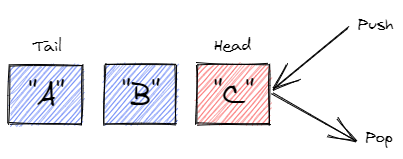
- Quick summary: a sequential collection where elements are added to and removed from the same end.
-
Important facts:
- First-in, last-out (FILO) data structure.
- Equivalent of a real-life pile of papers on desk.
- In stack terms, to insert is to push, and to remove is to pop.
- Often implemented on top of a linked list where the head is used for both insertion and removal. Can also be implemented using dynamic arrays.
-
Pros:
- Fast insertions and deletions:
O(1).
- Fast insertions and deletions:
-
Cons:
- Access and search are
O(n).
- Access and search are
-
Notable uses:
- Maintaining undo history.
- Tracking execution of program functions via a call stack.
- Reversing order of items.
-
Time complexity (worst case):
- Access:
O(n) - Search:
O(n) - Insertion (pushing):
O(1) - Deletion (popping):
O(1)
- Access:
- See also:
```js
class Stack {
  constructor() {
    this.stack = [];
  }

  push(item) {
    return this.stack.push(item);
  }

  pop() {
    return this.stack.pop();
  }

  peek() {
    return this.stack[this.length - 1];
  }

  get length() {
    return this.stack.length;
  }

  isEmpty() {
    return this.length === 0;
  }
}

const newStack = new Stack();
newStack.push(1);
newStack.push(2);
console.log(newStack);

newStack.pop();
console.log(newStack);

```
```py
class Stack(object):
    def __init__(self, limit=10):
        self.stack = []
        self.limit = limit

    # Printing the stack contents
    def __str__(self):
        return " ".join([str(i) for i in self.stack])

    # Pushing an element on to the stack
    def push(self, data):
        if len(self.stack) >= self.limit:
            print("Stack overflowed")
        else:
            self.stack.append(data)

    # Popping the top-most element
    def pop(self):
        if len(self.stack) <= 0:
            return -1
        else:
            return self.stack.pop()

    # Peeking the top-most element of the stack
    def peek(self):
        if len(self.stack) <= 0:
            return -1
        else:
            return self.stack[len(self.stack) - 1]

    # To check if stack is empty
    def is_empty(self):
        return self.stack == []

    # For checking the size of stack
    def size(self):
        return len(self.stack)


if __name__ == "__main__":
    my_stack = Stack()
    for i in range(10):
        my_stack.push(i)
    print(my_stack)
    my_stack.pop()  # popping the top element
    print(my_stack)
    my_stack.peek()  # printing the top element
    my_stack.is_empty()
    my_stack.size()

```
```java
class Stack {
    private String[] stack;
    private int top;

    public Stack(int size) {
        stack = new String[size];
        top = 0;
    }

    public void push(String value) {
        stack[top++] = value;
    }

    public void pop() {
        if (top > 0) {
            stack[--top] = null;
        }
    }

    public String peek() {
        if (top > 0) {
            return stack[top - 1];
        }
        return "";
    }

    public boolean isEmpty() {
        return top == 0;
    }

    public int length() {
        return top;
    }
}

public class Main {
    public static void main(String[] args) {
        Stack newStack = new Stack(10);
        newStack.push("1");
        newStack.push("2");
        System.out.println("Stack after pushing 1 and 2: " + newStack.length());
        newStack.pop();
        System.out.println("Top element after popping: " + newStack.peek());
    }
}
```
```cpp
#include <iostream>
#include <vector>
#include <string>

class Stack {
private:
    std::vector<std::string> stack;

public:
    void push(const std::string &item) {
        stack.push_back(item);
    }

    void pop() {
        if (!stack.empty()) {
            stack.pop_back();
        }
    }

    std::string peek() {
        if (!stack.empty()) {
            return stack.back();
        }
        return "";
    }

    bool isEmpty() {
        return stack.empty();
    }

    size_t length() {
        return stack.size();
    }
};

int main() {
    Stack newStack;
    newStack.push("1");
    newStack.push("2");
    newStack.pop();
    if (!newStack.peek().empty()) {
        std::cout << "Top element: " << newStack.peek() << std::endl;
    }
    return 0;
}
```
```csharp
using System;
using System.Collections.Generic;

public class Stack {
    private List<string> stack = new List<string>();

    public void Push(string item) {
        stack.Add(item);
    }

    public void Pop() {
        if (stack.Count > 0) {
            stack.RemoveAt(stack.Count - 1);
        }
    }

    public string Peek() {
        if (stack.Count > 0) {
            return stack[stack.Count - 1];
        }
        return "";
    }

    public bool IsEmpty() {
        return stack.Count == 0;
    }

    public int Length() {
        return stack.Count;
    }
}

public class Program {
    public static void Main(string[] args) {
        Stack newStack = new Stack();
        newStack.Push("1");
        newStack.Push("2");
        newStack.Pop();
        Console.WriteLine("Top element: " + newStack.Peek());
    }
}
```
```go
package main

import "fmt"

type Stack struct {
	stack []string
}

func (s *Stack) Push(item string) {
	s.stack = append(s.stack, item)
}

func (s *Stack) Pop() {
	if len(s.stack) > 0 {
		s.stack = s.stack[:len(s.stack)-1]
	}
}

func (s *Stack) Peek() string {
	if len(s.stack) > 0 {
		return s.stack[len(s.stack)-1]
	}
	return ""
}

func (s *Stack) IsEmpty() bool {
	return len(s.stack) == 0
}

func (s *Stack) Length() int {
	return len(s.stack)
}

func main() {
	newStack := &Stack{}
	newStack.Push("1")
	newStack.Push("2")
	newStack.Pop()
	fmt.Println("Top element:", newStack.Peek())
}
```
Hash Collision Check
True or False: a hash table can still have average O(1) lookup even though two different keys may produce the same hash bucket.
Hash Table
Hash Table
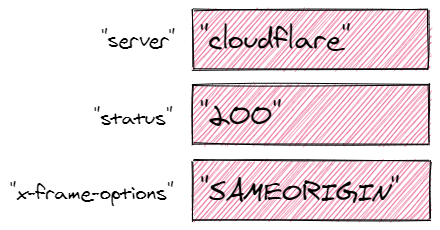
- Quick summary: unordered collection that maps keys to values using hashing.
- Also known as: hash, hash map, map, unordered map, dictionary, associative array.
-
Important facts:
- Stores data as key-value pairs.
- Can be seen as an evolution of arrays that removes the limitation of sequential numerical indices and allows using flexible keys instead.
- For any given non-numeric key, hashing helps get a numeric index to look up in the underlying array.
- If hashing two or more keys returns the same value, this is called a hash collision. To mitigate this, instead of storing actual values, the underlying array may hold references to linked lists that, in turn, contain all values with the same hash.
- A set is a variation of a hash table that stores keys but not values.
-
Pros:
- Keys can be of many data types. The only requirement is that these data types are hashable.
- Average search, insertion and deletion are
O(1).
-
Cons:
- Worst-case lookups are
O(n). - No ordering means looking up minimum and maximum values is expensive.
- Looking up the value for a given key can be done in constant time, but looking up the keys for a given value is
O(n).
- Worst-case lookups are
-
Notable uses:
- Caching.
- Database partitioning.
-
Time complexity (worst case):
- Access:
O(n) - Search:
O(n) - Insertion:
O(n) - Deletion:
O(n)
- Access:
- See also:
```js
class Hashmap {
  constructor() {
    this._storage = [];
  }

  hashStr(str) {
    let finalHash = 0;
    for (let i = 0; i < str.length; i++) {
      const charCode = str.charCodeAt(i);
      finalHash += charCode;
    }
    return finalHash;
  }

  set(key, val) {
    let idx = this.hashStr(key);

    if (!this._storage[idx]) {
      this._storage[idx] = [];
    }

    this._storage[idx].push([key, val]);
  }

  get(key) {
    let idx = this.hashStr(key);

    if (!this._storage[idx]) {
      return undefined;
    }

    for (let keyVal of this._storage[idx]) {
      if (keyVal[0] === key) {
        return keyVal[1];
      }
    }
  }
}

var dict = new Hashmap();
dict.set("james", "123-456-7890");
dict.set("jess", "213-559-6840");
console.log(dict.get("james"));

```
```py
class SimpleHashMap:
    def __init__(self):
        self.capacity = 10
        self.table = [None] * self.capacity

    def _hash_key(self, key):
        hash_val = 0
        for char in str(key):
            hash_val += ord(char)
        return hash_val % self.capacity

    def insert(self, key, value):
        hash_index = self._hash_key(key)
        key_value_pair = [key, value]

        if self.table[hash_index] is None:
            self.table[hash_index] = [key_value_pair]
            return True
        else:
            for pair in self.table[hash_index]:
                if pair[0] == key:
                    pair[1] = value
                    return True
            self.table[hash_index].append(key_value_pair)
            return True

    def retrieve(self, key):
        hash_index = self._hash_key(key)
        if self.table[hash_index] is not None:
            for pair in self.table[hash_index]:
                if pair[0] == key:
                    return pair[1]
        return None

    def remove(self, key):
        hash_index = self._hash_key(key)

        if self.table[hash_index] is None:
            return False
        for i in range(len(self.table[hash_index])):
            if self.table[hash_index][i][0] == key:
                self.table[hash_index].pop(i)
                return True
        return False

    def display(self):
        print("---PHONEBOOK---")
        for item in self.table:
            if item is not None:
                print(str(item))


phone_book = SimpleHashMap()
phone_book.insert("Alice", "555-1234")
phone_book.insert("Bob", "555-5678")
phone_book.insert("Alice", "555-9999")
phone_book.display()
phone_book.remove("Alice")
phone_book.display()
print("Bob: " + phone_book.retrieve("Bob"))
```
```java
import java.util.ArrayList;

class MyHashMap {

    private class Pair {
        String key;
        String value;
        Pair next;

        Pair(String k, String v, Pair n) {
            this.key = k;
            this.value = v;
            this.next = n;
        }
    }

    private final int SIZE = 10;
    private final ArrayList<Pair> buckets;

    public MyHashMap() {
        this.buckets = new ArrayList<>(SIZE);
        for (int i = 0; i < SIZE; i++) {
            buckets.add(null);
        }
    }

    private int hash(String key) {
        return Math.abs(key.hashCode() % SIZE);
    }

    public boolean insert(String key, String value) {
        int index = hash(key);
        Pair bucket = buckets.get(index);
        if (bucket == null) {
            buckets.set(index, new Pair(key, value, null));
            return true;
        } else {
            Pair newPair = new Pair(key, value, bucket);
            buckets.set(index, newPair);
            return true;
        }
    }

    public String retrieve(String key) throws Exception {
        int index = hash(key);
        Pair bucket = buckets.get(index);
        while (bucket != null) {
            if (bucket.key.equals(key)) {
                return bucket.value;
            }
            bucket = bucket.next;
        }
        throw new Exception("Key not found");
    }

    public boolean delete(String key) {
        int index = hash(key);
        Pair bucket = buckets.get(index);
        Pair prev = null;
        while (bucket != null) {
            if (bucket.key.equals(key)) {
                if (prev == null) {
                    buckets.set(index, bucket.next);
                } else {
                    prev.next = bucket.next;
                    bucket.next = null;
                }
                return true;
            }
            prev = bucket;
            bucket = bucket.next;
        }
        return false;
    }
}

public class MainExample {

    public static void main(String[] args) {
        MyHashMap map = new MyHashMap();
        map.insert("key1", "value1");
        map.insert("key2", "value2");
        try {
            System.out.println(map.retrieve("key2"));
        } catch (Exception e) {
            e.printStackTrace();
        }
    }
}
```
```cpp
#include <iostream>
#include <vector>
#include <string>

class HashMap {
private:
    struct KeyValue {
        std::string key;
        std::string value;
        KeyValue* next = nullptr;

        KeyValue(std::string k, std::string v, KeyValue* n) : key(k), value(v), next(n) {}
    };

    std::vector<KeyValue*> map;
    static const int BUCKET_SIZE = 10;

    int getHash(std::string key) {
        int hash = std::hash<std::string>{}(key);
        return abs(hash % BUCKET_SIZE);
    }

public:
    HashMap() {
        map.resize(BUCKET_SIZE, nullptr);
    }

    bool add(std::string key, std::string val) {
        int hash = getHash(key);

        if (map[hash] == nullptr) {
            map[hash] = new KeyValue(key, val, nullptr);
        } else {
            KeyValue* temp = new KeyValue(key, val, map[hash]);
            map[hash] = temp;
        }

        return true;
    }

    std::string get(std::string key) {
        int hash = getHash(key);

        if (map[hash] != nullptr) {
            KeyValue* temp = map[hash];
            while (temp != nullptr) {
                if (temp->key == key) {
                    return temp->value;
                }
                temp = temp->next;
            }
        }

        return "Specified key doesn't exist";
    }

    bool remove(std::string key) {
        int hash = getHash(key);

        if (map[hash] != nullptr) {
            KeyValue* temp = map[hash];
            KeyValue* parent = nullptr;

            while (temp != nullptr) {
                if (temp->key == key) {
                    if (parent == nullptr) {
                        map[hash] = temp->next;
                    } else {
                        parent->next = temp->next;
                        delete temp;
                    }
                    return true;
                }
                temp = temp->next;
            }
        }

        return false;
    }
};

int main() {
    HashMap abc;

    abc.add("abc", "def");
    abc.add("abdefc", "askjfhdjf");

    std::cout << abc.get("abdefc") << std::endl;

    return 0;
}
```
```csharp
using System;
using System.Collections.Generic;

class HashMap {
    private class KeyValue {
        public string Key { get; }
        public string Value { get; set; }
        public KeyValue Next { get; set; }

        public KeyValue(string key, string value, KeyValue next) {
            Key = key;
            Value = value;
            Next = next;
        }
    }

    private readonly List<KeyValue> map = new List<KeyValue>();
    private const int BUCKET_SIZE = 10;

    public HashMap() {
        for (int i = 0; i < BUCKET_SIZE; i++) {
            map.Add(null);
        }
    }

    private int GetHash(string key) {
        int hash = key.GetHashCode();
        hash = Math.Abs(hash % BUCKET_SIZE);
        return hash;
    }

    public bool Add(string key, string val) {
        int hash = GetHash(key);

        if (map[hash] == null) {
            map[hash] = new KeyValue(key, val, null);
        } else {
            KeyValue temp = new KeyValue(key, val, map[hash]);
            map[hash] = temp;
        }
        return true;
    }

    public string Get(string key) {
        int hash = GetHash(key);

        if (map[hash] != null) {
            KeyValue temp = map[hash];
            while (temp != null) {
                if (temp.Key.Equals(key)) {
                    return temp.Value;
                }
                temp = temp.Next;
            }
        }

        return "Specified key doesn't exist";
    }

    public bool Remove(string key) {
        int hash = GetHash(key);

        if (map[hash] != null) {
            KeyValue temp = map[hash];
            KeyValue parent = null;

            while (temp != null) {
                if (temp.Key.Equals(key)) {
                    if (parent == null) {
                        map[hash] = temp.Next;
                    } else {
                        parent.Next = temp.Next;
                        // delete temp
                        temp.Next = null;
                    }
                    return true;
                }
                temp = temp.Next;
            }
        }

        return false;
    }

    public static void Main(string[] args) {
        HashMap abc = new HashMap();

        abc.Add("abc", "def");
        abc.Add("abdefc", "askjfhdjf");

        Console.WriteLine(abc.Get("abdefc"));
    }
}
```
```go
package main

import (
	"fmt"
	"math"
)

type KeyValue struct {
	key  string
	val  string
	next *KeyValue
}

type HashMap struct {
	map         []*KeyValue
	BUCKET_SIZE int
}

func NewHashMap() *HashMap {
	h := &HashMap{
		BUCKET_SIZE: 10,
	}
	h.map = make([]*KeyValue, h.BUCKET_SIZE)
	return h
}

func (h *HashMap) getHash(key string) int {
	hash := 0
	for _, char := range key {
		hash += int(char)
	}
	return int(math.Abs(float64(hash % h.BUCKET_SIZE)))
}

func (h *HashMap) Add(key, val string) bool {
	hash := h.getHash(key)

	if h.map[hash] == nil {
		h.map[hash] = &KeyValue{key: key, val: val, next: nil}
	} else {
		temp := &KeyValue{key: key, val: val, next: h.map[hash]}
		h.map[hash] = temp
	}

	return true
}

func (h *HashMap) Get(key string) string {
	hash := h.getHash(key)

	if h.map[hash] != nil {
		temp := h.map[hash]
		for temp != nil {
			if temp.key == key {
				return temp.val
			}
			temp = temp.next
		}
	}

	return "Specified key doesn't exist"
}

func (h *HashMap) Remove(key string) bool {
	hash := h.getHash(key)

	if h.map[hash] != nil {
		temp := h.map[hash]
		var parent *KeyValue = nil

		for temp != nil {
			if temp.key == key {
				if parent == nil {
					h.map[hash] = temp.next
				} else {
					parent.next = temp.next
					temp.next = nil
				}
				return true
			}
			temp = temp.next
		}
	}

	return false
}

func main() {
	abc := NewHashMap()

	abc.Add("abc", "def")
	abc.Add("abdefc", "askjfhdjf")

	fmt.Println(abc.Get("abdefc"))
}
```
Graph
Graph
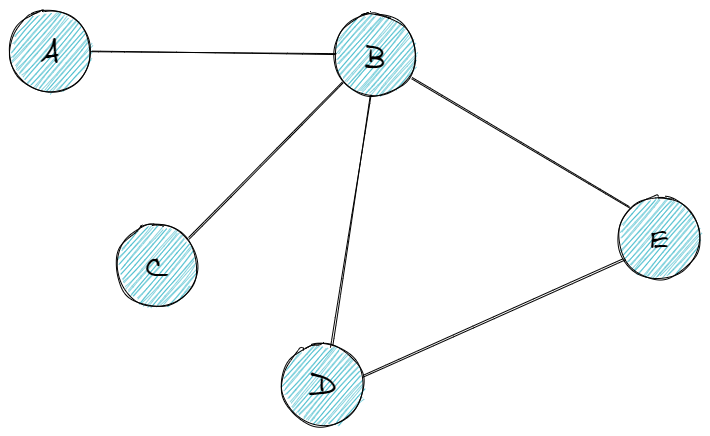
- Quick summary: a data structure that stores items in a connected, non-hierarchical network.
-
Important facts:
- Each graph element is called a node, or vertex.
- Graph nodes are connected by edges.
- Graphs can be directed or undirected.
- Graphs can be cyclic or acyclic. A cyclic graph contains a path from at least one node back to itself.
- Graphs can be weighted or unweighted. In a weighted graph, each edge has a certain numerical weight.
- Graphs can be traversed. See important facts under Tree for an overview of traversal algorithms.
- Data structures used to represent graphs:
- Edge list: a list of all graph edges represented by pairs of nodes that these edges connect.
- Adjacency list: a list or hash table where a key represents a node and its value represents the list of this node's neighbors.
- Adjacency matrix: a matrix of binary values indicating whether any two nodes are connected.
-
Pros:
- Ideal for representing entities interconnected with links.
-
Cons:
- Low performance makes scaling hard.
-
Notable uses:
- Social media networks.
- Recommendations in ecommerce websites.
- Mapping services.
-
Time complexity (worst case): varies depending on the choice of algorithm.
O(n*lg(n))or slower for most graph algorithms. - See also:
```js
class Graph {
  constructor() {
    this.adjacencyList = {};
  }

  addVertex(nodeVal) {
    this.adjacencyList[nodeVal] = [];
  }

  addEdge(src, dest) {
    this.adjacencyList[src].push(dest);
    this.adjacencyList[dest].push(src);
  }

  removeVertex(val) {
    if (this.adjacencyList[val]) {
      this.adjacencyList.delete(val);
    }

    this.adjacencyList.forEach((vertex) => {
      const neighborIdx = vertex.indexOf(val);
      if (neighborIdx >= 0) {
        vertex.splice(neighborIdx, 1);
      }
    });
  }

  removeEdge(src, dest) {
    const srcDestIdx = this.adjacencyList[src].indexOf(dest);
    this.adjacencyList[src].splice(srcDestIdx, 1);

    const destSrcIdx = this.adjacencyList[dest].indexOf(src);
    this.adjacencyList[dest].splice(destSrcIdx, 1);
  }
}

var graph = new Graph(7);
var vertices = ["A", "B", "C", "D", "E", "F", "G"];
for (var i = 0; i < vertices.length; i++) {
  graph.addVertex(vertices[i]);
}
graph.addEdge("A", "G");
graph.addEdge("A", "E");
graph.addEdge("A", "C");
graph.addEdge("B", "C");
graph.addEdge("C", "D");
graph.addEdge("D", "E");
graph.addEdge("E", "F");
graph.addEdge("E", "C");
graph.addEdge("G", "D");
console.log(graph.adjacencyList);

```
```py
class GraphStructure:
    def __init__(self):
        self.node_links = {}

    def add_node(self, node_label):
        self.node_links[node_label] = []

    def connect_nodes(self, node1, node2):
        self.node_links[node1].append(node2)
        self.node_links[node2].append(node1)

    def remove_node(self, node):
        if node in self.node_links:
            del self.node_links[node]

        for vertex in self.node_links.values():
            vertex.remove(node) if node in vertex else None

    def disconnect_nodes(self, node1, node2):
        self.node_links[node1].remove(node2)
        self.node_links[node2].remove(node1)

if __name__ == '__main__':
    my_graph = GraphStructure()
    vertices = ["A", "B", "C", "D", "E", "F", "G"]
    for vertex in vertices:
        my_graph.add_node(vertex)

    my_graph.connect_nodes("A", "G")
    my_graph.connect_nodes("A", "E")
    my_graph.connect_nodes("A", "C")
    my_graph.connect_nodes("B", "C")
    my_graph.connect_nodes("C", "D")
    my_graph.connect_nodes("D", "E")
    my_graph.connect_nodes("E", "F")
    my_graph.connect_nodes("E", "C")
    my_graph.connect_nodes("G", "D")

    print(my_graph.node_links)

```
```java
import java.util.HashSet;
import java.util.LinkedList;

class Node {
    private String name;
    private LinkedList < Edge > edgeList;

    public Node(String name) {
        this.name = name;
        edgeList = new LinkedList < > ();
    }

    public String getName() {
        return name;
    }

    public LinkedList < Edge > getEdges() {
        return edgeList;
    }
}

class Edge {
    private int weight;
    private Node destVertex;

    public Edge(Node dest, int w) {
        this.destVertex = dest;
        this.weight = w;
    }

    public Edge(Node dest) {
        this.destVertex = dest;
        this.weight = 1;
    }

    public int getWeight() {
        return weight;
    }

    public Node getDestVertex() {
        return destVertex;
    }
}

class Graph {
    private HashSet < Node > nodes;

    public Graph() {
        nodes = new HashSet < > ();
    }

    public boolean AddEdge(Node v1, Node v2, int weight) {
        return v1.getEdges().add(new Edge(v2, weight)) && v2.getEdges().add(new Edge(v1, weight));
    }

    public boolean AddVertex(Node v) {
        return nodes.add(v);
    }

    public void printGraph() {
        for (Node v: nodes) {
            System.out.print("vertex name: " + v.getName() + ":\n");
            for (Edge e: v.getEdges()) {
                System.out.print("destVertex: " + e.getDestVertex().getName() + ", weight: " + e.getWeight() + "\n");
            }
            System.out.print("\n");
        }
    }
}

public class Main {
    public static void main(String[] args) {
        Graph ourGraph = new Graph();

        // nodes
        Node v0 = new Node("0");
        Node v1 = new Node("1");
        Node v2 = new Node("2");
        Node v3 = new Node("3");

        ourGraph.AddVertex(v0);
        ourGraph.AddVertex(v1);
        ourGraph.AddVertex(v2);
        ourGraph.AddVertex(v3);

        // edges
        ourGraph.AddEdge(v0, v1, 2);
        ourGraph.AddEdge(v1, v2, 3);
        ourGraph.AddEdge(v2, v0, 1);
        ourGraph.AddEdge(v2, v3, 1);
        ourGraph.AddEdge(v3, v2, 4);

        ourGraph.printGraph();
    }
}
```
```go
package main

import "fmt"

type Graph struct {
    AdjacencyList map[string][]string
}

func NewGraph() *Graph {
    return &Graph{AdjacencyList: make(map[string][]string)}
}

func (g *Graph) AddVertex(vertex string) {
    g.AdjacencyList[vertex] = []string{}
}

func (g *Graph) AddEdge(src, dest string) {
    g.AdjacencyList[src] = append(g.AdjacencyList[src], dest)
    g.AdjacencyList[dest] = append(g.AdjacencyList[dest], src)
}

func (g *Graph) RemoveVertex(vertex string) {
    delete(g.AdjacencyList, vertex)
    for k, v := range g.AdjacencyList {
        for i, neighbor := range v {
            if neighbor == vertex {
                g.AdjacencyList[k] = append(v[:i], v[i+1:]...)
            }
        }
    }
}

func (g *Graph) RemoveEdge(src, dest string) {
    removeEdgeHelper(g.AdjacencyList, src, dest)
    removeEdgeHelper(g.AdjacencyList, dest, src)
}

func removeEdgeHelper(adjList map[string][]string, src, dest string) {
    for i, neighbor := range adjList[src] {
        if neighbor == dest {
            adjList[src] = append(adjList[src][:i], adjList[src][i+1:]...)
        }
    }
}

func main() {
    g := NewGraph()
    vertices := []string{"A", "B", "C", "D", "E", "F", "G"}
    for _, vertex := range vertices {
        g.AddVertex(vertex)
    }
    g.AddEdge("A", "G")
    g.AddEdge("A", "E")
    g.AddEdge("A", "C")
    g.AddEdge("B", "C")
    g.AddEdge("C", "D")
    g.AddEdge("D", "E")
    g.AddEdge("E", "F")
    g.AddEdge("E", "C")
    g.AddEdge("G", "D")

    fmt.Println(g.AdjacencyList)
}

```
```cpp
#include <iostream>
#include <unordered_map>
#include <vector>
#include <algorithm>

class Graph {
private:
    std::unordered_map<std::string, std::vector<std::string>> AdjacencyList;

public:
    Graph() {
        // Initialize an empty adjacency list
        AdjacencyList = {};
    }

    void AddVertex(std::string vertex) {
        AdjacencyList[vertex] = {};
    }

    void AddEdge(std::string src, std::string dest) {
        AdjacencyList[src].push_back(dest);
        AdjacencyList[dest].push_back(src);
    }

    void RemoveVertex(std::string vertex) {
        AdjacencyList.erase(vertex);
        for (auto& [key, neighbors] : AdjacencyList) {
            neighbors.erase(std::remove(neighbors.begin(), neighbors.end(), vertex), neighbors.end());
        }
    }

    void RemoveEdge(std::string src, std::string dest) {
        removeEdgeHelper(AdjacencyList[src], dest);
        removeEdgeHelper(AdjacencyList[dest], src);
    }

private:
    void removeEdgeHelper(std::vector<std::string>& adjList, std::string dest) {
        adjList.erase(std::remove(adjList.begin(), adjList.end(), dest), adjList.end());
    }
};

public class Main {
  int main() {
      Graph g;
      std::vector<std::string> vertices = {"A", "B", "C", "D", "E", "F", "G"};

      for (const auto& vertex : vertices) {
          g.AddVertex(vertex);
      }

      g.AddEdge("A", "G");
      g.AddEdge("A", "E");
      g.AddEdge("A", "C");
      g.AddEdge("B", "C");
      g.AddEdge("C", "D");
      g.AddEdge("D", "E");
      g.AddEdge("E", "F");
      g.AddEdge("E", "C");
      g.AddEdge("G", "D");

      // For demonstration purposes, you might want to print the adjacency list here.

      return 0;
  }
}

```
```csharp
using System;
using System.Collections.Generic;

class Graph {
    private Dictionary<string, List<string>> AdjacencyList;

    public Graph() {
        // Initialize an empty adjacency list
        AdjacencyList = new Dictionary<string, List<string>>();
    }

    public void AddVertex(string vertex) {
        AdjacencyList[vertex] = new List<string>();
    }

    public void AddEdge(string src, string dest) {
        AdjacencyList[src].Add(dest);
        AdjacencyList[dest].Add(src);
    }

    public void RemoveVertex(string vertex) {
        AdjacencyList.Remove(vertex);
        foreach (var neighbors in AdjacencyList.Values) {
            neighbors.Remove(vertex);
        }
    }

    public void RemoveEdge(string src, string dest) {
        RemoveEdgeHelper(AdjacencyList[src], dest);
        RemoveEdgeHelper(AdjacencyList[dest], src);
    }

    private void RemoveEdgeHelper(List<string> adjList, string dest) {
        adjList.Remove(dest);
    }
}

class Program {
    static void Main(string[] args) {
        Graph g = new Graph();
        string[] vertices = {"A", "B", "C", "D", "E", "F", "G"};

        foreach (string vertex in vertices) {
            g.AddVertex(vertex);
        }

        g.AddEdge("A", "G");
        g.AddEdge("A", "E");
        g.AddEdge("A", "C");
        g.AddEdge("B", "C");
        g.AddEdge("C", "D");
        g.AddEdge("D", "E");
        g.AddEdge("E", "F");
        g.AddEdge("E", "C");
        g.AddEdge("G", "D");

        // For demonstration purposes, you might want to print the adjacency list here.
    }
}
```
BST Traversal Check
For a valid binary search tree, which traversal visits the values in sorted order?
Tree
Tree
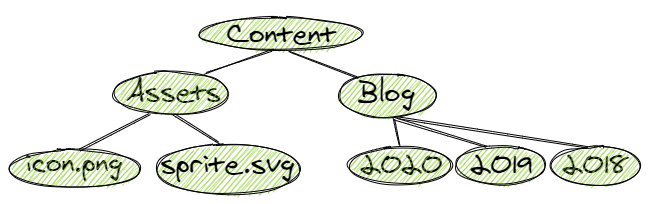
- Quick summary: a data structure that stores a hierarchy of values.
-
Important facts:
- Organizes values hierarchically.
- A tree item is called a node, and every node is connected to 0 or more child nodes using links.
- A tree is a kind of graph where between any two nodes, there is only one possible path.
- The top node in a tree that has no parent nodes is called the root.
- Nodes that have no children are called leaves.
- The number of links from the root to a node is called that node's depth.
- The height of a tree is the number of links from its root to the furthest leaf.
- In a binary tree, nodes cannot have more than two children.
- Any node can have one left and one right child node.
- Used to make binary search trees.
- In an unbalanced binary tree, there is a significant difference in height between subtrees.
- An completely one-sided tree is called a degenerate tree and becomes equivalent to a linked list.
- Trees (and graphs in general) can be traversed in several ways:
- Breadth first search (BFS): nodes one link away from the root are visited first, then nodes two links away, etc. BFS finds the shortest path between the starting node and any other reachable node.
-
Depth first search (DFS): nodes are visited as deep as possible down the leftmost path, then by the next path to the right, etc. This method is less memory intensive than BFS. It comes in several flavors, including:
- Pre order traversal (similar to DFS): after the current node, the left subtree is visited, then the right subtree.
- In order traversal: the left subtree is visited first, then the current node, then the right subtree.
- Post order traversal. the left subtree is visited first, then the right subtree, and finally the current node.
-
Pros:
- For most operations, the average time complexity is
O(log(n)), which enables solid scalability. Worst time complexity varies betweenO(log(n))andO(n).
- For most operations, the average time complexity is
-
Cons:
- Performance degrades as trees lose balance, and re-balancing requires effort.
- No constant time operations: trees are moderately fast at everything they do.
-
Notable uses:
- File systems.
- Database indexing.
- Syntax trees.
- Comment threads.
- Time complexity: varies for different kinds of trees.
- See also:
```javascript
function TreeNode(value) {
  this.value = value;
  this.children = [];
  this.parent = null;

  this.setParentNode = function (node) {
    this.parent = node;
  };

  this.getParentNode = function () {
    return this.parent;
  };

  this.addNode = function (node) {
    node.setParentNode(this);
    this.children[this.children.length] = node;
  };

  this.getChildren = function () {
    return this.children;
  };

  this.removeChildren = function () {
    this.children = [];
  };
}

const root = new TreeNode(1);
root.addNode(new TreeNode(2));
root.addNode(new TreeNode(3));

const children = root.getChildren();
for (let i = 0; i < children.length; i++) {
  for (let j = 0; j < 5; j++) {
    children[i].addNode(new TreeNode("second level child " + j));
  }
}

console.log(root);
children[0].removeChildren();
console.log(root);
console.log(root.getParentNode());
console.log(children[1].getParentNode());
```
```python
class TreeNode:
    def __init__(self, value):
        self.value = value
        self.children = []
        self.parent = None

    def set_parent_node(self, node):
        self.parent = node

    def get_parent_node(self):
        return self.parent

    def add_node(self, node):
        node.set_parent_node(self)
        self.children.append(node)

    def get_children(self):
        return self.children

    def remove_children(self):
        self.children = []


root = TreeNode(1)
root.add_node(TreeNode(2))
root.add_node(TreeNode(3))

children = root.get_children()
for i in range(len(children)):
    for j in range(5):
        children[i].add_node(TreeNode(f"second level child {j}"))

print(root.__dict__)
children[0].remove_children()
print(root.__dict__)
print(root.get_parent_node())
print(children[1].get_parent_node())
```
```java
import java.util.ArrayList;

class TreeNode<T> {
    private T value;
    private ArrayList<TreeNode<T>> children = new ArrayList<>();
    private TreeNode<T> parent = null;

    public TreeNode(T value) {
        this.value = value;
    }

    public void setParentNode(TreeNode<T> node) {
        this.parent = node;
    }

    public TreeNode<T> getParentNode() {
        return this.parent;
    }

    public void addNode(TreeNode<T> node) {
        node.setParentNode(this);
        this.children.add(node);
    }

    public ArrayList<TreeNode<T>> getChildren() {
        return this.children;
    }

    public void removeChildren() {
        this.children = new ArrayList<>();
    }
}

public class Main {
    public static void main(String[] args) {
        TreeNode<Integer> root = new TreeNode<>(1);
        root.addNode(new TreeNode<>(2));
        root.addNode(new TreeNode<>(3));

        ArrayList<TreeNode<Integer>> children = root.getChildren();
        for (int i = 0; i < children.size(); i++) {
            for (int j = 0; j < 5; j++) {
                children.get(i).addNode(new TreeNode<>("second level child " + j));
            }
        }

        System.out.println(root);
        children.get(0).removeChildren();
        System.out.println(root);
        System.out.println(root.getParentNode());
        System.out.println(children.get(1).getParentNode());
    }
}
```
```cpp
#include <iostream>
#include <vector>
#include <string>

template <typename T>
class TreeNode {
    T value;
    std::vector<TreeNode*> children;
    TreeNode* parent = nullptr;

public:
    TreeNode(T value) : value(value) {}

    void setParentNode(TreeNode* node) {
        this->parent = node;
    }

    TreeNode* getParentNode() {
        return this->parent;
    }

    void addNode(TreeNode* node) {
        node->setParentNode(this);
        this->children.push_back(node);
    }

    std::vector<TreeNode*> getChildren() {
        return this->children;
    }

    void removeChildren() {
        this->children.clear();
    }
};

int main() {
    TreeNode<int> root(1);
    root.addNode(new TreeNode<int>(2));
    root.addNode(new TreeNode<int>(3));

    std::vector<TreeNode<int>*> children = root.getChildren();
    for (int i = 0; i < children.size(); i++) {
        for (int j = 0; j < 5; j++) {
            children[i]->addNode(new TreeNode<std::string>("second level child " + std::to_string(j)));
        }
    }

    // Further code to print or interact with the structure.
    return 0;
}
```
```csharp
using System;
using System.Collections.Generic;

class TreeNode<T> {
    public T value;
    public List<TreeNode<T>> children = new List<TreeNode<T>>();
    public TreeNode<T> parent = null;

    public TreeNode(T value) {
        this.value = value;
    }

    public void SetParentNode(TreeNode<T> node) {
        this.parent = node;
    }

    public TreeNode<T> GetParentNode() {
        return this.parent;
    }

    public void AddNode(TreeNode<T> node) {
        node.SetParentNode(this);
        this.children.Add(node);
    }

    public List<TreeNode<T>> GetChildren() {
        return this.children;
    }

    public void RemoveChildren() {
        this.children.Clear();
    }
}

class Program {
    static void Main(string[] args) {
        TreeNode<int> root = new TreeNode<int>(1);
        root.AddNode(new TreeNode<int>(2));
        root.AddNode(new TreeNode<int>(3));

        List<TreeNode<int>> children = root.GetChildren();
        for (int i = 0; i < children.Count; i++) {
            for (int j = 0; j < 5; j++) {
                children[i].AddNode(new TreeNode<string>("second level child " + j));
            }
        }

        // Further code to print or interact with the structure.
    }
}
```
```go
package main

import (
	"fmt"
)

type TreeNode struct {
	value    interface{}
	children []*TreeNode
	parent   *TreeNode
}

func (n *TreeNode) setParentNode(node *TreeNode) {
	n.parent = node
}

func (n *TreeNode) getParentNode() *TreeNode {
	return n.parent
}

func (n *TreeNode) addNode(node *TreeNode) {
	node.setParentNode(n)
	n.children = append(n.children, node)
}

func (n *TreeNode) getChildren() []*TreeNode {
	return n.children
}

func (n *TreeNode) removeChildren() {
	n.children = []*TreeNode{}
}

func main() {
	root := &TreeNode{value: 1}
	root.addNode(&TreeNode{value: 2})
	root.addNode

(&TreeNode{value: 3})

	children := root.getChildren()
	for i := 0; i < len(children); i++ {
		for j := 0; j < 5; j++ {
			children[i].addNode(&TreeNode{value: "second level child " + fmt.Sprint(j)})
		}
	}

	// Further code to print or interact with the structure.
}
```
Binary Search Tree
Binary Search Tree
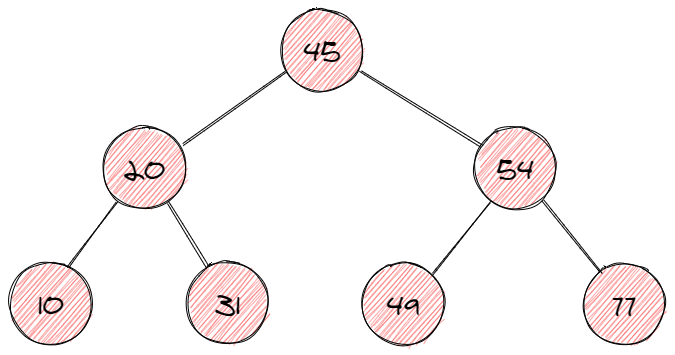
- Quick summary: a kind of binary tree where nodes to the left are smaller, and nodes to the right are larger than the current node.
-
Important facts:
- Nodes of a binary search tree (BST) are ordered in a specific way:
- All nodes to the left of the current node are smaller (or sometimes smaller or equal) than the current node.
- All nodes to the right of the current node are larger than the current node.
- Duplicate nodes are usually not allowed.
- Nodes of a binary search tree (BST) are ordered in a specific way:
-
Pros:
- Balanced BSTs are moderately performant for all operations.
- Since BST is sorted, reading its nodes in sorted order can be done in
O(n), and search for a node closest to a value can be done inO(log(n))
-
Cons:
- Same as trees in general: no constant time operations, performance degradation in unbalanced trees.
-
Time complexity (worst case):
- Access:
O(n) - Search:
O(n) - Insertion:
O(n) - Deletion:
O(n)
- Access:
-
Time complexity (average case):
- Access:
O(log(n)) - Search:
O(log(n)) - Insertion:
O(log(n)) - Deletion:
O(log(n))
- Access:
- See also:
```js
function Node(val) {
  this.val = val;
  this.left = null;
  this.right = null;
}

class BST {
  constructor(val) {
    this.root = new Node(val);
  }

  add(val) {
    let newNode = new Node(val);

    function findPosAndInsert(currNode, newNode) {
      if (newNode.val < currNode.val) {
        if (!currNode.left) {
          currNode.left = newNode;
        } else {
          findPosAndInsert(currNode.left, newNode);
        }
      } else {
        if (!currNode.right) {
          currNode.right = newNode;
        } else {
          findPosAndInsert(currNode.right, newNode);
        }
      }
    }

    if (!this.root) {
      this.root = newNode;
    } else {
      findPosAndInsert(this.root, newNode);
    }
  }

  remove(val) {
    let self = this;
    let removeNode = function (node, val) {
      if (!node) {
        return null;
      }
      if (val === node.val) {
        if (!node.left && !node.right) {
          return null;
        }
        if (!node.left) {
          return node.right;
        }
        if (!node.right) {
          return node.left;
        }
        let temp = self.getMinimum(node.right);
        node.val = temp;
        node.right = removeNode(node.right, temp);
        return node;
      } else if (val < node.val) {
        node.left = removeNode(node.left, val);
        return node;
      } else {
        node.right = removeNode(node.right, val);
        return node;
      }
    };
    this.root = removeNode(this.root, val);
  }

  getMinimum(node) {
    if (!node) {
      node = this.root;
    }
    while (node.left) {
      node = node.left;
    }
    return node.val;
  }

  // helper method
  contains(value) {
    let doesContain = false;

    function traverse(bst) {
      if (this.root.value === value) {
        doesContain = true;
      } else if (this.root.left !== undefined && value < this.root.value) {
        traverse(this.root.left);
      } else if (this.root.right !== undefined && value > this.root.value) {
        traverse(this.root.right);
      }
    }

    traverse(this);
    return doesContain;
  }
}

const bst = new BST(4);
bst.add(3);
bst.add(5);
bst.remove(3);
console.log(bst);

```
```py
class Node(object):
    def __init__(self, val):
        self.val = val
        self.left_child = None
        self.right_child = None

    def insert(self, val):
        """For inserting the value in the Tree"""
        if self.val == val:
            return False  # A BST cannot contain duplicate data

        elif val < self.val:
            """Values less than the root data are placed to the left of the root"""
            if self.left_child:
                return self.left_child.insert(val)
            else:
                self.left_child = Node(val)
                return True

        else:
            """Values greater than the root data are placed to the right of the root"""
            if self.right_child:
                return self.right_child.insert(val)
            else:
                self.right_child = Node(val)
                return True

    def min_node(self, node):
        current = node

        # Find the leftmost leaf
        while current.left_child is not None:
            current = current.left_child

        return current

    def max_node(self, node):
        current = node

        # Find the leftmost leaf
        while current.right_child is not None:
            current = current.right_child

        return current

    def delete(self, val, root):
        """For deleting the node"""
        if self is None:
            return None

        # If current node's data is less than that of root node,
        # then only search in left subtree, otherwise search in right subtree
        if val < self.val:
            self.left_child = self.left_child.delete(val, root)
        elif val > self.val:
            self.right_child = self.right_child.delete(val, root)
        else:
            # Deleting node with one child
            if self.left_child is None:

                if self == root:
                    temp = self.min_node(self.right_child)
                    self.val = temp.val
                    self.right_child = self.right_child.delete(temp.val, root)

                temp = self.right_child
                self = None
                return temp
            elif self.right_child is None:

                if self == root:
                    temp = self.max_node(self.left_child)
                    self.val = temp.val
                    self.left_child = self.left_child.delete(temp.val, root)

                temp = self.left_child
                self = None
                return temp

            # Deleting node with two children
            # First get the in-order successor
            temp = self.min_node(self.right_child)
            self.val = temp.val
            self.right_child = self.right_child.delete(temp.val, root)

        return self

    def find(self, val):
        """This function checks whether the specified val is in tree or not"""
        if val == self.val:
            return True
        elif val < self.val:
            if self.left_child:
                return self.left_child.find(val)
            else:
                return False
        else:
            if self.right_child:
                return self.right_child.find(val)
            else:
                return False

    def preorder(self):
        """For preorder traversal of the BST"""
        if self:
            print(str(self.val), end=" ")
            if self.left_child:
                self.left_child.preorder()
            if self.right_child:
                self.right_child.preorder()

    def inorder(self):
        """For Inorder traversal of the BST"""
        if self:
            if self.left_child:
                self.left_child.inorder()
            print(str(self.val), end=" ")
            if self.right_child:
                self.right_child.inorder()

    def postorder(self):
        """For postorder traversal of the BST"""
        if self:
            if self.left_child:
                self.left_child.postorder()
            if self.right_child:
                self.right_child.postorder()
            print(str(self.val), end=" ")


class Tree(object):
    def __init__(self):
        self.root = None

    def insert(self, val):
        if self.root:
            return self.root.insert(val)
        else:
            self.root = Node(val)
            return True

    def delete(self, val):
        if self.root is not None:
            return self.root.delete(val, self.root)

    def find(self, val):
        if self.root:
            return self.root.find(val)
        else:
            return False

    def preorder(self):
        if self.root is not None:
            print()
            print("Preorder: ")
            self.root.preorder()

    def inorder(self):
        print()
        if self.root is not None:
            print("Inorder: ")
            self.root.inorder()

    def postorder(self):
        print()
        if self.root is not None:
            print("Postorder: ")
            self.root.postorder()


if __name__ == "__main__":
    tree = Tree()
    tree.insert(11)
    tree.insert(9)
    tree.insert(6)
    tree.insert(3)
    tree.insert(17)
    tree.insert(5)
    tree.insert(4)
    tree.insert(19)
    tree.insert(12)
    print(tree.find(13))
    print(tree.find(5))
    """ The following tree is generated:
                    11
                 /     \
               6        9
              /           \
            3              17
             \             /  \
              5          12    19
             /
            4
    """

    tree.preorder()
    tree.inorder()
    tree.postorder()
    print("\n\nAfter deleting 19")
    tree.delete(19)
    tree.inorder()
    tree.preorder()
    print("\n\nAfter deleting 12")
    tree.delete(12)
    tree.inorder()
    tree.preorder()
```
```java
class Tree {
    private Node rootNode;

    /**
     * Create new Node with value and insert into this Tree
     * @param value Initial value for new Node
     */
    public void insertValue(int value) {
        insertNode(new Node(value));
    }

    /**
     * Insert new Node into this Tree
     * @param newNode Node to be inserted into this Tree
     */
    public void insertNode(Node newNode) {
        if (rootNode == null) {
            rootNode = new Node(newNode.getValue());
        } else {
            insertNode(rootNode, newNode);
        }
    }

    /**
     * Search this tree for a value
     *
     * @param value Value to be searched in this Tree
     * @return True if this tree contains value
     */
    public boolean containsValue(int value) {
        if (getNode(rootNode, value) == null) {
            return false;
        }
        return true;
    }

    /**
     * Get Node in this Tree that contains value
     *
     * @param value Value to be searched within this Tree
     * @return Node that matches value or null if no match found
     */
    public Node getNode(Node currNode, int value) {
        if (currNode == null)
            return null;
        if (currNode.getValue() == value)
            return currNode;
        if (value < currNode.getValue())
            return getNode(currNode.getleft(), value);
        return getNode(currNode.getright(), value);
    }

    /**
     * Insert a new node into this tree
     *
     * @param currNode Current node we are comparing to newNode
     * @param newNode     New node that is to be inserted
     */
    private void insertNode(Node currNode, Node newNode) {
        if (newNode.getValue() < currNode.getValue()) {
            if (currNode.getleft() == null)
                currNode.setleft(newNode);
            else
                insertNode(currNode.getleft(), newNode);
        }
        if (newNode.getValue() > currNode.getValue()) {
            if (currNode.getright() == null)
                currNode.setright(newNode);
            else
                insertNode(currNode.getright(), newNode);
        }
    }

    /**
     * @return String representation of this Tree
     */
    @Override
    public String toString() {
        if (rootNode != null) {
            return rootNode.toString();
        }
        return "";
    }
}

class Node {
    private Node left;
    private Node right;
    private int value;

    /**
     * Node constructor with initial Node value
     *
     * @param value Initial value for this node
     */
    public Node(int value) {
        left = null;
        right = null;
        this.value = value;
    }

    /**
     * Set left node pointer for this Node
     *
     * @param node Left node for this Node
     */
    public void setleft(Node node) {
        this.left = node;
    }
    /**
     * Set right node pointer for this Node
     *
     * @param node Right node for this Node
     */
    public void setright(Node node) {
        this.right = node;
    }
    /**
     * Set value for this Node
     *
     * @param value Value for this Node
     */
    public void setValue(int value) {
        this.value = value;
    }

    /**
     * @return Left node for this Node
     */
    public Node getleft() {
        return left;
    }
    /**
     * @return Right node for this Node
     */
    public Node getright() {
        return right;
    }
    /**
     * @return Current value for this Node
     */
    public int getValue() {
        return value;
    }

    /**
     * @return String representation of this Node
     */
    @Override
    public String toString() {
        String result = value + "";
        if (left != null) result = left.toString() + " - " + result;
        if (right != null) result = result + " - " + right.toString();
        return result;
    }
}

public class Main {
    public static void main(String[] args) {
        Tree myTree = new Tree();
        myTree.insertValue(20);
        myTree.insertValue(9);
        myTree.insertValue(13);
        myTree.insertValue(21);
        myTree.insertValue(14);
        System.out.println(myTree.toString());
        System.out.println(myTree.containsValue(20));
        System.exit(0);
    }
}
```
```cpp
#include <iostream>
#include <algorithm>
using namespace std;

struct Node {
    int value;
    Node* left;
    Node* right;
    Node(int val) : value(val), left(nullptr), right(nullptr) {}
};

class Tree {
private:
    Node* rootNode;

public:
    Tree() : rootNode(nullptr) {}

    void insertValue(int value) {
        insertNode(new Node(value));
    }

    void insertNode(Node* newNode) {
        if (rootNode == nullptr) {
            rootNode = newNode;
        } else {
            insertNode(rootNode, newNode);
        }
    }

    bool containsValue(int value) {
        return getNode(rootNode, value) != nullptr;
    }

    Node* getNode(Node* currNode, int value) {
        if (currNode == nullptr) return nullptr;
        if (currNode->value == value) return currNode;
        if (value < currNode->value) return getNode(currNode->left, value);
        return getNode(currNode->right, value);
    }

private:
    void insertNode(Node* currNode, Node* newNode) {
        if (newNode->value < currNode->value) {
            if (currNode->left == nullptr)
                currNode->left = newNode;
            else
                insertNode(currNode->left, newNode);
        }
        if (newNode->value > currNode->value) {
            if (currNode->right == nullptr)
                currNode->right = newNode;
            else
                insertNode(currNode->right, newNode);
        }
    }
};

// Added main function
int main() {
    Tree myTree;

    // Insert values
    myTree.insertValue(5);
    myTree.insertValue(2);
    myTree.insertValue(8);
    myTree.insertValue(1);
    myTree.insertValue(3);

    // Check if the tree contains a value
    cout << "Does the tree contain 3? " << (myTree.containsValue(3) ? "Yes" : "No") << endl;
    cout << "Does the tree contain 9? " << (myTree.containsValue(9) ? "Yes" : "No") << endl;

    return 0;
}
```
```csharp
class Node {
    public int value;
    public Node left;
    public Node right;

    public Node(int val) {
        value = val;
        left = null;
        right = null;
    }
}

class Tree {
    private Node rootNode;

    public void InsertValue(int value) {
        InsertNode(new Node(value));
    }

    public void InsertNode(Node newNode) {
        if (rootNode == null) {
            rootNode = newNode;
        } else {
            InsertNode(rootNode, newNode);
        }
    }

    public bool ContainsValue(int value) {
        return GetNode(rootNode, value) != null;
    }

    private Node GetNode(Node currNode, int value) {
        if (currNode == null) return null;
        if (currNode.value == value) return currNode;
        if (value < currNode.value) return GetNode(currNode.left, value);
        return GetNode(currNode.right, value);
    }

    private void InsertNode(Node currNode, Node newNode) {
        if (newNode.value < currNode.value) {
            if (currNode.left == null)
                currNode.left = newNode;
            else
                InsertNode(currNode.left, newNode);
        }
        if (newNode.value > currNode.value) {
            if (currNode.right == null)
                currNode.right = newNode;
            else
                InsertNode(currNode.right, newNode);
        }
    }
}

```
```go
type Node struct {
    Value int
    Left  *Node
    Right *Node
}

type Tree struct {
    RootNode *Node
}

func (tree *Tree) InsertValue(value int) {
    newNode := &Node{Value: value}
    tree.InsertNode(newNode)
}

func (tree *Tree) InsertNode(newNode *Node) {
    if tree.RootNode == nil {
        tree.RootNode = newNode
    } else {
        insertNode(tree.RootNode, newNode)
    }
}

func insertNode(currNode *Node, newNode *Node) {
    if newNode.Value < currNode.Value {
        if currNode.Left == nil {
            currNode.Left = newNode
        } else {
            insertNode(currNode.Left, newNode)
        }
    }
    if newNode.Value > currNode.Value {
        if currNode.Right == nil {
            currNode.Right = newNode
        } else {
            insertNode(currNode.Right, newNode)
        }
    }
}

func (tree *Tree) ContainsValue(value int) bool {
    return getNode(tree.RootNode, value) != nil
}

func getNode(currNode *Node, value int) *Node {
    if currNode == nil {
        return nil
    }
    if currNode.Value == value {
        return currNode
    }
    if value < currNode.Value {
        return getNode(currNode.Left, value)
    }
    return getNode(currNode.Right, value)
}

```
One Pager Cheat Sheet
One Pager Cheat Sheet
- This cheat sheet provides a quick summary of time complexity of common array operations and a reminder on Big O notation.
- A
Dynamic array, also known as anarray list,list,growable array,resizable array,mutable arrayordynamic table, is a type of array that can resize itself and provides constant time access withO(n)worst-case insertion (append) and deletion. - - Dynamic arrays keep
O(1)indexing by using contiguous memory, but resize whensizecatchescapacity. - Dynamic arrays trade rare
O(n)resize copies for usuallyO(1)appends. - A Linked List is a linear collection of elements ordered by links instead of physical placement in memory, featuring
optimizedoperations forinsertionanddeletionbut withcostly access and searchtime complexity. - Linked lists trade fast indexed access for cheap pointer-based insertion and deletion.
- A Queue is a
FIFOdata structure usually implemented on top of a linked list forO(1)enqueuinganddequeuing. - A Stack is a sequential collection where elements are added and removed from the same end, making insertions and deletions
O(1)but access and searchO(n). - Hash tables are average-case
O(1), but collision behavior explains the worst case. - A
hash tableis an unordered collection that mapskeystovaluesusinghashingfor quicksearch,insertionanddeletionwithaveragetime complexityO(1). - A Graph is a data structure that stores items in a connected, non-hierarchical network, connected by
edges, which can be directed or undirected, cyclic or acyclic, and weighted or unweighted. - In-order traversal of a BST returns values in sorted order.
- A
Treeis a hierarchical data structure composed of nodes connected through links, which can be used for indexing files, syntax trees, comment threads, and more, withO(log(n))average time complexity for most operations. - A
Binary Search Treeis a kind of binary tree where nodes to the left are smaller, and nodes to the right are larger than the current node.