 Albert Zak
Run, Build, and Grow
Small Systems
Without Leaving Your Text Editor
Presenting at LIVE @ SPLASH 2024
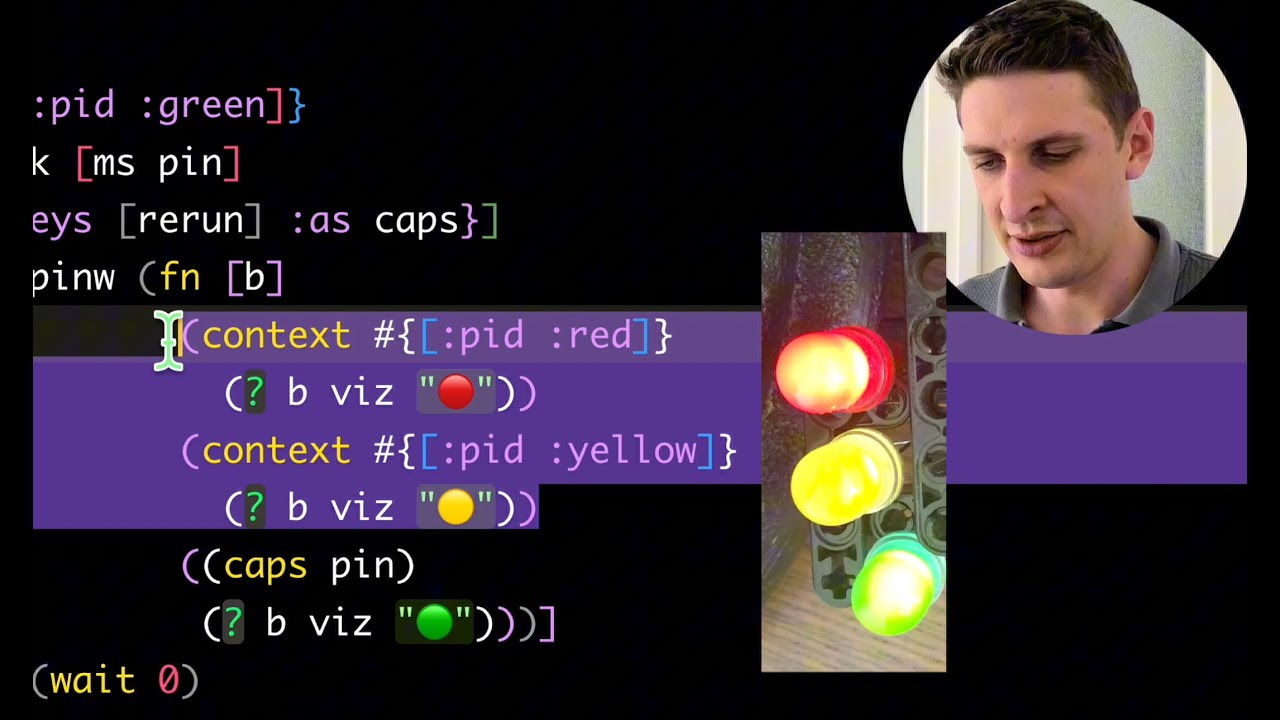
Clojure, but more alive
See the value of any expression on any node – in your code.
A REPL, but it's connected to all your nodes at the same time (1:n)
- Query macro expression
- rewrites itself to show the data inline
- Declarative deployment
- Say "this function should run on that node"
- Supervision & reconciliation
- Stop a process? Comment it out.
- Effects via object capabilities
- All host platform caps passed in as argument
- The editor is also a node
- You can run code in it
- Define and use custom inline editor visualizations
- Values have history
Taglines#
- "Grug-brained Erlang"
- "Debug mode is the only mode"
- "A personal Bank Python" [todo / future work]
- "(i) see inside (ii) see across time (iii)
[see across possibilities]" - Baby's First Situated System
- Worse is Better [?]
- If Raspberry Pi were as simple as Arduino / P.C.C
Status#
Hacked together with SCI, rewrite-clj, zprint, Lezer and CodeMirror. Everything barely holds together.
I am ashamed of the code. But I might clean it up and release it if enough people are interested.
There's a babashka script ./new-commit-every-minute.bb that does what you'd think.
I'm building this in public, scrappily.
Follow along, or get notified when this is ready:
Related work#
- Smalltalk
- Lisp
- Emacs
- org-mode
- Emacs
- TaskTXT - via Potluck - roundtrip state through plain text
- APX - trace points + context
- Cap'n Proto - IDs in code to stabilize expressions
- music live coding environments
- Eve - viz, feature flags, programming for humans
- Dark classic - redeploy-on-every-keystroke, production traces in the editor
- preimp, aka: The Program is the Database is the Interface - self-rewriting Clojure notebook
More related work that's missing from the video#
- Glisp - bidirectional self-rewriting Clojure-ish code, custom editor UIs for types
- Quokka.js, Console Ninja - inline runtime values, inline logging
- DreamBerd - question marks! 🐸
Future work (todo)#
- error handling - at least like Sentry, maybe even a poor Smalltalk debugger or Common Lisp condition system
- persistence story - accretive bitemporal facts like XTDB or something local-first?
- communication - infer netcode like Electric
- codebase management - hashed like Unison or Scrapscript
- collaboration / ocap code sharing / delegate authority to change part of the system
- control over when and where changes deploy: staged rollout, feature flags, "under construction" development preview areas
- actually secure security
- release as extensions for common editors (maybe as language server?)
FAQ#
- What is this? A Language? An IDE? A new REPL?
- It's just ClojureScript, with a handful of additions:
!to redeploy the next top level form on every change?the query macro, rewrites itself to show values inlinenodeto assign functions to physical placescontextscopes queried values to only show those matching some node contextwith-contextattaches custom metadata to node context
- You can call it a different kind of REPL
- or a programming environment with a runtime
- for building distributed information processing systems
- It's just ClojureScript, with a handful of additions:
- Is there any chance something like this can become an Emacs mode, VS Code extension, or NeoVim plugin?
- Yes. Editor plugins are necessary. It should be fairly straightforward to port, apart from the inline html views.
- The editor API surface for plaintext interactions is tiny right now: callback on every change, get buffer contents as string, (async) replace position span with string.
- Inlining graphics in text always breaks the editing flow anyways. I don't like the heavyweight feel of blocks, so I never use this feature.
- Just checking the rough shape of data in plain text is good enough usually.
- It's also easy to hook the query macro into Clojure's tap system, so non-text output renders in a sidecar viewer like Portal (or Clerk, but haven't tried that)
- Yes. Editor plugins are necessary. It should be fairly straightforward to port, apart from the inline html views.
- It's always connected to all the running processes?
- Yes, conceptually
- nodes can be anywhere, behind firewalls, in production, etc.
- communication goes through a central broker
- nodes can be anywhere, behind firewalls, in production, etc.
- It feels like a REPL that's connected to all nodes at the same time.
- Yes, conceptually
- Can I just eval forms like normal?
- Not trivially. I'm still thinking about the UX of targeting specific nodes.
- Evaluation in this system should feel more like nodes pulling your specification (code).
- Instead of you imperatively pushing code to nodes that they should execute,
- they all pull the latest code from you
- (and decide themselves how to best fulfill it)
- Can it do transient sessions, like browser clients?
- Not yet. The set of all nodes has to be hardcoded.
- But the solution is simple, and I'll implement it soon
- Introduce random sessions IDs
- and keep the (then non-unique) node IDs to tell them to run the same code
- But the solution is simple, and I'll implement it soon
- Not yet. The set of all nodes has to be hardcoded.
- Does it run on Clojure on the JVM / CLR / babashka?
- Almost. There's no reason it couldn't run anywhere SCI does.
- Why Clojure / Lisp?
- (Watch any of Rich Hickey's Talks)
- (start with Are We There Yet)
- s-expressions
- code being data
- trivial for the query macro to rewrite
- Clojure emphasizes simple plain data throughout your system
- plain data is trivial to inspect
- and to hold on to
- copy/pasteable
- serializable
- safely experiment with it
- functions take plain data and return new plain data
- see the data in every step in between
- plain data is trivial to inspect
- semi-structural navigation via keyboard shortcuts
- just works across code and data
- (Watch any of Rich Hickey's Talks)
- What does it take to set up and connect a node to this system (eg how are the node's capabilities specified)?
- it's a library you embed into your application. call it with:
- a random node ID
- the central message broker's URL
- and an optional map (dict/object) of this node's capabilities for effects you want to expose
- caps are function closures or references to host platform objects
- or just download ready-to-use runtimes (just give them node IDs)
- docker containers
- standalone binary (Windows, Linux, Mac)
- single board computer SD card image (e.g. Raspberry Pi)
- babashka library/pod?
- it's a library you embed into your application. call it with: