Most people who know of John Conway will remember him as the creator of Conway’s Game of Life. There are two problems with that. One is that it’s not even a game in the sense that most people think of games. The other is that he didn’t want to be known or remembered for it.
The game is simple: take some graph paper, or a computer if you’re short on time, and color in some of the squares. This is your starting point, and the only choice you get to make. There is no goal. So it is not a game in any competitive sense of the word.
Now, take a fresh page, and place it over so you can trace. Systematically go through every square, and apply these rules: if it’s colored in and has two or three neighbors colored in on the sheet below, it stays colored in. It’s “safe”. If it has fewer than two neighbors, it dies from lack of support from its fellows. If it has more than three neighbors, it dies from overcrowding.
This is where it gets weird. Blank tiles stay blank unless they are next to exactly three filled in tiles. So these creatures can reproduce, but only by ménage à trois. Diagonals count in all of this.
But what gives this game an enduring appeal is that from such simple rules that it has become a common rite of passage for beginning programmers to reproduce this simulation as a way to learn a new language, you get a dizzying array of complex patterns and behaviors.
An animation of one possible stable pattern: a field of twinkling stars creates a shower of meteors, but where they collide in the center, they generate starships that fly off into infinity.
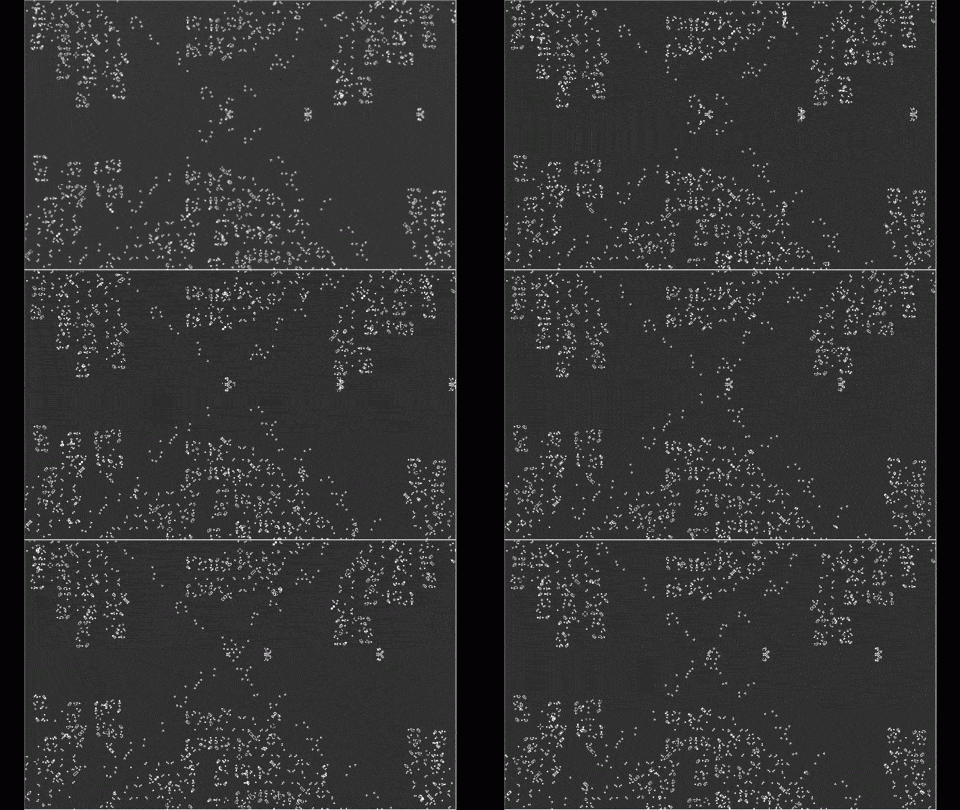
What brought me to write this, however, was the strange coincidence of meaning surrounding the recent passing of John Conway. He died of the Coronavirus, which is taking its worst toll in places with excessive crowding.
This brings me to reflect on the other enduring quality of this game, which is its strangely lifelike quality. There are other such systems that produce similarly dizzying complexity, but this one is the most like life writ large, the wretched refuse of our teeming shore.
There are two kinds of ways to die in the game, as in life: you can die from contact with other people, whether by disease or competition for life’s necessities or by violence, or you can die from being too alone, cut off from help in your time of need.
In a time of social distancing it’s difficult to remember this second lesson of the game: that while we are stuck at home, if lucky, others are in need.
A final word about how Conway would be preferred to be remembered: he was a brilliant mathematician. Most of his contributions he was actually proud of would go over most of our heads. He expressed more than once a desire to understand one particular problem before he died, which sadly was denied him: to understand why a particular mathematical object existed. It’s called the monster group, and it is an approximately 180,000 dimensional object.
People can’t even envision a fourth dimension without the aid of time or color to give another kind of direction besides up, North, and East. He had his sights set high, as if to a heaven of twinkling stars that made patterns beyond all mortal understanding.