The gravlax is excellent. I know this because I’m paying very close attention to the salmon, and not to the conversation happening three seats down, where a partner named Per is explaining to a table of attentive managers that the glory days are behind us – the kind of motivational pep talk we all needed.
It’s a team offsite somewhere in Northern Europe, the kind of place with floor-to-ceiling windows, neutral-toned furniture, and a wine list longer than most decks we have ever prepared (if you’ve seen the Succession episode with the Nordic retreat, then that’s exactly the vibe). I’ve recently made it into what they call the “LT” (Leadership Team, for the unacquainted), which mostly means I now get invited to dinners where partners say things that keep me up at night. My job today is to laugh at the right jokes, not spill anything on my shirt, not say anything inappropriate, and absorb whatever wisdom floats downstream from the partner end of the table.
Per is holding court. He’s got the confidence, the practiced cadence of a man who has told this story before. And he’s got the Rolex, of course, they all have a Rolex. He’s talking about the old days. About deal flow. About the kind of years where senior partners quietly accumulated collections of Ferraris (yes, plural).
And then, almost wistfully, like a retired sea captain describing the last age of sail: “Those days? They’re definitely over.”
I take another bite of gravlax and nod. Everyone nods. But it’s not the enthusiastic nodding of people receiving good news. It’s the slow, heavy nod of people doing the math. You can feel it settle over the junior end of the table like a fog – that quiet sigh of resignation when you realize you’ve been pulling sixty- and seventy-hour weeks for a shot at a prize that’s already been downgraded. The Ferraris were for the generation before us. Maybe the generation before them. We got the hours without the upside, and now even the partners are admitting it out loud. It was obvious all the way – they now drive a Porsche at best, and when they do, you can see they get an urge to flaunt it at every possible occasion (whether it’s out of vanity or to dangle a prize in front of us so that we’ll work harder nobody knows)
But Per’s lament was just the insider version of a much louder conversation happening outside the firm. Per was mourning the returns. But out in the wider world, that same unease was metastasizing into something far more dramatic. Not just “the golden years are over” but “the whole thing is over.” Was it the outsiders who detest consultants wishing to see their end, or was it insiders like Per not wanting to see the magnitude of the tragedy they are facing?

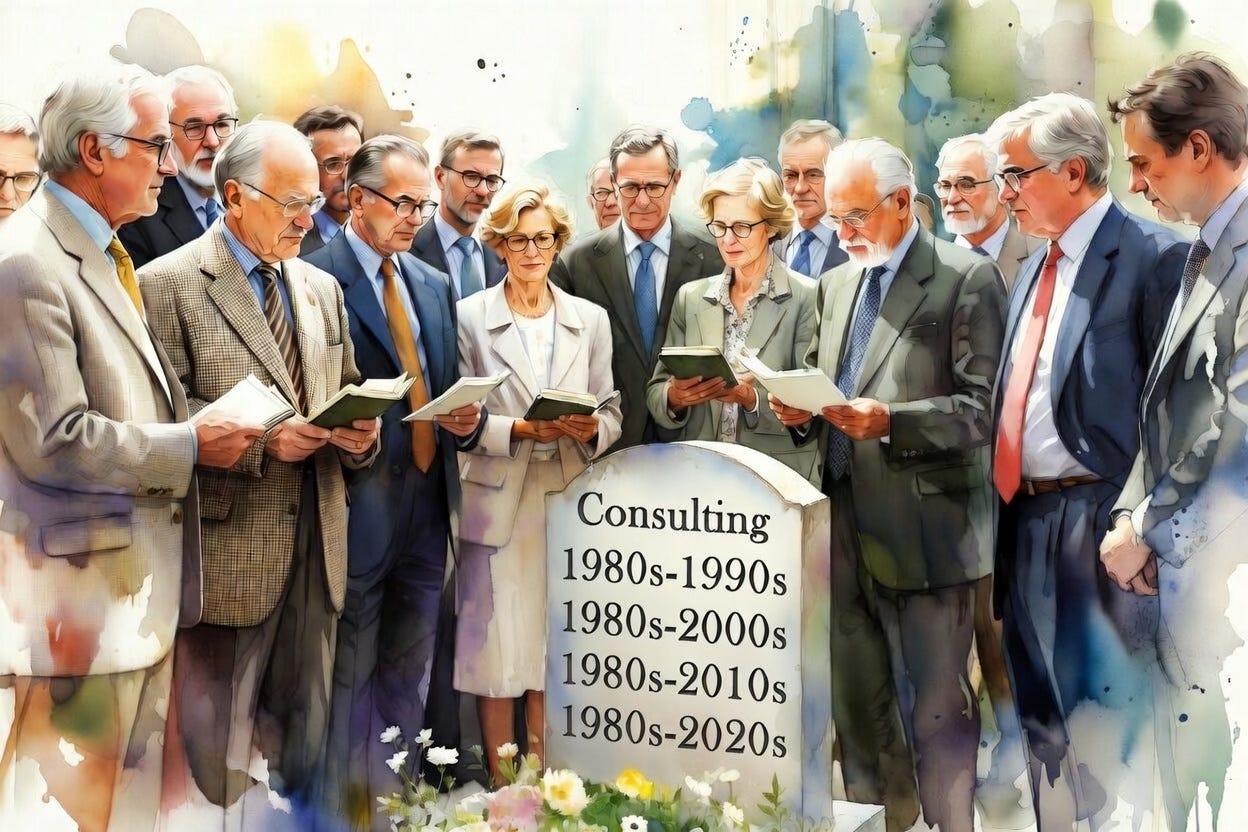
It turns out people have been predicting the death of consulting for thirty-five years. Per was not delivering breaking news. He was performing the latest rendition of what might be the longest-running eulogy in the history of professional services.
And the eulogy has been delivered at least six times (non-exhaustive)
The 1980s were consulting’s original golden era. The corporate raiders came, antitrust got loose, and suddenly every Fortune 500 company was merging with another Fortune 500 company. Someone had to fire the redundant workers. Someone had to “find synergies.” Someone had to tell the CEO what to do with two overlapping IT departments and three competing sales forces.
Consultants. That’s who.
And they printed money doing it. The good old increase revenue and cut costs.
But by the mid-1990s, the backlash had arrived. In 1996, two editors at The Economist –John Micklethwait and Adrian Wooldridge – published The Witch Doctors, a bestselling takedown that branded management consultants as modern-day snake oil salesmen peddling recycled fads to terrified executives. A year later, two Chicago Tribune journalists published Dangerous Company, documenting case after case of consulting engagements that cost companies hundreds of millions of dollars and left them worse off than before. The public was starting to see what you actually got when you sent in a team of smart twenty-five-year-olds with PowerPoints: a lot of billable hours, a lot of jargon, and, sometimes, a company in ruins.
The prediction of course was: consulting was an emperor with no clothes – an industry built on mystique, jargon, and the insecurities of C-suite executives. Once clients wised up, the game would be over.
But as we all know, that’s not what happened; instead, the firms kept right on selling strategy and post-merger integration while also expanding into IT strategy, process reengineering, and whatever else they could convince a CxO to pay for. The old work didn’t die. It just got company. Revenue kept growing.
Eulogy delivered. Two bestselling books. Industry grew larger.
The late 1990s consulting boom looked unstoppable. ERP implementations. Dot-com strategies. Firms were hiring MBAs faster than business schools could produce them.
And then it all went sideways. Enron collapsed. Arthur Andersen (one of the largest professional services firms on the planet) was gone by 2002. Not restructured. Not acquired. Gone. PwC sold its consulting arm to IBM. KPMG spun off BearingPoint, which later went bankrupt. The entire audit-consulting nexus was forcibly separated.
The prediction, again was: the industry was structurally broken. The conflicts of interest were too deep. The scandals proved the model was rotten. Maybe finally those Economist and Chicago Tribune journalists would be vindicated.
But no, they weren’t. The firms that survived absorbed the talent and clients from the firms that didn’t. McKinsey, Bain, and BCG – who had no audit arms to worry about – sailed through relatively unscathed. And thus, they kept on growing.
Eulogy delivered. Several firms actually died. But overall, the industry grew larger.
In 2005, Martin Kihn – a former Booz Allen Hamilton consultant – published a memoir that pulled back the curtain on what he described as an architecture of performance: manufactured frameworks, recycled insights repackaged under new names, and client meetings that were more theater than strategy. Similar to the journalists of the 90s, but this time from the inside.
I’ll confess: when I read this, it kinda hit close to home. I once spent the better part of a week refining a deck for a partner named Carl. Carefully structured arguments, airtight logic, every number triple-checked. When we finally walked him through it, he nodded quietly, clicked through to the agenda page, and said: “I like the background image in the agenda slides”. That was the entirety of his feedback that day before the client meeting. Later, over drinks, he offered what might be one of the most honest things a consulting partner has ever said to me: “You know, Albert – we’re in the show business.”
Noted.
Maybe that’s why Kihn’s book became a TV show. Suddenly everyone’s uncle at Thanksgiving had an opinion about how consulting was a scam. And that evolved into the internet giving us all of those brilliant McKinsey consultant memes, you know the ones: “McKinsey consultant heading home after telling the client to increase revenue and cut costs.”
The prediction: the curtain was lifted, the mystique was gone, the premium fees would be brought down. Consultants would drive Skodas.
But no. The firms kept growing. It turns out that knowing consulting is partly theater doesn’t reduce demand for it, the same way knowing movies are fake doesn’t reduce box office revenue. People want the performance, because it’s part of the reassurance. They want someone in a nice suit to tell the board that their strategy is correct, or more often, to take the blame when it isn’t. Carl, as usual, was right.
Eulogy delivered. Became a Showtime series. Industry grew larger.
This is the intellectually heavyweight eulogy – the one you cite in your MBA thesis.
Clayton Christensen, the godfather of disruption theory, published “Consulting on the Cusp of Disruption” in the Harvard Business Review. His argument was elegant: consulting’s fundamental business model hadn’t changed in over a century. The share of classic strategy work at traditional firms had plummeted from 60–70% to about 20%. Data was being democratized. Experienced ex-consultants were available for hire. The same forces that had disrupted steel, publishing, and education were finally coming for McKinsey.
Some senior consultants interviewed for the study reportedly scoffed at the thesis. “As long as there is business,” they said, “there will always be problems that need fixing.”
The firms didn’t move upstream – they were already at the top. Instead, they expanded sideways, absorbing digital, implementation, and analytics work until ‘strategy consulting’ meant everything from boardroom advice to building dashboards. The market they served didn’t shrink. It shapeshifted around them.
And they were right. In the decade following Christensen’s prediction, the global consulting market roughly doubled.
Eulogy delivered. Became required reading at HBS. Industry doubled. Again.
COVID hit and exposed everything that was fragile about the consulting model. Source Global Research predicted a 19% market drop. The sacred rituals were suddenly impossible: you couldn’t fly a team to a client site, commandeer their best conference room, and order too much sushi for a late-night working session. The whole performance required physical proximity, and physical proximity was illegal.
The prediction: the pandemic revealed that the consulting delivery model was overpriced, over-engineered, and under-adapted. The permanent shift to remote work would make clients question why they ever paid for business-class flights and hotel suites.
What actually happened: consulting revenue bounced back to record highs by 2022 (I remember firms scrambling to hire people from my MBA class in May 2021 because they couldn’t keep up with demand), largely because companies needed more outside help navigating the chaos, not less. Turns out a pandemic is very good business for consulting.
Eulogy delivered. Market dropped briefly. Industry hit all-time revenue highs.
And here we are. The current eulogy. The big one.
Peter Thiel – never one to whisper when he can declare – tells The Free Press that if consulting were a stock, he’d be shorting it. Mariana Mazzucato and Rosie Collington call consulting “A Big Con” (with the subtitle of their book doing a great job at summarizing it “How the Consulting Industry Weakens our Businesses, Infantilizes Our Governments, and Warps our Economies”). INSEAD professors are declaring that AI can now match or exceed the analytical capabilities of traditional strategy consultants. Joe Nocera at The Free Press writes about “The Consulting Crash.” And finally, even McKinsey’s own executives are reportedly calling AI “existential” for their industry.
The argument is familiar if you’ve been paying attention to the previous eulogies. But this time it’s not databases, or the internet, or freelance platforms. It’s large language models that can synthesize research, build financial models, generate strategy decks, and do it all without a single business-class flight (damn, I like those).
I won’t pretend this one doesn’t feel different. For some, the anxiety is very real. Others don’t see a threat at all. Are they the orchestra playing Vivaldi while the Titanic is listing? But I’ve also just walked you through thirty-five years of “this time it’s different,” and the pattern is hard to ignore.
Nassim Taleb might have seen this coming. His Lindy Effect holds that for non-perishable things – e.g., technologies, institutions, ideas – life expectancy is proportional to current age. A business model that’s survived a hundred years isn’t overdue for death. It’s demonstrated a hundred years’ worth of resilience. Christensen looked at consulting and saw an industry ripe for disruption. Taleb’s framework would look at the same data and see an organism that’s been stress-tested by a century of shocks.
But here’s the thing every eulogy gets right: something is being disrupted. The database companies of the 1990s really did make certain research tasks trivial. Enron really did expose conflicts of interest. Christensen really did identify that the base of the strategy pyramid was getting commoditized. AI really is automating analytical work that used to take a team of associates two weeks.
But here’s what every eulogy gets wrong: they think the thing being disrupted is consulting.
It’s not. It’s the delivery model.
The predictions consistently confuse the vehicle with the destination. They look at a specific way consulting is delivered – i.e., the pyramid staffing model, the billable hour, the 200-slide deck, the team of fresh MBAs deployed to a conference room – and mistake it for the thing itself.
The thing itself is much older, and much more resilient.
When the sixteen-year-old Nero became Emperor of Rome in 54 AD, the most powerful person in the known world needed help. So his mother did what powerful people have always done: she hired an outside advisor. Seneca – Stoic philosopher, orator, and one of the sharpest minds in the ancient world (and still fashionable today) – was brought in to tutor and counsel the young emperor. He ghostwrote Nero’s speeches. He composed policy frameworks. He even produced a written deliverable: De Clementia, a treatise on merciful leadership addressed directly to his client. The engagement lasted about a decade, until the client-advisor relationship deteriorated and Nero ordered Seneca to kill himself. A rough offboarding, even by consulting standards.
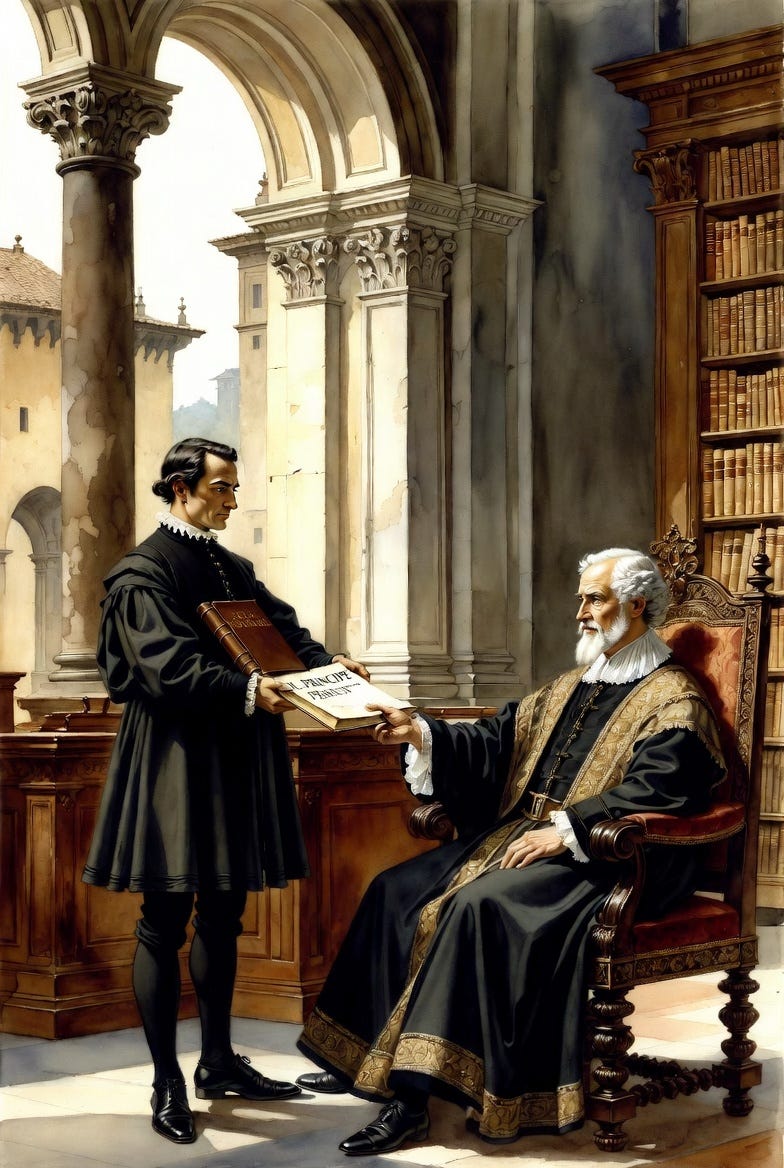
Five centuries later, medieval kings had privy councils. And then there’s Machiavelli, who wrote The Prince for the Medici – a strategic advisory document on acquiring and maintaining political power that remains, arguably, the most famous consulting deliverable in history (and didn’t use a single slide! Like Amazon! Way ahead of its time)
.
The underlying need, that is, a leader turning to an external, trusted mind to help think through a high-stakes decision, is as old as leadership itself. It predates management consulting by a couple of millennia. It will outlast it too.
What changes, every time, is the form factor.
Think about what happened to photography. The value proposition – immortalizing a moment – never went away. What died was Kodak’s particular way of delivering it. Paint to film to digital to smartphone. Three extinctions of the delivery mechanism, zero extinctions of the underlying need. Your great-great-grandmother and your teenager both want to capture a moment. They just use completely different tools to do it.
Or take entertainment. The value proposition – being entertained by a story – is exactly as strong as it was when you were renting VHS tapes at Blockbuster on a Friday night or gathered around the fire with some villagers and a troubadour (or bard or minstrel, pick your poison). What died was the rental model. The physical store. And the late fee (phew). The need for a story on a Friday night survived every format transition unscathed, from Troubadour to VHS to DVD to streaming. Blockbuster is a punchline. Netflix has 300 million subscribers. The need didn’t blink.
Music is the same story on repeat (pun intended). Vinyl. Cassette. CD. MP3. Spotify. Five extinctions of the delivery mechanism. The value proposition – dancing, crying, reminiscing, getting in general emotional to the tune of a song – is unchanged since someone first banged a drum in a cave. What dies is the format. What lives is the human need.
Consulting is no different. The value proposition – a trusted external perspective on a high-stakes decision – is indestructible as long as there are humans (and maybe beyond – could an AI deciding an investment decision engage another AI to have an “outside perspective”? At least for now many of us have turned Claude into one of our most trusted advisors – and he doesn’t bill by the hour, doesn’t need to buy a Rolex nor eat gravlax). It’s wired into how organizations work and into the psychology of leadership. And it doesn’t go away because the outside consultant is now augmented by AI, any more than the desire to capture a moment went away because the camera moved from your hands to your pocket.
What will die, whether now or in the future, is a particular delivery model. The model where you pay $200,000 a week for a team of five, half of whom are twenty-six years old and learning how to make excel formulas on your dime, to spend three weeks building a deck that synthesizes information you could now get in an afternoon with the right tools.
That model? Per was right. It’s definitely not delivering anyone a Ferrari collection. And maybe soon it won’t even deliver the Porsche. Nor the Rolex.
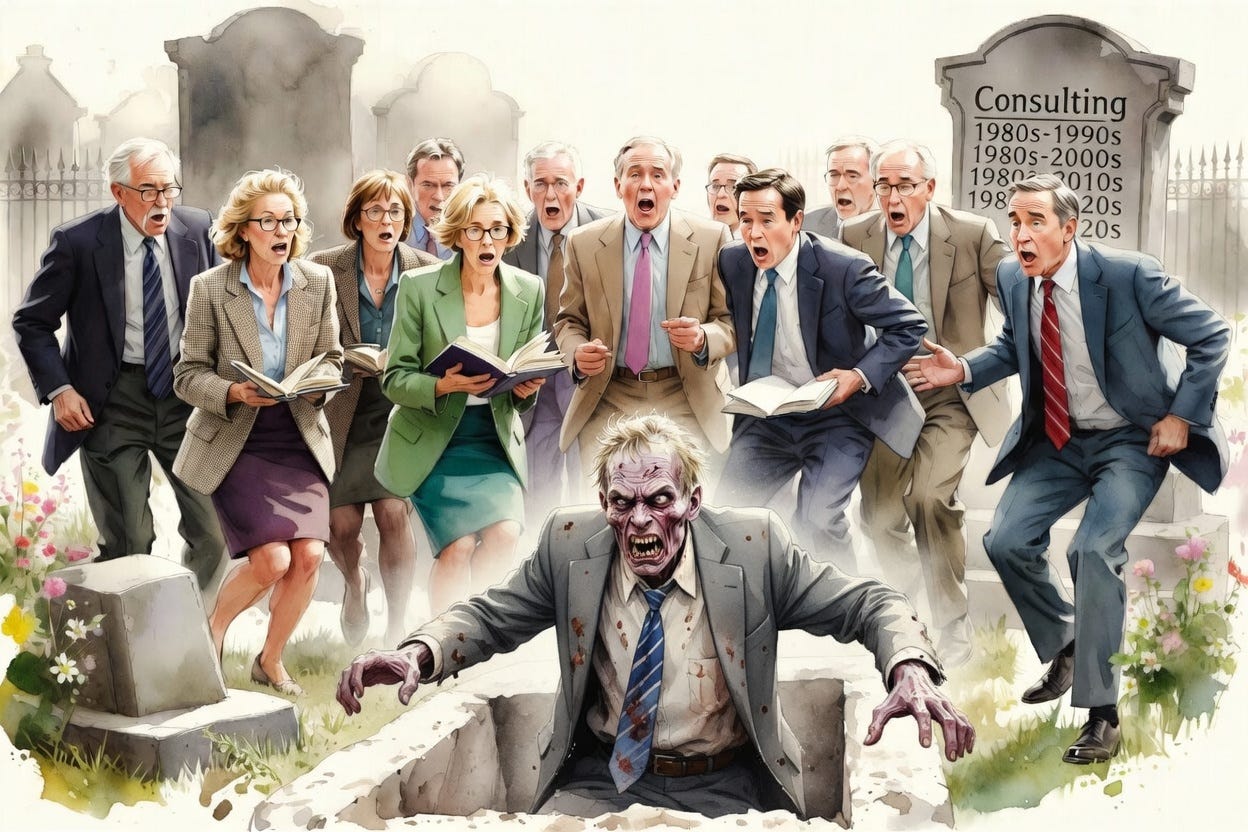
So here we are. Six eulogies in, and the patient keeps sitting up on the table.
And I think this will keep happening. The critics keep eulogizing the delivery model and calling it the industry. They’re saying “Kodak is dead” and concluding that no one takes photographs anymore.
The question that actually matters, and the one I spend most of my time thinking about now, isn’t whether consulting survives. It will. People will always pay for trusted external judgment on high-stakes decisions. Emperors did. CEOs do. Maybe even AIs will. They always will.
The question is: what does the next delivery model look like?
That’s the interesting question. That’s the trillion-dollar question. And if the last thirty-five years of eulogies are any guide, the people who figure it out first will do very well.
Probably well enough for a Ferrari or two. And a Porsche. And a Rolex, of course.
If you enjoyed this, subscribe to The Last Consultant. And if you work at a consulting firm and have stories about how AI is actually being used on the ground – the real stuff, not the press releases – I want to hear from you. Drop me a line.