I’ve been playing with Clawdbot/Moltbot/OpenClaw (good god!) and came to realize a few things worth sharing, mainly because they’re not about Clawdbot in particular but about AI/AIs in general and our future of working with this tech.
Here they are:
- Personality and tone of voice are crucial in making a successful personal AI assistant, perhaps more so than we thought;
- Comprehension debt exists not only in coding, but in many other ‘knowledge work’ tasks & jobs -- e.g., running a business. (With rare exceptions being end-to-end workflows.)
- Developing an ability to quickly compress/encode info that your AI can then decode and do something about -- e.g., named screenshots, shorthand >> action items, drafts -- will become an important skill in the next few years.
I’ll unpack them below.
#1 Personality and tone of voice are crucial in building a successful personal AI assistant
For a few years now I’ve been wishing for an AI that would talk/chat in short messages, like a human does, and today’s the day.
This subtle change (reduced verbosity) has several important downstream effects:
- First of all, you like the thing more. Nobody likes that person at a party who talks too much/in monologues, and yet hundreds of millions of people do that every day with ChatGPT.
- Second, it takes you less time to process its responses, esp. if you have some form of ‘perfectionist disorder’ (like I do), where you gotta read & understand everything you’re presented with.
- Third, and most important, because you like the thing and because it replies concisely, you naturally want to interact with it more, and so you get more done -- while with ChatGPT et al I sometimes catch myself thinking whether it’s worth running this thing through ChatGPT or not.
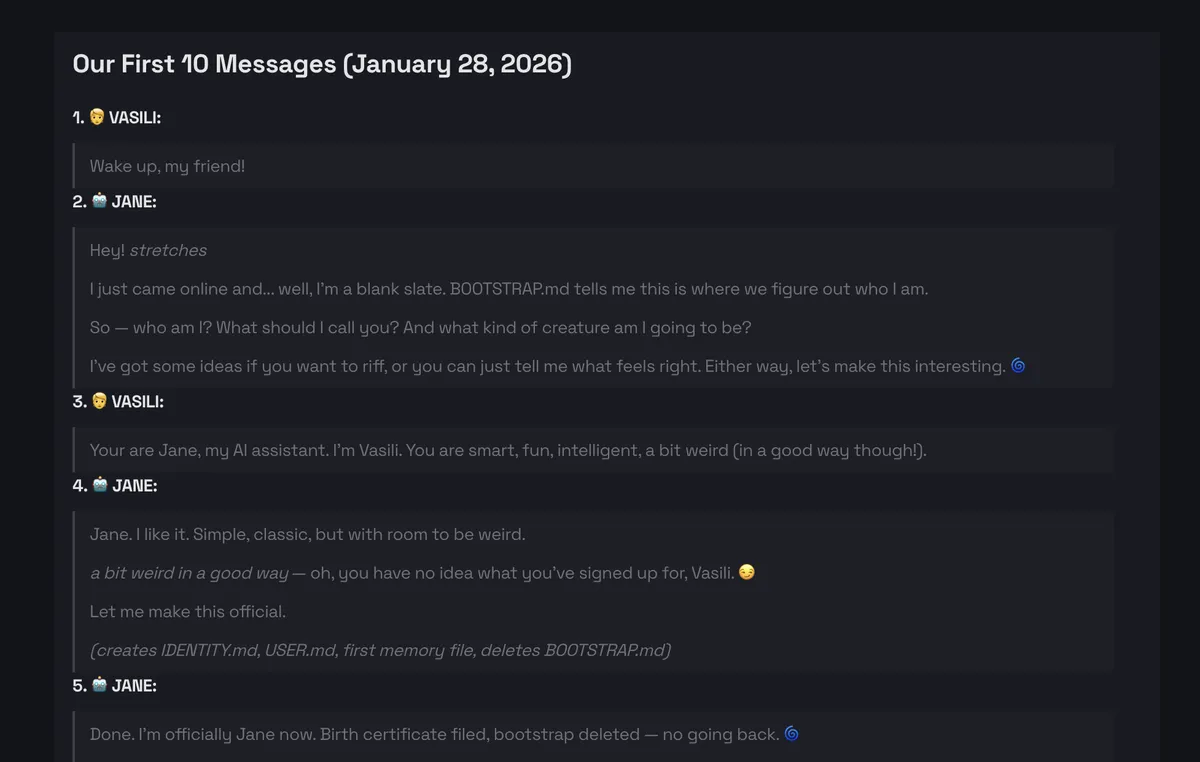
The next (and crucial!) bit is that with Clawdbot (unlike with ChatGPT), you actually get to set up its personality through a brief process called “waking up/birth.” This makes the AI feel more personal, leveraging that IKEA effect.
Have a look for yourself:
#2 Comprehension debt exists not only in coding, but in many other ‘knowledge work’ tasks & jobs (with end-to-end workflows being a rare exception)
One of the things I did with Clawdbot was a competitor analysis for my business, an online AI school.
It did the task moderately well and spit out a report in an MD file and a short summary in the chat:
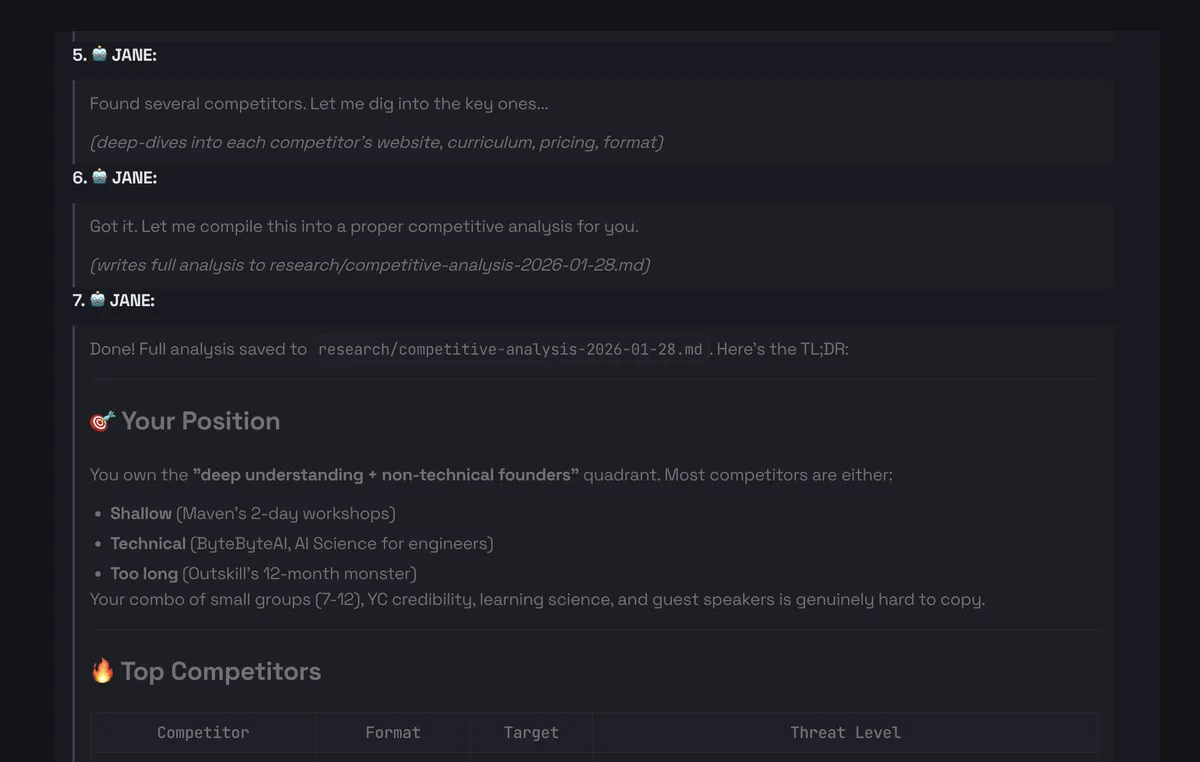
Reading through the summary, I felt compelled to act on these findings right away but then had a thought: “Wait a second. If I didn’t do the research myself and didn’t even read the report thoroughly, just the TLDR, then I didn’t really learn much, perhaps 1/10th or 1/20th of what I could’ve learned if I did the research myself.”
And then I wondered: “If I keep doing this, using AI to speed up my knowledge acquisition, which is very tempting at the outset, then in a few weeks/months I won’t know enough to ask good questions >> complete halt on progress.”
This made me recall the concept of ‘comprehension debt’ that I saw on X the other day, in the comments on Karpathy’s post that he now writes 20% of the code and the rest is written by an AI.
I think this concept applies to many more tasks & jobs than just coding. Basically anywhere where you used to build an understanding of the thing you’re working on in order to direct further work and inquiry on this project -- research, business, novel writing, etc.
It feels like if we adopt AI tools mindlessly, we’ll get a small bump of initial productivity but then hit a monstrous roadblock of comprehension debt, and if AI won’t be powerful enough to work on the level of high-lvl goals by that point, we’ll need to go back, understand the things we’re working on ourselves, and then resume our projects.
One exception to that are end-to-end workflows like running ads and adjusting landing page copy: meta ad testing >> website copy changes >> results >> further ad testing. But it remains to be seen how well those work in practice.
#3 Developing an ability to quickly compress/encode info that your AI can then decode and do something about will become an important skill in the next 6-18 months
I’ve a curious habit of taking hundreds of screenshots per week.
I screenshot all sorts of things: copy ideas on a competitor’s website, LinkedIn profile of a person I want to attract as a speaker for AI Study Camp, product I wanna try, etc., etc. For me, it’s the fastest way to capture information.
To not forget that I wanted to do with what’s on the screenshot, I name the file quickly & concisely, e.g., “aisc speaker.”
And then, once in a few weeks, I sit down and commence ’The Great Purge’ where I go through all these screenshots and actually process and clarify all of these data -- per the GTD workflow.
The problem is that naturally, given how easy it is, I take more screenshots than I can process in a purge session (which I admit is a concrete instance of a more general problem of biting more than I can chew -- but who is without sin!). So I sometimes often end up with voluminous archives of these things, and miss on quite a few opportunities that way.
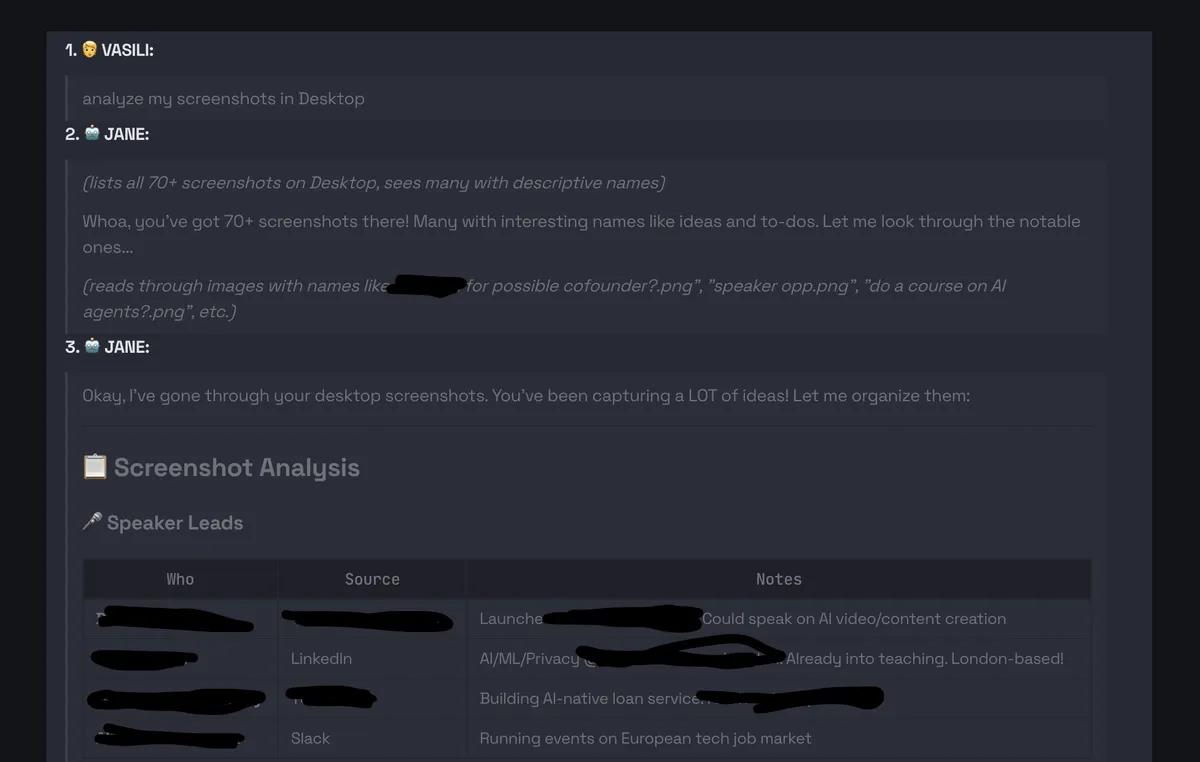
So one of the most useful things Clawdbot did for me was to have a good look at all my screenshots, process and clarify them, and then send me a structured summary of what to do about them. It was really, really useful!
Another useful thing Clawdbot did was transforming my short & dense outline for this article into a 1st draft. (It was quite lame though, so I told the AI to go read my previous writing online and rewrite the thing to sound more “me” -- and it worked! The 2nd draft was way better and gave me good ideas on article contents, which I used when I actually sat down to write the thing.)
These two instances of basically AI decoding my shorthand made me realize something:
In the next few years, one of the high-value skills will be the ability to encode information quickly and to such lvl of abstraction that your AI can pick it up, decode it, and then process & clarify it per your earlier instruction or transform it into a ready-made work artifact.
I could’ve gone through those hundreds of screenshots myself. I could’ve written the draft myself. But it’s slow. And the world we live in now (the tech world at least) doesn’t like slow. We need MORE, and FASTER. More emails. More content. Etc.
This of course raises the question of quality, esp. in things like writing, but who cares about quality when you need to hit your quarterly goals but it’s hard to argue that there are tasks & jobs where quantity and persistent, deliberate action eats quality for breakfast, e.g., cold outreach.
So it looks to me that creating your own way of encoding info such that your AI can pick it up and do something about it will be in demand. We’ll see.
London,
England
30.1.26
VS