I came to Mozambique without a firm sense of direction, my heart feeling bruised and battered, kicking around between my ribs. I wasn’t sure whether I was moving away from something or towards something else, and I was equally unconvinced that the distinction mattered. Those impulses often feel identical when you book flights at odd hours, when you close your door without quite knowing what you are trying to leave behind, when you tell people you need “a change of scene”.
What I did know was that it felt good to be warm again. The heat landed on me with uncomplicated certainty. I could feel myself slowly defrosting, the sun wheeling me out of my own emotional morgue. It was a physical reset, a reminder that not everything has to be negotiated or analysed before it can be felt. The relief of a sensation that cuts cleanly through whatever internal static you have been carrying.
Tofo, however, is not a place that allows you to inhabit your internal world uninterrupted. Everything is visible here: the vividness of the landscape, the sharp edges of poverty, the physical labour that underpins daily life. There is no convenient distance. Nothing is blurred or softened for aesthetic effect. It is a place that resists being staged. The town does not adjust itself to accommodate your emotional state. In that sense, it is a difficult location to bring a private sadness. Not because your sadness is unwelcome, but because it cannot occupy the foreground for very long.
On my last day, I sat down with Steven, the owner of Kumba Lodge. Kumba, he explained, carries several meanings, including “the place of transformation.” I had assumed our conversation would follow the standard script of people who have remade their lives elsewhere: bureaucratic frustrations, the charm and difficulty of remoteness, the narrative of “escape”. Instead, the discussion unfolded into something more layered. It was less a story of hardship and triumph, more a meditation on privilege, scarcity, and the different ways people come to measure what they have and what they lack.
Steven told me about his old life in Johannesburg, where he worked as a commodities trader, overseeing steel, chemicals and shipping routes across southern Africa, managing an office of more than fifty people. “The phone never stopped,” he said. “I was travelling constantly.” There was a good salary. There was a company car. There was a veneer of success that looked impressive from the outside and hollow from within. He described the experience with the kind of quiet precision that suggests he has replayed it many times. “I was money-rich but time-poor,” he said. “Attention-poor, energy-poor, health-poor.”
He did not walk out in a single dramatic gesture. The decision to leave settled slowly over years. It was only when his daughter was born that the shape of his life became impossible to ignore. The idea of trading her early years for flight schedules and quarterly targets suddenly seemed less like responsibility and more like abdication.
Before that, there had been a long road trip: Botswana, Zimbabwe, Victoria Falls, eventually Mozambique. “We were so tired after five thousand kilometres,” he said, “that we just kept extending our stay.” Something remained with him from that visit, something that resurfaced years later when he returned to Tofo as a yoga teacher, leading retreats from Johannesburg. “Suddenly I thought, what am I doing in Johannesburg? Why can’t I live somewhere like this?”
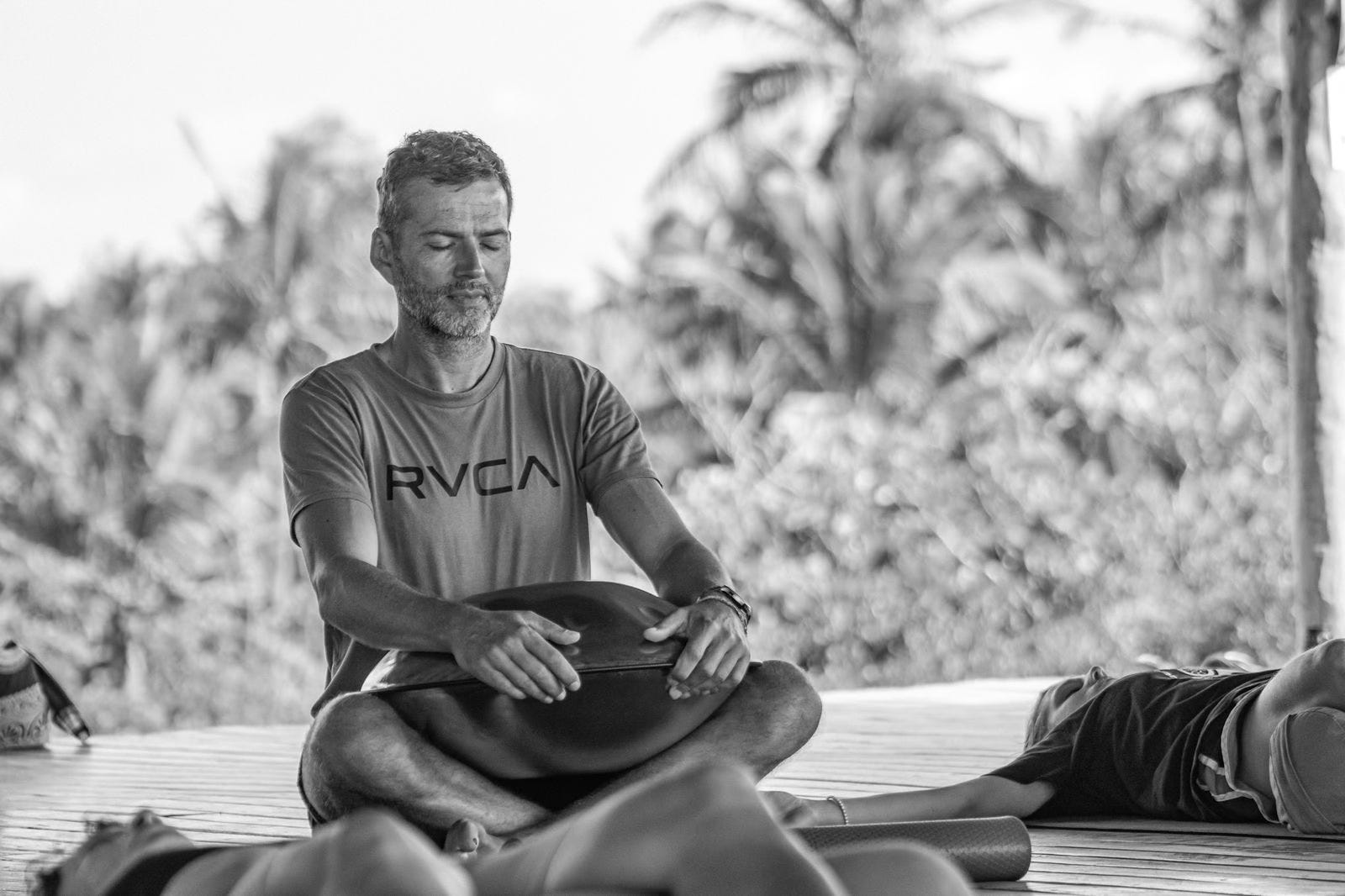
Before he ever thought about building a lodge in Mozambique, Steven had already performed one drastic experiment with his life. He had quit being a commodities trader and become a yoga teacher. He did not arrive easily at yoga. His partner practised long before he did, and he resisted it in the way people often resist things that might force them to pay attention to themselves. “I thought it was this weird thing with stretches,” he said. She eventually dragged him to a class. He hated it. Not because the class was bad, but because he was stiff, impatient, and used to the quick hit of more conventional exercise. Yoga, with its insistence on repetition and breath, felt slow and vaguely humiliating. It took a trip to India to soften his resistance. They stayed at ashrams, went to classes, and something in him conceded that this was not a passing curiosity but a practice he needed. When he came back to Johannesburg, the office he worked in happened to move into a building above a yoga studio. He began going to vinyasa classes after work, then signed up for teacher training. At first he viewed it as a way to understand the philosophy. Somewhere in the process, it became a way to understand his own life. During that training, his daughter was born. The friction between his work and his home life became unbearable and he quit his corporate role. The job that paid so well suddenly looked less like security and more like a form of self-abandonment.
The transition was not tidy. He taught classes wherever he could. One teacher handed over a “yoga in the park” slot. He contacted an NGO in central Johannesburg, in an area everyone told him not to go to because of drugs, prostitution and gangs, and started teaching there every week. He built a company called Yoga Works, which grew into retreats, rooftop classes, large outdoor events with DJs and hundreds of people practising together. He trained teachers. He turned yoga from a personal rescue into an actual business. One of those retreats brought him to Tofo in 2019. That was when the thought landed properly: why am I not living like this? Kumba Lodge is, in some ways, the physical extension of that question.
Yoga is not the main revenue stream at Kumba. The rooms and the restaurant keep the lights on. But yoga is the organising principle. “It’s one of the hearts of the place,” Steven said. “It’s not what makes the money. But it’s what brings people here, around the shala.” He has three adjectives for how he wants his classes to feel; inclusive, adventurous, and joyful. Inclusive because he remembers exactly how it felt to be the stiff person at the back of the room who could not touch their toes. “I don’t want anyone to feel like they suck,” he said. Adventurous because he wants people to feel they have been on a small journey, tried something new, discovered that there is more available to them than they assumed. Joyful because if yoga becomes another serious task to endure, it loses its usefulness. If you dread your practice, you will not keep it.
Classes are open to guests and locals. There are people from Europe and South Africa on mats next to people from Tofo, and a few who come simply because they asked and could not afford it otherwise. “Some say, I want to practise but I don’t have money,” Steven said. “So I tell them, come.” The lifeguards on the beach, funded in part by the lodge, join classes for free. The idea is not to create an exclusive wellness bubble but to let yoga be one of the fibres stitching the place together.
When Steven talks about what yoga has given him, he does not default to clichés about peace or flexibility. He talks about resources. “In yoga we say there are four,” he told me. “Attention, energy, time and money. We tend to think if you have money, you’re sorted. But that’s just one quarter of the picture.”
In Johannesburg, he had money but almost no control over the other three. His attention was colonised by work. His energy was spent before the day began. His time was scheduled down to the minute. Yoga, for him, was not some soft lifestyle accessory but a reallocation of those resources. Leaving his job was less about rejecting money than about recovering attention, energy and time.
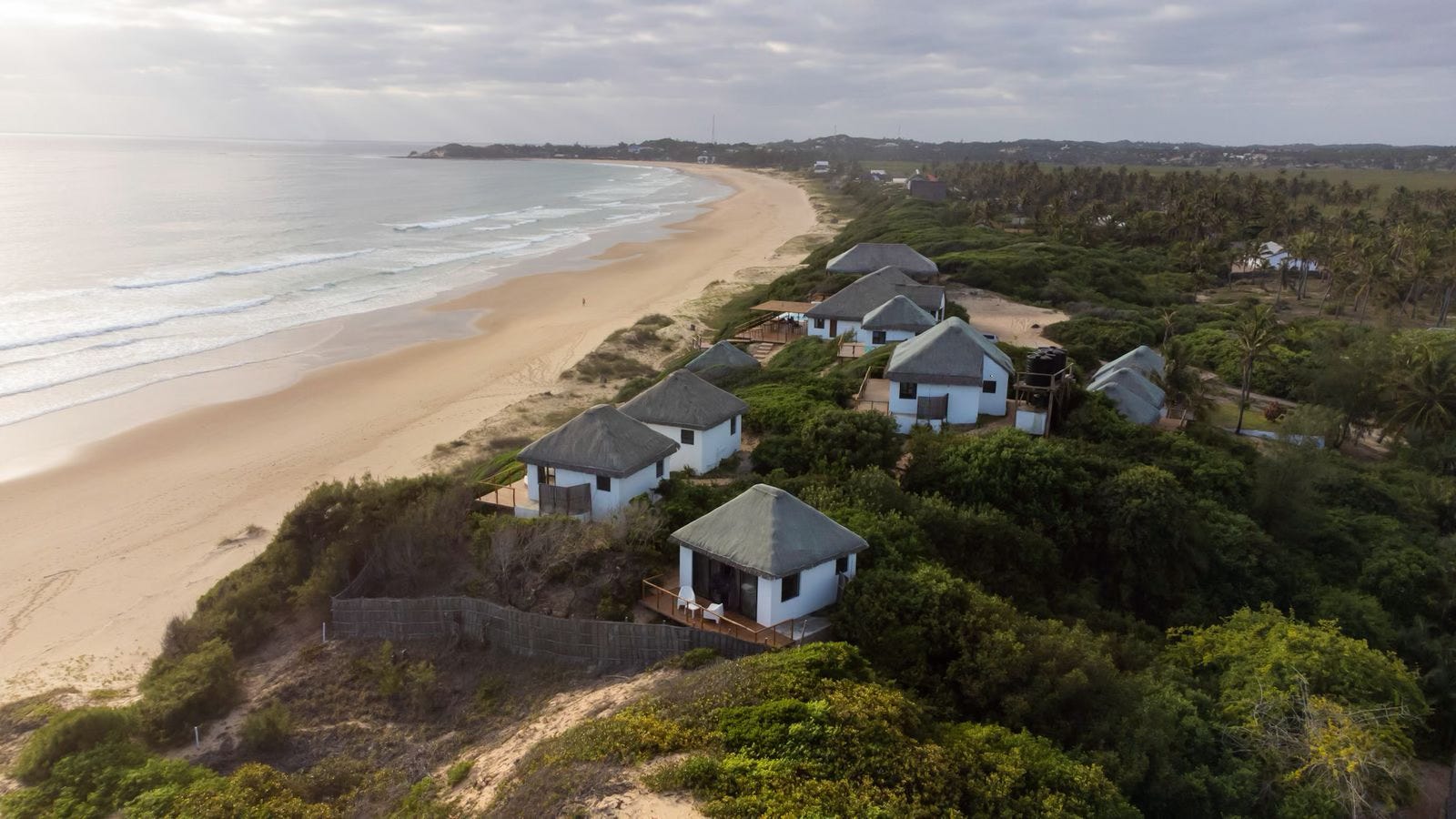
At Kumba, this logic has become architectural. The shala sits slightly apart from the main lodge, a raised wooden platform that looks out over the trees and ocean. It is open to the wind and the sound of the sea. Classes happen at set times, morning and late afternoon, but the space is used outside the schedule for people to stretch, read, sit, or simply be somewhere that is not designed for consumption. The point is not to perfect postures. It is to practise inhabiting your life differently, even if only for an hour.
In that sense, yoga at Kumba is not the spectacle. It is the counterweight. It is what stops the place becoming another pretty retreat where people come to briefly escape the consequences of how they live, then leave unchanged. Steven is not trying to convert anyone, and he is not pretending that an hour on a mat solves structural problems. What he is quietly doing is offering people, including himself, a rehearsal space for a different way of allocating those four resources.
Money, after all, is the only one you can never actually feel. Attention, energy and time are the ones you live inside. Yoga is simply the discipline of noticing how you spend them, and whether that spending aligns with the kind of life you say you want.
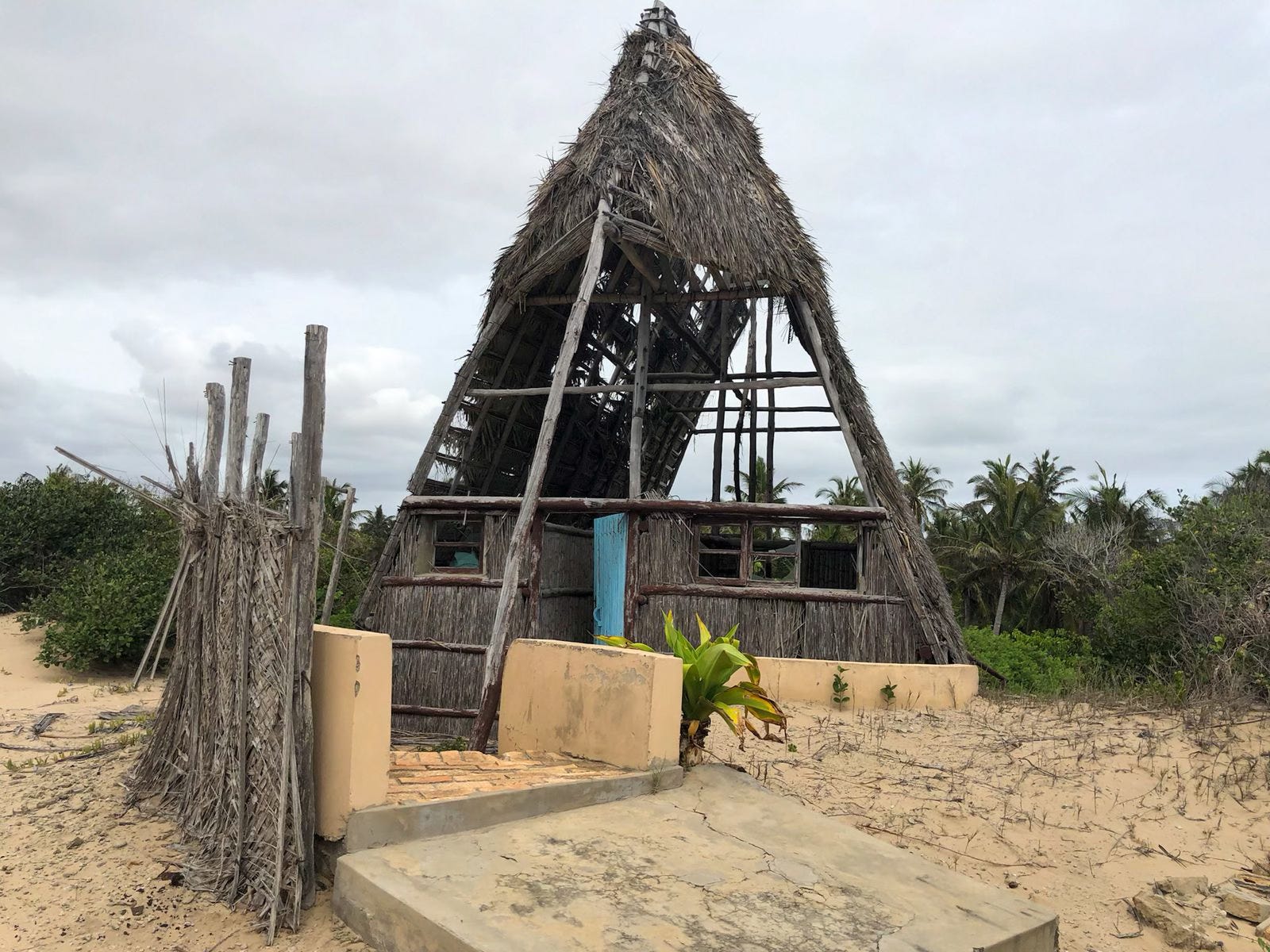
What he eventually took on was not a functioning lodge but the ruins of a once-famous backpacker camp called Bamboozi, abandoned for seven years. “It was completely destroyed,” he said. “Just platforms and rubble.” The land, like all land in Mozambique, could not be owned; it could only be leased from the state for fifty years. This was written into the post-independence constitution, an attempt to prevent the extractive land ownership patterns that had defined the country’s colonial past. “No one has ever reached the end of a fifty-year lease yet,” Steven noted, almost amused by the temporal scale. He rebuilt from scratch, with local workers who needed jobs, particularly once the pandemic arrived and borders closed. Construction became, in part, a form of crisis relief. He was stuck in Johannesburg while the buildings went up in Tofo, relying on trust, WhatsApp photos and the unglamorous momentum of commitment.
As we talked, it became clear that Steven refuses to romanticise his position as a foreigner in one of the poorest countries in the world. “All of us who come here are disgustingly rich compared to the average Mozambican,” he said. “Even if we think we’re poor back home.” I asked Steven what it meant, in real terms, to be a wealthy white European man building a life in one of the poorest countries in the world. He answered without defensiveness, almost with relief. Living in South Africa, he said, had already taught him that race and power aren’t abstract forces but engineered systems. “You feel the scaffolding of it in your daily life,” he said. “Even if you’re not trying to take space, you’re standing somewhere someone else was barred from.” Which is why, he added, it matters to him that his family is woven into the fabric of the town, that his children grow up alongside local children, and that the lodge contributes more than it extracts.
To understand what Steven has done, you have to understand what Mozambique is. At the end of the civil war in 1992, Mozambique ranked among the poorest countries in the world and it remains near the bottom of most development indices. The war lasted fifteen years, from 1977 to 1992, and decimated infrastructure that was already fragile. Nearly a million people were killed. A generation grew up with trauma that was never formally processed, only folded into family histories and carried forward.
Today, richness here is measured in bicycles, tin roofs, access to a school that doesn’t require your child to walk for hours. The national minimum wage is 132 euros a month, recently raised from 120 euros. Many of Steven’s staff walk several kilometres to work. One man, for a long time, walked two hours each way, five days a week. “That was his own choice,” Steven said. “He could have taken a taxi for part of it. But he didn’t. Two hours here and two hours back. Every day. To me, that’s some other level of strength. I’m not sure I would do so well if this was my situation.”
He is careful not to reduce this to a sentimental image of resilience. He keeps returning to the idea that poverty takes different forms. “There’s economic poverty,” he said, “but also social poverty, mental poverty, poverty of time.” In Johannesburg, he had known people whose monthly salaries exceeded what some Mozambican families might see in a year, yet they were lonely, overworked, physically depleted and largely disconnected from any real community.
The contrast is most visible at the lodge itself. Many guests arrive with expensive luggage and very modern reasons for exhaustion: burnout, anxiety, the erosion of boundaries between work and everything else. They are seeking rest. Some are seeking something more nebulous: healing, perhaps, or reprieve from a low-grade dissatisfaction they cannot quite name. They often expect serenity, but in a controlled form. They want nature without inconvenience, beauty without unpredictability. Some struggle with the sound of the ocean; one guest even complained that it was too loud. Others are irritated by things that are entirely normal here: the slope of the hill, the way sand gets into everything, the fact that Wi-Fi in a coastal town in Mozambique does not operate at the speed of a European capital. It is not that their complaints are ridiculous; if anything, they are revealing. They expose how many of us have come to see comfort as a right rather than a circumstance, and how surprised we are when the natural world refuses to behave like a service.
Steven talks with a kind of wry curiosity about the reviews that criticise him for the wrong warmth or the wrong distance. He does not sound bitter, only gently bemused. The wealthiest guests, he has noticed, are often the least able to relax. “When you have money,” he said, “you start to really succumb to instant gratification. I want it now. I can buy it now.” The muscle for tolerating discomfort atrophies. So does the capacity to recognise how much you already have.
His own ambitions have shifted dramatically. “My mistake has always been making things bigger,” he said. “Now I want to make things better.” Where he once imagined franchises and expansions, he now talks about depth: improving the quality of what already exists, for staff as much as for guests. He spoke about spending time with his children, taking long walks on the beach without constantly checking his phone, building a lodge that functions as a genuine extension of the local community rather than an enclave that simply extracts from it.
By the time I left our conversation, the story I thought I had been living in Mozambique had changed shape. I realised that my reason for coming had less to do with heartbreak as such and more to do with the discomfort of recognising what I had been taking for granted. Privilege is not only about money. It is also about time, autonomy, the freedom to examine your own unhappiness in detail.
At some point during my stay, my heartbreak did not disappear, but it began to feel different. Not invalid, not unreal, just disproportionate in a way I had not noticed before. Obscene, almost, in its luxury. I could afford to be heartbroken. I had clean water. I had hot showers. I had three meals a day and the physical safety to sit alone or with others, thinking about things I had lost. I had the economic stability to feel emotionally unstable. I had time, which might be the most significant resource of all, to be consumed by grief.
People here who work physically demanding jobs do not get that version of sadness. If they are heartbroken, they still walk to work. They still work their shifts. They still have families to feed on wages that don’t stretch far enough. Their grief cannot be the organising principle of their lives. It has to fit around the basic task of survival. This, I realised, is one of the cruellest and most unexamined aspects of privilege. Grief, in the active, time-devouring sense many of us mean when we say we are grieving, is a luxury. You can only cry about a breakup if you are not also worrying about food. You can only fall apart after a miscarriage if you have access to the kind of healthcare that keeps you alive in the first place, to hot water and clean clothes and someone else doing the dishes. You can only sink fully into the drama of your distress if there is a solid floor beneath you.
This is not to say that the pain itself is lesser. Heartbreak is still heartbreak and loss is still loss. But these experiences sit on a foundation of met needs - there is no moral ranking of suffering here, only a hierarchy of conditions. The emotional crises that dominate many of our lives in richer countries - breakups, loneliness, a career that did not go as planned - require room. They need time, privacy, predictability. They depend on a set of guarantees that millions of people in the world do not have. The luxury is not the feeling - it is the ability to devote resources to feeling it.
Watching people in Tofo changed the proportions of my own sadness. It did not shame me out of it, but it made it harder to treat my grief as the central fact of my life. It began to look more like what it was: one part of a much larger picture. I also started to see more clearly the forms of wealth that Western life has quietly dismantled. Community, for one, which redistributes both emotional and practical labour. Here, when someone dies, colleagues and neighbours contribute to the funeral. When a house needs a new roof, people appear with tools. Children drift in and out of one another’s homes. Responsibility is shared. Hardship is distributed. These things do not erase difficulty, but they make it less solitary.
By the time I left Mozambique, my sadness had not vanished, but it had been recalibrated. I had arrived hoping for escape, or clarity, or some external force that would rearrange my feelings for me. What I left with was quieter and more uncomfortable: the recognition that money cannot buy happiness and cannot shield you from loss, but it can create the exact conditions in which you are allowed, even expected, to explore those things at length. It was also obvious that the richest people are not always the ones with the most resources, but often the ones with the most interdependence. The ones who live inside networks of mutual obligation. The ones who understand, instinctively, that time, attention and community are currencies as real as money and sometimes more valuable.
I hadn’t needed to escape my life at all - just to see it set against a backdrop that made its contours impossible to ignore. To be reminded that what I possess, what I lack, and what I misunderstand about both are not fixed categories. They change, depending on where I stand and who is walking past, on their way to a job that requires them to carry on, regardless of how they feel.
Kumba Lodge did not heal my heartbreak. It did something more honest, truer to its name - transformed the feeling, and set it down where it belonged.

Thank you for reading. The next instalment of After Asana is another interview.
Gaya 💗