In the story of cosmic history, one of the most important supporting characters is dust. As clouds of interstellar gas cooled and condensed in the early Universe, dust grains absorbed and re-emitted radiation, eventually forming stars. Later, dust provided the raw material from which planets could form and grow. Dust grains may even have been the surfaces on which the first complex organic molecules formed. Yet, if you ask most cosmologists, they’ll tell you that dust is a sheer nuisance.
In astrophysics, ‘nuisance’ is a quasi-technical term. Astrophysicists call any phenomenon that gets in the way of the thing they actually want to study a ‘nuisance’. Dust grains emit polarised light that can mimic subtle signals from the afterglow of the Big Bang (the cosmic microwave background) that cosmologists have spent decades and billions of dollars trying to detect. A cosmologist studies dust not to uncover its role in shaping the cosmos, but to subtract it – the term ‘sweeping under the rug’ couldn’t be more apt.
This dichotomy between ‘signal’ and ‘nuisance’ is found across many sub-fields in astronomy. Astronomers who study a phenomenon called ‘weak lensing’ use the subtle distortions of light caused by gravity to map invisible dark matter. For them, the ordinary matter that makes up everything we can see is a nuisance. Pulsar timing astronomers use rapidly spinning neutron stars called pulsars as extraordinarily precise clocks to detect the passage of gravitational waves through the galaxy. For them, the nuisance is ionised interstellar gas, which scatters and disperses the light from pulsars.
Yet one astronomer’s nuisance is another’s treasure. Just as a laser beam reveals the intricate swirls of smoke in a dark room, pulsars illuminate the fine structure of the interstellar medium, the unlit space between galaxies. If you want to study the interstellar medium and its role in shaping our galaxy’s evolution, the light-scattering gas is an invaluable resource.
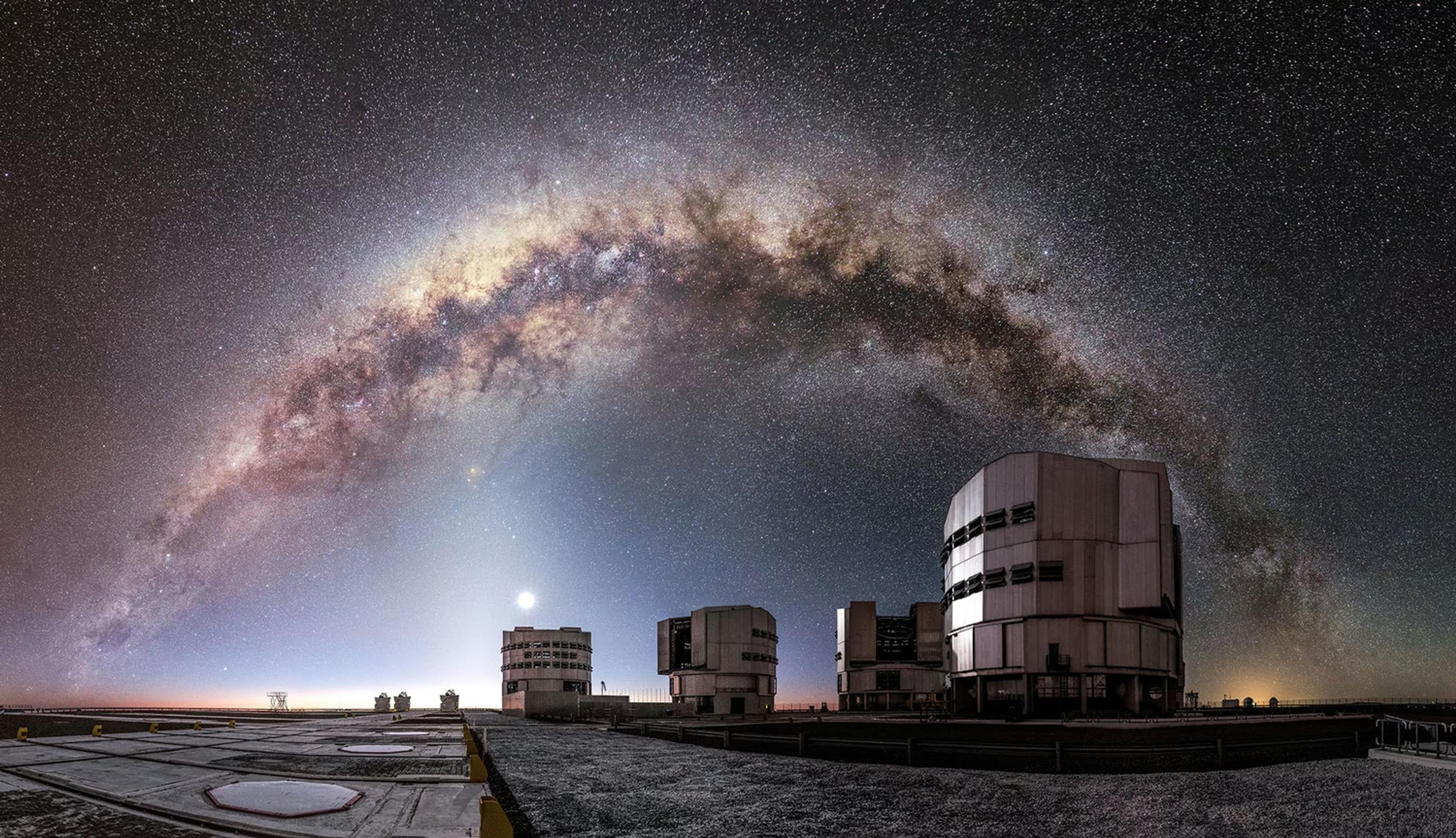
The ESO-operated Very Large Telescope based at the Cerro Paranal site in the Atacama Desert of northern Chile. Photo by Miguel Claro/ESO
Whether a phenomenon is a nuisance or something worth studying in its own right clearly depends on the investigator and their interests. But in a discipline as collaborative as astronomy, shared priorities must be developed. Gone are the days of Galileo and other lone scientists in the tower, pointing telescopes built by their own hands wherever curiosity dictates. Modern astronomy is a highly specialised discipline, marked by large collaborations. The tools of the trade – telescopes – are designed, built and maintained by hundreds of scientists and engineers across many institutions. But you can’t just stroll in and ask to use one. Investigators must fiercely compete for time with these advanced instruments. To guide how that access is allocated, the research community has developed a set of shared priorities. Some questions are elevated to the status of ‘Big Questions’ to which all others inevitably become subordinate.
But are these Big Questions necessarily the right ones? Who decides where to draw the boundaries between signal and nuisance, or big and small? Fields of enquiry are defined by the questions they seek to answer. If we want to understand modern astrophysics, it is not enough to understand the scientific and mathematical content of its theories. We also need to understand the human forces that shape the questions themselves and cause some questions to be prioritised, and other questions to be viewed as irrelevant or merely means to those bigger ends.
To identify the Big Questions that dominate the field, you need look no further than the flagship projects set to shape the discipline for decades. These include the Square Kilometre Array Observatory, the James Webb Space Telescope, the Vera C Rubin Observatory, the Nancy Grace Roman Space Telescope, and the Laser Interferometer Space Antenna. Each of these projects will cost several billion dollars over its lifetime.
When we look at the stated science goals of these projects, consistent themes emerge. For example, the Square Kilometre Array Observatory at Jodrell Bank in the UK is a massive radio array that will define the field of radio astronomy for the foreseeable future. Its website contains a list of science goals. On that list, the early Universe, gravitational waves, dark energy and cosmology are all listed before stars, the interstellar medium and the origins of life. The official page for the much-covered James Webb Space Telescope similarly lists the early Universe – the ‘cosmic dawn’ – before more prosaic matters such as stars, planets and dust. Such priorities are often reflected in media coverage of these projects, which further shape perceptions among young researchers, politicians, funders and the general public about which questions matter most.
The boundaries between the big and small questions often fall along the lines between ‘fundamental’ physics and ‘messy’ astrophysics. This is reflected in the language of many cosmologists who study dark matter, for example. For decades, the study of dark matter has focused on the largest physical scales – giant clusters of galaxies – where the gravitational effects of dark matter can be directly inferred. On small scales, within and around galaxies, dark matter’s effects become entangled with the complex dynamics of interstellar gas. To use the terminology that is widely adopted by cosmologists: the physics of dark matter on small scales is obscured by the astrophysics of interstellar gas. Implicit in this framing is the idea that astrophysics is messy and complicated, and, ultimately, subordinate to clean, fundamental physics.
When the fundamental is elevated above everything else, it’s easy to see why an impressionable young mind might be captivated
Young researchers encounter this supposed predominance of physics over astrophysics long before they set foot in a laboratory. Growing up, I loved space, as many children do. My parents bought me an amateur telescope, and I spent many nights in the backyard becoming familiar with the winter night sky (the summer sky was more elusive because it appeared after my bedtime). But, by the time I entered graduate school, I had largely forgotten about my early childhood passion for the heavens. Like many of my peers at the time, I wanted to study theoretical particle physics.
Particle physics enjoys a kind of mythical status in popular culture as the apex of the natural sciences. After all, the purported goal of particle physicists is not just a theory of particles, but a theory of everything. Of course, such a theory would be a theory of ‘everything’ only in the limited sense that it would describe how all matter behaves on a fundamental (microscopic) level – never mind the fact that such a description would be functionally useless to describe even basic chemical reactions due to the mathematical complexity. But when the fundamental is elevated above everything else, it’s easy to see why an impressionable young mind might be captivated.
In the end, I did not study theoretical particle physics as a graduate student. The competition was intense – almost all of my classmates were vying for the few positions available. So, I rekindled my love of astronomy and decided to study astrophysics. But the truth is, at the time, I viewed astrophysics as something of a consolation prize.
This hierarchy, which ranks fundamental physics above all else, is a historical contingency. Over the course of the second half of the 20th century, astronomy transformed from a distinct discipline into a sub-discipline of physics. Historically, astronomy was a science of mapping, cataloguing and observation. But the successes of mid-century nuclear physics, the rise of physical cosmology and the discovery of dark matter and dark energy began a process that fused the two disciplines.
The discovery of general relativity, which describes gravity as a warping of the fabric of space and time, provided a new framework that enabled the quantitative study of the dynamics of the Universe as a whole. Cosmology, which had previously been the domain of philosophers, became the domain of physicists. In the closing decades of the 20th century, this framework enabled the dual discovery of dark matter and dark energy – both mysterious substances unaccounted for by the standard model of particle physics. Crucially, these gaps in the standard model would have gone completely undetected without the observations of astronomers.
The heavens, then, transformed from an object of study in its own right to a new laboratory for testing fundamental physics. This shift is preserved in our vocabulary: the term ‘astronomy’ was demoted in favour of the more prestigious term ‘astrophysics’.
I saw astronomy as a means to an end, a stepping stone on the path to a theory of everything
The rise of astrophysics was, in part, fuelled by the geopolitics of the Cold War, which saw an unprecedented surge in funding for physics, in addition to a rise in the cultural prestige of physics in the public imagination. Governments invested large sums of money in physics mega-projects, cementing a culture of large collaborations dedicated to the study of fundamental, high-energy physics. This was the era of the particle accelerator, in which subatomic particles are accelerated to extremely high energies to test theories of physics that manifest only at those energy scales. But then the Cold War ended, and the cash flow stopped. In 1993, the US Congress cancelled the Superconducting Super Collider project in Texas, after billions had already been spent.
Suddenly, a generation of particle physicists found themselves without the experimental tools to test their theories on Earth. Astronomy, however, provided an attractive alternative. The Universe revealed itself to be the ultimate, free particle accelerator: full of violent events, such as supernovae, colliding black holes and the Big Bang, reaching energy scales that no terrestrial collider ever could. If only the complications of real astrophysical environments could be modelled and accounted for, then the heavens would be the perfect new laboratory for physics.
It was precisely this logic that sold me on astrophysics as a new graduate student. At the time, I saw astronomy as a means to an end, a stepping stone on the path to a theory of everything. I was interested in the messy complications of astronomy only insofar as understanding them would enable us to disregard them.
Today, this ‘physicisation’ of astronomy has left a deep imprint on the cultural norms of the discipline. Modern astrophysics is characterised by massive, hyper-centralised international collaborations, and an often tacit belief that ‘fundamental’ physics sits at the top of the scientific pyramid, while the questions of real ‘astrophysics’ are mere nuisances.
This ideological elevation of the fundamental over the particular is evident in the architecture of modern big-data astronomy. The past few decades have been characterised by experiments yielding massive volumes of data. Yet, these pipelines are not neutral data-gathering machines; indeed, their very design reflects and reinforces the institutional bias towards astrophysics as a barrier to fundamental truth. The logic is that, with enough data, the rich and diverse astrophysical phenomena that manifest in particular cosmic environments can be statistically modelled and averaged away, leaving only what is fundamental.
AI models inherit untested assumptions about the physical processes they aim to illuminate
Consider, for example, the phenomenon of weak gravitational lensing, where astronomers measure how gravity distorts the shapes of distant galaxies. They can use this to build a map of the dark matter in the Universe, which is otherwise invisible. However, weak gravitational lensing is equally sensitive to the gravitational effects of all matter in the Universe – the dark matter and the ‘ordinary’ matter. The physical interactions that govern ordinary matter complicate inferences of the underlying dark matter distribution. Data analysis pipelines for modern weak lensing surveys flatten the complex physics of astrophysical environments to a set of ‘nuisance parameters’, which, with enough data, can be averaged away. Rich astrophysical phenomena are, from the very outset and in the survey design itself, framed as statistical obstacles to fundamental truths.
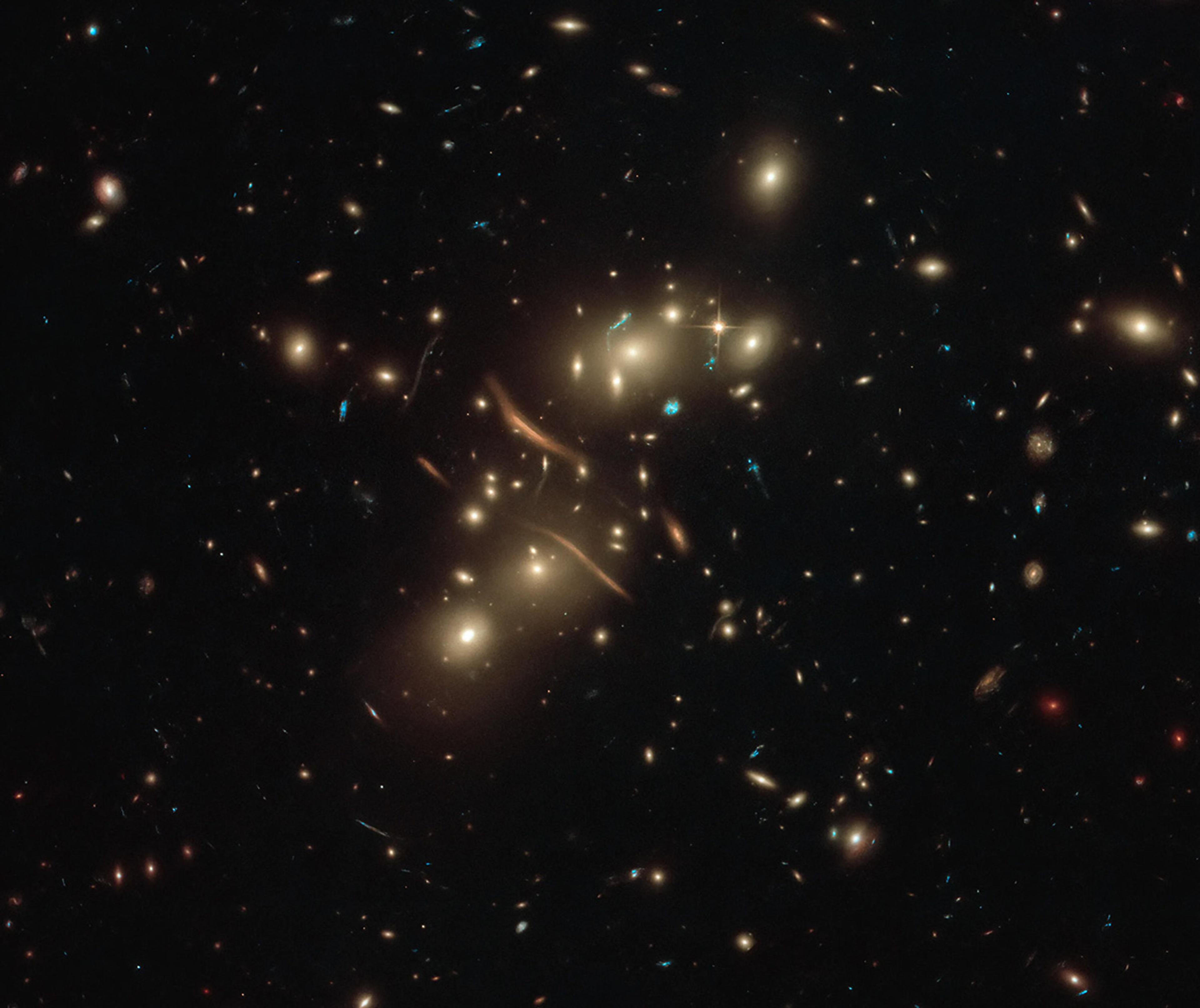
A Hubble image featuring the galaxy cluster Abell 2813 demonstrates the concept of gravitational lensing. Among the tiny dots, spirals and ovals that are the galaxies that belong to the cluster, there are several distinct crescent shapes. These curved arcs of light are distant galaxies. Their light is magnified and distorted by the strong gravitational field of the foreground galaxy cluster. Courtesy NASA/ESA/Dan Coe
This paradigm is further reinforced by the turn towards artificial intelligence (AI). A natural symbiosis exists between the petabytes of data generated by modern observatories and the massive datasets needed to train deep learning architectures. Driven by the hype, if a project promises to use AI, it helps attract funding and allocation of computational resources, even when its capacity for genuine discovery remains unclear.
Foundation AI models are heralded as the best way to digest datasets too massive for detailed human analysis, promising to automatically infer complex astrophysics from raw images of the sky. But there is a fundamental disconnect between the statistical patterns these technologies learn and the underlying physical mechanisms that generate the observations. Whereas you might train an AI to learn what a cat looks like with a set of images of known cats and non-cats, there is no set of galaxy images where all the relevant astrophysics is known. Instead, models need to be trained with synthetic data drawn from astrophysical simulations. However, computational limitations force these simulations to rely on simplified approximations of the very physics in question. As a result, AI models inherit untested assumptions about the physical processes they aim to illuminate.
This is not a problem if your goal is simply to account for complex astrophysics in massive data sets to infer the underlying fundamental physics. These models are, after all, exceptional at identifying and correcting for subtle correlations in the data. But if your goal is to understand the complex physics of the astrophysical phenomena themselves, the benefit is less obvious.
Thus, modern astrophysics appears to be oriented towards a paradigm of modelling massive data sets to uncover fundamental constants. This paradigm is mutually reinforced by the questions that are institutionally prioritised and the tools used to answer them. However, this loop of reinforcement can create an illusion of field-wide consensus around what the most important questions are, which obscures the daily realities of many working astronomers.
This is nowhere more visible than in the discourse surrounding the ‘Hubble tension’ – the fact that different methods of measuring the Universe’s expansion rate (the Hubble constant) yield contradictory results. Across white papers and popular science articles, the Hubble tension is touted as a profound crisis in physics. If the discrepancy is real (as opposed to a statistical fluke), then it could be an important hint about the nature of dark energy, which drives the expansion.
And yet, in the trenches of astrophysics research, attitudes are markedly different. At nearly every talk I have attended on the Hubble tension, the reaction from working astrophysicists is surprisingly muted. If this discrepancy is the great white whale of modern cosmology, why do so many researchers respond with a shrug?
The reality is that most scientists are passionate and obsessive creatures, devoting many years of their lives to extremely niche topics that others might struggle to care about. Such people naturally find their work intrinsically interesting, not just as a step towards some bigger question. Of course, scientists have complex motivations that are shaped by their institutional environments and that shape the long-term trajectory of their careers. But, on a day-to-day basis, many astronomers really do just care a lot about dust, or gas dynamics, or cosmic magnetic fields.
For myself, the further away I got from physics proper, the more I rediscovered my love of astronomy for its own sake. Whether or not astronomy unearths new fundamental laws of physics, it has much to tell us about our place in the Universe and what it means to be human. Since Copernicus, astronomy has gradually demoted humanity’s position in the cosmos, from occupying the literal centre of everything, to merely occupying an unremarkable planet, orbiting an unremarkable star, in an unremarkable galaxy in a potentially infinite Universe. At the same time, as the bounds of the known Universe expand, we have increasingly understood the rarity and fragility of life in the cosmos. Astronomy, therefore, plays a critical role in the story of the human species. While I remain hopeful that astronomy can lead us to new fundamental physics, that hope is no longer the driving force of my interest in the heavens. I suspect this is the case for many of my fellow astronomers.
Despite this, investigators are required to play a rhetorical game, justifying their deeply specific research within the context of the predetermined Big Questions. When you apply for academic jobs, the advice is: Always, always, always link your work to the Big Questions. Since hiring or grant committees typically comprise faculty with a diverse range of expertise, an applicant cannot rely on the committee sharing an intrinsic interest in their niche topic. Justifying your science in relation to the Big Questions is more likely to lead to a successful application, even if individually none of the members of the committee are particularly passionate about those questions.
Scientific journals reinforce this rhetorical game. The most prestigious journals demand that their articles represent significant advancements in the field. In other words, they require that the research they publish make progress on the pre-defined Big Questions. Investigators are incentivised to frame their papers in this context. I have personally written papers that motivate the work as a step towards resolving the Hubble tension. While technically true, this framing misrepresents the reasons I embarked upon that research and the real reasons I find it interesting.
If you could uncover the nature of dark energy, or discover alien life, which would you choose?
This is not to suggest that having shared priorities across a research community is somehow wrong – indeed, it is inevitable. But it is important to recognise that these priorities are historically contingent and, to some degree, arbitrary. When investigators play the rhetorical game of justifying their research, the game ends when they link their work to a fundamental question in physics. But why stop there? Why is the search for dark energy or dark matter inherently more justified than the lifecycle of interstellar dust? The ‘fundamental’ questions are no more or less intrinsically justified than the nuisances that get in their way. Rather, we choose which questions are ends in themselves and which require further justification.
Many commentators have made a great deal of the crisis that faces high-energy physics today. Terrestrial collider experiments have failed to reveal any signs of the new physics they were built to find, and we may well be reaching the limit of what astrophysics can tell us about fundamental physics. Even if the Hubble tension is confirmed, we may never settle on the correct physical theory of dark energy. Even as we better characterise the gravitational behaviour of dark matter, its particle nature may remain a mystery forever. The Big Questions are beginning to lose their lustre, and some are beginning to ask whether the billions of dollars spent on mega-projects are diminishing in their returns. But if this is a crisis for high-energy physics, there is no crisis for astronomy. Astronomers will continue to investigate all the weird and wonderful things the Universe has to offer.
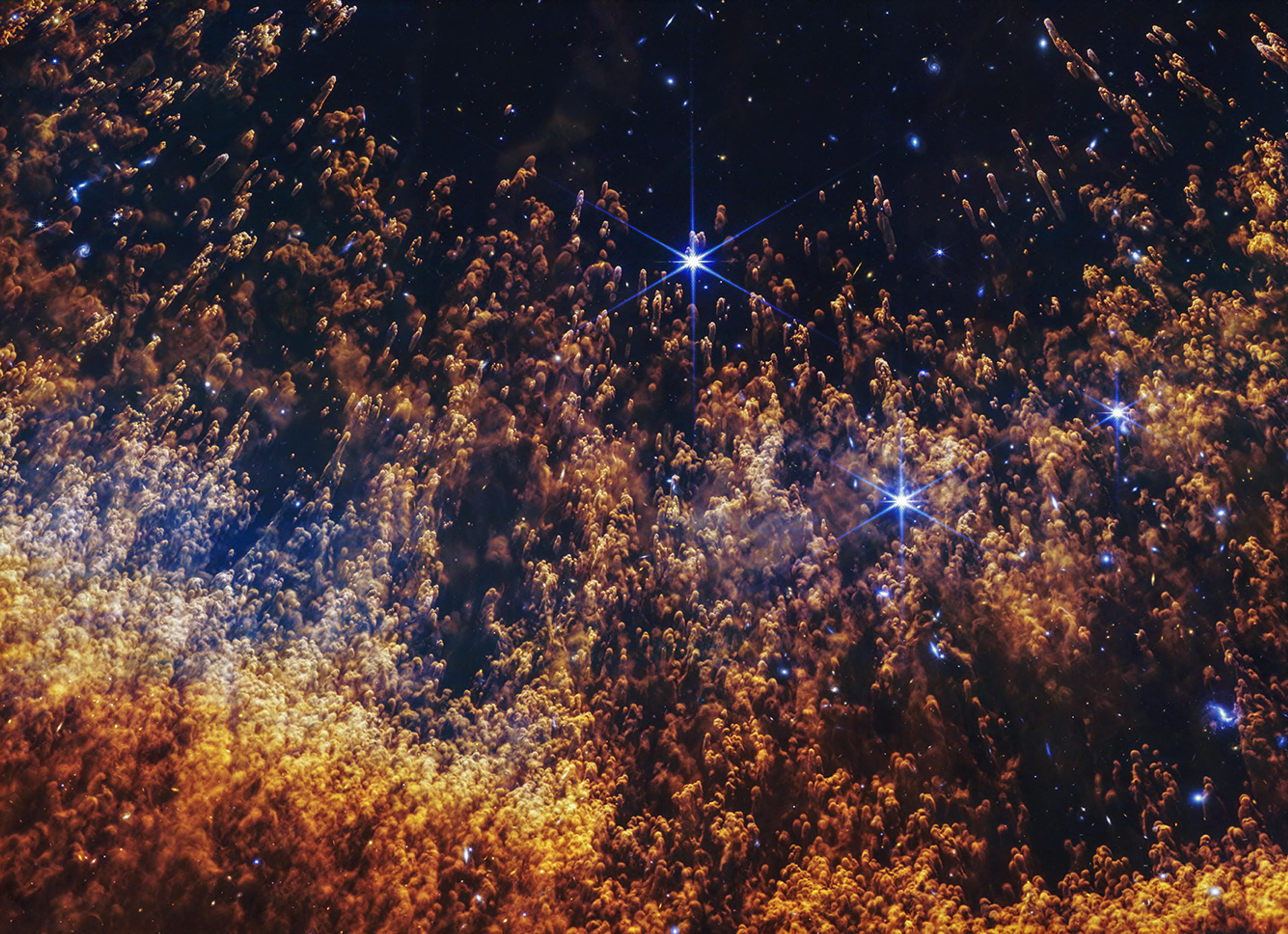
The intricacies of a dying star in the Helix Nebula, captured by the James Webb Space Telescope. Courtesy NASA
If you’re an astronomer reading this – or anyone who would like to play along – I invite you to consider the following hypothetical. If, tomorrow, you could uncover the nature of dark energy, or discover alien life, which would you choose? Both would guarantee a Nobel, but which one actually feels like the bigger, more meaningful discovery? Although I can speak only for myself, I suspect many astronomers – even bona fide astrophysicists – would choose the latter.
Astronomy has a unique place among the natural sciences. Its immediate practical benefits are limited – especially the further away from Earth you go. It’s hard to imagine a detailed understanding of galaxy evolution directly leading to some technological benefit in any foreseeable timeline. Yet astronomy excites the public imagination like no other science. It’s not because astronomy has the potential to uncover new physics at high energy scales. It’s because we, as a species, have always looked up to try to understand our place in the Universe.
Peering through my backyard telescope as a child, I had no concept of fundamental physics. But looking at the fuzzy haze of the Orion Nebula and realising that I was watching the birth of stars – well, there are no words to describe the sense of wonder I felt. If astronomy must justify itself according to some Big Questions, let them be these: where did we come from, and what is our place in the cosmos?
Ultimately, the priorities of a field are not immutable facts but a choice. Shifting priorities need not be seen as a crisis, but as an opportunity to ask ourselves why we study what we study in the first place – an opportunity to make different choices that better align with those reasons. Astronomers, then, have an opportunity to reorient the priorities of the field away from a reductionist view of physics, and to reclaim the value of the nuisance.