Six months ago, around Feb or so — I launched this cool AI-powered code generation tool for gaming engines called haddock.ai. It basically supports scripting for Roblox/Unreal/Unity/Minecraft (forge) platforms using text prompts. This is what the code generation interface looks like for the Roblox version:
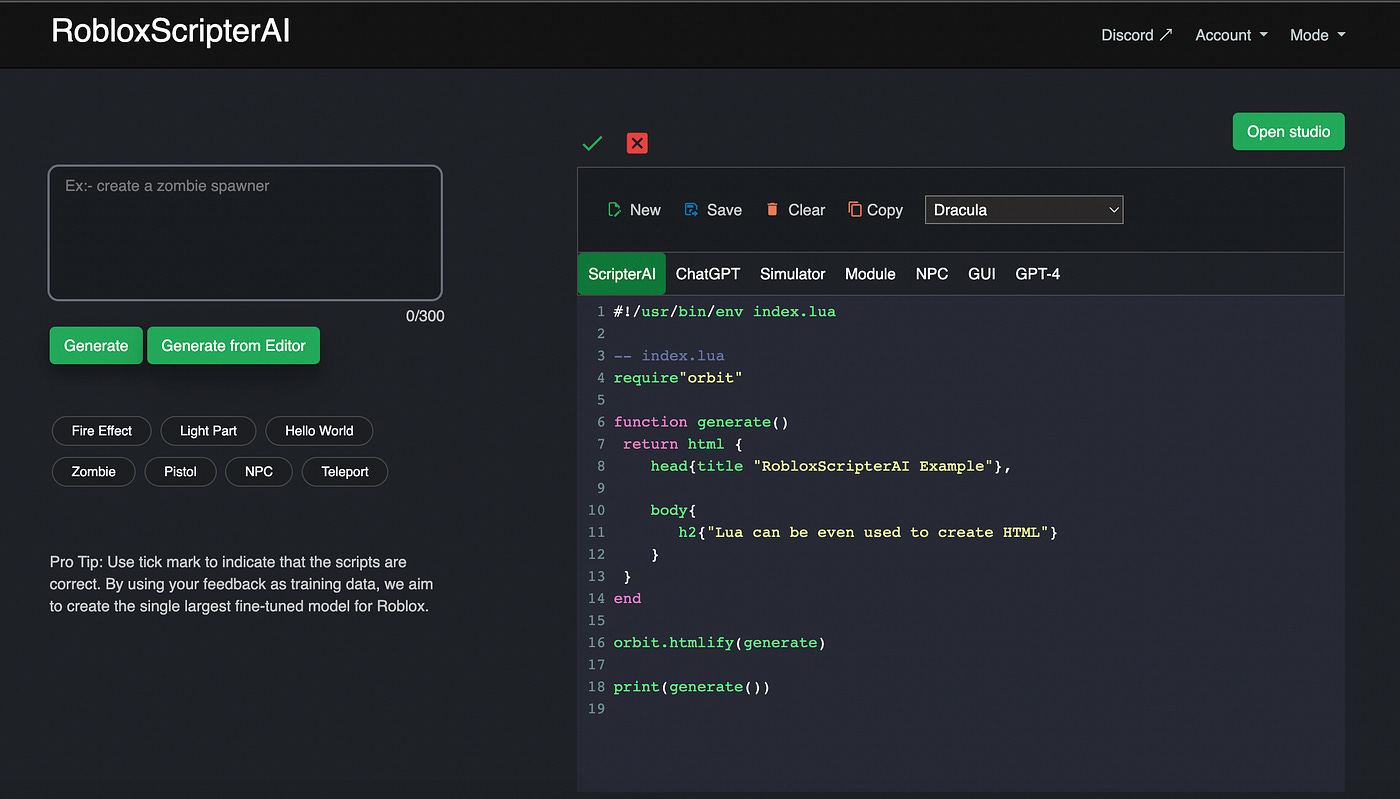
When it was first launched, there was only one tab (ScripterAI) and it was limited to Roblox. The idea was to train the GPT-3 model to work with updated libraries since ChatGPT’s cut-off date made it largely unusable for Roblox game dev. However, since it wasn’t possible to create a fine-tuned model using ChatGPT at that time, I used a vector store with embeddings to extend GPT-3’s code generation abilities to Roblox.
The first month was great! With very little product marketing on YouTube & TikTok — I was able to reach $150 MRR. Then, came two major roadblocks: 1/ ChatGPT released its API which meant that the market was about to get flooded with competitors, and 2/ Roblox released their very own Generative AI tool. As a result, my MRR grew to a measly 30% the next month to $195 with a surge in cancellations.
In March/April, I felt disappointed to see my numbers drop and also started having second thoughts on the overall usefulness of such a product when a plethora of AI companies including OpenAI were working on similar tools. Not to mention, ChatGPT — while very restricted and less resourceful for my product’s use case — was still free to use. I saw quite a few users in my discord ask in the chat how my product fared against ChatGPT and the value they could get out of it. My answer was almost the same every time:
“RobloxScripterAI is more advanced and is trained specifically with the Roblox documentation”.
But, it didn’t work for some time. I naturally thought about shutting it all down. Then, I was struck by this strange finding — I realized that even though my net revenue growth was very small, my website was seeing an influx of users signing up and verifying their email, only to bounce away after being hit by the subscription paywall. It was 5–10 users an hour! I felt guilty about the fact that so many users saw value enough in my product to check it out only to find out later that it’s paid and leave. With this new revelation, I decided to 1/ introduce a free library of scripts generated using my tool and 2/ expand to other gaming engines.
Relaunch & New Ideas
Aside from this influx of users flocking to my website, there were two other things that made me double down on my efforts to revamp the product: 1/ Roblox’s Generative AI tool was surprisingly worse than even ChatGPT — from my own experience it seemed so that they had gone for the fine-tuning approach by using a very limited base model. This made interested users continue exploring alternatives, and 2/ GPT-4 had been launched and I had received access to it in the first week itself.
So, I launched a glut of new features in late April including the free library, and also introduced more modes (such as an integration with GPT-4). I started marketing my product as a free-to-use library of scripts generated using paid and advanced AI models on platforms like YouTube, TikTok, and Reddit, and this helped me earn the trust of my users:
With this relaunch so-to-speak, my product grew to $290 MRR in May. I continued expanding to more gaming engines albeit I found more success with Roblox. I created more videos and even showed that the scripts worked. I started to become active on websites like ProductHunt, IndieHackers, and 𝕏, and even launched the Minecraft tool in a tweet:
https://x.com/adi808080/status/1683166672192978945
Pricing & Testimonials
While these efforts helped raise my product to $420 MRR by June — I saw that I had not changed my pricing ever since I had launched. It was $7.99/$8.99, depending on the number of generations required. The majority of the users were going for the second option which made me think that I was underpricing the product. As a result, I started to experiment with price changes in June and eventually settled at $8.99/$14.99/$18.99. This has not been changed since. The current split is: 80% going for the first option and 20% for the third one. The second tier attracts almost zero net new subscribers. I like to think that its sole function is to make the third tier seem more attractive.
Another change I added in the last couple of months was testimonials. I was inspired to read stories on ProductHunt and Reddit — on the underrated value of featuring testimonials. So, I was able to gather three positive ones and put them up on my landing page along with the updated pricing tiers. I even launched a PayPal integration for payments and almost 25% of my revenue now comes in through it.
All of this has helped me grow my product to $560 MRR as of this day 🚀
By the way, I do run other products too but this is the most I have made so far out of a single product. My overall cumulative products’ MRR is $935 :)