(Yes, it’s another longish piece, but this is an important issue that’s deserves the attention. If we don’t act soon, it will become too big fix. Happy reading. Please share if it resonates.)

A camel does not collapse under the weight of its load. It collapses under one more straw, and that straw looks exactly like the ten thousand before it. Nobody can tell which one it will be. Everyone can see the pile growing.
On August 20th the US Treasury confirmed that the federal government owes just over $40 trillion, double the total of just ten years ago, and associated annual interest payments that already exceed the defense budget. The common assumption in DC and Silicon Valley is that we double down on AI and can just grow our way out of it…
The debt itself is survivable. What is not survivable indefinitely is the combination now forming: an interest bill that compounds without any vote, and a tax system built for an economy that artificial intelligence will be dismantling underneath it. Those two clocks will converge by the end of this decade.
“If something cannot go on forever, it will stop.”
— Herbert Stein, chairman of the Council of Economic Advisers under Nixon
Most writing on the debt and on AI errs in the same direction: it treats technology as the solution and the deficit as the problem. The arguments below run the other way.
1. Growth will not save us, and the conditions that made it possible in 1946 no longer exist today. AI won’t grow the economy as fast as the AI CEOs claim, and a pending AI-driven market correction will require unplanned stimulus and raise borrowing costs, exacerbating the problem.
2. Falling prices from automation make the debt worse, not better. Every historical case of a country outgrowing its debt ran on rising dollar incomes. Cheap AI-produced goods and services deliver the opposite.
3. AI curing disease is a gift to humanity and a bill for the Treasury. Longer lives mean more years of costly benefits no actuarial table assumed. Enormous welfare gain; negative fiscal effect.
4. The tax code pays companies to replace people. Hiring a worker is taxed at roughly 25 to 34 percent. Buying the software that replaces the worker is taxed at about 5 percent. We get what we incentivize. This gap predates AI by two decades, but AI accelerates decisions.
5. The fiscal crisis and the jobs crisis are one crisis. Roughly 84 cents of every federal dollar comes from taxing somebody’s paycheck, so anything shrinking labor’s share of income shrinks the revenue base, whether or not unemployment ever rises.
6. A tax on automation is not mainly about slowing automation. Its side effect is preserving a tax base that is evaporating. We need tax reform that gives the economy and the workforce time to adapt.
7. Cooperation with China is fiscal policy, not just foreign policy. Roughly $2.6 trillion a year of global capital is allocated by rivalry logic rather than return. Some is necessary. But much of today’s data center buildout is to win a race rather than serve a customer. Reducing rivalry also means we can share the heavy lifting of enabling the global south with AI while creating a long-term market for American goods and services.
8. The answer is predistribution, not redistribution. If capital captures the gains, taxing the survivors to compensate the displaced does not scale. Changing who owns the capital does, including an idea Americans reject on reflex: a national sovereign wealth fund.
I’m not writing to announce collapse. I wrote this because we still have time to prevent it. But the window in which the solutions are merely difficult, rather than catastrophic is closing fast.
In 1946, American debt was larger than the entire economy, the highest ratio in the country’s history, fueled by the war effort. By 1974 it had fallen to under a quarter.
Most people misattribute the cause. Nobody paid it off; the dollar amount barely moved for two decades. What changed was the economy underneath it and the real return earned by bondholders. When George Hall and Thomas Sargent took the postwar deleveraging apart, they found growth and inflation did a lot of the work. Later research by Acalin and Ball in 2024 found that budget surpluses and interest rate repression played an even bigger role than raw economic growth in improving the debt to GDP ratio.
The recipe had four ingredients: fast real growth, sustained inflation, a central bank holding rates artificially low (a policy called financial repression, which the Fed ran until 1951), and a world where America was the only large industrial economy left standing. Washington and Silicon Valley are both reaching for that playbook. We have none of the four at the strength required to execute this time around, and the AI transition actively attacks three of them.
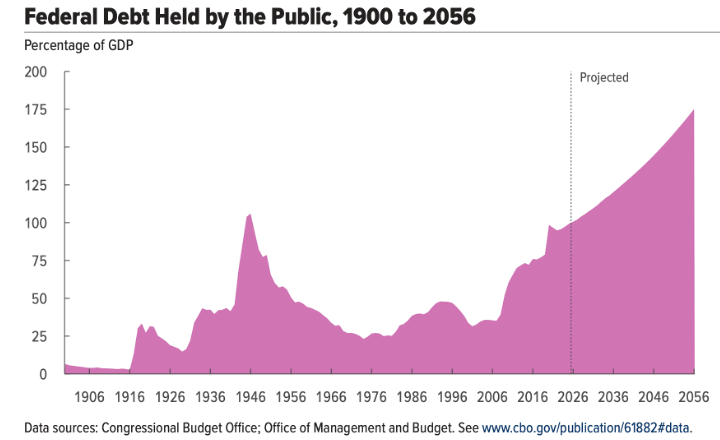
Figure 1. Federal Debt held by the Public (not Gross Debt), 1900-2056, as percent of GDP. Source: Congressional Budget Office, Budget and Economic Outlook 2026-2036.
The $40 trillion is four things stacked in sequence, plus a fifth that now grows by itself.
Wars and emergencies, 2001 to 2021. Iraq and Afghanistan (~$8T), the great financial crisis (~$5T), and the pandemic response (~$5T).
Tax cuts without matching spending cuts. Four major tax acts since 2001 each lowered the revenue baseline permanently while spending commitments kept growing.1
Demographics. In 1960, five workers supported each retiree. Today it’s three.
Health costs outrunning the economy. Sustained for fifty years. The quiet giant.
Interest on all of the above. Now the fastest-growing line in the budget and the only one that requires no vote at all.
That last item has quietly changed the nature of the problem. Strip out interest and the gap between what government spends and collects is projected to shrink slightly over the next decade. Add interest back and the deficit grows by half. Every dollar of projected deterioration comes from servicing money already borrowed. This dramatically gets worse if interest rates go up due to economic or geopolitical instability.
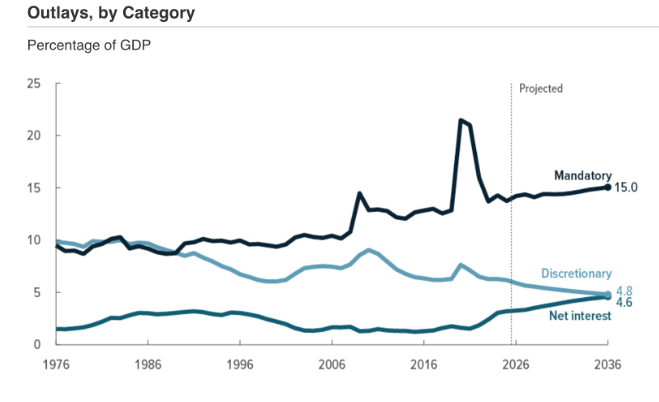
Figure 2. Primary deficit (spending minus revenue, excluding interest) versus net interest, as a share of the economy. Source: Congressional Budget Office, Budget and Economic Outlook 2026-2036.
We have crossed from a spending problem into a compounding problem. They call for completely different instruments, and Washington is still using the ones designed for the first.
Most people, including many executives, picture the federal budget as a pot Congress divides up each year. It is not!
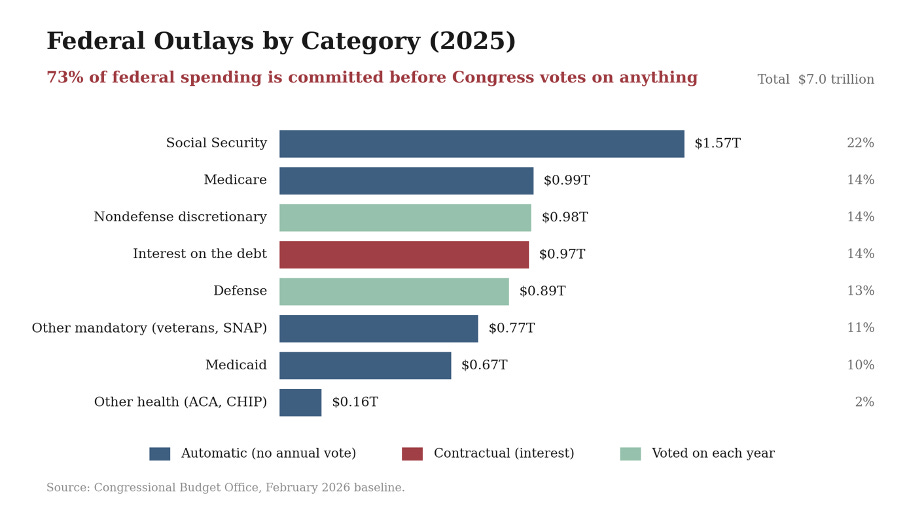
Figure 3. Federal outlays by category, fiscal year 2025, total $7.0 trillion. Source: Congressional Budget Office February 2026 baseline.
When a politician promises to fix the deficit through spending discipline, look at the arithmetic. About three-quarters of federal spending is either automatic or contractual. Automatic means Social Security, Medicare, Medicaid, and veterans benefits, which pay out to anyone who qualifies whether or not Congress ever meets. Contractual means interest. What is left, the portion Congress actually appropriates, is under two trillion dollars (green bars above). Half is defense (and growing). The other half funds everything else: the National Institutes of Health, the Federal Aviation Administration, the national parks, education aid, the entire civilian scientific enterprise, food safety, the courts, the diplomatic corps, and the Internal Revenue Service. So the proposal is to close a $1.9 trillion gap with a $1.9 trillion lever, half untouchable and half containing nearly every public investment that generates future growth. It has never been done, and the lever shortens every year.
Stabilizing the debt ratio does not require closing the entire deficit, only about one-third to two-fifths, since a growing economy can absorb the rest (assuming growth trends continue). It does not rescue the arithmetic. It just means the task is not as impossible as it appears, as long as we don’t create a new crisis that creates discontinuous growth in the debt. There are also other tools to grow tax income which are discussed later in this essay that can take us onto a downward path.
Most people understand that governments want to see low unemployment and usually they tax what they want less of as taxes are generally seen as disincentive by taxpayers. Which is why the current US tax laws confuses me, especially when everyone is so worried about AI taking their jobs.
Hire a person and the employer pays payroll tax plus unemployment insurance, workers’ compensation, and health benefits, while the employee pays payroll tax again plus income tax. Buy a machine or software agent to do the same task and the company deducts the purchase immediately, pays no payroll tax, and returns flow to shareholders at capital gains rates that can be deferred indefinitely and wiped clean at death by stepped-up basis. Daron Acemoglu, Andrea Manera, and Pascual Restrepo measured the gap.
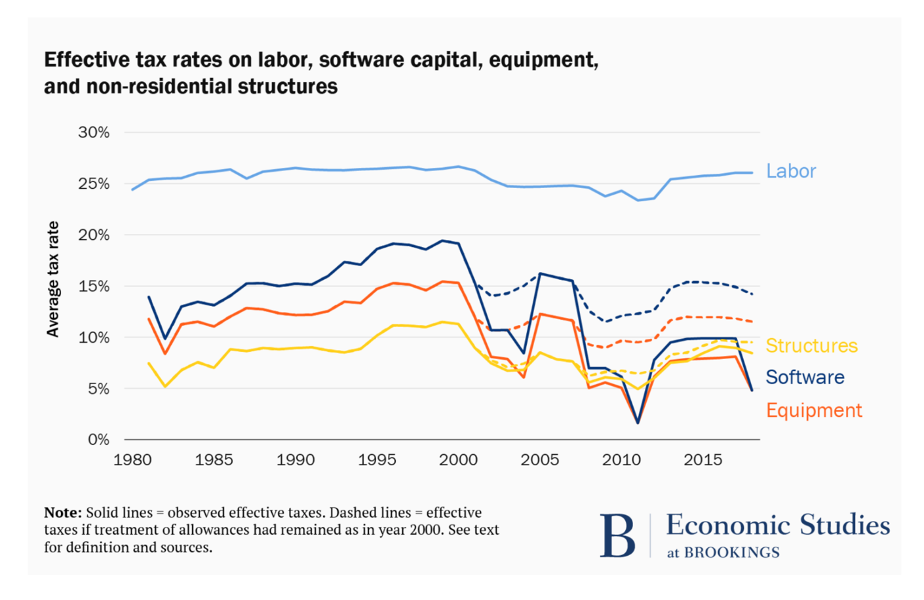
Figure 5. Effective tax rates on labor versus on software and equipment capital. Source: Acemoglu, Manera and Restrepo, Brookings Papers on Economic Activity, 2020.
Their conclusion is counterintuitive: much of recent automation may not be productivity-enhancing at all. It is tax-arbitrage automation, machines deployed not because they outperform the worker but because they are cheaper after tax. Fixing this alone, they find, would raise employment about four percent. The fiscal crisis and the labor crisis are not two problems that coincide. They are one problem seen through two windows.
We spent forty years building a tax code that subsidizes replacing the very thing that funds the government. As AI matures, this issue is only going to compound!
This is where the AI transition does its damage, and not enough people are talking about it. Federal revenue is overwhelmingly a tax on human work. Income tax and payroll tax together supply about 84 cents of every dollar collected. Corporate income tax contributes roughly nine cents, down from a quarter of revenue in the 1950s.
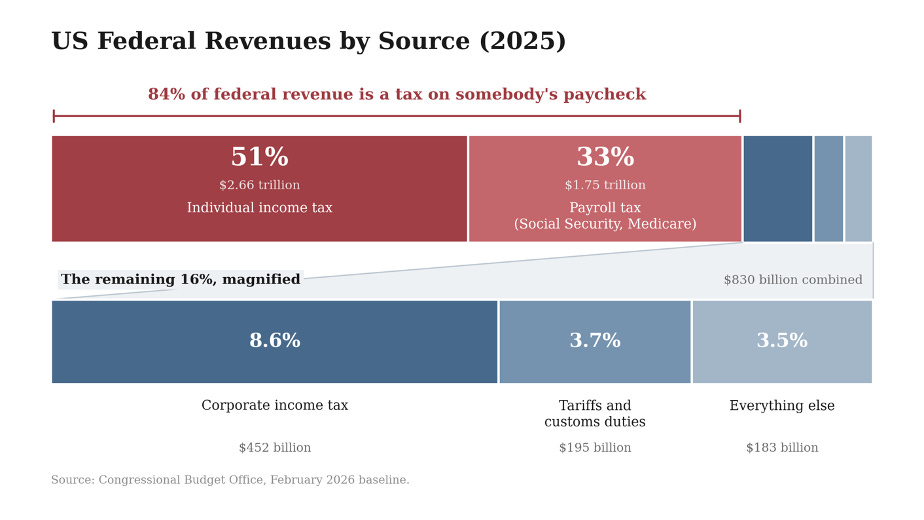
Figure 4. Federal revenue by source, fiscal year 2025, total $5.2 trillion. Source: Congressional Budget Office February 2026 baseline.
Neither of these is a law of nature. The mass income tax was a wartime improvisation nobody revisited. The Revenue Act of 1942 expanded the income tax from about four million filers to more than forty million, and the businessman Beardsley Ruml sold Washington on paycheck withholding in 1943 as the way to collect it. Social Security was designed in 1935 as contributory wage insurance, funded by a levy on wages specifically so recipients would feel they had earned the benefit. Both were brilliant designs for their moment, and both rested on one assumption: that most of what a country produces would keep flowing to people as wages. For eighty years that assumption held. It is now failing, and in a way the architects never modeled: not because workers are being fired in waves, but because we have created a K-shaped economy where the share of production reaching people as pay has been drifting down while production itself rises.
The consensus I hear in Silicon Valley runs like this: AI delivers a productivity surge, the economy compounds, revenue rises, and the ratio deflates as it did after 1946. Tested against the actual fiscal models, we get a very different answer.
Start with what is already assumed. The Congressional Budget Office baseline already builds in a positive AI productivity effect. The pessimistic projection is the optimistic-technology projection.
Estimates of what additional AI growth buys cluster in a narrow, disappointing band. Penn Wharton-based modeling finds AI shrinking the annual deficit by about three-tenths of a percentage point. Douglas Elmendorf and Louise Sheiner find a large permanent productivity gain could halve the projected debt rise over thirty years, then note the catch: that assumes Congress does not spend the windfall, which Congress has never managed.
The most complete study, by Brookings, finds that a once-in-a-generation productivity boom could cut annual deficits by roughly two-thirds, then names five side effects specific to an AI boom that claw back more than half: longer lifespans expanding retirement programs, displaced workers drawing on income support, income shifting from wages to capital and lowering the average tax rate, higher interest rates raising debt costs, and an AI arms race lifting defense spending. Four of the five are not technological risks. They are tax-structure and geopolitical risks. The technology delivers the growth; our institutions leak most of it back out.
A further problem the models handle poorly, which I took apart in The AGI Windfall Mirage: much of the growth we are measuring is construction, not application. Building the factory counts toward the economy. Whether it produces enough value to justify itself is a separate question, and as we found in the Stanford Enterprise AI Playbook, enterprise adoption is still delivering far less and slower than markets are pricing in.
Assuming AI delivers as promised with no hiccups, it’s worth somewhere between half a point and one and a half percentage points of the economy on the annual deficit. The gap that needs closing is three to four points. AI is a real tailwind and roughly a third of a solution. Anyone selling it as the whole solution is selling the 1946 recipe without the 1946 ingredients.
VII. What an AI correction does to the ledger
If the ROI doesn’t get realized as expected, we’ll have a different problem on our hands. It could be the fastest available route to a much larger debt.
Suppose the market correction I described in The AGI Windfall Mirage and The Great Reckoning arrives: capacity built against projected demand that does not appear on schedule, write-downs across the supply chain, and a repricing of everything valued on the assumption that frontier labs can maintain revenue growth. What makes this fiscal rather than merely financial is that the buildout stopped being an equity story. In August the Wall Street Journal found nine large technology companies carrying roughly $3 trillion in off-balance-sheet commitments tied to AI, about five times their reported capital spending, most of it in uncommenced leases and purchase obligations that accounting rules keep off the books. For scale, subprime mortgages outstanding at the height of the housing bubble came to roughly $1.3 trillion. Equity drawdowns destroy paper wealth. Obligations of this kind destroy balance sheets, and balance sheets are what governments end up standing behind.
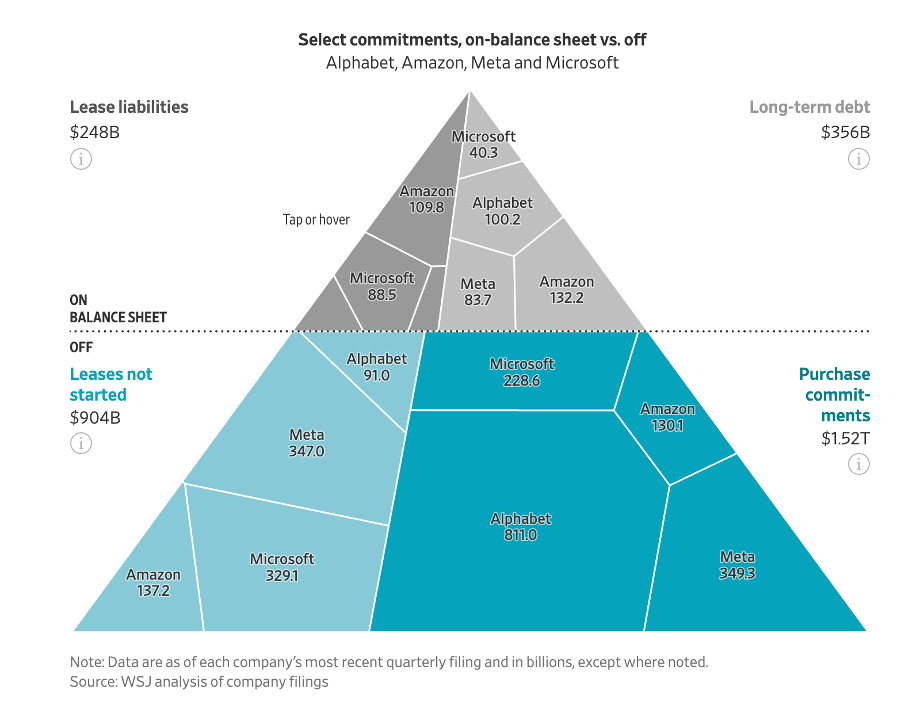
Figure 6. Breakdown of spending commitments from the major hyperscalers relating to AI spend. WSJ, Aug 16, 2026.
The 2008 precedent is highly instructive. Federal debt held by the public went from 35 percent of the economy in 2007 to 70 percent by 2012, doubling in five years, while the deficit went from about one percent of output to ten percent, the largest share since 1945. The misremembered part is the cause. TARP authorized $700 billion, disbursed $443 billion, and after repayments cost the government about $31 billion net (which doesn’t sound bad). The Recovery Act added roughly $800 billion. Together, less than a third of the borrowing. The rest was revenue collapse and automatic stabilizers, with federal receipts falling roughly a fifth in two years. A recession does most of the fiscal damage before Congress votes on anything.
And the usual consolation may not hold this time. In 2007 we entered with debt at 35 percent of output, an interest bill of 1.6 percent, and a policy rate above five percent, all of it ammunition, and money fled into Treasuries and cheapened the debt as it went. We would enter the next crisis above 120 percent of GDP with interest already at 3.3 percent, and the reflex itself is weaker. The marginal holder is no longer a patient foreign central bank but a leveraged fund that sells Treasuries in a crisis to meet margin calls, Chinese and Japanese official holdings have been shrinking for years, and April 2025 already delivered one shock in which the dollar weakened and long rates rose together. A crisis originating in American assets is precisely the kind where foreign capital reduces dollar exposure rather than rotating into it, at the exact moment issuance surges by well over a trillion. Every hundred basis points added to the average rate costs over $300 billion a year.
There are two regimes and only one is survivable on the 2008 template. If the shock is global and disinflationary and the dollar still functions as the refuge, falling yields offset perhaps half the revenue loss. If the shock is American in origin, revenue falls while borrowing costs rise and the arithmetic compounds in both directions at once. Given who holds the paper now, the second is likelier than it was in 2008.
We are borrowing enormous sums today against a windfall that will not arrive at the promised scale, and the public balance sheet absorbs the difference. That is the windfall mirage in fiscal form, and it is the shortest path to the last straw.
Very few in the AI debate have internalized this next point, and it is why I have grown more concerned over the past year rather than less. Cheaper goods and services sound unambiguously good. For consumers they are. For a government carrying a large debt, they are poison, and the reason is mechanical. Debt is a fixed dollar amount, and the ratio that matters puts the economy in the denominator, measured in current dollars. After 1946 the dollar size of the American economy roughly quintupled in under thirty years while the debt crawled. Take away the price increases and half that arithmetic disappears. Automation-driven price declines do something worse than remove inflation: they remove it while simultaneously moving income away from the thing we tax. Three steps:
AI drives down the cost of software, analysis, design, diagnosis, legal drafting, customer service. Prices fall, real output rises, measured dollar output rises much less.
Savings flow to whoever owns the model, the compute, and the deployment. Labor’s share falls even where headcount holds, because the wage bill per unit collapses.
Federal revenue, 84 percent of it from paychecks, falls as a share of the economy even as the economy grows in real terms.
The obvious rejoinder is that if deflation is the trap, we will simply inflate our way out as we did after 1946. That exit is narrower than it looks. Inflating away debt requires long maturities, and the average maturity of American debt is under six years, so higher inflation reprices most of the stock within a single presidential term and raises the interest bill faster than it erodes the real principal. It also requires a central bank willing to tolerate it, which the post-2021 experience makes politically improbable. And automation-driven disinflation lands hardest in exactly the tradable goods and services the price index captures, while the categories that resist automation, housing, care, and energy, keep climbing. The likely outcome is not the smooth reflation of 1946 but a widening split: cheap output, expensive necessities, and a debt ratio that gets relief from neither.
The fiscally worst-case AI scenario is not rapid mass unemployment. It is strong real growth, weak dollar growth, and a falling share going to wages. Which is currently also the most likely scenario.
The payroll system feels this first. Social Security taxes wages, only wages, only up to a ceiling, and the retirement trust fund is projected to run dry in the early 2030s assuming labor’s share holds steady. Nothing dramatic need happen for it not to. Goldman Sachs’s base case involves only six or seven percent of workers displaced over a decade: enough to move the tax base substantially, nowhere near enough to trigger emergency politics. Meanwhile Stanford’s Digital Economy Lab finds employment among 22 to 25 year olds in the most AI-exposed occupations has already fallen about 19 percent (vs. less exposed peers) since late 2022, while the least exposed grew about ten percent. The canary in the coalmine is not dead yet. It is coughing, and nobody is paying attention.
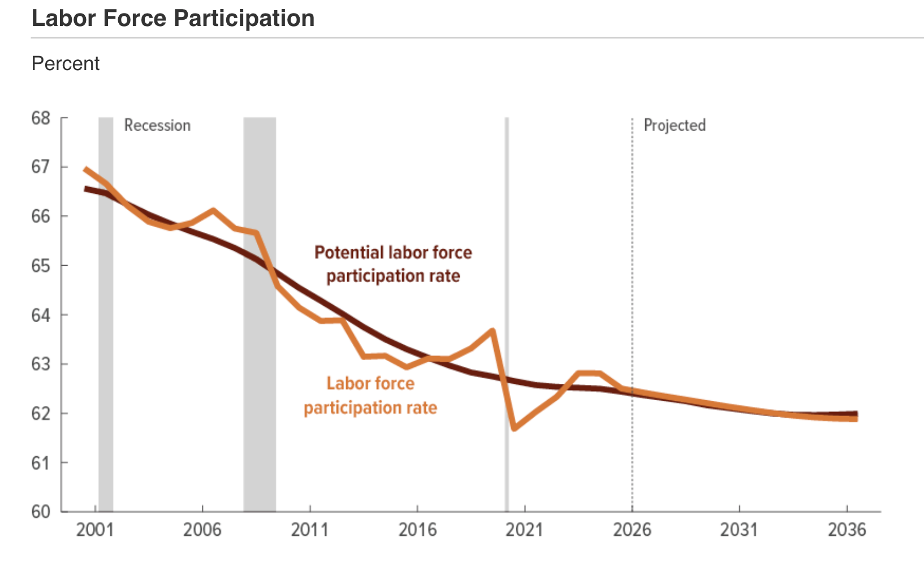
Figure 7. US Labor Force Participation, fiscal 2001-2036. Source: Congressional Budget Office February 2026 baseline.
Even without AI’s impact, there’s been a downward trend for the last 20 years. Projected trend likely underestimating the AI displacement impact.
The claim is not that technology destroys work on net. It hasn’t in the past, and it probably will not for some time still. The claim is narrower and harder to dismiss: the fiscal system does not tax employment, it taxes wages, so what matters is the share of output that flows through a paycheck. That share can fall while the number of jobs holds or even rises. A reinstatement effect that creates millions of new roles at a lower wage share still shrinks the base. The service sector where most displaced workers will flow to is currently lower-wage occupations and less differentiated compared to the white-collar roles they will likely be drawn from.
This is why I argued in The Post-Labor Prophecy that Pigouvian instruments, taxes that make a private actor bear a cost it imposes on everyone else, belong in this conversation. But the usual version of that argument is weak: taxing automation as compensation for social harm invites an endless fight about measuring the harm. Yes, these taxes will likely slow displacement of human labor, but not necessarily slow automation. What’s more important is that we give time for the economy to adapt to change, and we are trying to keep the government solvent while the thing it taxes evaporates underneath it. If 84 percent of federal revenue rides on wages, and wages are a shrinking claim on what the economy produces, there needs to be a counterbalance.
Everyone has heard the saying, “we can’t slow down AI, because it’s going to cure cancer!” That’s why this section I find genuinely painful to write. AI will make medicine dramatically better: faster diagnosis, cheaper drug discovery, personalized treatment, and eventually a real extension of healthy lifespan. An enormous welfare gain, arguably the largest available to humanity this century. It is also, under current law, a bill that increases the deficit.
Test the claim circulating in AI circles that fixing healthcare frees trillions for debt repayment. American health spending runs near eighteen percent of the economy. The most careful published estimate, in the Journal of the American Medical Association, puts total waste at roughly a quarter of that, but finds proven interventions recover only about a third of the waste. Federal programs capture perhaps forty percent of any real saving, and only if Congress legislates it into lower payment rates rather than letting it settle as provider margin. Realistic federal capture is on the order of a tenth of the interest bill. Not trillions.
Then the paradox. In the Brookings framework, reduced mortality shows up as a fiscal cost: every additional year of life past 65 is another year of Social Security and Medicare that the actuarial tables never assumed. When benefits began in 1940, a man who reached 65 could expect about 12.7 more years of them, and only about half of 21-year-old men reached 65 at all. Today it is roughly 19 years, and about three-quarters get there. A cure for Alzheimer’s is a moral triumph and an enormous unfunded obligation, at the same time, in the same ledger.
Baumol’s cost disease compounds it: where productivity is hard to raise, wages still track the rest of the economy, so relative costs climb. AI will automate the paperwork and much of the diagnostic layer. But the human-contact layers, nursing, elder care, rehabilitation, mental health, are exactly where demand rises with longevity and machines substitute worst. Some models find a productivity surge actually raises health spending as a share of the economy rather than lowering it.
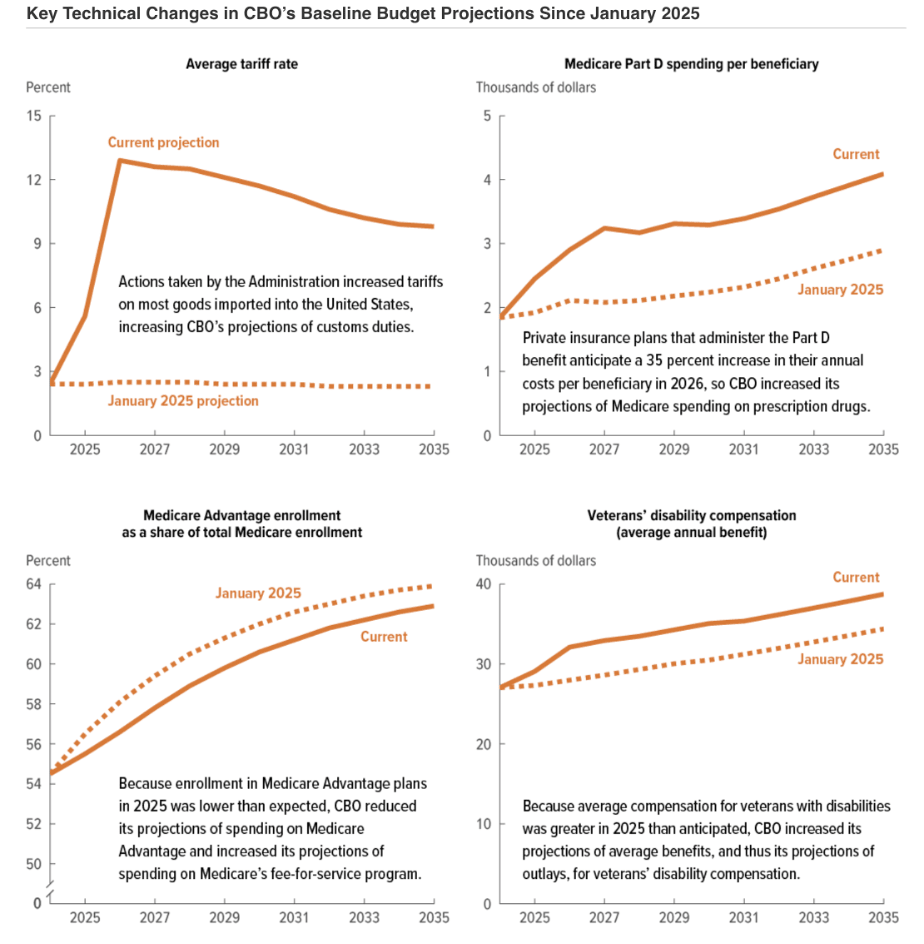
Figure 8. Federal healthcare outlays projected to be rising while tariff income expected to decline, fiscal year 2025-2035. Source: Congressional Budget Office February 2026 baseline.
AI medicine is a welfare windfall and a Treasury liability at the same time. Both statements are true. Any honest argument for abundance has to hold both.
The resolution should not be to slow medical progress. It’s that we need to recognize our social insurance architecture was calibrated for a mortality curve AI is about to bend, and to recalibrate it deliberately rather than let it break by surprise. Eligibility ages, benefit formulas, the wage ceiling on payroll tax: all were set for a world where 65 meant something different. That is a reform agenda, and action is needed before the bill arrives.
“There is a great deal of ruin in a nation.”
— Adam Smith, 1777, responding to panic over British debt after the defeat at Saratoga
Smith was right, and he described a country that would go on to carry debt at twice the size of its economy and survive. Large debts are survivable. But that was also at a different time when rapid economic growth came naturally as the country itself expanded from a small base.
Like many things, sovereign crises do not announce themselves. Hemingway’s character, asked how he went bankrupt, gives the famous two-stage answer: “gradually, then suddenly.” Britain in 1976, Mexico in 1994, Asia in 1997, Greece in 2010: fundamentals deteriorated visibly for years, markets financed them cheerfully throughout, and the repricing took weeks.
So the key question isn’t whether $40 trillion is too much, but what has changed about who is holding the straw. Brookings documents an inversion: foreign private investors now hold nearly twice as much American government debt as foreign central banks do. Central banks were the patient anchor; they bought and held. The new marginal buyers include heavily leveraged funds running arbitrage strategies that can unwind in days under stress, as in March 2020. China’s holdings have fallen to their lowest since 2008, Japan’s share by more than half.
Meanwhile the exorbitant privilege, Valery Giscard d’Estaing’s phrase for America’s ability to borrow cheaply because the world needs dollars, is intact but eroding: down from about 71 percent of global reserves in 1999 to about 57 today. It is not free money but a discount on borrowing costs, plausibly worth $100 to $250 billion a year. And in April 2025 we saw the first modern instance of that discount failing when needed: a risk-off shock produced a weaker dollar and rising long-term rates, the opposite of the flight to safety assumed for eighty years.
We are not at the last straw. We are loading straws faster than at any point in peacetime, onto a camel whose creditors are less patient and more leveraged than at any time since Bretton Woods. When the structure gives way, the healthy parts underneath get crushed along with the rest.
Every conversation about the tax base eventually collides with the word redistribution, and the moment it does, half the room stops listening. It is the wrong word.
Redistribution takes income after it is earned and moves it. It arrives late, it is resented by those it taxes and stigmatizing to those it aids, it changes nothing structural, and it does not scale to a problem this size.
Predistribution, a term Jacob Hacker introduced, asks a different question: how do we shape market rules so income spreads more broadly before the tax collector arrives? Who owns the assets? Who captures returns from publicly funded research? How the factors of production are taxed against each other? Who owns the data and the compute?
This is the entire game. If AI pushes labor’s share of GDP from roughly 57 percent toward 45, no redistributive scheme is large enough to fix it politically: you would tax a shrinking group at rates that trigger capital flight and pay a growing group in a way that reads as charity. Universal Basic Income flounders exactly here. It is redistribution scaled to a predistribution problem.
We need to recognize that this is not fundamentally about fairness. We need to wake up to the reality that the nation’s antiquated fiscal structure needs redesign. Predistribution is the structural repair our leaders are still unwilling to discuss.
Here are the five reforms I’d suggest. None of it is easy, but all of them are necessary.
Stop paying companies to replace people. Equalize effective tax rates on labor and automation capital, end immediate expensing for capital that displaces payroll, tax investment returns at ordinary rates above a threshold, eliminate stepped-up basis at death, and broaden the payroll base toward a measure of value added so Social Security no longer rides on labor’s declining share.
Layered on top, a Pigouvian levy: a charge on the gap between a firm’s value added and its wage bill, measured against sector norms, dedicated by law to the transition. Add taxes on data centers, chips, and token revenues, just as cigarette and fuel taxes compensate for societal externalities.
Acemoglu and his coauthors argue the first-best is removing the existing distortion rather than layering a new tax on top. They are right that neutrality is cheaper and raises more, but it leaves the transition unfunded, and a dedicated levy is what makes the bargain closable. Do both, lead with parity. This is the largest lever available.
The Servicemen’s Readjustment Act of 1944 trained or educated close to eight million veterans, roughly half of everyone who served. A congressional study four decades later estimated a return near seven dollars per dollar spent, realized through the tax receipts of a more productive workforce. Note the timing: costs in the 1940s budget, returns twenty years later.
That is the model for the GI Bill for the AI Age I laid out in Beyond Rivalry: a transition entitlement funded by the automation levy, portable across employers, covering wage insurance, retraining, relocation, and benefits.
Why it attacks both problems in this essay. It is a fiscal instrument, not only a compassionate one, targeting two of the five side effects Brookings found clawing back AI’s gains: displaced workers drawing on income support, and falling labor force participation. A prime-age worker who stays attached is worth roughly $12,000 to $15,000 a year to the Treasury, so the program pays for itself at low effectiveness thresholds. It also resolves the healthcare paradox: the care economy is where longer lives create demand and machines substitute worst, so channeling displaced knowledge workers into care work turns a fiscal liability into tax-paying labor supply. One instrument, both problems.
The counterpoint: America’s record here is poor. Evaluations of Trade Adjustment Assistance, which was supposed to do this for manufacturing workers, found near-zero or negative earnings effects. Retraining people for occupations that are themselves moving does not work. So, lead with wage insurance and portable benefits and treat classroom retraining as the smaller component. The good news is that most people don’t need a lot of specialized training to care for the elderly or mentor youth, they just need the social motivation to want to do it. This is where redefining what counts as high-status work, which I discussed in The Post-Labor Prophecy, does more work than any curriculum.
This proposal will likely draw resistance, but it follows most directly from predistribution logic. If capital captures a rising share of output, the durable fix should not be about taxing the winners harder forever. It must be about making ordinary citizens owners of that capital. Norway’s Government Pension Fund Global holds roughly 1.5 percent of every listed company on earth for five million people. Alaska’s Permanent Fund has mailed every resident a dividend since 1976 and is quietly the most popular program in the state.
An American version would be funded not by borrowing but by three streams already public property and currently given away: the automation levy above, an equity carry on commercialized federally funded research, and receipts from public assets like telecom spectrum or federal lands. Hold it passively and indexed. No voting rights, no industrial policy, no ministerial discretion. Pay a visible annual dividend, so citizens experience the AI transition as owners rather than bystanders. And specialized deals with key players like what the current administration struck with Intel last year could be included, as long as it doesn’t become a form of regulatory capture.
Some may object that you cannot responsibly run a wealth fund while running a large deficit: you would be borrowing at four percent to buy equities and calling the spread a policy. Norway funds its own from oil surpluses; we have none. Government equity ownership also invites political capture. My answer: fund it only from the dedicated levy, never from borrowing, start small, keep it fully passive, and treat the dividend as the point rather than the returns. The goal is a way to give a hundred million households a direct stake in the machines displacing their labor, which is the difference between a transition and a rupture.
The original Marshall Plan disbursed about one and a quarter percent of American output a year for four years. Replicating that today means several hundred billion annually, which Congress would never appropriate. What made it pay was never the aid. It bought a trading system, a set of institutions, and a bloc of solvent customers who purchased American goods and held American assets. The exorbitant privilege is, in a real sense, still the Marshall Plan’s dividend eighty years on. Size the AI version accordingly:
Co-funded, explicitly. Not an American subsidy but a joint facility with the European Union and China, plus Gulf and East Asian sovereign funds, on the model of CERN or ITER, the international fusion project, rather than foreign aid. An American contribution in the tens of billions a year, matched by partners, is serious and fundable.
Aimed at the Global South as a market, not a charity case. Four billion people lack meaningful access to frontier capability. Compute access, localized models, health and agricultural deployment, and standards capacity across Africa, South Asia, and Latin America build the customer base for thirty years of American, European, and Chinese exports. Every general-purpose technology, from electrification to mobile telephony, generated more value from diffusion than invention.
Justified as defending the dollar’s reserve role. If the borrowing discount is worth $100 to $250 billion a year, spending a fraction of that to keep countries who might otherwise build a parallel financial architecture inside the tent is not selfless generosity. This type of program would be one of the cheapest debt-service reductions available.
There are those who suggest the causation may run backward: military primacy and Bretton Woods may have created the privilege, with the Marshall Plan a lagging indicator. And AI diffusion may erode American leverage by handing middle powers capabilities they now rent. But the counterfactual matters more than the mechanism: the alternative to a co-funded facility is a solely Chinese-funded and controlled one, strictly worse for the dollar and long-term American influence.
The peace dividend is a real historical phenomenon, not a hopeful abstraction. American defense spending ran near six percent of the economy at the Cold War’s 1986 peak and about three percent by 2000. That swing, with the productivity boom and two revenue acts, produced the surpluses of 1998 through 2001, the only time in modern American history the debt ratio fell meaningfully outside a war’s aftermath. It required the brutal Base Realignment and Closure process and took a decade to land. But it worked.
“Every gun that is made signifies a theft from those who hunger and are not fed.”
— Dwight Eisenhower, Chance for Peace address, April 1953
Eisenhower wasn’t a pacifist; he was doing arithmetic. The current picture runs hard the other way. All 32 members of the North Atlantic Treaty Organization met the two percent target in 2025 for the first time, alliance spending passed $1.4 trillion, and the Hague summit committed them to five percent of economic output by 2035, which the Kiel Institute prices at an extra 831 billion euros a year for Europe alone and growing. Add the AI buildout, allocated by identical logic: roughly a trillion this year globally, and growing rapidly. Sum the rivalry-related budget, and even if a portion can be redirected to peaceful infrastructure buildout, the economic returns would be significant. Part of the reason why Japan and Germany recovered so quickly from WWII was because they were not burdened with a high defense budget.
That is roughly $2.6 trillion a year of the world’s capital being allocated by rivalry logic rather than by return today. Of course, not all of it is waste, but a great deal of it could provide better long-term societal benefit.
This is The Great Reckoning in fiscal terms, resting on the thesis in Misdiagnosing the US-China AI Race. Détente does not merely lower defense budgets. It changes what the AI buildout is for. Much current data center construction is racing rather than serving: capacity procured on the theory that whoever holds the most compute or gets to AGI first wins something, not on demonstrated returns. 60% of today’s compute resources are used for training dozens of near duplicate models where real-world users can’t tell a clear difference in most cases. Remove the race premium and a meaningful fraction of that capital frees up for grid modernization, transmission, water, housing, education and broadband, which carry higher and far more broadly distributed returns per dollar and employ many more people.
Détente plausibly yields half a point to a full point of economic output in defense savings over ten to fifteen years, plus redirection of some share of the AI capital expenditure. Not a solution on its own, but roughly the size of the projected growth in interest costs over the same period, which means a peace dividend can offset the compounding and buy time for the other four reforms.
The security environment has genuinely deteriorated in recent years, and unilateral drawdown would be reckless. I’m not suggesting disarmament. That framing treats cooperation as a concession, when in budget terms it is the highest-return investment available to both parties at once.
The arithmetic closes. Stabilizing the debt ratio needs roughly three to four percentage points of economic output. There are five plausible sources:
AI productivity, may provide: half a point to one and a half. (If we can avoid the previously mentioned correction. If not, it could be a sizable drag.)
Closing the labor-capital wedge and broadening the tax base: one and a half to two and a half.
Bending health cost growth one point below the economy’s: about one point by the 2040s.
Recalibrating Social Security for longer lives: about one point.
Peace dividend and capital redirection: half a point to one point over ten to fifteen years.
Two large levers and any one of the others closes it. All five close it comfortably and fund the transition besides. No single one closes it, which is why every proposal offering just one lever, whether growth, spending cuts, or taxing billionaires, is unserious.
One additional lever is missing from that list on purpose. Immigration is the fastest-acting fiscal instrument available to a country with a worker-to-retiree problem, and the Congressional Budget Office scores lower immigration as adding roughly half a trillion dollars to deficits over the coming decade. I left it off the menu not because it is unimportant but because it is the one item where the politics currently overrides the arithmetic. That is itself evidence about which of the three clocks below is really binding.
Why three years and not thirty. Three clocks are running. The interest clock: every year of delay adds roughly two trillion to the pile while the average rate keeps repricing upward, so the same reform costs more each year you wait. The political clock: tax reform is feasible while the group that pays is small and the group that benefits is large; once labor’s share falls far enough, the coalition that could have voted for parity has itself been hollowed out. Predistribution also has a shelf life, shorter than the problem. The later we implement, the less it helps. The standards clock: decisions being made now about who owns model weights, who allocates compute, and whether the Global South builds on shared infrastructure or rents from two vendors are hardening into permanence. Standards are cheap to set and enormously expensive to change.
“Only a crisis, actual or perceived, produces real change.”
— Milton Friedman
Friedman’s follow-on was the important part: when the crisis comes, what gets done depends on which ideas happen to be lying around. The crisis will come. The only question is whether the ideas within reach are good ones, or whether we grab the ineffective standby tools of austerity and protectionism because nothing better was on the shelf.
Forty trillion dollars is not a sign of imminent doom. The United States is not Greece and cannot be forced into default in a currency it prints. This number should be a wake-up call, addressed to all of us.
To the nation: we are running a tax system built for an industrial labor market into an economy that is ceasing to be one and financing the gap from a creditor base quietly becoming less patient. That is a choice, made annually, by people we elect.
To companies: the tax arbitrage that makes automation cheaper than employment can’t be relied upon long term. It is a policy error and it will be corrected. Firms assuming labor stays expensive and capital stays cheap are building on sand. The ones that thrive will use AI to expand what their people can do, which is also where the actual enterprise returns have been.
To individuals: the retirement, healthcare, and education promises we have made to ourselves are not funded. Understanding this gives us the motivation to prepare for it and demand change.
The camel is not down yet. The load is heavy, but the animal is strong, and we still choose which straws we add and which we take off. What we do not choose is whether the last straw exists. It does. We cannot see it, and we will know which one it was only after the fall. I’m not telling you to panic. But we need to greatly increase our sense of urgency.
We have a few years to trade a hard choice for a catastrophic one. Every previous generation of Americans that faced this arithmetic, in 1790, in 1865, in 1946, chose the hard thing and was rewarded for it. There is no reason we cannot today. The only question is whether we will.
Thanks for reading Abundanist: Please share this with people that can benefit from a new perspective. 💡
If this content resonated or you disagreed with it,
please leave a comment and tell me what you thought.
Alvin Wang Graylin writes The Abundanist. He is a Digital Fellow at Stanford HAI | Digital Economy Lab, a Senior Fellow at the Asia Society Policy Institute’s Center for China Analysis, a professor of AI and Tech Policy at the University of Washington and the author of Our Next Reality. Prior to his current academic and think tank roles, he has had over 35 years of direct operating experience managing businesses in all five layers of the “AI cake” on both sides of the Pacific.