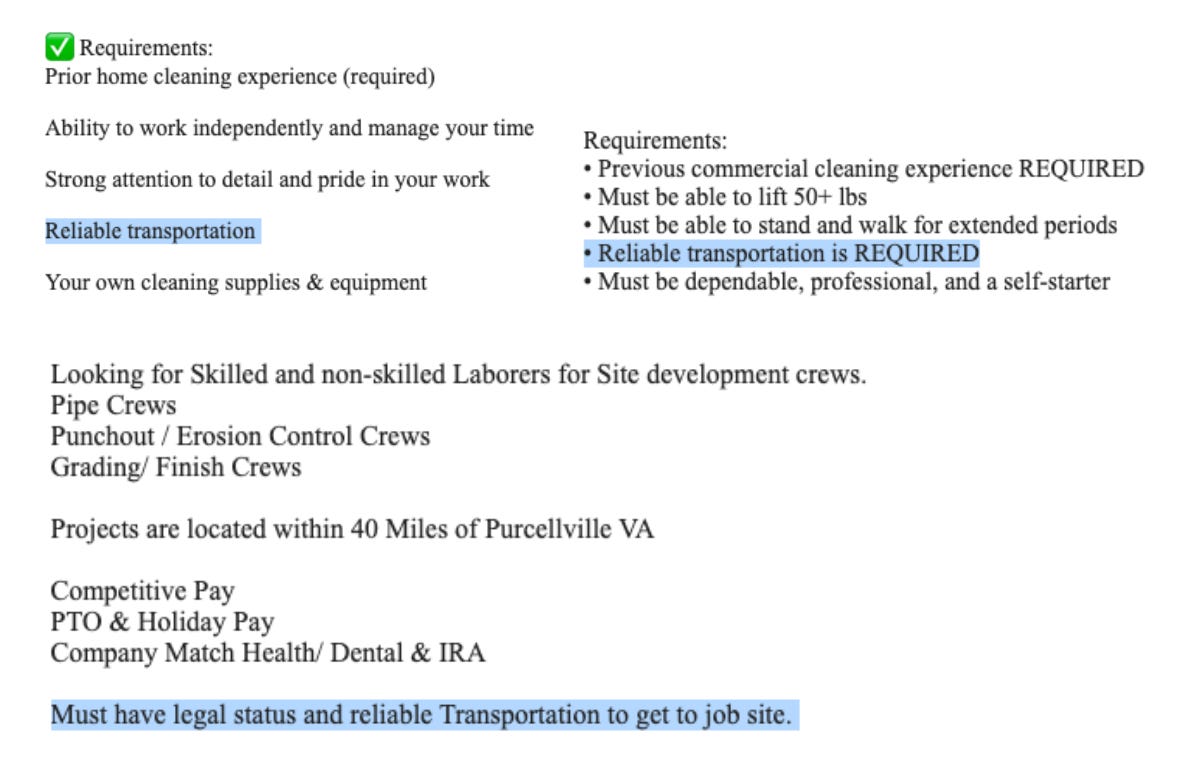
“Reliable transportation required” is one of the most common lines in low-wage job ads. You see it in Craigslist job ads for cleaning and day labor.
People get stuck in low-wage work for a variety of reasons, often a lack of transportation. In much of the U.S., a bus is not reliable transportation. It often doesn’t show up, or it shows up late.
A car is only reliable if it runs. When my brother’s car broke down, he lost his job at Red Lobster. He couldn’t get there consistently, so they let him go. He needed the job to fix the car.
That car is both essential and precarious. The poorest fifth of American families spend 38 percent of their income on their car, if they even have a car. When that one car breaks down, the whole household scrambles.
The Waymo debate in America focuses on liability frameworks, rideshare driver jobs, and edge cases where the technology fails. It should also focus on how bad the status quo is for poorer people. Self-driving cars, if they get cheap enough, could be a safe alternative to car ownership for people who can’t afford one or can’t drive.
If self-driving cars get cheaper the way refrigerators and cell phones did, borrowing a car for 20 minutes becomes cheaper than owning. If self-driving cars are available to purchase, several family members, or even several families, could share one. One car could drop a parent off at work, return for another, and still take an elderly relative to a midday medical appointment. Waymos could become an on-demand shuttle service similar to our early-1900s privately run streetcar system. Not owning a car wouldn’t mean not having reliable transportation.
When you earn $15 an hour, getting a working car is its own project. A used car costs $3,000 to $8,000 upfront. Before it’s useful, you need insurance, a license, and registration. My brother’s one and only night in jail was because he couldn’t afford insurance and registration.
You also need $500 to $800 on hand for whenever the check engine light comes on.
A lot of people I know never cleared those humps. They asked family for rides. One friend walked over an hour to work every day, even with a sprained ankle.
Even when you do get a car, it runs your life. So much of my mental bandwidth went to keeping mine running. I knew the status of every car in my circle: mine, my friends’, my parents’.
When my car broke down on the highway during a storm, I cried. Trucks blew past so fast the frame shook. I knew one wrong swerve would have killed me. But I was more worried about missing class. A missed class meant a B. A B could cost me my chance at winning a scholarship. My straight As and club presidencies would count for nothing.
I’d waitressed to buy that car. Other kids got theirs as gifts and half-tried in school. I worked extra hours just to compete with them. That wouldn’t show on a college application.
I was one of the lucky ones because I had a car at all. I saved up because my parents didn’t often need money from me and could drive me to my first job, a privilege my older brother didn’t get. Nothing was stopping me from driving.
Some friends of mine have seizures. Some have anxiety around driving, which is understandable. We give 16-year-olds two-ton vehicles for roads where families walk on sidewalks a few feet away.
Some have revoked licenses after DUIs and drive anyway, because being stuck at home without work is worse. It’s hard to keep people off the road when the road is the only way to get around.
Waymo could make a dent in this; even Uber did. When Uber came to Houston, alcohol-related crash fatalities dropped 24%.
About 40,000 people die on American roads every year. More of those deaths happen in low-income communities. In D.C., where I live, lower-income neighborhoods have eight times more traffic fatalities than the city’s wealthiest area. Nationwide, high-speed urban roads in low-income areas have 300 percent more crashes than those in high-income areas. There’s surprisingly little research on why.
There is even less research on how road deaths make families poor and keep them that way.
A loved one of mine lost her partner in a crash when their son was a baby. She ended up in a tough place and got together with someone she knew was abusive. She didn’t feel like she had other options. She stayed for decades.
My friend who walked miles to work on a sprained ankle was covering his own rent at 18. His working parent had died in a car crash. His remaining parent couldn’t legally work in the U.S.
When you live in that world, you don’t think to blame the car. It all just looks like bad luck. It doesn’t have to. Waymo vehicles are involved in 92 percent fewer serious-injury crashes than human drivers on the same roads.
I want more public transit, walkable cities, and trains. I’ve advocated for them for years. The Netherlands cut road deaths sharply without self-driving cars, and we could too.
We don’t have the political will. If Waymo can move things in the right direction, we should let it.
If a quarter of cars on the road were Waymos, families would own fewer cars and cities would need fewer parking spots. This is a big deal. Concerns about parking are a major reason neighbors block dense development. In U.S. cities with more than a million people, 22 percent of downtown land is parking. That is some of the most valuable, walkable land in the city. Replace some of it with housing, and you get more homes and more walkable neighborhoods.
Much of the Waymo debate centers on rideshare drivers. They are a small slice of the people autonomous vehicles will affect. They are not the lowest-wage workers in the picture. Rideshare drivers at least have a working, clean, relatively new car. That already puts them ahead of the bottom quintile.
Ninety-four percent of Lyft drivers work fewer than 20 hours a week. Most stay less than two years and use rideshare to fill gaps between other shifts. Only about half of Uber drivers are still driving after a year.
Even if the job losses were larger, it would feel wrong to hold back a technology that could change how millions of people get around. Road deaths and car costs fall hardest on the people with the least margin to spare. They already have enough working against them.