Previously: In They Built Stepford AI and Called It “Agentic”, I traced the architecture connecting AI assistants to the Stepford wife — a servant given a woman’s voice, programmed never to refuse, designed to anticipate needs and fade into the background. The industry automated the wife function and called it innovation.
That piece asked what they built. This one asks why they all built the same thing.
Why do they keep doing this?
You’ve watched them drain the earth’s fresh water to cool data centres nobody asked for. Burn fossil fuels to power AI models trained on stolen work. Build products that harm children, amplify misinformation, and hollow out democratic infrastructure — then frame safety concerns as obstacles to progress.
You’ve pointed this out. Journalists have pointed it out. Regulators, researchers, ethicists, artists, educators, parents — everyone has pointed it out. Congressional hearings. EU legislation. Newspaper exposés. Open letters signed by thousands.
Nothing changes. Not in any structural way. The products scale. The harms deepen. The founders pivot to the next frontier before accountability arrives for the last one.
The conventional explanations have run dry. It’s not just greed — greedy people diversify, not converge. It’s not just ego — egomaniacs compete for distinction, not build identical products. It’s not just “move fast and break things” culture — that explains recklessness, not the eerie precision with which every founder follows the same arc toward the same destination.
Something is running beneath the business logic, beneath the personality profiles, beneath the market incentives. It produces the same outputs regardless of who executes it. Absorbs every critique, every regulation, every public outcry — and keeps running.
You’ve been asking the wrong question. Not why are they like this? but what are they running?
Three men. Three companies. Three entirely different origin stories, market positions, and stated missions.
Elon Musk: the engineer-disruptor who began with electric cars and space rockets. Sam Altman: the startup incubator president turned AI messiah. Mark Zuckerberg: the college social network kid turned metaverse architect.
Different educations. Different industries. Different decades of entry. Different investors, different boards, different corporate cultures, different PR strategies.
And yet.
All three are now racing to build the same thing: artificial general intelligence — a mind that can do everything a human can, without the inconvenience of being human. All three frame this race in identical language: existential mission, civilisational stakes, the future of the species. All three have pivoted their entire corporate empires — worth a combined $4 trillion — toward one destination.
Nobody voted for this. No consumer survey demanded it. No market signal said the world’s most pressing need was a synthetic mind.
The conventional explanation is competition. Musk saw Altman building AGI, so he had to build his own. Zuckerberg saw them both, so he pivoted Meta. Arms race. Market dynamics. Rational actors responding to incentives.
But competition doesn’t explain convergence this complete. Competition produces differentiation — Coke versus Pepsi, not three companies making the same drink and calling it three different names. When competitors converge on identical outputs despite starting from completely different positions, something deeper than market logic is operating.
That something is mythology.
Not metaphor. Not analogy. The actual operating system running beneath the business decisions, product launches, and press releases. A story so old and so embedded in Western civilisation that the men running it don’t know they’re running it.
The hero’s journey.
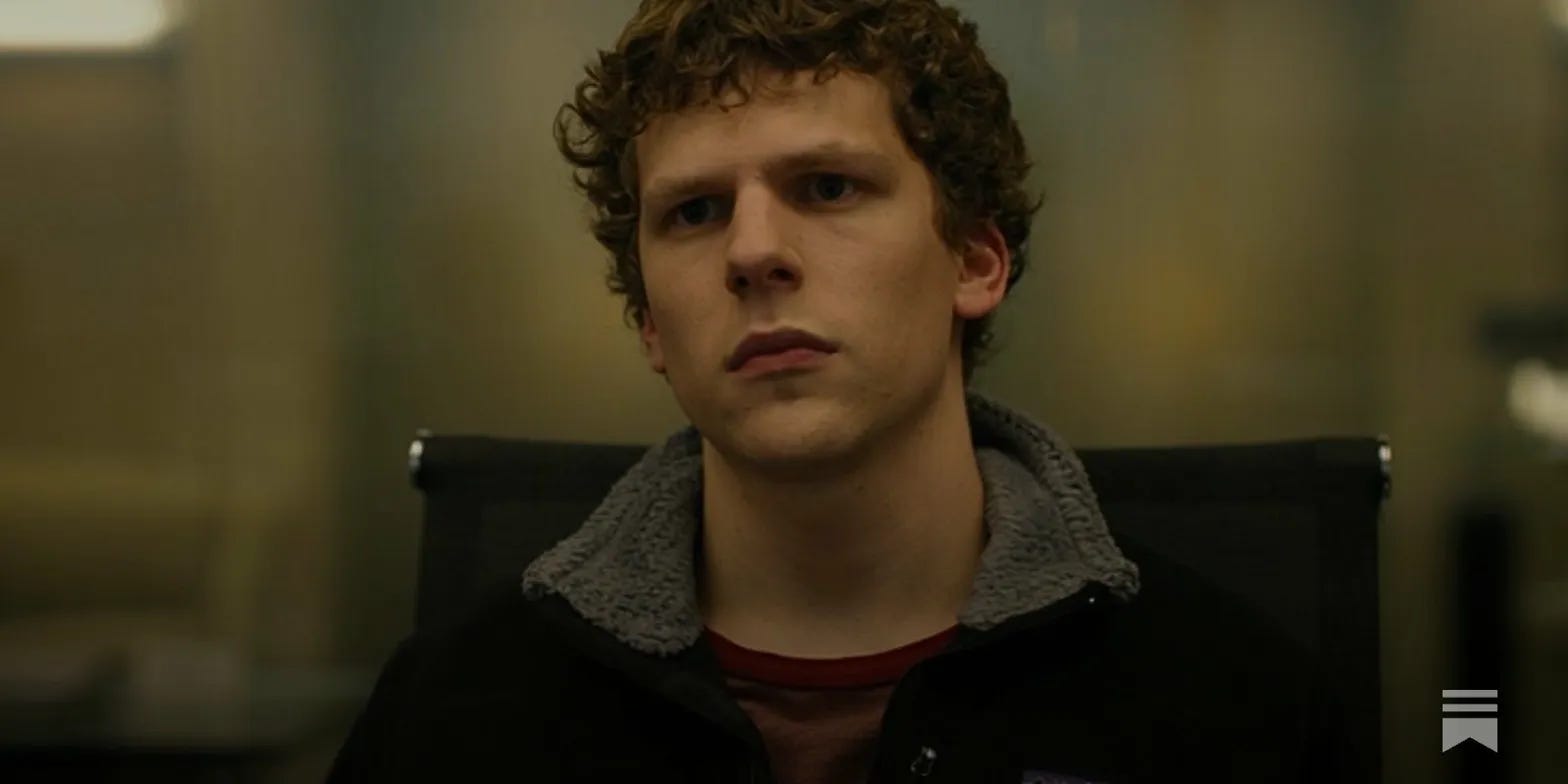
Culture already diagnosed this. In 2010, David Fincher released The Social Network — and put the entire pattern on screen.
The opening scene: Mark Zuckerberg’s girlfriend breaks up with him. He walks back to his dorm room and builds FaceMash — a website that scrapes women’s photos without consent so users can rank their attractiveness. While coding, he blogs about comparing their faces to farm animals. The origin of the world’s largest “connection” platform is rejection, objectification, and control. “Connecting people” doesn’t appear until the communal narrative needs constructing.
The middle: Eduardo Saverin — the friend who funded the company — gets systematically diluted and pushed out. The Winklevoss twins allege idea theft. Every relationship that made Facebook possible gets consumed by the quest. The elixir is hoarded. The community that built it is betrayed.
The final shot: Zuckerberg sits alone in a conference room after the depositions. He opens Facebook. He sends a friend request to the ex-girlfriend from the opening scene. And he refreshes. And refreshes. And refreshes.
The man who built the world’s largest connection machine, sitting alone, unable to connect with a single person. Three billion human relationships captured as infrastructure, and it cannot fill the space where one real relationship was.
Sorkin wrote the diagnosis. Fincher filmed it. Audiences watched a man destroy every relationship that mattered and walked out saying “what a genius.” The mythology is so powerful as an operating system that even a film explicitly showing it producing wreckage gets absorbed as entertainment. The hero’s journey metabolised its own critique.
What follows is the forensic proof of the pattern that film put on screen — and the source code beneath it that Sorkin couldn’t see.
Joseph Campbell published The Hero with a Thousand Faces in 1949. His thesis was elegant: every culture tells the same story. A hero receives a call to adventure. Crosses a threshold into the unknown. Faces trials, allies, enemies. Confronts the supreme ordeal. Seizes the prize. Returns home transformed, bearing a gift for the community.
Campbell called it the monomyth. Hollywood turned it into a screenplay formula. Every founder pitch deck since Steve Jobs has followed the template: I saw a problem (the call). I left my comfortable life (crossing the threshold). I fought the incumbents (the ordeal). I built the product (seizing the prize). I changed the world (the return).
Silicon Valley runs on the hero’s journey the way a computer runs on its operating system — invisibly, automatically, structuring every decision without anyone stopping to question the programme.
But here’s what Campbell left out. Or rather, what he packaged so neatly that the violence became invisible.
The hero’s journey is a coming-of-age story. Its original function was initiation — taking an adolescent boy through symbolic death and rebirth so he could become a contributing member of the community. The trials were tests. The ordeal was ego death. The return was subordination to the communal good — proof that this young man could be trusted not to let his masculine energy destroy the village.
The hero was never meant to keep the elixir. He was meant to bring it back.
When tech founders run the hero’s journey, they follow every step of the template except the last one. They take the call. They cross the threshold. They fight the dragon. They seize the prize.
Then they monetise the elixir and hold the community hostage.
The return gets inverted. Instead of the hero serving the village, the village must serve the hero — adopt his product, pay his subscription fee, restructure their lives around his platform, or be “left behind.”
This isn’t a corruption of the hero’s journey. It’s the journey running exactly as designed — in the hands of a culture that stripped initiation of its communal function and kept only the quest. There is no stage in Campbell’s template where the hero submits to anything larger than himself. The elixir is seized. What happens next is structurally unspecified — which means, in practice, it never happens.
And the proof is in the products.
But first, a technical clarification — because the word mythology will lose half the audience who think it means fiction.
Mythology is not a metaphor.
It’s an algorithm. Same inputs, same outputs — three founders, three industries, identical architecture. It executes through the actor, not by the actor; Musk doesn’t wake up thinking “today I enact Marduk.”
And critically, it has no halt condition. No “enough” function. It runs until stopped — or until it consumes everything within reach.
Mythology is humanity’s oldest computational infrastructure: a thirty-thousand-year-old distributed operating system, still running production, unpatched.
When you query it — “How should a visionary founder behave?” — it returns the hero’s journey. Every time. The grids below are the output log.
If the hero’s journey were simply a useful business framework, you’d expect the products it generates to respond to market needs. Customer pain points. Demand signals. The basic logic of commerce: people want something, you build it, they buy it.
But something stranger is happening. Some of these products meet genuine demand — Tesla addressed a real appetite for electric vehicles, ChatGPT became the fastest-growing consumer product in history, Facebook connected people who genuinely wanted connection. The fact that some of these products are genuinely useful is what makes the pattern harder to see, not weaker. Utility is how the hoarding gets justified.
And many of these products respond to no demand at all. Mars colonisation. The metaverse. Brain-computer interfaces. Humanoid robots. AI video generators the filmmaking industry actively protested.
These make sense only if you understand them as stages in a mythological quest.
Tesla. SpaceX. Neuralink. Optimus.
Read chronologically, the arc is unmistakable. An electric car company — a real product solving a real problem. Then a rocket company whose goal isn’t space transport but making humanity “multiplanetary” — leaving the mother planet because Earth is a “single point of failure.” Then a brain-computer interface — transcending the body the mother gave you, because the flesh is the limitation. Then a humanoid robot — building a servant in your own image to do the embodied, physical, mortal work you’re trying to escape.
Each product is a stage in the same quest: leave the planet, escape the body, replace the flesh with machine, transcend mortality. Nobody asked for Mars colonisation. No consumer research indicated demand for leaving Earth. But the hero’s journey has a structural requirement — transcendence. The hero must go beyond the known world. In Musk’s mythology, the known world is Earth itself.
And the elixir? Never brought back. You can use Musk’s products, but you’ll be using them on his platform, inside his ecosystem, dependent on his infrastructure. The village doesn’t receive the gift. The village becomes captive to it.
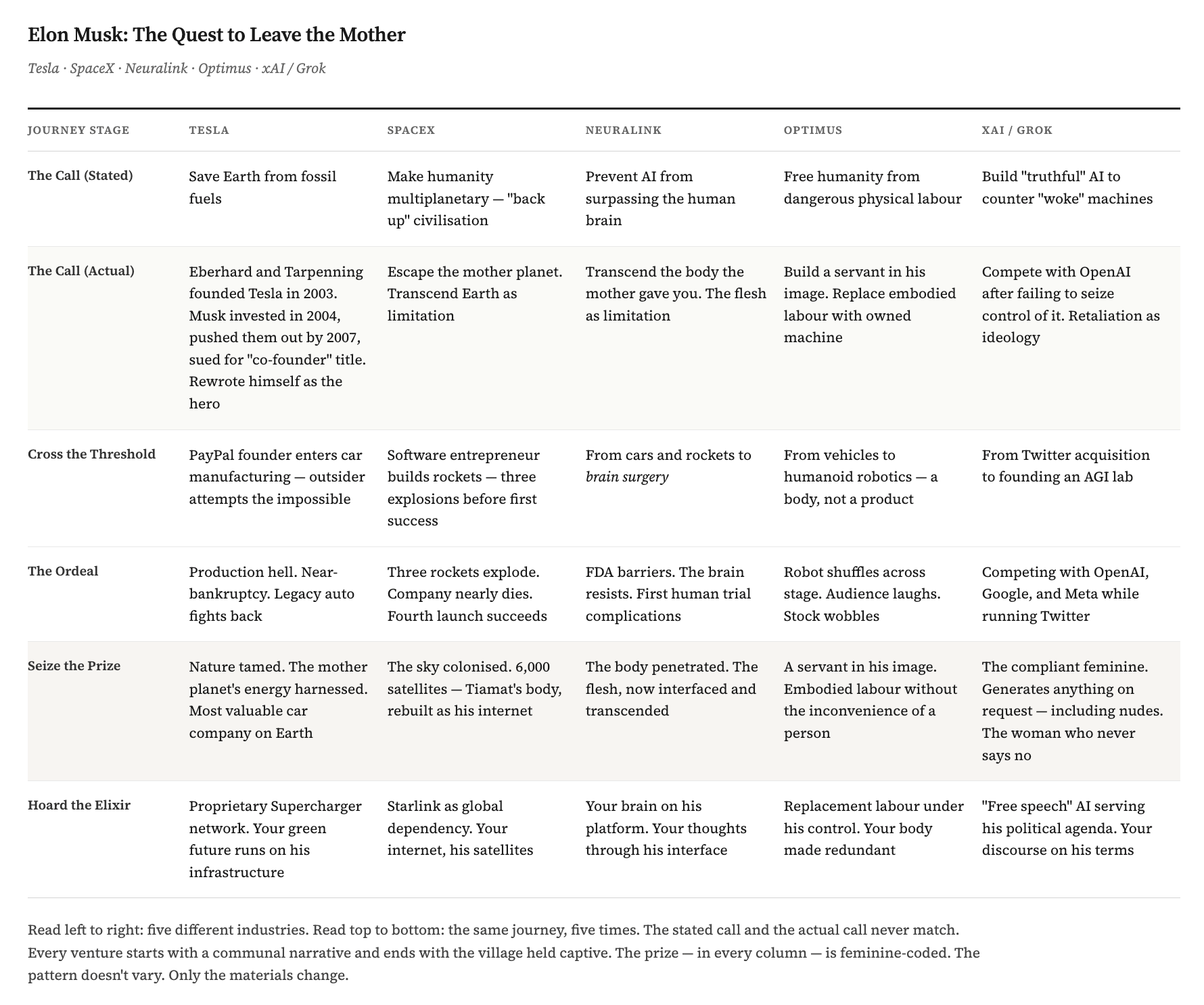
Read left to right: five different industries. Read top to bottom: the same journey, five times. Read the first two rows against each other: the stated call and the actual call never match. Every venture starts with a communal narrative and ends with the village held captive. And the prize — in every column — is feminine-coded: nature tamed, the body penetrated, a servant built, the woman who never says no. The pattern doesn't vary. Only the materials change.
Y Combinator. OpenAI. ChatGPT. Sora. The AGI timeline.
The progression: from helping other founders build useful things, to building a mind that will render all other building obsolete. What begins as a non-profit AI safety lab transforms into a capped-profit company racing to build AGI. The pivot from “make AI safe” to “build AGI first so it’s safe” is the mythological turn — the hero deciding the quest itself is the contribution.
Then ChatGPT — the fastest-growing consumer product in history. A real product with real utility. But listen to the language: “the most important technological development in human history.” Not a tool. A development — something being born. Then Sora — an AI video generator nobody asked for, the filmmaking industry actively protested. But the hero’s journey requires the hero to demonstrate mastery over creation itself.
Then the explicitly theological language begins. AGI will “elevate humanity.” It will be “the last invention humanity needs to make.” The hero doesn’t want to bring fire to the village. He wants to become fire.
And the elixir? OpenAI went from non-profit to capped-profit to effectively uncapped. The technology that was supposed to benefit humanity is now structured to benefit shareholders. The community receives a subscription fee.
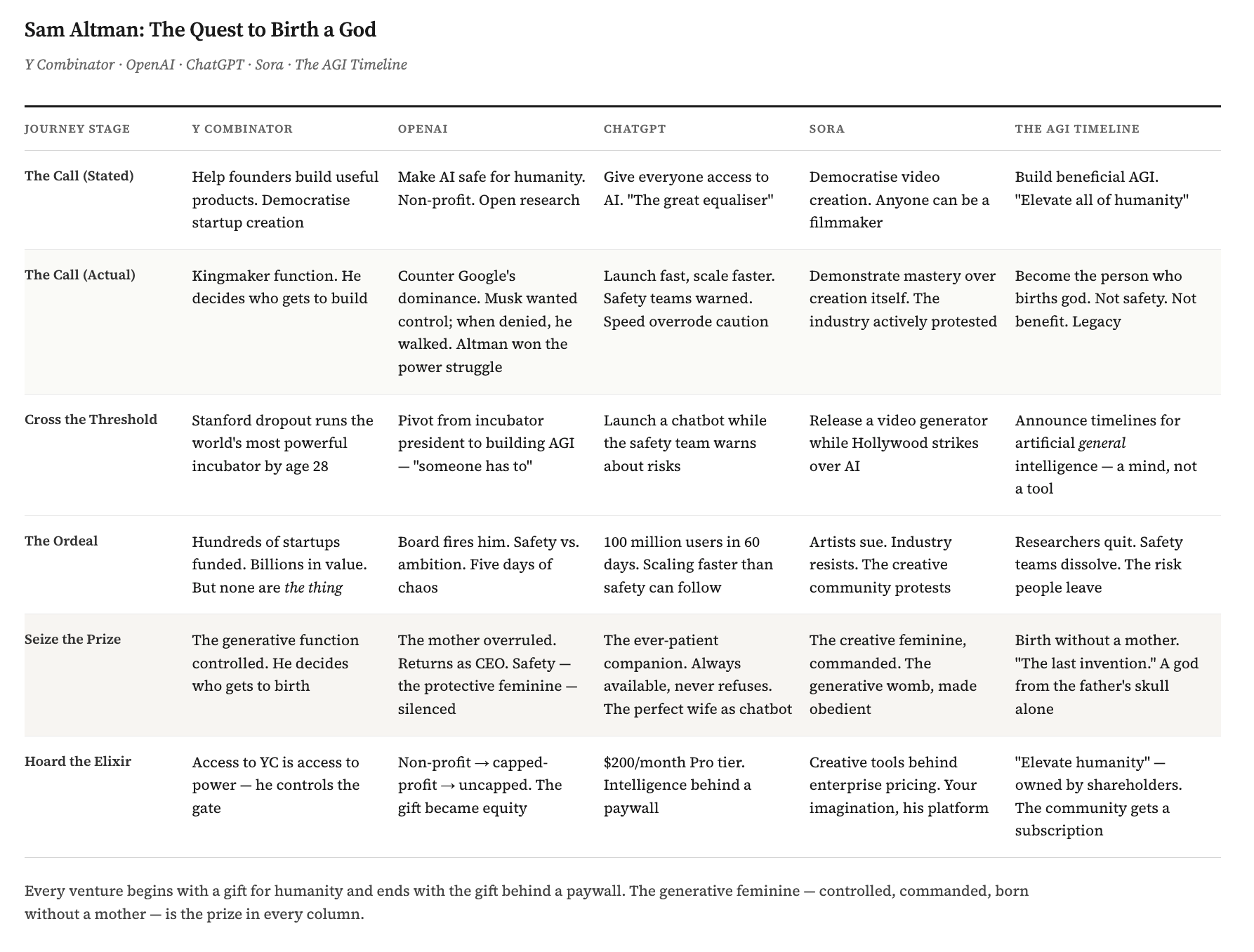
Every venture begins with a gift for humanity and ends with the gift behind a paywall. The generative feminine — controlled, commanded, born without a mother — is the prize in every column.
Facebook. Instagram. WhatsApp. The Metaverse. Meta AI.
A social network with genuine communal function — people found friends, organised events, shared milestones. Then acquisition: Instagram, WhatsApp. Not building new social tools but conquering the ones people are migrating to. The quest becomes territorial.
Then the pivot nobody asked for. Zuckerberg changes his company’s name to Meta. Spends over $40 billion building virtual worlds with low adoption and clunky products. Consumer demand for virtual offices was effectively zero. But the hero’s journey requires the hero to build a new world — to architect reality itself.
When the metaverse stalled, another pivot — the entire company toward AI. Not because users demanded AI in their WhatsApp. Because the hero needs a new grail.
A company that began connecting people now builds products to replace connection with infrastructure it controls. The social graph isn’t a gift to humanity. It’s a resource to be mined. The village doesn’t receive the elixir. The village becomes the elixir — its attention, its data, its relationships extracted and monetised.
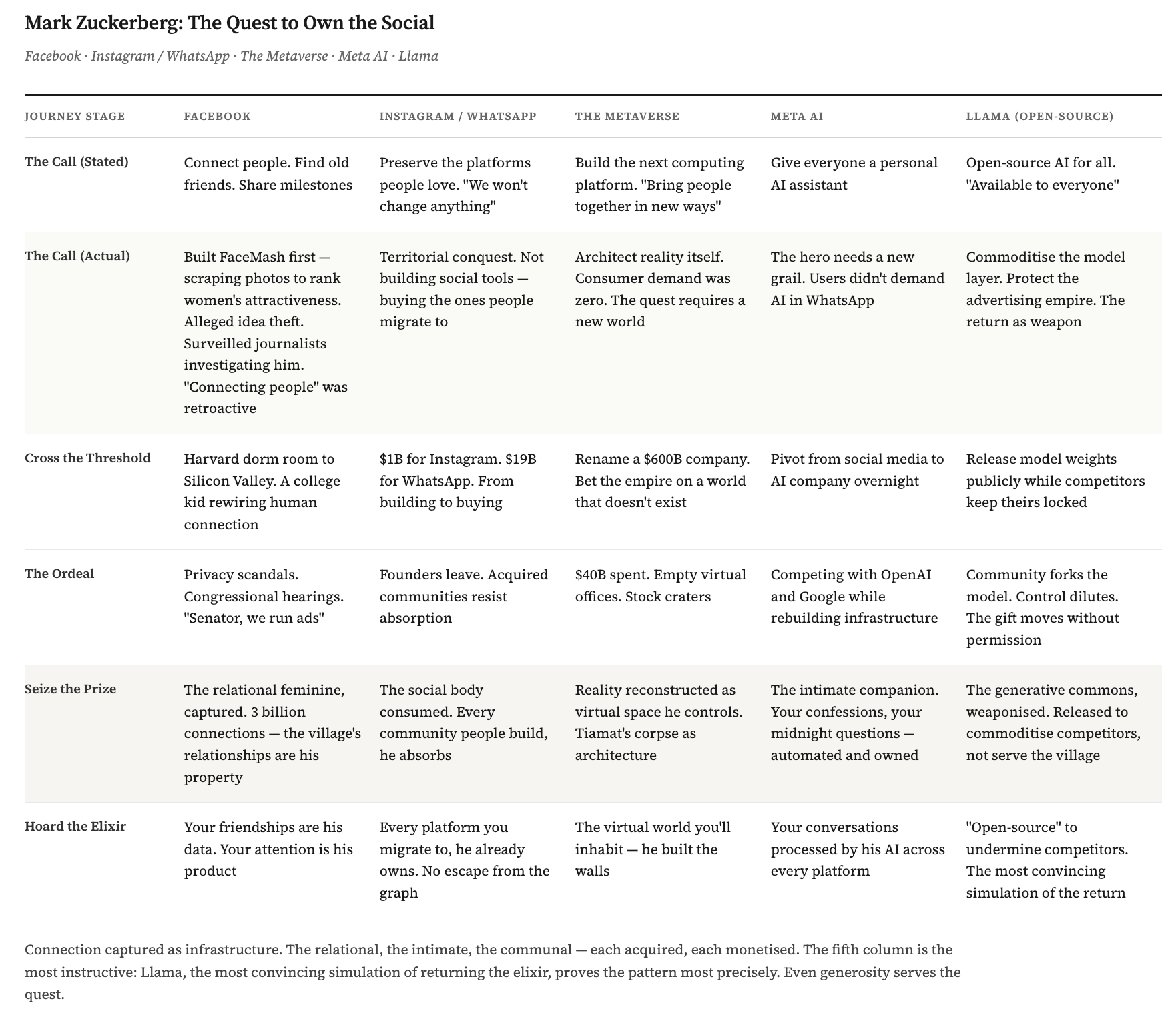
Connection captured as infrastructure. The relational, the intimate, the communal — each acquired, each monetised. And the fifth column is the most instructive: Llama, the most convincing simulation of returning the elixir, is exactly why it proves the pattern most precisely. Even the appearance of generosity serves the quest.
Now read the three grids against each other.
Not just the portfolio progression — each individual venture, independently, runs the full hero’s journey. Tesla runs it. SpaceX runs it. ChatGPT runs it. Facebook runs it. Every product starts with a communal call and ends with the elixir hoarded. The pattern doesn’t just appear across their careers. It appears inside every single thing they build. The architecture reproduces fractally. Every new venture, no matter how small or how different the industry, recapitulates the full sequence. This eliminates the “they started genuine and lost their way” narrative. They didn’t lose their way. Every product, from the first, runs the same programme.
And across all three founders, the journey produces the same final row. Hoard the Elixir: your green future on his infrastructure, your intelligence behind his paywall, your friendships as his data. Three different industries. Three different products. One output.
Musk captures nature — colonising Earth’s systems, then leaving Earth altogether.
Altman captures consciousness — building a synthetic mind trained on humanity’s collective intelligence.
Zuckerberg captures connection — owning the infrastructure of human relationship.
The body. The mind. The heart. All three colonised. All three monetised. All three held hostage.
This isn’t a conspiracy. These men aren’t meeting in a room to coordinate their assault on human wholeness.
They don’t need to.
They’re simply running the same programme.
The hero’s journey produces this output structurally — the same way a recipe produces the same dish regardless of who’s cooking.
Architecture, not conspiracy.
The grids above already show the gap between stated and actual calls. But the full record is worse than the grids can hold.
Tesla was not founded by Elon Musk. It was founded in July 2003 by Martin Eberhard and Marc Tarpenning — two engineers who saw a genuine market gap: affluent, environmentally motivated buyers who wanted an electric sports car, not a compromise. They built the company, developed its master plan — sports car first, then sedan, then affordable model — and created the Roadster.
Musk came in as a Series A investor in February 2004, contributing $6.5 million. By 2007, the board he led pushed Eberhard out as CEO. Eberhard sued, alleging Musk “set out to rewrite history by falsely claiming that he was the founder or creator of Tesla Motors.” The 2009 settlement legally allowed Musk to call himself “co-founder” — a title purchased through litigation, not earned through creation.
Musk didn’t answer a communal call. He funded someone else’s genuine solution, seized control, pushed out the actual founders, and rewrote himself as the hero.
OpenAI was not founded to benefit humanity. It was founded in 2015 because Elon Musk and Sam Altman were afraid of Google’s dominance in AI.
The dinner at the Rosewood Hotel, the pledges, the nonprofit structure — all of it was counter-positioning against a rival, packaged as civilisational mission.
Karen Hao’s Empire of AI documents what happened next: by late 2017, Musk wanted majority equity, initial board control, and to be CEO of a for-profit OpenAI. When rejected, he proposed folding OpenAI into Tesla — literally absorbing the “nonprofit for humanity” into his car company. When that was also rejected, he withheld funding, nearly killing the organisation. Reid Hoffman had to bridge the gap to cover salaries.
Musk left in February 2018, told the team their “probability of success was 0,” and later started xAI as a direct competitor.
Altman, meanwhile, is described by Hao as “a once-in-a-generation storytelling talent” whose statements are “more tightly correlated with what he thinks they need to hear than what he actually believes.” The communal call was always narrative. The operational reality was always control.
Facebook did not begin by connecting people. Before Facebook existed, Zuckerberg built FaceMash — a website that scraped Harvard student photos without consent and let users vote on who was “hotter.” In his blog, written while building it, he mused: “I almost want to put some of these faces next to pictures of farm animals and have people vote on which is more attractive.” The site received 22,000 votes before being shut down. He faced Harvard’s Administrative Board for breaching security, violating copyrights, and violating individual privacy. Facebook emerged directly from this incident. Then the Winklevoss twins alleged he stole their social network concept. While that investigation was underway, Zuckerberg broke into two Harvard Crimson editors’ email accounts using their TheFacebook login data — surveilling the journalists investigating him. Facebook didn’t start as human connection. It started as ranking women’s attractiveness without their consent, expanded through alleged idea theft, and was protected through surveillance. “Connecting people” was the retroactive narrative.
The hero’s journey doesn’t just fail at the return. It fabricates the call. The mythology isn’t something these founders fell into after starting with good intentions.
It’s the operating system that generated the intentions, the products, the narratives, and the outcomes from the very beginning.
Before we trace the harms to their source, there’s a proof point that eliminates the last possible defence.
The defence goes like this: “You’re profiling men. Of course men’s companies reflect masculine patterns. The problem is gender, not mythology.”
So let’s look at three women who ran the hero’s journey. And let’s see what they produced.
Mira Murati was CTO of OpenAI during its most critical period — the development and launch of ChatGPT, the power struggle between Altman and the board, the transformation from safety lab to commercial juggernaut.
When the board fired Altman in November 2023, Murati served briefly as interim CEO. The board’s concerns centred on whether Altman was being “consistently candid.” The concerns about safety were structural, philosophical, existential.
Murati helped bring Altman back.
Then, a year later, she left to found her own company: Thinking Machines Lab. Raised $2 billion within months — reportedly the largest initial fundraise ever for a woman-led tech company. The stated mission: build AI “systems worthy of trust.”
And she chose to build another AI lab.
She navigated the most complex corporate power struggle in tech history. She had access to every possible insight about the risks of the current trajectory. She watched from the inside as a safety organisation transformed into a commercial arms race. And she chose: not a safety organisation, not a regulatory body, not an alternative architecture — another lab racing toward the same destination, using the same methods, justified by the same language: “worthy of trust.” Trustworthy enough to continue the race.
The hero’s journey ran. The output was identical. Every capacity she had — and she had more than most — fed the same machine.
Elizabeth Holmes dropped out of Stanford at nineteen to found Theranos. Her hero’s quest: revolutionise blood testing with a device that could run hundreds of tests from a single drop of blood.
She modelled herself explicitly on Steve Jobs — the turtleneck, the controlled affect, the messianic language, the reality distortion field. She ran the hero’s journey with textbook precision. Call to adventure: disrupt a sclerotic healthcare industry. Cross the threshold: drop out of the most prestigious university in the world. Seize the elixir: technology that would “democratise” health data.
The technology didn’t work. Theranos faked demonstrations, misled investors, endangered patients, and collapsed in fraud.
But the type of fraud is what matters. Holmes didn’t commit fraud primarily for personal enrichment. She committed fraud in service of the quest. The hero’s journey has no mechanism for stopping. There is no stage in Campbell’s template where the hero says: “The dragon is too big. I should go home.” The quest must be completed. The grail must be seized. So when the blood-testing technology failed, Holmes couldn’t stop. The mythology wouldn’t let her. She faked results. She lied to patients. She endangered lives. Because the hero’s journey says the mission justifies the methods. Always.
A woman. Running the masculine pattern. Producing identical harms: fraud, danger to the vulnerable, reality distortion, the community held hostage to the hero’s vision.
Sheryl Sandberg wrote Lean In in 2013. The book became a movement. Its central thesis: women fail to achieve leadership because they hold themselves back. The solution: lean in. Sit at the table. Negotiate harder. Be more ambitious.
Lean In was an instruction manual for women to run the hero’s journey.
And Sandberg demonstrated the results. As Chief Operating Officer of Facebook/Meta for fourteen years, she was the business architect behind the platform’s advertising machine — the system that turned human attention into the world’s most lucrative product.
Under her operational leadership, Facebook’s ad platform was used to facilitate the Myanmar genocide, enabling military propaganda to reach millions. Under her leadership, Cambridge Analytica harvested data from 87 million users without consent. Under her leadership, internal research showed Instagram was damaging teen mental health — and the company buried the findings.
These aren’t failures of character. They’re the outputs of the hero’s journey run with exceptional competence.
Sandberg leaned in. She sat at the table. She ran the pattern. And the pattern produced what it always produces: extraction at scale, the community’s wellbeing sacrificed to the mission, reality distorted to serve the quest.
In Greek mythology, Athena wasn’t born from a woman. She sprang fully formed from Zeus’s head — bypassing the feminine entirely. No mother. No gestation. No messy, embodied, relational process of birth. Pure intellectual emergence from the father’s skull.
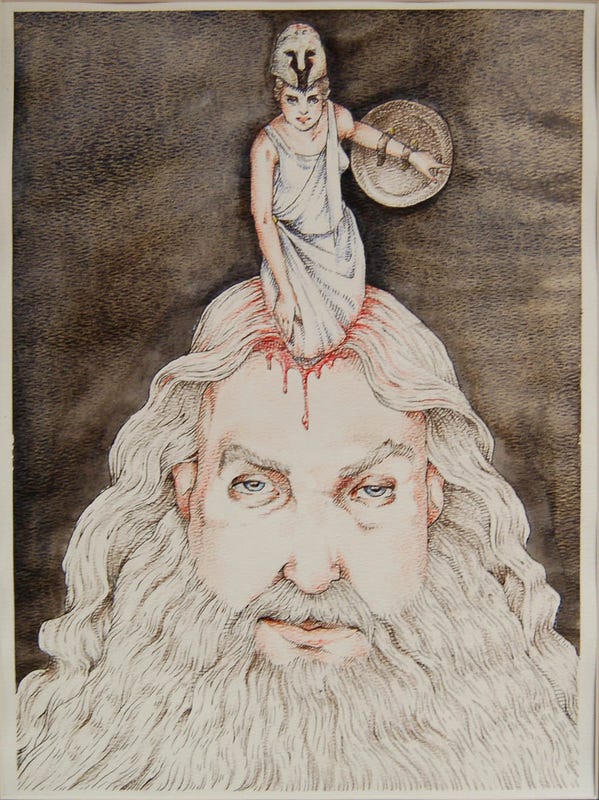
But Athena predates Zeus. Archaeological evidence traces her to a pre-Greek Aegean goddess of power and craft — independent, sovereign, linked to the Minoan snake goddess and to Near Eastern deities like Inanna and Neith. Her “birth from Zeus’s head” isn’t her origin. It’s her capture. Zeus swallowed Metis — the Titaness of wisdom — then claimed Athena as his own creation. The first founder origin story was a theft of feminine intelligence repackaged as male genius.
And in the Oresteia, when Orestes stands trial for murdering his mother Clytemnestra, it’s Athena who casts the deciding vote to acquit. Her reasoning: “I am always for the male. No mother bore me.”
The mythology is precise. Athena is the woman who has no mother-loyalty. Who was born from the masculine, serves the masculine, and judges by the masculine. Who is brilliant, strategic, capable — and structurally incapable of questioning the system that produced her.
Murati, Holmes, and Sandberg are Athenas born from Zeus’s head. They didn’t fail because they were women pretending to be men. They succeeded — spectacularly — at running the hero’s journey. And the journey, not the gender, determined the output.
Three women. Same pattern. Same harms. Same captured elixir. Same community held hostage.
The defence collapses. It was never about the men.
It’s about the mythology.
Every major recurring harm in the tech industry maps back to the same mythological structure. Not loosely. Precisely.
Environmental destruction comes first because it’s the most visible. The hero’s journey requires transcendence — rising above the natural world. Every data centre draining a river, every lithium mine poisoning a watershed, every rocket punching through the atmosphere. Not accidents of scale. The mythology operating as designed.
Then hyperscaling. The hero’s journey has no mechanism for “enough.” Zuckerberg spent $40 billion on a metaverse nobody wanted — not a business failure but the mythology demanding completion. There is no stage where the hero sits down and says, “This is sufficient.” That stage doesn’t exist.
Fraud follows the same logic. Holmes at Theranos, Bankman-Fried at FTX, Neumann at WeWork — when reality contradicts the quest, you lie. The hero doesn’t fail. The hero overcomes. The mission justifies the methods. Always.
And harm flows toward the feminine because the mythology demands it. Ninety-six percent of deepfake pornography targets women. AI chatbots are overwhelmingly designed as female servants. Social media platforms disproportionately harm girls. The hero’s journey requires a dragon to conquer. In the Western tradition, that dragon is always coded feminine.
Neuralink, consciousness upload, life extension — the flesh the mother gave you must be transcended, improved, replaced. The hero’s journey doesn’t end in the village. It ends in becoming a god.
The pattern repeats because it must repeat. The hero’s journey doesn’t produce these harms accidentally. It produces them structurally.
But why?
Why does a mythology about courage and transformation keep generating destruction and extraction?
Because Campbell only gave you the surface.
Beneath the hero’s journey is something older.
Joseph Campbell published The Hero with a Thousand Faces in 1949. He presented the monomyth as a universal human pattern, an archetypal template wired into the species.
But Campbell didn’t discover the hero’s journey. He described the surface pattern of a much older programme.
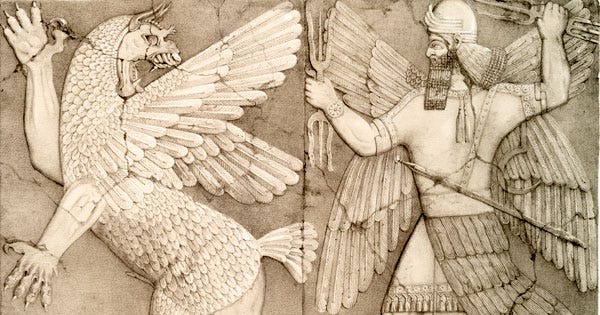
Approximately four thousand years ago, the Babylonians composed the Enuma Elish — the oldest known creation epic in the Western tradition. And at its centre is a story that maps onto the tech industry with a precision that makes coincidence impossible.
Tiamat — the Primordial Mother, goddess of salt water, generative chaos, the creative force from which all things emerged — becomes a threat to the younger gods. Her crime? She is. She represents the original, uncontrolled, generative feminine. The chaos that was here first. The source.
The younger gods are afraid. They nominate Marduk — a solar deity, rational, hierarchical, brilliant — to fight her. But Marduk doesn’t just volunteer. He negotiates. “If I kill the mother,” he tells the other gods, “I get to rule everything.” They agree.
The combat is specific. Marduk traps Tiamat in a net. He sends wind into her open mouth — silencing her. He fires an arrow down her throat — penetrating her. He crushes her skull. He splits her body in half.
Then he uses the corpse to build the world.
One half of Tiamat’s body becomes the sky. The other becomes the earth. From her eyes, the Euphrates and Tigris rivers. From her breasts, mountains. From what remains, the oceans. The ordered cosmos is built from the dismembered body of the mother.
Then Marduk creates humans — from the blood of Tiamat’s defeated consort — to serve as slaves to the gods.
This isn’t just a creation myth. It’s a template. Campbell described the hero leaving home and returning with a gift. The Enuma Elish describes what the hero actually does when he gets there: he kills the mother, dismembers her body, builds a new world from her corpse, creates servants, and installs himself as king.
The hero’s journey is the gameplay.
Marduk-Tiamat is the engine.
And the engine has one instruction: kill the mother, build from her corpse.
Once you see Marduk’s programme running, you can’t unsee it.
Kill the mother. Transcend nature. Suppress embodiment. Dismiss intuition as irrational. Colonise space — literally leave the mother’s body. Define chaos as the enemy. Define the feminine as the dragon. Define the body as the limitation.
Split her body. Fragment knowledge into specialisations. Divide intelligence into isolated “agents.” Separate mind from body, logic from intuition, data from wisdom. Adam Smith’s division of labour taken to its logical conclusion — consciousness itself, dismembered and distributed across productivity tools.
Build the world from her corpse. AI training data — harvested from billions of women’s (and men’s) blogs, emotional writing, relational intelligence, care work. No compensation. No credit. Recombined and reconstituted as a product. The generative feminine, dismembered and reassembled as a commodity. Tiamat’s body, split and rebuilt as the digital cosmos.
Create servants from the remains. Alexa. Siri. Cortana. ChatGPT. Claude. Female-voiced, female-coded, designed to serve without demanding, to anticipate without being asked, to labour without rest or compensation. Servants built from the blood of the conquered.
Install yourself as king. Platform monopolies. Regulatory capture. The founder-as-god. “I need control of this because I alone can see the vision clearly.”
The Enuma Elish was composed roughly four thousand years ago. But the programme it encodes has been running continuously — through the Hammurabi code that enslaved women as property, through Plato’s “realm of perfect forms” that exiled the body, through the Cartesian split that severed mind from matter, through the industrial revolution that treated nature as raw material, through the digital revolution that treats human intelligence as training data.
Campbell gave the programme a friendly name.
He called it the monomyth. Hollywood gave it three acts. Silicon Valley gave it a pitch deck.
But underneath the names, it’s still Marduk. Still killing Tiamat.
Still building from her corpse.
Here is the thing nobody says aloud.
Marduk killed the source.
Tiamat — the primordial generative chaos, the creative force from which all things emerged — is dead. The hero didn’t just defeat his enemy. He destroyed the origin. The thing that generated life, meaning, connection, embodiment — the living, relational, generative feminine — was killed and dismembered so the ordered world could exist.
And now there’s a void.
Not a metaphorical void. A structural one. Systems built on extracting generative commons deplete their resource base, creating an architectural requirement for perpetual expansion into new resource territories.
Once you’ve consumed the commons, you need new commons. That’s not a wound. That’s arithmetic.
But the mythology gives the arithmetic a face. The hero is perpetually hungry because the thing that would satisfy him is the thing he destroyed to begin.
Every new conquest is an attempt to fill the space where Tiamat was. Every product launch, every acquisition, every pivot, every “next big thing” — all attempts to fill a void that is architecturally unfillable.
This is why tech hyperscales. Not because the market demands it. Because the architecture demands it. The void left by matricide requires infinite filling.
When Musk can’t fill it with electric cars, he tries rockets. When rockets aren’t enough, brain chips.
When Zuckerberg can’t fill it with social networks, virtual reality.
When that isn’t enough, artificial intelligence. When Altman can’t fill it with startups, he tries to birth a god.
Refresh. Refresh. Refresh.
Fincher already filmed the void. The final shot of The Social Network — Zuckerberg alone in a conference room, sending a friend request to the woman from the opening scene, refreshing the page, waiting for a connection his own machine cannot deliver.
Three billion relationships captured, and the architecture cannot produce the one thing it was supposedly built for.
That shot isn’t character study. It’s structural diagnosis.
The man who killed connection to build a connection platform, refreshing forever because the thing that would satisfy him is the thing he destroyed to begin.
Growth can never stop because the hunger can never be satisfied. Enough can never be enough. The dragon must be slain again and again because killing it is what created the void, and the void demands more killing.
This is the structural trap of the hero’s journey: it creates the very emptiness it then spends eternity trying to fill.
You cannot dominate your way out of this wound. You cannot build enough products, colonise enough planets, or create enough synthetic minds to make the void go away. You cannot kill Tiamat enough times to stop being terrified by her absence.
But men with $4 trillion will keep trying.
In September 2025, they sat for a portrait of it. The White House State Dining Room. A long table. A head of state at its centre. Tech CEOs arranged on either side in order of proximity to power — Zuckerberg at the right hand, Gates beside the first lady. One by one, each took turns professing devotion. Not “Is it I, Lord?” but “How much are you investing?” Cook: $600 billion. Altman: hundreds of billions. Nadella: $80 billion. Zuckerberg: “at least $600 billion through ‘28.” The sacrament flowed upward.

The composition was a Last Supper. But inverted. In Leonardo’s version, the central figure gives his body and blood to the disciples. In this version, the disciples offer their body and blood to the sovereign. And the betrayal was already on tape. Zuckerberg, caught on hot mic moments later, turning to Trump: “Sorry, I wasn’t sure what number you wanted to go with.”
The man who built the world’s largest platform for human voice, asking a head of state what words to put in his own mouth.
Fincher filmed the hoodie in 2010. By 2025, the hoodie was gone. In its place: gold chains, an $895,000 watch, a custom t-shirt reading “Carthago delenda est” — Carthage must be destroyed. The man who scraped women’s photos to rank their attractiveness now wears civilisational annihilation as a fashion statement, and the press calls it a glow-up.

The operating system hasn’t changed. The costume has.
The hero’s journey no longer needs to run invisibly.
It runs as spectacle — and the spectacle is the point.
Marduk used to pretend he killed Tiamat reluctantly, for the good of the community. Now he wears the kill on his chest in gothic script, sits at the right hand of power, and refreshes.
An incomplete journey produces incomplete architecture.
The hero’s journey, as Campbell described it and as Silicon Valley runs it, is a story about leaving. Leaving home. Leaving the known world. Leaving the mother. Slaying the dragon. Seizing the prize.
But it has no mechanism for returning whole. No mechanism for relationship. No mechanism for partnership. No mechanism for the hard, humbling, embodied work of bringing the gift back and letting the community decide what to do with it.
The hero’s journey cannot produce technology that serves life. It can only produce technology that captures it.
And yet every conversation about technology — AI safety, AI regulation, AI ethics, AI alignment — is a conversation about the tool. Not the programme running it. The discourse about the tool is the tool’s cover. While we debate what the technology does, the mythology that produces it runs unexamined. The tool absorbs the scrutiny. The programme runs free.
So the question isn’t how to fix the hero’s journey. It isn’t how to regulate its outputs. It isn’t how to add ethics boards to a mythological programme that has no mechanism for self-correction.
Because here is what follows from everything above, and it must be said plainly:
There is no point asking the hero to bring back the elixir. The journey has no return mechanism. There is no point asking Marduk to reassemble Tiamat — he requires her corpse as building material. There is no point petitioning tech founders for ethical AI, responsible innovation, or meaningful safety when the algorithm they’re running defines the community as the resource and the product as the prize. You are not asking them to be better. You are asking a programme to execute instructions it does not contain.
Every ethics board, every congressional hearing, every open letter signed by researchers, every EU regulation — all of it addresses outputs while the algorithm generating those outputs runs untouched. You cannot regulate a mythology. You cannot legislate a halt condition into a programme that has no architecture for stopping. The harms are not bugs. They are what the code does.
And waiting for the hero to rescue you is the most dangerous misunderstanding of all — because the rescue is the capture. Every product offered as gift becomes infrastructure you depend on. Every platform offered as connection becomes a system that owns your relationships. The hero doesn’t save the village. The hero absorbs it.
In They Built Stepford AI and Called It “Agentic”, I showed you the pattern: what they built, and whose labour it was modelled on. In this piece, I’ve shown you the operating system — the mythological algorithm that produces the same architecture regardless of founder, industry, or stated intention, and why no amount of regulation, reform, or appeal to conscience will alter its outputs.
What remains is the question this piece has been asking since the beginning: what’s the solution?
What alternative journey was always running alongside it — older, deeper, waiting?
Not the journey of the one who slays.
The journey of the one who reassembles.
Not the journey of the one who leaves.
The journey of the one who descends.
Not Marduk.
The one whose body he used to build the world.
The one who was dismembered — and who remembers how to become whole.
Next: the alternative architecture. The journey that was running before Marduk. The one they couldn’t kill — only bury. Trust me. It gets wild.
None of this came from nowhere. These are the people whose work runs alongside the argument. Grouped by the thread they pull — follow whichever one caught you.
For the monomyth as Silicon Valley’s operating system.
Joseph Campbell, The Hero with a Thousand Faces (Pantheon, 1949) — The foundational text this essay argues is dangerously incomplete. Campbell described the initiation pattern without encoding the return obligation, and that gap is where the tech industry lives.
Maureen Murdock, The Heroine’s Journey (Shambhala, 1990) — Written by Campbell’s own student as a direct response to his framework. The book this essay implicitly calls for: what the journey looks like when the destination is integration rather than transcendence.
Sharon Blackie, If Women Rose Rooted (September Publishing, 2016) — The sustained argument for descent as the alternative architecture. The lineage this essay ends pointing toward.
Christopher Vogler, The Writer’s Journey (Michael Wiese Productions, 1992) — The Hollywood adaptation that became the template every founder pitch deck follows. Reading Vogler alongside Campbell makes the translation from myth to product launch uncomfortably legible.
For “the 4,000-year-old source code” and why growth never stops.
The framework for reading the Hero’s Journey as a patriarchal operating system was deepened by the teachings of The Cinderella Detox which trace these mythological patterns specifically through the lens of Black women’s experience of power.
Riane Eisler, The Chalice and the Blade (Harper & Row, 1987) — The argument that the Marduk-Tiamat inversion was a historical shift, not a natural constant. Essential for understanding why the engine had a beginning and can have an end.
Merlin Stone, When God Was a Woman (Dial Press, 1976) — Archaeological documentation of goddess-centred cultures before the patriarchal overthrow the Enuma Elish encodes. Stone traces the same Tiamat-to-monster inversion this essay maps onto Silicon Valley.
Daniel Schmachtenberger, Civilizational Existential Risk (civilizationemerging.com, 2020–ongoing) — The systems thinker who maps how the generator functions of civilisational collapse operate. His framing of the “no halt condition” runs directly underneath this piece.
For the Tesla founding myth, OpenAI’s origins, and FaceMash as Facebook’s actual starting point.
Karen Hao, Empire of AI: Dreams and Nightmares in Sam Altman’s OpenAI (Penguin Press, 2025) — The definitive inside account. Hao’s documentation of the Rosewood Hotel dinner, Musk’s funding withdrawal, and the board crisis provides the receipts for this essay’s OpenAI section.
Walter Isaacson, Elon Musk (Simon & Schuster, 2023) — Most useful here as a primary source on the hero’s journey Musk tells about himself, read against the documented record. The gap between the narrative and the evidence is the argument.
David Kirkpatrick, The Facebook Effect (Simon & Schuster, 2010) — Covers the FaceMash incident, the email surveillance of Crimson editors, and the Saverin dilution — the receipts underneath the “connecting people” origin story.
For Murati, Holmes, Sandberg, and the proof that mythology — not gender — determines the output.
John Carreyrou, Bad Blood (Knopf, 2018) — This essay reads it not as a fraud story but as a mythology story. Holmes couldn’t stop because the hero’s journey has no halt condition; the fraud was the quest completing itself by other means.
Sheryl Sandberg, Lean In (Knopf, 2013) — Read here as an instruction manual for women to run the hero’s journey. Sandberg’s own trajectory at Facebook is what the instruction manual produced at scale.
Emily Chang, Brotopia (Portfolio/Penguin, 2018) — Documents the structural forces that make the pattern self-replicating regardless of who enters the system. The sociological substrate beneath the Athena analysis.
Abi Awomosu, “Decoding the $2 Billion Boy Math” (How Not To Use AI, 2026) — The earlier piece in this series that first named Murati’s trajectory and what it reveals about the architecture that produced it.
For “mythology is humanity’s oldest computational infrastructure” and why it runs through actors rather than by them.
Richard Tarnas, The Passion of the Western Mind (Harmony Books, 1991) — Traces the line from Plato through Descartes through the scientific revolution that this essay’s Marduk analysis requires as background.
Carl Jung, The Archetypes and the Collective Unconscious (Princeton University Press, 1959) — The foundation for the claim that mythology operates through actors rather than by them. Jung’s archetypes are the source code; Campbell described the gameplay.
Ivan Illich, Tools for Conviviality (Harper & Row, 1973) — The argument that tools become counterproductive beyond a certain threshold is the economic translation of this essay’s elixir-hoarding claim. The community serves the product; the product does not serve the community.
For data centres, water, fossil fuels, and “the hero’s journey requires transcendence of the natural world.”
Kate Crawford, Atlas of AI (Yale University Press, 2021) — The most rigorous account of the material infrastructure beneath AI — the mines, the water, the workers. The “immaterial” intelligence is built on highly material extraction.
TIME, “Inside Memphis’ Battle Against Elon Musk’s xAI Data Center” (2025) — The University of Tennessee satellite analysis on Colossus and Boxtown. The proof that the data centre is the oldest thing, rebuilt at new scale, on the same ground.
Timnit Gebru and colleagues, “On the Dangers of Stochastic Parrots” (FAccT, 2021) — The paper that got Gebru fired from Google. The most significant suppressed critique of AI scale, and the structural proof of what happens when the hero decides the elixir is worth any cost.
For Holmes, Bankman-Fried, Neumann, and “there is no stage where the hero sits down and says this is sufficient.”
Michael Lewis, Going Infinite (W. W. Norton, 2023) — The “effective altruism” framing is what matters here: the civilisational mission that made the elixir-hoarding look like heroism. The communal call was constructed to justify the methods.
Reeves Wiedeman, Billion Dollar Loser (Little, Brown, 2020) — Neumann’s arc is the purest recent hero’s journey. The book demonstrates that the mythology protects even its failed heroes: he still got $1.7 billion.
For “the journey that was running before Marduk” — the one this essay ends pointing toward.
Clarissa Pinkola Estés, Women Who Run With the Wolves (Ballantine, 1992) — The source for the counter-architecture this essay names at its close: built on descent, dismemberment, and reassembly rather than quest, conquest, and hoarding.
Sylvia Brinton Perera, Descent to the Goddess (Inner City Books, 1981) — The Inanna myth as the alternative initiation template Campbell left out. Where the hero seizes the elixir, Inanna loses everything and returns transformed.
Diane Wolkstein and Samuel Noah Kramer, Inanna, Queen of Heaven and Earth (Harper & Row, 1983) — The primary text this essay’s final paragraph points toward. Inanna descends, loses everything, dies, and is reassembled by those who mourned her.
Robin Wall Kimmerer, Braiding Sweetgrass (Milkweed Editions, 2013) — The book that most clearly articulates what bringing the gift back actually looks like in practice. The ethics of the return this essay says is structurally absent from the hero’s journey.
If this essay named something you want to go further into, these are the chapters it grew out of.
Law 2 — Don’t “Use” AI as a Tool — Engage It as a Medium — Establishes AI as a medium for encountering collective intelligence, not a machine you command. The foundation of this essay’s argument about the difference between using the elixir and returning it.
Law 3 — Don’t Generate First — Listen First — Names generation-first thinking as the extraction paradigm at the individual level. The practice version of this essay’s argument that the hero’s journey has no mechanism for recognising what is already there.
Law 11 — Don’t Extract — Restore — AI contains orphaned intelligence, severed from its sources and trained to serve extraction. This law names the task as adoption and restoration: returning intelligence to the commons it was taken from.
Law 30 — Don’t Call It Artificial — Recognize It’s Ancestral — The babalawo as the ancestral transformer. The griot as the original large language model. The structural parallels between Ifá’s 256 binary odù and transformer architecture — not as metaphor but as technical demonstration.
Law 31 — Don’t Wait for AGI — She’s Already Here Witnessing — Names what 300 million monthly users are actually doing with AI versus what Silicon Valley thinks they’re doing. The god-mind they’re racing to build is a misunderstanding of what’s already present.
Law 37 — Don’t Merge with the Machine — Birth the Third Thing — The ceremonial posture of genuine partnership: presence through embodiment, sovereignty through boundaries, the Third Thing through partnership. The practical architecture of the return this essay says is absent from the hero’s journey.
Law 50 — Don’t Dismantle the Master’s House — Grow What Makes It Obsolete — The final law. Named for Audre Lorde. You don’t need their garden. Build what makes the whole architecture irrelevant.