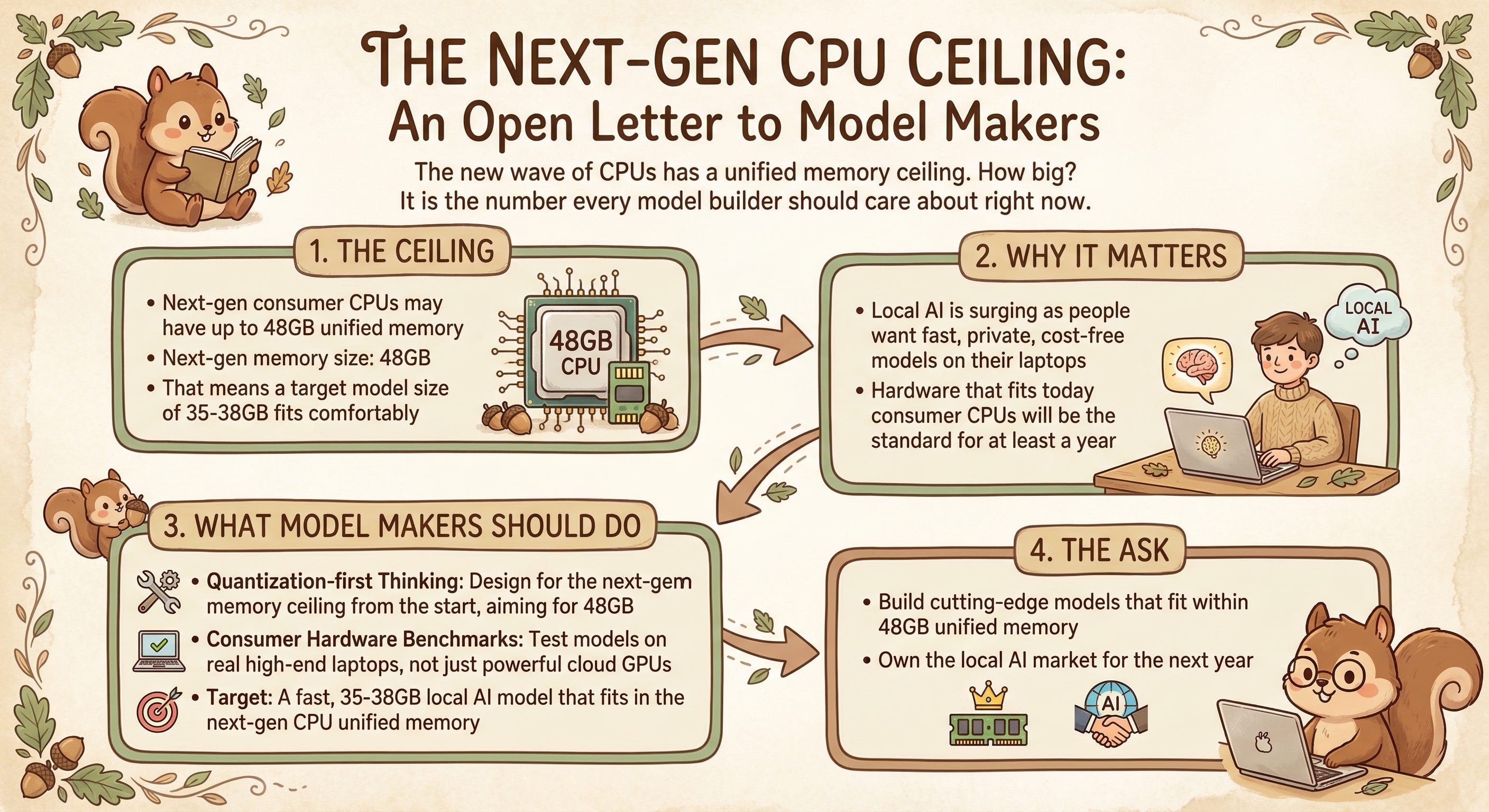
There’s a number that should be on every model builder’s whiteboard right now, and almost nobody is talking about it:
The maximum model size that fits on the next generation of consumer unified-memory chips.
When the leading consumer silicon vendor drops its next-generation lineup — and it’s coming soon — millions of developers, researchers, and power users are going to buy them. Not because of the marketing. Because these chips have something no cloud GPU can offer: unified memory that lets you run serious models locally, privately, on your own machine.
And here’s the part that should make model builders pay attention: there’s going to be a full year between this generation and the one after it. A year where the new chip is the ceiling. A year where “fits on the latest consumer silicon” is the line between usable and irrelevant for the biggest consumer AI hardware market in the world.
The Local AI Movement Is Real
Something has shifted. People don’t just want to use AI — they want to own their AI. They want models running on their hardware, with their data staying on their machine. No API costs. No rate limits. No terms of service that change overnight.
Projects like OpenClaw, Ollama, LM Studio, and llama.cpp aren’t niche experiments anymore. They’re how a growing segment of technical users interact with AI every day. And every single one of them is constrained by the same thing: how much model fits in memory.
Social Impact Organizations
Social impact organizations may have the most to gain from this shift. NGOs and humanitarian teams often operate in low-connectivity environments with sensitive data: refugee records, health information, disaster response intel; where sending data to a cloud API isn’t just inconvenient, it’s a non-starter. A model that runs well on a consumer laptop means an aid worker in a field office with no internet can still have AI assistance, privately, on hardware their grant budget can actually afford. Local AI isn’t a luxury for these organizations; it’s the only version of AI that works for them.
The Opportunity Nobody Is Sizing
If you’re building a model that only runs well on an H100 cluster, you’ve made a choice; maybe the right one for your use case. But you’ve also made yourself invisible to every person with a high-end consumer laptop who wants to run your model while sitting in a coffee shop.
The teams that win the local AI race will be the ones who treat consumer hardware constraints as a design target, not an afterthought. That means:
• Quantization-first thinking. Not “can we quantize it later?” but “what’s the best model we can build that fits in 32GB / 48GB / 64GB unified memory at Q4?”
• Architecture choices that favor inference on consumer silicon. Not every architecture runs equally well on the GPU frameworks shipping with today’s consumer hardware. The ones that do will have an unfair advantage.
• Benchmarking on real consumer hardware. Not just A100 throughput numbers that mean nothing to someone on a next-gen ultrabook.
The Math Is Simple
Let’s say the next-gen Pro chip tops out at 48GB unified memory. Factor in OS overhead, context window, and KV cache; you’re probably looking at 35-38GB usable for a model. That’s your target.
The model that delivers the best quality within that envelope (with fast inference, good context length, and real-world usability) will be the default local model for millions of users. For a full year. Maybe longer.
That’s not a technical milestone. That’s a market position.
Open Source Has the Edge
This is where open source wins. You can’t ask a closed-model provider to build a model optimized for your laptop. But you can fork, quantize, fine-tune, and optimize an open model to run beautifully on specific hardware.
The open source community has already proven this with models like Llama, Mistral, Qwen, and DeepSeek running on consumer machines with unified memory. But there’s still a gap between “it technically runs” and “it runs well enough to replace a cloud API.”
Closing that gap, specifically for the next generation of consumer silicon, is a billion-dollar opportunity hiding in plain sight.
The Ask
To every model maker reading this; especially in open source:
Find out the next-gen chip’s memory ceiling. Build your best model to fit inside it. Make it sing on consumer unified-memory hardware.
The people who do this will own the local AI market for the next year. Which at this crazy AI pace of life now, is like 3 years in 2020. The people who don’t will wonder why nobody’s downloading their model. Pair that with the latest generation Personal assistant like OpenClaw and you got a great product people will want.
Build for the hardware people actually own.
What do you think? Are model makers paying enough attention to consumer hardware constraints? I’d love to hear from anyone working on inference optimized for the latest consumer silicon.