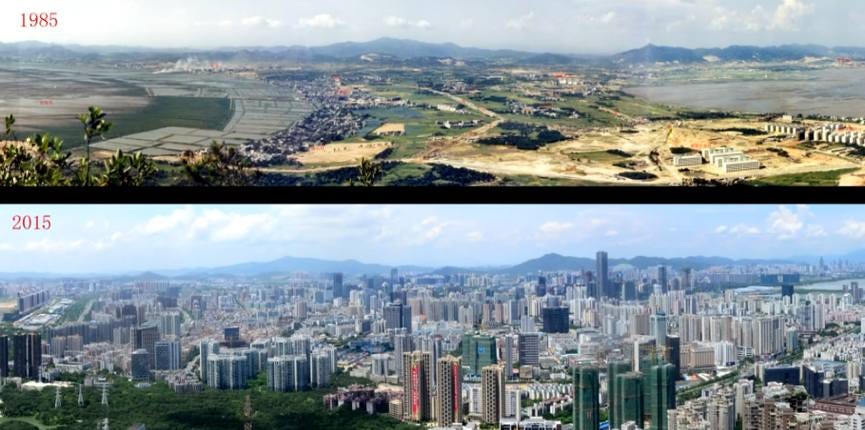
Listen to any educated European complain about America and you’ll hear a familiar refrain: we don’t need what you have. We don’t need your economic growth—it just produces inequality. We don’t need your technology sector—it just creates oligarchs. We don’t need immigration or the frantic churn of American capitalism. And why would we ever need a military?
But Europe exists beneath the American umbrella. It relies on NATO to bind America to European security. It absorbs the pharmaceutical innovation that America’s for-profit system produces, then uses price controls to keep its own citizens insulated from the cost. It relies on the US Navy to patrol shipping lanes so it can import cheap manufactures from China. It depends on Big Tech for its basic digital infrastructure, then fines it to preserve European moral purity.
Indeed, Europe acknowledges that America is necessary. It sees it as a place to outsource the grubby work of capitalism, and it wants to capture the benefits of that growth without bearing any of its costs.
The irony is that over last five decades, America has done the same with China.
In the 1980s, as the American century waxed to apogee, China reemerged as a world power. Deng Xiaoping, after taking power in 1978, rolled back each successive facet of Maoism until he built a capitalist state under the nominal auspices of communism. He dismantled collective farming, built special economic zones to attract foreign investment, allowed private businesses to form, and encouraged joint ventures with foreign firms. China became the world’s biggest export-led growth story, using its resources of cheap labor to win low-end manufacturing on price, and then, it steadily moved up the value chain.
That growth was predicated on American disinterest. When China began its massive urbanization project, reshaping its cities from low-rise regional centers into massive megalopolises, America instituted ever more stringent zoning laws, freezing its own cities in amber. As China broke ground on new factories, new mines, and new foundries, America created a new regime of environmental review, blocking the expansion of any new industrial enterprise. And as Chinese factories flooded the world with cheap goods, America opened the door even wider by letting it into the WTO in 2001.
The result? Chinese growth led to American deindustrialization. American capital flowed into China. Factories in Cincinnati and Detroit were replaced by contracts with Foxconn. Some 2.4 million jobs were shipped overseas, leaving the industrial heartland devastated. American cars became a domestic cottage-industry. American steel turned into nostalgic symbolism. And American defense manufacturing withered to such a degree that today, the “arsenal of democracy” produces some 90 Tomahawk missiles in a year. For context, we just used 850 in Iran.
We accepted this with little more than a shrug. We don’t need manufacturing, we said. Instead, we abandoned our industrial base and moved into services. Chinese innovations lowered our input prices, while American service firms settled for the final “value-add” layer to pocket the highest margins. Finance and technology became the market’s darlings, and in the absence of any industrial policy, the US degraded into a nation of mere consumers. Ford’s “Built in America” gave way to Apple’s “Designed in California.”
Nowadays, America is steadily transitioning to the very same risk-averse museum it constantly accuses Western Europe of being. Every facet of the future we hope to build depends on Chinese industry. Solar panels, wind turbines, electric cars, and most electronic components, are primarily made in China. Most of the world’s robots and drones are built in China. Most rare-earth minerals are mined in China.
Yet, beyond empty rhetoric, we’re doing almost nothing to contest their dominance. Instead, we spend our time gloating about all the things China has that we don’t need. We talk about their sweatshops, their 996 work culture, their “overcrowded” cities, the brutal gaokao and their impersonal education system, and we congratulate ourselves on our victory over such suffering. We talk about how much easier life is in America, and how we would never tolerate such an overbearing government or a polluted environment or such overcrowded cities.
As a westerner in the twenty-first century, it seems fairly obvious that industrialization was a triumph. That first application of coal to superheat water cascaded into our unadulterated victory over the Malthusian past.
This brings up an obvious rejoinder: just do it again. Build. It’s what the moment requires.
But the magnitude of industrialization’s triumph ignores the costs imposed on those that went through it. If we actually analyze the toll the industrial revolution extracted from its subject populations, you’ll see why any functioning democracy would prevent it, each time.
Consider America’s experience with industrialization. Its demographic impact alone was profound. Between 1870 and 1920, America’s urban population increased sevenfold. From 1870 to 1900, Chicago grew from ~300k people to over 1 million. New York grew from 1 million people to 3.4 million. Immigrants arrived in unprecedented numbers. 25 million landed between 1870 and 1920, into a country that started with just 38.6 million people. By 1890, some 60% of the urban population were foreign-born. And there was the Great Migration. Between 1870 and 1970, some six million black Americans fled the post-Reconstruction South and settled in northern cities. For the first time, the North had a significant black population.
By 1900, New York’s Lower East Side became the densest urban conurbation in the world. Immigrants crowded into tenements, living twelve to a room, while gangs ran gambling and prostitution rings just below. Water sources were polluted with human waste and cholera ran rampant. Some five-hundred thousand horses in the city produced 1000 tons of manure a day. Inequality increased each year, while median wages stagnated for decades. By several measures, the average height of American men fell below their 1870 equivalents until the 1940s.
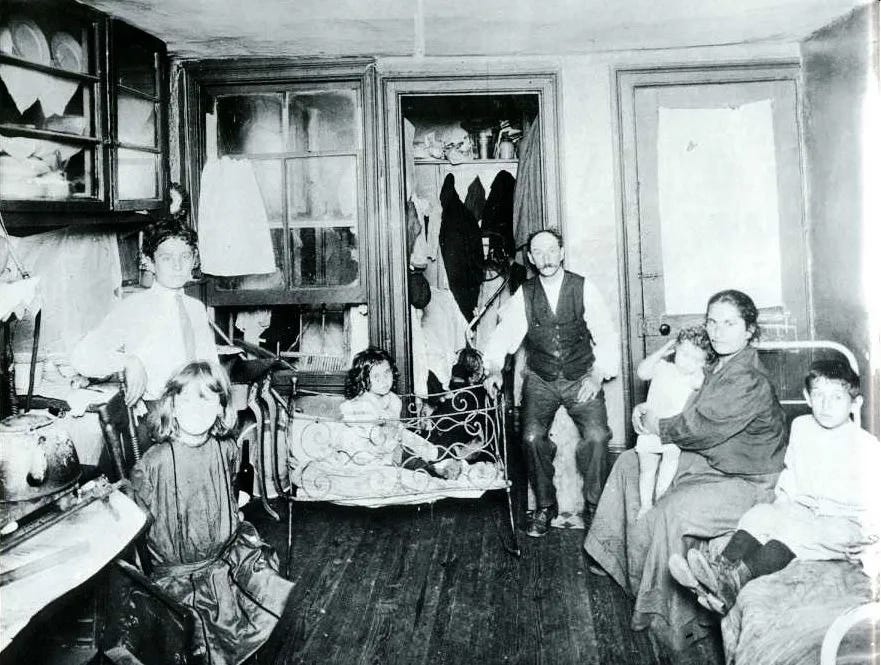
The impact was especially disastrous for the middle-class artisans. They went from respectable independent proprietors operating from their own workshops to interchangeable laborers in hellish factories. Their children, once destined to apprenticeships and respectability of their own, were now consigned to hard labor in the same factories.
In the American West, the patchwork of homesteaders were outcompeted by consolidated agribusiness, leaving the farmers themselves as disinherited urban dwellers. First railroads, then the interstate system, cut through the country, creating new towns but destroying others. Thousands of new bridges, new highways, new buildings were constructed, and hundreds of thousands of people were forced from their land with minimal recompense.
By 1970, America had spent a century in near-constant social reinvention. Immigration transformed the country’s demographics, while industrialization upended its social structure.
Now, consider that China underwent that very transition over just forty years, with an order of magnitude more people. Between 1978 and 1999, 174 million Chinese migrated into cities, rising steadily to 900 million by 2020—the largest and fastest urbanization in history. This transformed the urban landscape. Shanghai went from a decaying post-colonial port to one of the world’s great financial centers in fifteen years. Shenzhen grew from a fishing village of 30,000 to a metropolis of 17 million.
Urbanization was matched with an explosion of infrastructure development. China had no high speed rail in 2007; by 2024, it had 45000 km—more than the rest of the world combined. It built 175,000 kilometers of highway in twenty years. Between 2011 and 2013, it poured more concrete than the US did in its entire history.
Like everywhere else, this massive social upheaval had a long ledger of human costs. The hukou system—a system of local registration—excluded most rural workers, creating a permanent underclass that doesn’t have access to urban schools and hospitals. The migration also left some 60 million children abandoned by parents to grow up in dying villages.
Infrastructure development required massive displacement. For the Three Gorges Dam, 13 cities, 140 towns, and 1650 villages, amounting to 1.35 million people, were forcibly relocated. Most of them are now mired in poverty. High speed rail development has had that same impact, over and over again, across the country, as has the network of interstates. On average, China displaced about 800,000 people each year between 1949 and 1989 for infrastructure development, leading to tens of millions of total displacements across some 86,000 different projects.
Chinese workers, as well, face profound misery. Foxconn installed suicide nets in 2010 after 14 workers leapt from dormitory buildings in a single year. Internal migrant workers, without permits, build much of the infrastructure in China, and only 22% have health insurance, pensions, or injury compensation. Even most of China’s relatively-privileged white-collar workforce labors under “996” conditions—9 AM to 9 PM, six days a week.
In retrospect, these costs are elided because we are the beneficiaries of the imposed change. But imagine yourself perched on the edge of each transformation—you would be far less amenable. If you were a British artisan in 1812, you’d be a Luddite. If you were an Ohio farmer in 1898, you would resist your crucifixion on a cross of Gold. And would you be wrong? The Luddites are now an object of ridicule, but really, they’re just a class of artisans resisting their own imminent immiseration. That we now reap great benefits from cheap textiles is of little succor to them, or their children, or their children’s children, all of whom likely faced nasty, brutish, and short lives under the new industrial regime.
From a Rawlsian perspective then, industrialization should have never proceeded. That it did is a product of the distribution of power in each of these countries. America, despite its universal white manhood suffrage, was always deferential to the interests of capital. Before 1913, the Senate was an appointed body, and even after, a lack of labor regulations and the judicial upholding of strong property rights made government unresponsive to labor. Southerners also agreed to support industrial interests in exchange for the maintenance of racial apartheid. And China under Deng had one of the most centralized governments in history. It was the very same government that, in the midst of a massive famine, forced its starving population to kill sparrows en masse, and would go on to massacre pro-democracy protestors at Tiananmen in 1989. There was little chance of any popular resistance to industrialization.
Eventually, America did become a genuinely democratic country, and that gave popular sentiment real teeth. This peaked in the 70s, when cascading government action empowered a new set of interests aligned against capital. The National Environment Protection Act (NEPA), occupational safety regulations (OSHA), and the expansion of standing doctrine for environment litigation, created many new methods for organized groups to oppose change. And because capital was the primary transformative force in industrialization, each policy that went against it arrested its ability to impose change.
Mass democratic participation thus became the avenue to arrest dynamism. Those set to lose from socially disruptive growth now had the power to prevent it. And thus, even as technology progressed, actual societal change slowed. A new crop of conservationists, anti-gentrification activists, and small-c conservatives, used the new public mood to gum up the gears of the state-capitalist machine.
And so, as Robert Moses fell in New York, America’s appetite for social reinvention fell with him. America’s next fifty years saw the same pace of technological change, but not nearly the same degree of sociopolitical change.
Robert Gordon, in The Rise and Fall of American Growth, described this best with a simple thought experiment. Imagine taking an American from 1870 and transporting them to 1970: the world they’d enter was utterly unrecognizable. Their house would have indoor toilets, plumbing, and running water, unheard of in the 1870s. They wouldn’t need candles or kerosene lamps, as 95% of American homes had electricity. They could turn on the radio for instant news and entertainment. If they needed food, they could use their automobile and drive along a paved road to a supermarket. They wouldn’t need to create fruit preserves or salt their meat—they could just put their purchases into a refrigerator. If they faced any number of sicknesses, they could drive to their local doctor and get antibiotics.
1870 to 1970 is one (very long) life. From birth to death, that one lifetime experienced the overturning of the Earth. Now, take that American from 1970 to 2026—clearly, much less has changed. The gas-powered automobiles they grew up in are still the ones they use now. There aren’t any new intercity train lines. Planes take the same amount of time. Refrigerators do the same thing basically the same way. Medicine is on average the same, better for rare diseases, and the biggest issues of cancer and heart disease are still unsolved. If you live in New York, the subway looks the same. If you’re in San Francisco, most of the houses are exactly the same.
The biggest changes are in the Internet, computers, and mobile phones. These are certainly transformative, but don’t have nearly the same broad-based impact as something like the car did. Gordon stated that most of our recent inventions have been optimizations: marginal improvements that don’t create new degrees of freedom for the human experience. They proliferated because they slot neatly into our existing systems without inducing socioeconomic tumult.
This is not because we’ve stopped innovating. The scope of technological change since 1970 has been vast. Instead, we’re unable to deploy that technology at scale because our political system has massive status quo bias. The groups disenfranchised by technology can now successfully stop its adoption, and more than that, can claim virtuous grounds in doing so. So our cars remain manual, our trains remain slow, our bridges keep collapsing, and I spent four years of my adult life paying $2500 a month to live in a 110 year old building and shower in an 80 year old tub.
If you want to see the urban landscape that modern technology can enable, go to Shenzhen, where autonomous drones deliver you lunch and a fleet of autonomous buses run citywide. Or, go to Chongqing, which has levels like Blade Runner’s Los Angeles and they thread monorails through residential buildings. In Xiong’an, pipes, cables, and freight all run autonomously in underground tunnels monitored by thousands of sensors, while in Shanghai, a maglev ferries you from the airport at 200 mph, and an entirely autonomous dockyard handles more freight in a day than Long Beach does in a week.
In America’s reaction to AI—our most revolutionary innovation since the internet—you see the basis of our stagnation. There’s barely excitement about the new possibilities it creates. Instead, politicians are already searching for new methods to arrest its progress. Artists are trying to level copyright claims, writers are trying to preemptively ban it from bookstores, lawyers are pushing legislation to prevent it from generating contracts. Teachers are fighting its use in classrooms. Every facet of American society is organizing to preserve its own particular rent.
Because today’s America doesn’t have a pro-growth constituency. Every issue is blocked by some parochial interest guarding its own rent. Housing abundance is imperiled by both progressive anti-displacement politics and suburban homeowner conservatism. Energy expansion is hampered by the left’s insistence on onerous environmental review processes and MAGA’s antipathy towards solar and wind. On re-industrialization, both left and right populists see this as a jobs program for their own identitarian goals. Each also opposes the degree of automation and foreign skilled labor this would require. Meanwhile, standard left-liberals object on various conservation, aesthetic, and environmental grounds. The left supports immigration on compassionate grounds but not strategic ones, while the right considers skilled immigration a threat to white male jobs and all immigration a “poisoning of the blood.”
It doesn’t take much extrapolation to chart our future from here. In a responsive democracy, parochial interests become impossible to dislodge. The cost of overturning them is concentrated on a single group, but the benefits are diffuse across the population: that makes it impossible to build a strong opposing coalition. Governments become beholden to those interests and lose the ability to actually serve the population. Voters notice the dysfunction but cannot diagnose it correctly, leading to epiphany politics and zero-sum populism.
And the nation experiences a decline entirely of its own choosing.
Perhaps, once America joins Europe in Ogygia—both former hegemons consigned to merely watch the coming of a new world on foreign shores—it can contest a claim to its a new, more befitting title: the regulatory superpower.