We previously described why scientific peer review at NIH is critical and how changes to policies at the National Institutes of Health (NIH) have damaged this fundamental process that the scientific community relies on. These and other policy changes at NIH now occur with limited input from NIH staff, the scientific community, Congress, and the public. In our prior writing, we forecasted a further assault on peer review that would reduce transparency about scoring, obscuring justifications for funding decisions.
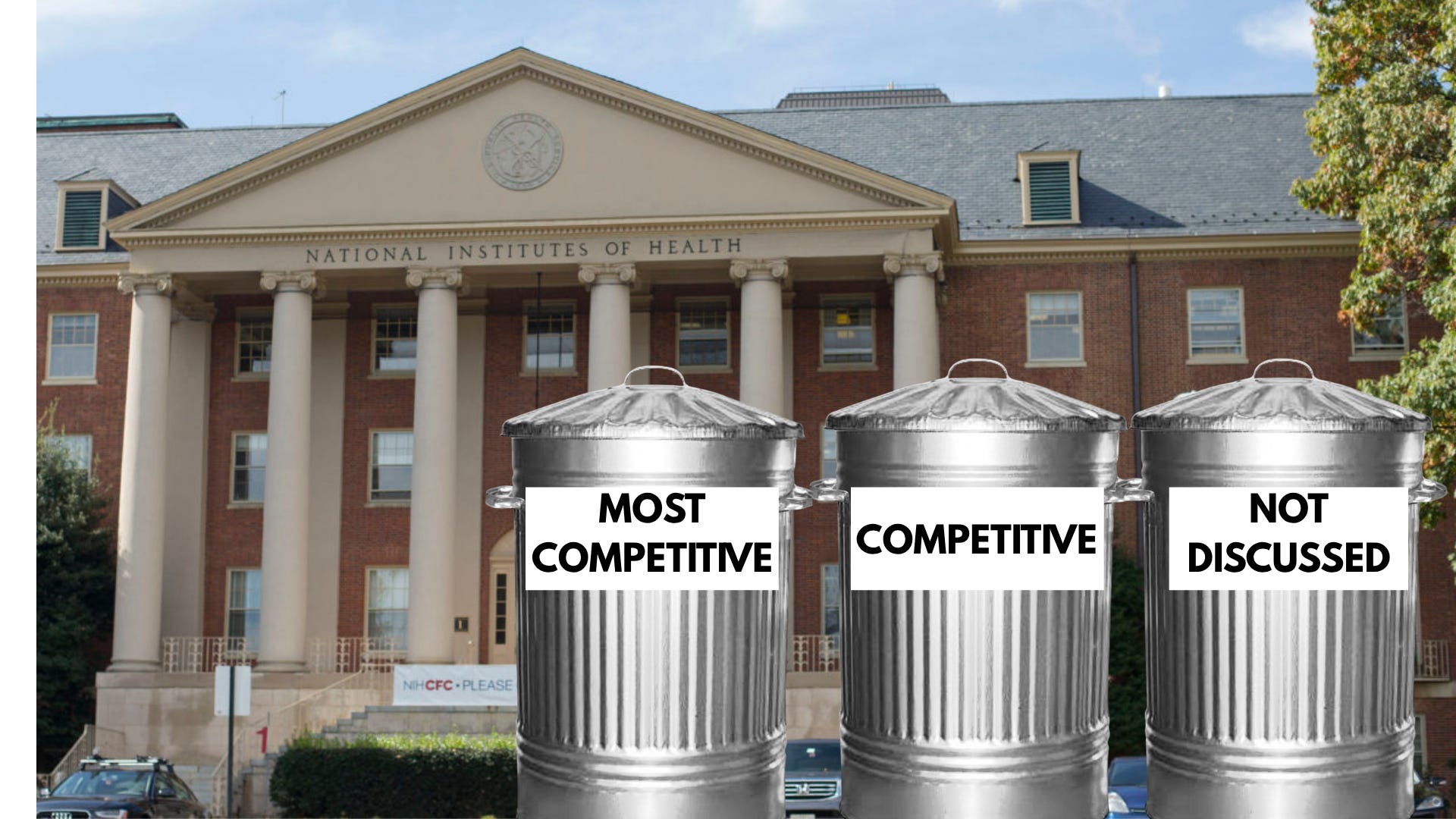
On August 14, NIH unveiled a plan to blind grant applicants and their program officers (POs) to the scores determined by peer reviewers. In a Request for Information (RFI), NIH proposes to align peer review results reporting with the Unified Funding Strategy, which restricts Institutes and Centers (ICs) from using paylines in their funding decisions. A payline is a non-binding, estimate of the score up to which an IC expects to award grants based on its budget. Instead, NIH intends that grants get binned into one of three categories: most competitive, competitive, and not discussed. Together with the Executive Order and the proposed OMB Regulation targeting federal grants, this proposal advances the administration’s long-term plan to undermine science and politicize the NIH funding process.
NIH has modified the peer review process before. Previous major changes included the more structured review criteria (1997), the enhanced review criteria and streamlined scoring scale (2009), and the Simplified Review Framework (2025). Each change was a multiyear effort that solicited input from working groups of extramural scientists, internal NIH committees, IC directors, and the public. In contrast, the current RFI is the result of an internal, anonymous working group. Despite the one-sentence summary of the working group’s process, NIH provided no final report for a process change of this gravity.
Here, we describe this most recent proposal and its likely impact on NIH peer review and funding decisions. If enacted, the measures will obscure funding decisions, allow political interference in grant making, and increase the burden on grant applicants and NIH staff.
When NIH receives a grant application, a scientific review officer (SRO) typically assigns three reviewers to the application. Each reviewer evaluates the application independently, without knowing the identities or opinions of the other two reviewers, and submits written critiques and preliminary overall impact scores. Scores are on a one to nine scale with one being the best score. In order to focus the review meeting on the most meritorious applications, the SRO ranks them by the average preliminary score of the assigned reviewers, and the panel discusses the applications in the top half (the lowest average preliminary scores) during the meeting; the rest are generally not discussed. At the meeting, three assigned reviewers present their critiques and then the panel discusses each application. All of the members who do not have a conflict of interest cast votes for a final score. Scores reflect each panelist’s balance of strengths and weaknesses after considering all points of view. All panelists’ scores are averaged and multiplied by 10. This final score is included in the summary statement and accessible to applicants, POs, grants management officials, and the IC advisory councils. Variations in panel scoring are also normalized for most investigator-initiated research applications through percentiling, in which an application’s score is standardized against the historical scoring patterns of its panel to present a more accurate picture of where the application falls relative to others.
NIH now proposes to eliminate final scores and percentiles from summary statements and internal databases used by POs, grants management officials, and advisory council members. Instead, interested parties will be informed that the final scores placed the applications in one of three categories (bins):
“Most competitive” (based on the top 25% of final overall impact scores),
“Competitive” (based on the 26-50% of final overall impact scores), or
“Not discussed” (scores >50%, or ND).
These bins are too large to provide useful information. The vast range makes it difficult to know whether an application met with high enthusiasm by the reviewers for being among the best in its group, or received mixed reviews and was among the worst. For context, NIH has not funded anything close to the top 25% for more than two decades.
In justifying the RFI, NIH makes several claims. NIH states that it “reviewed literature on the predictive value of peer review scores for scientific outcomes.” This issue is well debated, but without resolution. Some researchers conclude that better scores predict higher productivity, while others argue the lack of correlation. This is a complex topic with many caveats: the sampling, refinement of the research plan based on reviewers’ comments, and the reliance on bibliometrics as a measure of productivity. NIH does not bring clarity to this debate with an explanation, instead broadly asserting that “peer review scores are estimates with imperfect discriminative ability.”
We agree with the RFI that “peer review outcomes are multifaceted and contain valuable information beyond the overall impact score.” However, it misrepresents how POs and advisory councils actually make funding recommendations, and how IC directors reach funding decisions. The implication of the working group’s recommendations is that current funding decisions minimize factors, including scientific priorities and portfolio balance, in favor of scores. A former director of extramural operations at an NIH Institute debunked this idea in a recent post. Further, NIH claims that the proposed change will allow program staff to use “good judgement” when making funding recommendations. Program staff generally have doctorates and deep experience in their fields. The implication that they have not used good judgement to date and require additional encouragement to consider more than overall impact scores is baseless and frankly insulting.
NIH falsely claims that the proposed changes “support elevating the role of scientific peer review.” Removing the collective decision of the review panel in fact diminishes their role. As we previously wrote, NIH’s Center for Scientific Review already devalued reviewers by eliminating continuous submission and removing requirements for gender and racial/ethnic balance in review panels. Eliminating the final scores further diminishes reviewer contributions.
NIH argues that the proposed change “would align NIH practices with those followed by other major funders such as the National Science Foundation, Department of Energy, and U.S. Department of Agriculture.” This statement ignores the method that those agencies use. For example, they determine and apply at least five different categories for scoring bins. Reviewers receive instructions on the meaning and probable outcome of applications in each bin. They then deliberate which bin each application belongs in. In addition, applications within a bin are often ranked against each other, giving program staff guidance on priorities. Instead, the proposed NIH plan would generate a hidden score and place applications in a large bin without further distinctions.
Finally, reviewers at the other agencies discuss every application. This strategy is not practical at NIH, given the volume of grant applications. In Fiscal Year (FY) 2025, NIH received over 94,000 grant applications while the National Science Foundation received approximately 43,000. The largest scientific review component within the Department of Energy, the Office of Science, received 7,743 applications in FY2023. Similarly, the National Institute of Food and Agriculture of the U.S. Department of Agriculture received 5,465 applications in FY2022-2023 combined. The working group did not address how the practices of smaller funding agencies could be scaled to function for NIH, which expects increases in applications, and whether this makes sense.
SROs, POs, reviewers, and applicants alike agree that scores are not perfect. Imperfect measures are still useful when combined with careful analyses and wider perspectives on scientific portfolios. As stated above, all voting panelists contribute to the final score. So numerical scores, unlike the proposed “most competitive” designation, indicate exactly where an application lies in the top 25%. While POs may always consider other factors in their funding recommendations, they put significant weight on the score, because that is the panel’s determination of how much of an overall impact the work is predicted to have on the field.
Scores help applicants determine whether they should revise and resubmit their applications. This is a crucial consideration for applicants who rely on grant funds to keep their research going and may need an award, or at least evidence of an excellent review score, to obtain tenure or promotion. Based on the timing of the grants process, they often must resubmit before a final funding decision is issued. A “most competitive” designation putting an application in the top 25% is not helpful in deciding whether to resubmit, when the overall NIH success rate is only 13%, with several ICs funding less than 10%. The likely result is that everyone will resubmit their applications in the absence of more information, and review will be overrun with applications that may not have needed resubmission at all.
The likely result is that everyone will resubmit their applications in the absence of more information, and review will be overrun with applications that may not have needed resubmission at all.
POs need to provide a written justification for every application they nominate for funding. This process is made increasingly laborious with new checklists, justifications, requested revisions, and additional layers of approvals. Scores also help POs prioritize the time spent on funding considerations. The National Cancer Institute and the National Institute for Allergy and Infectious Diseases, the largest institutes, received 13,883 and 10,101 grant applications in FY2025, respectively. Scores allow staff to quickly identify the applications that have fewer weaknesses. As the scores worsen, the applications are more likely to have greater weaknesses weighed against the potential benefit of the work. Knowing the range of scores allows POs to carefully evaluate applications that elicited differences of opinions from the reviewers and make informed funding recommendations. The scores are never the only deciding factor, but they represent an important and transparent element in the responsible distribution of taxpayer money. In sum, scores allow NIH to make more efficient and informed funding decisions and awards.
Even with access to scores, POs still attend review meetings, listen to the discussions, and read summary statements. So the implication (some in NIH leadership have said this explicitly) that POs do not consider the reviewers’ comments is false. In fact, the comments are often used directly to justify funding an application that did not score as well but has promise to significantly advance the field if funded. The enthusiasm of reviewers, along with their misgivings, are also weighed carefully by program staff to distinguish between applications with identical or similar scores.
At a time when HHS and NIH promote “radical transparency,” withholding key pieces of information from concerned parties does the exact opposite. On top of the backlog caused by delays in funding over the last two fiscal years and the censorship of research, applicants will have even less of an idea of their likelihood of funding. To pay their staff and keep their labs open, they will likely have no choice but to resubmit applications regardless of prior review outcomes, thereby increasing the burden on volunteer peer reviewers who are also working to maintain their own funding.
Binning will require POs to assess each application in the competitive bins, resulting in less time for careful appraisals of any single application. Furthermore, POs will have less recourse to contest questionable funding decisions. This enables political appointees to have complete control over grant funding, removing opportunities for oversight and covertly implementing the proposed Office of Management and Budget (OMB) rule. The appointments of Kyle Walsh as director of the National Institute of Environmental Health Sciences and John Gaitanis as director of the Eunice Kennedy Shriver National Institute of Child Health and Human Development, amplify concerns of political influence over NIH funding.
The credibility of our public health agencies has been undermined by leaders who promote falsehoods about vaccine safety and autism and platform conspiracy theories as “scientific freedom.” The proposed change will mask political interference in grant making and further erode trust in the NIH mission “to seek fundamental knowledge” and “reduce illness and disability.”
THE DEADLINE IS OCTOBER 13, 2026, 11:59 PM ET
NIH requests public comments on the proposed changes to reporting of peer review outcomes. Speak up about how the changes will affect you and NIH-funded science. If you have alternative suggestions to improve peer review and scientific funding decisions, please share these with NIH leadership. The opinions of the scientific community, concerned public, and NIH staff can potentially encourage NIH leaders to reconsider eliminating the reporting of scores.
STEP 1:
Go to the right place: Request for Information (RFI) on Proposed Changes to Reporting Outcomes from NIH Peer Review
STEP 2:
Fill in the details of the comment form. Your name, institutional affiliation, and email address are OPTIONAL.
STEP 3:
Write your comment. The goal is simply to explain in your own words why this change to peer review concerns you and how it would affect you or your work. You may type your comments into the box provided or attach a document with your concerns.
1. First paragraph: Say who you are and how this impacts you. You do not need credentials — being affected is enough.
Examples:
I am a graduate student in [your field] who receives NIH funding.
I am a member of the public who cares about getting the best science funded.
I am a scientist whose research on [your topic] has been supported by the NIH for X years.
I am an administrator at an institution where the faculty depend on NIH funding for their research.
2. Second paragraph: Explain your main concerns. Examples:
I apply for NIH grants to support my research/training/career development. This plan will remove information that I need to understand how the review panel judged my application.
The faculty at my university actively participate in peer review and are very concerned that their scores will not be available to assist funding decisions.
I have participated as a reviewer on several study sections and am very concerned that the numerical score assessed by the entire panel will not be provided to the applicant or program staff.
As a taxpayer, I am concerned that NIH will not use my money to support the best research projects to develop treatments and cures.
I am concerned about the lack of transparency if a score is not provided. Based on all the changes at the NIH this past year, it makes funding even more opaque. I am not convinced that reporting the peer review outcome as three bins will better inform funding decisions.
3. Closing: State clearly what you want the NIH to do. This can be as simple as: “I urge the NIH not to make this change to peer review.” Click Submit.
STEP 4: Spread the word. Ask your colleagues to submit a comment.
Together we can push back against policies that will harm U.S. biomedical research.
Editor’s note: 27 UNIHTED publishes opinions and information from the perspective of our members, who all identify as part of the NIH community. Publication indicates that this piece meets our editorial and factual standards and aligns with our mission, including support of scientific integrity and health research that serves all people. Publication does not indicate endorsement by all members and views expressed are the authors’ own.