Bitcoin can’t compete with AI for compute power. Bitcoin miners have already signed more than $70 billion in AI and high-performance computing contracts.
Since the beginning of 2026, Bitcoin miners have been signing AI and high-power compute contracts. Between Q2 and Q4, there was a flurry of major new or expanded commercial deals announced in the period.
TeraWulf and Anthropic in July agreed to a 20-year lease for ~401 MW critical IT at the Justified Data campus in Hawesville, KY.
In that same month, CleanSpark and Meta agreed in July to a 20-year triple-net lease at Sandersville, GA and CoreScientific and AMD came to a 15-year agreement across five sites in Texas, Oklahoma, Alabama, and Georgia.
In August, Bitdeer signed a deal with Volta Tydal, Riot Platforms with Anthropic in August, AIB Data Centers with Nebius, and more.
Analysts expect the industry to earn as much as 70 percent of their revenue from AI by the end of 2026.
The reason? AI simply pays more per electron than Bitcoin mining. Whereas Bitcoin mining monetizes electricity through a hash price and shrinking block rewards that become more difficult to mine, AI contracts provide multi-year revenue certainty.
Therefore, in blockchain technology, revenue is unpredictable. AI, on the other hand, not only pays more, it also offers predictable revenue.
The Simple Math Of Bitcoin Mining in AI Age
In the post-2024 halving world, the block reward has once again been cut in half, and the network hashrate near all-time highs, Bitcoin mining margins have fallen to multi-year lows.
Paired with higher industrial power prices in primary markets and debt servicing requirements, bitcoin mining margins have decreased to the point where miners have no option but to diversify their operations. AI offers higher revenue per megawatt-hour, without the headaches of mining difficulty.
What’s more, there is already a robust buyer for their scarce, permitted power capacity and interconnection rights, which currently represent two significant bottlenecks for data-center developers.
Diversifying into high-growth sectors makes sense. Enter HPC for AI workloads, since those workloads can be placed onto the same physical assets with only incremental capital when compared with the cost of building entirely new facilities.
The International Energy Agency (IEA) expects global electricity consumption for data centres to double to around 945 TWh by 2030, driven primarily by the adoption of artificial intelligence. Certain Bitcoin miners identified the opportunity early and pivoted.
Specific miners began securing multi-year AI and HPC leases while traditional data-center developers navigated multi-year interconnection queues, the waitlist and review process for a grid operator or utility when examining any new energy project or large power consumer wanting to connect to the electric power grid.
Yet, the Bitcoin miners who pivoted still trade today at a steep discount to other data center peers on a market cap to megawatt basis. This is likely, at least in part, a result of skepticism over the Bitcoin exposure of the Bitcoin miners.
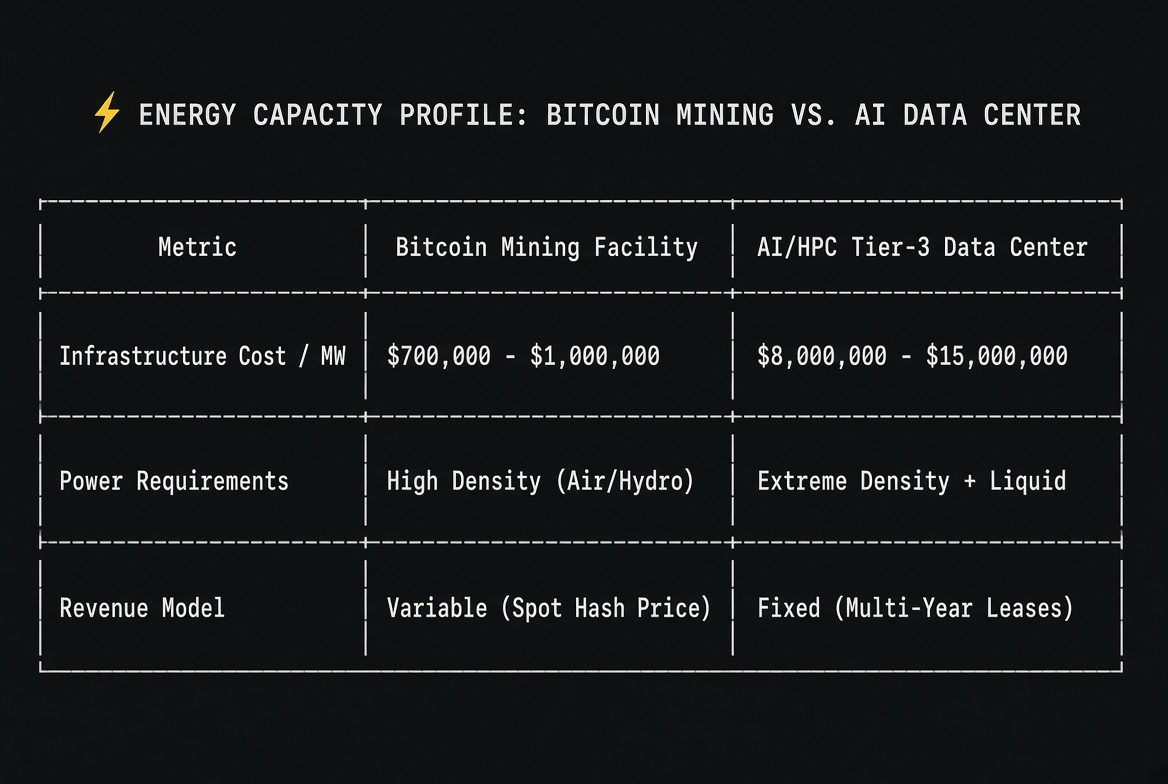
A mining facility costs approximately $1 million per MW. For an AI facility, the infrastructure alone, without compute equipment, costs $10 million to $15 million per 1 MW. All that needs to be done is a site that needs to be rebuilt for liquid cooling, increased power density, and hyperscaler service-level agreements to become equipped to manage AI loads.
According to CoinShares, Bitcoin mining infrastructure runs approximately $700,000 to $1 million per megawatt versus about $8 million to $15 million per megawatt for AI facilities.
11 publicly traded miners have pointed roughly 2,700 MW to AI, which represents 10-16% of the Bitcoin network’s total computing capacity.
AI could already consume more than double the power of the bitcoin network. Its rate of growth, moreover, is steeper. The main constraint for data centers is power, which Bitcoin miners already control.
These mining facilities must execute, as they’ve so far only delivered approximately 25 percent of the AI and high-performance computing (HPC) capacity leased to customers.
Bitcoin miners pivoting into AI infrastructure, however, have one major problem. They must overcome an approximately $50 billion near-term funding gap. They also have long-term capital needs as high as $221 billion.
A Fiduciary Duty
Wall Street values leased megawatts as a separate, more valuable asset class than mined Bitcoin or unsold power capacity, and is penalizing miners who are not adapting to the market.
Contracted AI and high-performance computing miners trade at over 10 times gross energy out.
Bitcoin miners trade at approximately 2 to 6 times gross energy out.
The market clearly sees AI cash flow as a better and more predictable bet than Bitcoin mining or Bitcoin speculation.
The reasoning for mine operators is simple. They have a fiduciary duty to shareholders to return as much money as possible based on their asset: land and power. AI offers a much higher return than Bitcoin.
Electricity is a scarce input. Multi-year AI contracts pay multiples of what Bitcoin mining can generate per electron at current prices. Bitcoin at present does not compete with maximizing the value of the power and real estate these companies already control. To compete for mining resources, Bitcoin would have to sit at a much higher price than today.
Kadan Stadelmann began his career working in cybersecurity for the Austrian government, before co-founding and serving as Chief Technology Officer (CTO) for Komodo Platform, leading the blockchain platform to a $23.5 million acquisition. He currently serves as a cybersecurity advisor to blockchain, AI, robotics, and quantum computing startups.