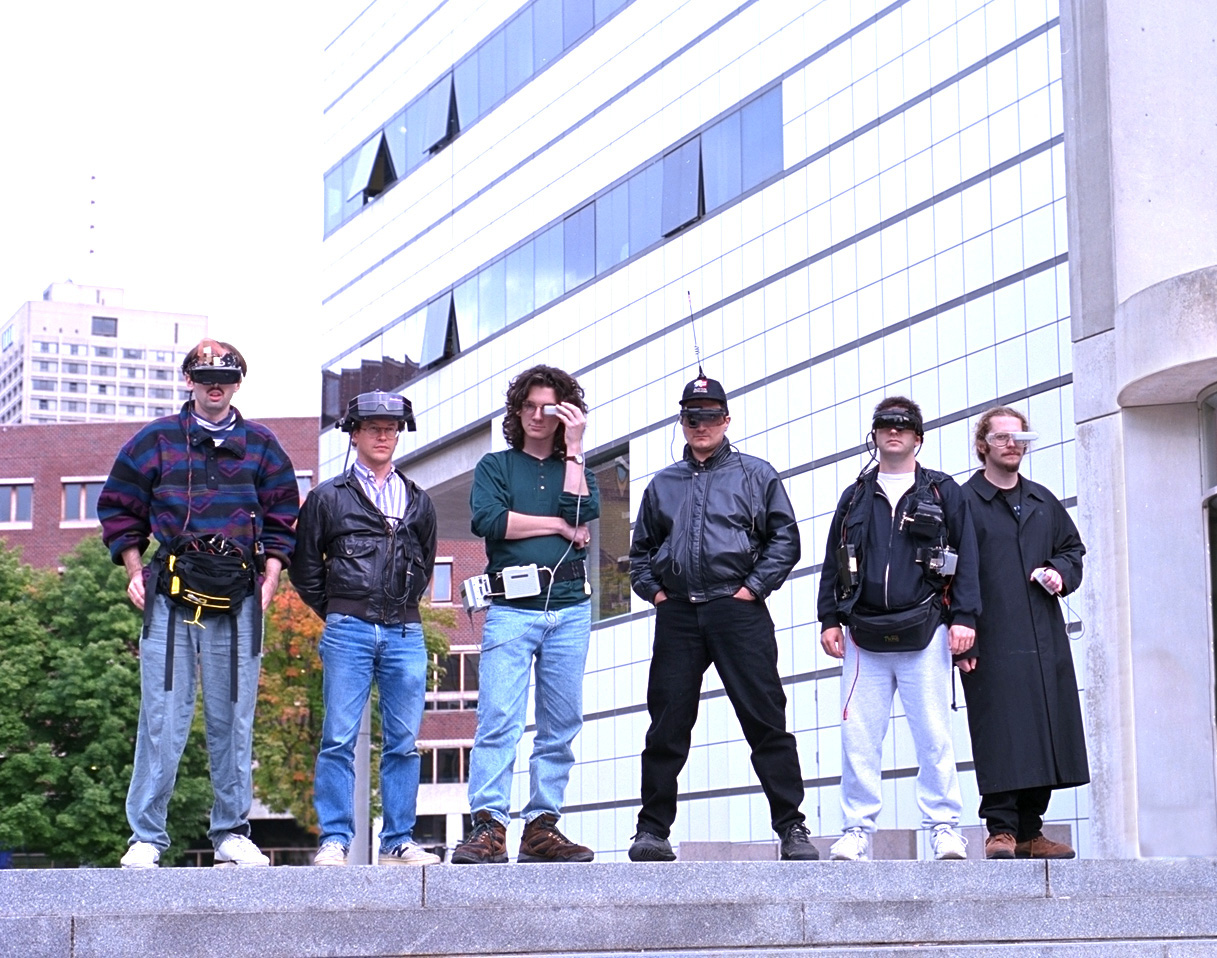
Image by Steve Mann (click for image info)
Coming Soon: Summaries of the Workshop on Wearable Computer Systems August 19-21 and, finally, a detailed "How to make a wearable for $2-3k"

Welcome to the MIT Wearable Computing Web Page. This page is meant to both serve as an introduction to the field of wearable computing and as a resource for more technical information. Updates occur as new technology is released. If you have information or code to share, send mail to wearable-web@media.mit.edu
In places, this is a very image intensive site due to scanned data pages. If you are having very long delays in reading these pages, select the "no images" option on your web browser.
What's a Wearable?
To date, personal computers have not lived up to their name. Most machines sit on the desk and interact with their owners for only a small fraction of the day. Smaller and faster notebook computers have made mobility less of an issue, but the same staid user paradigm persists. Wearable computing hopes to shatter this myth of how a computer should be used. A person's computer should be worn, much as eyeglasses or clothing are worn, and interact with the user based on the context of the situation. With heads-up displays, unobtrusive input devices, personal wireless local area networks, and a host of other context sensing and communication tools, the wearable computer can act as an intelligent assistant, whether it be through a Remembrance Agent, augmented reality, or intellectual collectives.Applications for wearables
- Augmented Memory: The Remembrance Agent
- Augmented Reality
- Desktop applications ported to wearables
- Collective Intelligence
Cost
Hardware (see also the commercial wearables sites below)
- Input devices: keyboards, cameras, GPS, etc.
- Output devices: displays, speech, sound, etc.
- PC104 Boards (for custom building a system)
- Networks and communications
- Energy and batteries
- Spec for Hackman 0.4 a S-MOS card based wearable computer
- Making your own
Software (Currently Linux only)
- X and console Linux driver for Twiddler 1.0 (by Jeff Levine-tarred and gzipped-with thanks to Mark Eichin)
- Wavelan wireless ethernet driver
- WA4DSY's 56kbps RF modem (please send a note to N1NLF for more conversation on this item)
- Mobile IP announcement
- MIT Linux ftp/archive site
- Why Linux?
- Scripts for D-Link DE620 Parallel port Ethernet interface
MIT Wearable Computing Associated Papers
- Human Powered Wearable Computing, by Thad Starner (HTML). Version 2.0! Compressed postscript version.
- The Remembrance Agent: A continuously running automated information retrieval system (html), by Brad Rhodes and Thad Starner
- Wearable Computing and Augmented Reality, Preliminary copy (V0.5), by Thad Starner, Steve Mann, Bradley Rhodes, Jennifer Healey, Kenneth B. Russell, Jeffrey Levine, and Alex Pentland (compressed Postscript). Replaces #318
- Smart Clothing, by Steve Mann, N1NLF
- Mediated Reality, by Steve Mann, N1NLF (compressed Postscript)
- Affective Computing, by R.W. Picard (compressed Postscript)
- Interview with New Scientist (html)
- Wearable Computing (meant for the popular press-html). Replaced by TR #355 above.
- Making multimedia computers and wireless communication more personal --- a paradigm shift in wearable computing, by Steve Mann (meant for general broad readership).
Links to commercial wearables sites
Moderators' note: As with many tech companies these days, announcements are made even when the hardware is not available and may be many months, in some cases years, away. Each of these companies currently has a product to sell, but even if a particular unit is marked available, all of the options may not be. Contact the company directly for current information.- Phoenix Group (their page) and our old page on them
- Xybernaut (formerlly CPSI).
- Intervision (their site)
- Symbol Tech's arm mounted bar code scanning computer
- VE Technologies (vision system in a camera)
- (RMICRO Stand Alone Controller)
Links to other research of interest.
MIT research and independent efforts supported by this server
- The Visual Filter and Netcam
- Affective Computing
- The MIT Microdisplay Project
- Adam Oranchak's WIT Project (Oranchak's presentation at MIT Media Lab
- OS-9 wearable project
Academic Programs
- The WetPC (an underwater wearable in Australia)
- Vuman (CMU)
- CMU's Speechwear paper (using speech on a wearable)
- Virtual Retinal Display (HIT Labs, U. Washington)
- Walkstation II (Kth, Sweden)
- University of Oregon wearable program
- Georgia Tech wearables
- Georgia Tech Future Computing Environments
- Columbia Augmented Reality projects
- Columbia Mobile Computing Laboratory
- Reports from Rutgers DATAMAN group (mobile IP)
Privacy Issues
- MCSA `94
home page
See the following papers:
- Anonymity in a Mobile Computing Environment, N. Asokan - University of Waterloo.
- A Method Providing Identity Privacy to Mobile Users during Authentication, Didier Samfat and Refik Molva - Institut Eurecom.
- On Travelling Incognito, A. Herzberg, H. Krawczyk - IBM T.J. Watson, and G. Tsudik - IBM Zurich.
Military, Commercial, and Independent research
- Hackman 0.4 a S-MOS card based wearable computer
- Nomadic Research Labs (Steve Roberts)
- Sony Computer Science Lab. Inc., Katashi Nagao (in particular, Ubiquitous Talker)
- Army's Force XXI (takes some digging)
General
- Mobile and Wireless Computing index. This is a good one!
- Apple's FCC proposal for making 300Mhz in the 5Ghz spectrum unlicensed!
Enabling technologies for the handicapped
- A Home-Made Low Vision Reading Assistant (Thad's hack)
- Wearable, Tetherless, Computer-Mediated Reality With Possible Future Applications to the Disabled (Steve Mann)
- The Visual Filter and Netcam (Steve's pages)
- WebABLE "First-Stop-Shop" for people with disabilities
- Magnicam low vision commercial system (formerly Innovention)
- Visionics commerical low vision system
- High-Tech Help for the Blind by Peter Tyson (popular press paper)
Acknowledgments
- Maintainers: Thad Starner, Steve Mann, and Bradley Rhodes
- Artwork: Liz Manicatide.
- Scanning and OCR: Tavenner Hall and Kevin Pipe.
- Made possible by the Wearable Computing Project, MIT Media Laboratory.
 CDA ruled unconstitutional!
Last modified: Mon Dec 18 03:26:38 1995