
How Gender Diversity Leads to a Bigger Bottom Line
Despite making up half of the population and 47% of the labor force, women remain highly underrepresented in the top echelons of business.
- 5% of the richest billionaires are women
- 6% of S&P 500 companies have women CEOs
- 20% of Fortune 500 board members are women
There are many arguments that can be made for closing this gender gap, but the most compelling one is very simple: there’s a growing body of research that shows that gender diverse companies make more money.
Women and Profit
Today’s infographic comes to us from Evolve ETFs, a company that has launched an ETF focused on gender diversity, and it shows that companies with more women in senior roles are making better decisions and ultimately higher profits.
Better Decisions
The more diverse a team is, the more likely it is to make the best business decision. Logically, this makes sense, since multiple perspectives are considered this way – and groupthink can be avoided.
There have been various studies on decision-making that show this, but one compelling example highlighted by Forbes covers 600 business decisions made by 200 different teams over a two year span. This research found that more diverse and inclusive teams made better decisions up to 87% of the time, took less time to make the decision, and delivered 60% better results.
Better Bottom Line
Not surprisingly, making better business decisions leads to bigger returns, as well. Credit Suisse, for example, found that boards with more women had a 36% higher return on equity.
Meanwhile, research from Morgan Stanley found that the top-third of companies (that hire the most women) had 2% higher equity returns than average.
A final study worth noting is from The Peterson Institute for International Economics, a Washington, D.C. think tank, which shows that companies with at least 30% female leaders end up raking in 6% higher net margins.
Future Growth
On the company level, gender diversity means more profit and better decisions – but what could this mean in aggregate?
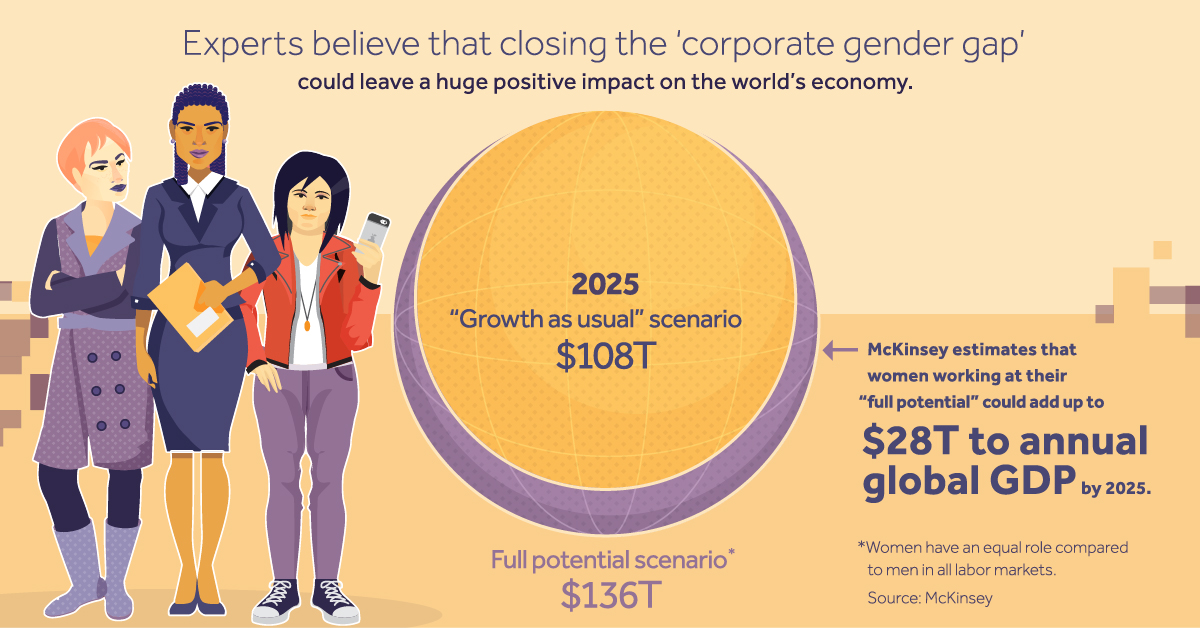
Global management consultancy firm McKinsey & Company offers up a rosy picture: they figure that if the gender gap is closed in their “full potential” scenario, up to $28 trillion extra could be added to global GDP growth by 2025.
Markets
Ranked: The World’s Most Valuable Brands in 2026
The world’s most valuable brands in 2026 ranked, led by Apple, Microsoft, and Google, with Nvidia climbing fast.

Published
4 days ago
on
March 6, 2026

Ranked: The World’s Most Valuable Brands in 2026
See visuals like this from many other data creators on our Voronoi app. Download it for free on iOS or Android and discover incredible data-driven charts from a variety of trusted sources.
Key Takeaways
- Apple remains the world’s most valuable brand in 2026 at $608B, followed by Microsoft ($565B) and Google ($433B).
- Nvidia jumps four spots to become the #5 global brand, fueled by the AI boom.
Technology brands dominate the global rankings in 2026, with companies like Apple, Microsoft, and Google collectively representing more than $1.6 trillion in brand value.
The visualization above compares the 50 most valuable brands in the world, with bubble sizes scaled by brand value. The data comes from Brand Finance, which evaluates brands based on marketing investment, brand strength, and overall financial performance.
From consumer platforms and e-commerce giants to AI chip leaders like Nvidia, digital ecosystems now dominate the world’s most valuable brands.
Big Tech Tops the List
Technology and digital platforms dominate the upper ranks.
Apple has ranked as the world’s most valuable brand since 2024, with its brand value reaching $608 billion in 2026.
That means that Apple’s brand alone is worth more than the entire market capitalization of almost every non-tech company in the world, and the GDPs of most countries.
| Rank | Brand | Sector | Brand Value |
|---|---|---|---|
| 1 | 🇺🇸 Apple | Electronics | 608B |
| 2 | 🇺🇸 Microsoft | Internet & Software | 565B |
| 3 | Media | 433B | |
| 4 | 🇺🇸 Amazon | E-Commerce | 370B |
| 5 | 🇺🇸 NVIDIA | Semiconductors | 184B |
| 6 | 🇨🇳 TikTok | Media | 154B |
| 7 | 🇺🇸 Walmart | Retail | 141B |
| 8 | 🇰🇷 Samsung | Diversified | 119B |
| 9 | Media | 107B | |
| 10 | 🇨🇳 State Grid Corporation of China | Utilities | 102B |
| 11 | 🇩🇪 T | Telecoms | 96B |
| 12 | 🇨🇳 ICBC | Banking | 91B |
| 13 | Media | 81B | |
| 14 | 🇨🇳 China Construction Bank | Banking | 77B |
| 15 | 🇺🇸 Home Depot | Retail | 73B |
| 16 | 🇺🇸 Verizon | Telecoms | 73B |
| 17 | 🇨🇳 Bank of China | Banking | 71B |
| 18 | 🇺🇸 Oracle | Internet & Software | 68B |
| 19 | 🇨🇳 Agricultural Bank of China | Banking | 63B |
| 20 | 🇯🇵 Toyota | Automobiles | 63B |
| 21 | 🇩🇪 Allianz Group | Insurance | 61B |
| 22 | 🇨🇳 Moutai | Spirits | 60B |
| 23 | 🇺🇸 American Express | Commercial Services | 57B |
| 24 | 🇺🇸 UnitedHealthcare | Healthcare Services | 55B |
| 25 | 🇺🇸 AT&T | Telecoms | 54B |
| 26 | 🇺🇸 Costco | Retail | 53B |
| 27 | 🇨🇳 Tencent | Media | 52B |
| 28 | 🇬🇧 Shell | Oil & Gas | 52B |
| 29 | 🇺🇸 Disney | Media | 51B |
| 30 | 🇺🇸 Uber | Mobility | 50B |
| 31 | 🇨🇳 China Mobile | Telecoms | 49B |
| 32 | 🇨🇳 Ping An | Insurance | 49B |
| 33 | Media | 48B | |
| 34 | 🇺🇸 Bank of America | Banking | 48B |
| 35 | 🇸🇦 Aramco | Oil & Gas | 47B |
| 36 | 🇩🇪 Mercedes-Benz | Automobiles | 47B |
| 37 | 🇺🇸 Coca-Cola | Soft Drinks | 46B |
| 38 | 🇰🇷 Hyundai Group | Diversified | 46B |
| 39 | 🇺🇸 Chase | Banking | 45B |
| 40 | 🇺🇸 VISA | Commercial Services | 44B |
| 41 | 🇩🇪 BMW | Automobiles | 44B |
| 42 | 🇺🇸 Deloitte | Commercial Services | 43B |
| 43 | 🇺🇸 McDonald's | Restaurants | 43B |
| 44 | 🇺🇸 Accenture | IT Services | 42B |
| 45 | 🇯🇵 NTT Group | Telecoms | 42B |
| 46 | 🇺🇸 Wells Fargo | Banking | 40B |
| 47 | 🇹🇼 TSMC | Semiconductors | 39B |
| 48 | 🇺🇸 Lowe's | Retail | 39B |
| 49 | 🇺🇸 YouTube | Media | 38B |
| 50 | 🇩🇪 SAP | Internet & Software | 38B |
Microsoft ($565 billion), Google ($433 billion), Amazon ($370 billion), and Nvidia ($184 billion) round out the top five, underscoring the continued strength of e-commerce and semiconductors.
Nvidia’s four-place jump since 2025 is particularly notable. As demand for AI chips and data center infrastructure accelerates, the company’s brand has strengthened alongside its financial performance.
Further down the list, companies like Oracle, SAP, TSMC, and Samsung show how critical enterprise software and chipmaking have become to the global economy.
China’s Strong Presence
Chinese brands continue to feature prominently in the top 50. TikTok ranks sixth globally at $154 billion, making it the highest-ranked Chinese brand in 2026.
Major state-backed banks—including ICBC, China Construction Bank, Bank of China, and Agricultural Bank of China—also rank among the world’s most valuable brands.
Media and tech platforms such as Tencent and WeChat further reinforce China’s growing digital influence.
Finance, Retail, and Energy Hold Their Ground
Beyond tech, traditional sectors remain highly competitive. Walmart ($141 billion), Home Depot, Costco, and Lowe’s show the enduring power of large-scale retail.
Banking and financial services brands—including Bank of America, Chase, American Express, and Visa—collectively represent hundreds of billions in brand value. Insurance giants like Allianz and Ping An also rank highly.
The list also includes energy majors such as Shell and Aramco.
Learn More on the Voronoi App 
If you enjoyed today’s post, check out Ranked: The World’s Top Startup Hubs on Voronoi, the new app from Visual Capitalist.
Markets
Ranked: The World’s 50 Most Valuable Companies in 2026
AI has propelled semiconductor companies to the top in 2026. See how Nvidia, TSMC, and other chipmakers rank among the world’s most valuable firms.

Published
1 week ago
on
March 2, 2026

The World’s 50 Most Valuable Companies in 2026
See visuals like this from many other data creators on our Voronoi app. Download it for free on iOS or Android and discover incredible data-driven charts from a variety of trusted sources.
Key Takeaways
- Nvidia leads at $4.8 trillion, followed by Apple ($4.0 trillion) and Alphabet ($3.8 trillion).
- Tech firms represent seven of the top 10 companies by market cap.
- Along with Nvidia, three other AI-related semiconductor companies—TSMC, Broadcom, and ASML—rank in the top 20 most valuable firms.
Nvidia, with a $4.8 trillion market valuation, is the world’s most valuable company in 2026.
The company has once again surpassed Apple and Alphabet as record sales lift its valuation, despite AI bubble fears. Meanwhile, TSMC’s $2 trillion market cap now exceeds both Meta Platforms and Tesla, ranking in sixth globally.
Using data from CompaniesMarketCap, this graphic shows the 50 most valuable companies worldwide in 2026.
The Top 50 Companies in 2026
Here are the largest companies by market capitalization as of February 25, 2026:
| Rank | Name | Country | Market Cap |
|---|---|---|---|
| 1 | Nvidia | 🇺🇸 U.S. | $4,769,090,895,872 |
| 2 | Apple | 🇺🇸 U.S. | $4,030,215,225,344 |
| 3 | Alphabet | 🇺🇸 U.S. | $3,786,845,192,192 |
| 4 | Microsoft | 🇺🇸 U.S. | $2,976,667,402,240 |
| 5 | Amazon | 🇺🇸 U.S. | $2,261,686,681,600 |
| 6 | TSMC | 🇹🇼 Taiwan | $2,009,122,209,792 |
| 7 | Saudi Aramco | 🇸🇦 Saudi Arabia | $1,659,869,263,655 |
| 8 | Meta Platforms | 🇺🇸 U.S. | $1,653,772,779,520 |
| 9 | Broadcom | 🇺🇸 U.S. | $1,575,548,878,848 |
| 10 | Tesla | 🇺🇸 U.S. | $1,566,227,562,496 |
| 11 | Berkshire Hathaway | 🇺🇸 U.S. | $1,067,125,637,120 |
| 12 | Walmart | 🇺🇸 U.S. | $1,002,825,187,328 |
| 13 | Eli Lilly | 🇺🇸 U.S. | $971,747,753,984 |
| 14 | Samsung | 🇰🇷 South Korea | $953,387,784,196 |
| 15 | JPMorgan Chase | 🇺🇸 U.S. | $818,792,038,400 |
| 16 | Exxon Mobil | 🇺🇸 U.S. | $629,201,108,992 |
| 17 | Visa | 🇺🇸 U.S. | $603,784,871,936 |
| 18 | Tencent | 🇨🇳 China | $602,976,288,768 |
| 19 | ASML | 🇳🇱 Netherlands | $592,511,303,680 |
| 20 | Johnson & Johnson | 🇺🇸 U.S. | $591,292,792,832 |
| 21 | SK Hynix | 🇰🇷 South Korea | $492,511,926,210 |
| 22 | Micron Technology | 🇺🇸 U.S. | $482,640,887,808 |
| 23 | Mastercard | 🇺🇸 U.S. | $455,227,998,208 |
| 24 | Costco | 🇺🇸 U.S. | $441,631,375,360 |
| 25 | Oracle | 🇺🇸 U.S. | $425,078,030,336 |
| 26 | AbbVie | 🇺🇸 U.S. | $400,878,174,208 |
| 27 | Procter & Gamble | 🇺🇸 U.S. | $382,102,667,264 |
| 28 | Roche | 🇨🇭 Switzerland | $380,012,805,029 |
| 29 | Bank of America | 🇺🇸 U.S. | $377,648,578,560 |
| 30 | Home Depot | 🇺🇸 U.S. | $373,943,992,320 |
| 31 | ICBC | 🇨🇳 China | $369,137,809,154 |
| 32 | Chevron | 🇺🇸 U.S. | $368,560,832,512 |
| 33 | Alibaba | 🇨🇳 China | $363,649,957,888 |
| 34 | General Electric | 🇺🇸 U.S. | $361,938,288,640 |
| 35 | Caterpillar | 🇺🇸 U.S. | $358,505,119,744 |
| 36 | Netflix | 🇺🇸 U.S. | $350,804,246,528 |
| 37 | Coca-Cola | 🇺🇸 U.S. | $346,150,469,632 |
| 38 | AMD | 🇺🇸 U.S. | $343,772,135,424 |
| 39 | Agricultural Bank of China | 🇨🇳 China | $331,706,101,844 |
| 40 | China Construction Bank | 🇨🇳 China | $329,442,725,971 |
| 41 | LVMH | 🇫🇷 France | $324,094,895,625 |
| 42 | HSBC | 🇬🇧 United Kingdom | $323,268,870,144 |
| 43 | Novartis | 🇨🇭 Switzerland | $322,706,767,872 |
| 44 | Palantir | 🇺🇸 U.S. | $320,938,967,040 |
| 45 | AstraZeneca | 🇬🇧 United Kingdom | $319,598,690,304 |
| 46 | Toyota | 🇯🇵 Japan | $315,160,494,080 |
| 47 | Applied Materials | 🇺🇸 U.S. | $313,424,740,352 |
| 48 | Lam Research | 🇺🇸 U.S. | $313,366,904,832 |
| 49 | Cisco | 🇺🇸 U.S. | $312,610,619,392 |
| 50 | Merck | 🇺🇸 U.S. | $305,828,593,664 |
As the largest publicly-traded company in the world, Nvidia recently posted a record $68.1 billion in quarterly earnings, up 94% year-over-year.
With OpenAI, Oracle, and Microsoft among its largest customers, a string of strong earnings reports has pushed its valuation close to a $5 trillion market capitalization. Still, investor skepticism has tempered share price gains amid concerns about overvaluation.
Apple, Alphabet, and Microsoft follow, each valued at roughly $3 trillion or more.
Saudi Aramco, one of only two non-U.S. companies in the top 10, ranks seventh with a $1.7 trillion valuation. Weaker oil prices have weighed on its performance, with shares down about 30% from their 2022 peak.
Meanwhile, chip designer Broadcom ranks ninth at nearly $1.6 trillion. In addition to producing custom AI accelerator chips for OpenAI and Meta, it designed Google’s tensor processing units (TPUs).
Today, Broadcom is increasingly emerging as a competitor to Nvidia, alongside companies such as Google (#3) and AMD (#38) as Big Tech prepares to spend $650 billion on AI infrastructure in 2026 alone.
Learn More on the Voronoi App
To learn more about this topic, check out this graphic on the largest U.S. semiconductor firms by market cap.