This is the first in a series of two posts on The Octothorpe (#). Continue to PART 2 or view ALL POSTS in the series.
The ‘#’ symbol is something of a problem child. It seems at first to be quite innocuous, a jack-of-all-trades whose names and uses correspond in a pleasingly systematic manner: ‘#5’ is read ‘number five’, leading to the name ‘number sign’; in North America, ‘5#’ means ‘five pounds in weight’, giving ‘pound sign’, while the cross-hatching suggested by its shape leads to the commonly used British name of ‘hash sign’.1
Dig a little deeper, though, and this glyph reveals itself to be a frustratingly multifaceted beast. Its manifold uses encompass the sublime and the ridiculous in equal measure. Its varied but functional aliases have lately been joined by the grandiose moniker ‘octothorpe’, bestowed upon it for reasons more frivolous than practical, and the whys and wherefores of its etymology elude even the most studied experts. The simple ‘#’ is not nearly as simple as it seems.
Unlike the pilcrow, whose lineage of Greek paragraphos and Latin capitulum can be plainly seen in a succession of ancient manuscripts, and unlike the interrobang, whose creator thoughtfully provided the definitive explanation of its etymology, solid clues to both the ‘#’ symbol’s visual appearance and its various names prove to be thin on the ground. Perhaps the most credible story behind the evolution of the symbol, and the only one to be corroborated by at least some tangible evidence, springs once again from ancient Rome.
The Roman term for a pound in weight was libra pondo, where libra means scales or balances (from which the constellation takes its name)2 and where pondo comes from the verb pendere, to weigh.3 The tautological flavour of this pairing is borne out by the fact that both libra and pondo were also used singly to mean the same thing — a pound in weight4 — and it is from these twin roots that the ‘#’ takes both its form and its oldest name.
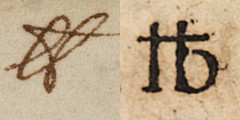
Some time in the late 14th century the abbreviation ‘lb’ for libra entered English,* and according to common scribal practice it was accessorised with a line drawn across the letters to highlight the use of a contraction.6 Jotted down in haste, as can be seen in Isaac Newton’s elegant scrawl below, ‘℔’ was transformed into ‘#’ by the carelessly rushing pens of successive scribes.7 Originally so common that some early typecutters provided a dedicated letter punch for it, but now considerably outshone by both predecessor and descendant, ‘℔’ has become a typographic missing link.†
Parallel to all this, libra’s estranged partner pondo was also changing. Where libra had become ‘lb’ and subsequently ‘#’ through the urgency of the scribe’s pen, pondo was instead subjected to the vagaries of the spoken tongue. The Latin pondo became first the Old English pund, (sharing a common Germanic root with the German Pfund) and subsequently the modern word ‘pound’.9 Libra and pondo were reunited, and ‘#’, the ‘pound sign’, was born.
The ‘#’ is not the only child of the phrase libra pondo, and the ‘£’ symbol for ‘pounds sterling’, the British unit of currency, is one of its more notable siblings. The term originates from the practice of weighing coins to determine the value of a payment,‡ such as might be made in silver Norman pennies called ‘sterling’, while the ‘£’ symbol itself is an abbreviation for libra in the form of a stylised uppercase ‘L’.11 In fact, clues to the ‘£’ symbol’s Latin ancestry remained quite explicit until decimalisation in 1970. In Charlemagne’s system of coinage from the 8th century AD, 240 denarii were minted from one libra of silver, and twelve silver denarii had the same value as one gold solidus.14 This ratio — 240 : 12 : 1 — was retained in Britain until decimalization, and the traditional abbreviation for ‘pounds, shillings and pence’ came straight from the Latin librae, solidi, denarii to yield ‘£sd’, or ‘L.s.d.’.15
Despite boasting Latin roots of noble purpose, the ‘#’ symbol has since come to be used so promiscuously as to be completely dependent on its context. In addition to its uses as pound and number signs, in chess notation a ‘#’ signifies checkmate;16 for the less pedantic typographer it can be a stand-in for the musical sharp symbol (‘♯’),§ and in many programming languages it indicates that the rest of the line is a comment only, not to be interpreted as part of the program.18 Proofreaders wield the ‘#’ to denote the insertion of a space: placed in the margin, an accompanying stroke indicates where a word space should be inserted, while ‘hr #’ specifies that a thin or ‘hair’ space should be used instead.19 Perhaps most obscurely, three hash symbols in a row (‘###’) are used to signal the end of a press release.20
The ‘#’ has names almost as varied as its uses, and aside from the prosaic ‘number’, ‘pound’ or ‘hash’ sign, it is or has been variously known as the ‘crunch’, ‘hex’, ‘flash’, ‘grid’, ‘tic-tac-toe’, ‘pig-pen’ or ‘square’.21,22 In most cases, a name can be trivially linked to the character’s shape or to its function in a particular context, but its most elliptical alias does not give up its secrets so easily. The story of how the ‘#’ symbol came to be known as the ‘octothorpe’ is entirely more tortuous.
Works such as Robert Bringhurst’s Elements of Typographic Style (widely acknowledged as the modern bible of typography), the American Heritage Dictionary and the mighty Oxford English Dictionary have all weighed in with competing explanations for the origins of the ‘#’ mark’s most prominent nickname. The 4th edition of the American Heritage Dictionary, for instance, says this of the word ‘octothorpe’:
- oc·to·thorpe
- n. The symbol (#).
Alteration (influenced by octo–) of earlier octalthorpe, the pound key, probably humorous blend of octal, an eight-point pin used in electronic connections (from the eight points of the symbol) and the name of James Edward Oglethorpe.23
Unfortunately for this particular definition, the AHD appears to be its sole proponent. Oglethorpe, founder of the American state of Georgia as a refuge for inmates of English debtors’ jails,24 seems an unlikely candidate to be granted such an honour; his name is little known outside the state he founded, and there is no real evidence to suggest a link between Oglethorpe’s haven for financial miscreants and the character itself. The AHD provides no details of the provenance of this theory, and it has a strong whiff of speculation about it.
Robert Bringhurst and the OED come closer to agreeing on a plausible theory. The Elements of Typographic Style states that:
In cartography, it is a traditional symbol for village: eight fields around a central square. That is the source of its name. Octothorp means eight fields.25
A picturesque theory, and one with an apparent historical significance: the suffix -thorp(e) is an Old English word for village26 and can still be seen in British place names such as Scunthorpe. However, it is unusual to find a Greek prefix such as octo- wedded to an Old English word in this manner, and indeed the OED’s own definition for octothorpe acknowledges its unconventional construction. It provides two similar but separate etymologies, both of which emanate from the unlikely linguistic wellspring of AT&T’s one-time research subsidiary, Bell Telephone Laboratories. The first cites the industry journal Telecoms Heritage, explaining that an engineer named Don McPherson was hunting for a suitably unique name for the age-old symbol:
His thought process was as follows: There are eight points on the symbol so ‘OCTO’ should be part of the name. We need a few more letters or another syllable to make a noun […] (Don Macpherson […] was active in a group that was trying to get JIM THORPE’s Olympic medals returned from Sweden). The phrase THORPE would be unique[.]27
while the second quotes a 1996 issue of New Scientist magazine, and claims that:28
‘Octo-‘ means eight, and ‘thorp’ was an Old English word for village: apparently the sign was playfully construed as eight fields surrounding a village.29
Though this construction matches Bringhurst’s suggestion, the two disagree on its derivation: Bringhurst claims that the name ‘octothorpe’ is derived from a ‘traditional [cartographic] symbol’, while the OED suggests that it is instead a modern name, a tongue-in-cheek amalgam of Greek and Old English applied to a much older symbol. Unfortunately for Bringhurst, the ‘#’ is not a cartographic symbol; though his construction is correct, his etymology is not.
Of course, the OED’s two suggested etymologies still stand: octo- for eight points plus the name ‘Thorpe’, and octo- for eight fields and thorpe for village, both of which emanate from that most unexpected of sources, Bell Labs. The question remains: why, exactly, did the engineers at America’s premier telecommunications lab feel compelled to give this centuries-old symbol a new name?
- 1.
-
“Hash”. Oxford University Press, April 2011.
- 2.
- Unknown entry ↢
- 3.
- Unknown entry ↢
- 4.
- Unknown entry ↢
- 5.
-
Cappelli, Adriano., David. Heimann, and Richard Kay. “The Elements of Abbreviation in Medieval Latin Paleography”. In. University of Kansas Libraries, 1982.
- 6.
-
Bischoff, Bernhard, and . “Abbreviations”. In Latin Palaeography: Antiquity and the Middle Ages, 150+. Cambridge University Press, 1995.
- 7.
- 8.
- 9.
-
“Pound”. Oxford University Press, May 2011.
- 10.
-
, and Ernest. Brehaut. Cato the Censor on Farming. Vol. 17. Columbia Univ. Press, 1933.
- 11.
-
Encyclopaedia Britannica. “Pound Sterling (money)”.
- 12.
-
Friedberg, Robert, Arthur L. Friedberg, and Ira S. Friedberg. “Gold Coins of the World : Complete from 600 A.D. to the Present : An Illustrated Standard Catalogue With Valuations”. In Gold Coins of the World : Complete from 600 A.D. to the Present : An Illustrated Standard Catalogue With Valuations. Coin and Currency Institute, 1980.
- 13.
-
Judson, Lewis Van Hagen. Weights and Measures Standards of the United States : A Brief History. Dept. of Commerce, National Bureau of Standards, 1976.
- 14.
-
Redish, Angela. “From Carolingian Penny to Classical Gold Standard”. In Bimetallism: An Economic and Historical Analysis, 1-12. Cambridge University Press, 2006.
- 15.
-
Sutherland, C. H. V. English Coinage, 600-1900. B.T. Batsford, 1973.
- 16.
-
“E.I.01B. Appendices”. World Chess Federation, April 2011.
- 17.
- 18.
-
“2. Lexical Analysis”. Python Software Foundation, May 5, 2011.
- 19.
-
Rosendorf, Theodore. “proofreaders’ Marks”. In The Typographic Desk Reference, 67. New Castle, DE: Oak Knoll Press, 2009.
- 20.
- 21.
- 22.
-
“Green Book”. In. International Telecommunication Union, 1973.
- 23.
-
Baugh, John, Robert Hass, Maxine Hong Kingston, and Wendy Lesser. “The American Heritage Dictionary of the English Language”. In. Houghton Mifflin, 2000.
- 24.
-
Blackburn, Joyce. James Edward Oglethorpe. Lippincott, 1970.
- 25.
-
Bringhurst, Robert. “Octothorpe”. In The Elements of Typographic Style : Version 3.2, 314+. Hartley and Marks, Publishers, 2008.
- 26.
-
“Thorp”. Oxford University Press, May 2011.
- 27.
-
Carlsen, Ralph. “What the ####?”. Edited by Andrew Emmerson. Telecoms Heritage Journal, no. 28 (1996): 52-53.
- 28.
-
Dekker, Kay. “Letters: Internet Hash”. New Scientist.
- 29.
-
Simpson, J. A., E. S. C. Weiner, and . The Oxford English Dictionary. Clarendon Press; Oxford University Press, 1989.
- *
- The corresponding abbreviation ‘oz’, for ‘ounce’, has a similar genesis. The Latin uncia, or twelfth (used in the sense of twelfths of a Roman pound), became the medieval Italian onza and was subsequently abbreviated to ‘oz’.5 ↢
- †
- ‘℔’ does still survive today, lurking unremarked in the standard computer character set Unicode as the so-called ‘L B BAR SYMBOL’.8 It is rare to see it used in type. ↢
- ‡
- Neatly coincidental though all this appears, nailing down the exact weight of a so-called ‘pound’ is remarkably tricky. The Roman libra pondo, for example, was divided into twelve uncia or ounces and weighed approximately 327 grams.10 The ‘pound’ of silver from which the British unit of currency is derived was instead closer to a ‘troy pound’,11 named for the French town of Troyes, and weighed in at roughly 373 grams. Like the libra pondo, the troy pound is divided into twelve ounces, though these ‘troy ounces’ are commensurately heavier than their Roman equivalents.12 Finally, the modern ‘international pound’ — formalised from an older common unit named the avoirdupois pound — comprises sixteen ounces rather than twelve and is defined to be exactly 0.45359237 kilograms.13 Little wonder the metric system is now mandated by law in all countries bar the USA, Liberia and Burma. ↢
- §
- Microsoft took this path of least resistance when rendering the names of their programming languages ‘C Sharp’ and ‘F Sharp’ as ‘C#’ and ‘F#’, attracting a certain amount of derision in the process.17 ↢