Milner, a tech start-up entrepreneur and philanthropist, is partnering with scientists around the world to search for life among the stars
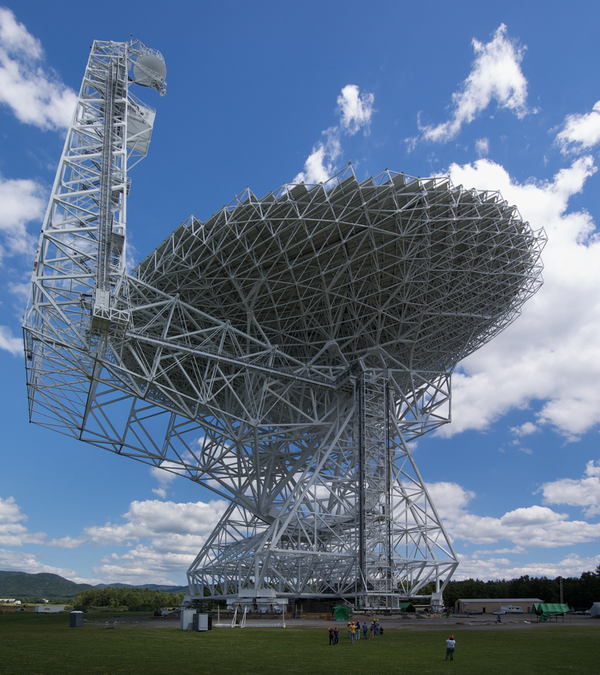
The Green Bank Telescope is the world's largest steerable radio telescope, and one of three telescopes Breakthrough Listen will use extensively in its groundbreaking search for extraterrestrial intelligence.
Join Our Community of Science Lovers!
SETI—the Search for Extraterrestrial Intelligence—has been one of the most captivating areas of science since its inception in 1960, when the astronomer Frank Drake used an 85-foot radio telescope in the first-ever attempt to detect interstellar radio transmissions sent by beings outside our solar system. Yet despite its high public visibility and near-ubiquity in blockbuster Hollywood science fiction, throughout most of its 55-year history SETI has languished on the fringes of scientific research, garnering relatively scant funding and only small amounts of dedicated observation time on world-class telescopes.
Today, in a live webcast originating from London and set for 6:30 am Eastern, the Russian entrepreneur Yuri Milner, along with the physicist Stephen Hawking, is announcing his intentions to change that. Watch the live streamed event below, starting at 6:30 am.
On supporting science journalism
If you're enjoying this article, consider supporting our award-winning journalism by subscribing. By purchasing a subscription you are helping to ensure the future of impactful stories about the discoveries and ideas shaping our world today.
Although Milner has made his name—and billions of dollars—through investments in Facebook, Alibaba, and many other tech start-ups, his true passion is science, which he has demonstrated through his formation of the Breakthrough Prize Foundation. This organization awards the world's most lavish scientific prizes. Milner's latest project is part of the Foundation's new Breakthrough Initiatives division and is called Breakthrough Listen. Providing $100 million in funding over the next decade to top SETI researchers, Breakthrough Listen will allow new state-of-the-art radio and optical surveys to take place using the world's premiere telescopes, creating the most ambitious and robust SETI program yet performed. The project is set to begin making observations in 2016.
Following the live webcast, Milner and distinguished scientists participating in Breakthrough Listen will conduct a media teleconference to discuss the new project and answer questions. Scientific American will continue to follow this story as it develops.
It’s Time to Stand Up for Science
If you enjoyed this article, I’d like to ask for your support. Scientific American has served as an advocate for science and industry for 180 years, and right now may be the most critical moment in that two-century history.
I’ve been a Scientific American subscriber since I was 12 years old, and it helped shape the way I look at the world. SciAm always educates and delights me, and inspires a sense of awe for our vast, beautiful universe. I hope it does that for you, too.
If you subscribe to Scientific American, you help ensure that our coverage is centered on meaningful research and discovery; that we have the resources to report on the decisions that threaten labs across the U.S.; and that we support both budding and working scientists at a time when the value of science itself too often goes unrecognized.
In return, you get essential news, captivating podcasts, brilliant infographics, can't-miss newsletters, must-watch videos, challenging games, and the science world's best writing and reporting. You can even gift someone a subscription.
There has never been a more important time for us to stand up and show why science matters. I hope you’ll support us in that mission.