Summer is here! Time to pump up your video game backlog until it’s bloated, gurgling, and making vaguely taunting motions from over in the corner. In other words, the Steam Summer Sale has begun. I just bought Hotline Miami, Fez, and The Swapper for like 14 cents1 while typing that.
Like last time, Steam is offering discounted digital downloads in the form of daily sales that change every 24 hours, plus “flash deals” that change every 8 hours. And there are community choice deals where users vote on which of three titles should get its price slashed next. But this time there’s something new: Steam is tying its summer sale in with its trading card system. For every $10 you spend, you get a random card2 from a limited edition set of 10 created just for the event. Collect all 10 of those cards and you can perform some digital origami to turn them into a special badge.3

Let me be clear: I love Valve, I love Steam, and I especially love Steam sales. But I thought it would be interesting to highlight a few of the ways that the these events nudge us towards making more purchases than we may intend to.
Artificial Scarcity
The research is pretty clear that “available for a limited time” is a super effective sales pitch because we value things more that have limited availability. Psychologist Stephen Worchel illustrated this with a study involving cookies unlike those that Steam’s website deals in.4 Posing as a consumer products survey, the experimenters offered subjects a chocolate chip cookie from one of two jars. One of the jars had many cookies in it. The other had only a few. People reported the cookies from the mostly empty jars as more delicious, more desirable, and more expensive. This despite that the cookies in both jars WERE THE SAME COOKIES.
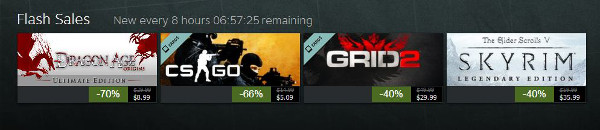
Despite delivering games that are no more than streams of infinitely available 1s and 0s, Steam capitalizes on the scarcity effect because the bias applies to opportunities as well as physical goods. All the Steam deals are time limited and feature prominent countdowns. If you’re thinking of buying a game, you have no idea if it will come up again before the sale is over, so you’re more likely to grab it rather than lose your shot. And maybe for a slightly higher price than you would otherwise.
Psychological Reactance
This one is related to the scarcity effect, but worth addressing separately. Not only do we tend to value scarce things more highly, we often see them as better than more readily available alternatives. This is a kind of boomerang effect in response to perceived lost choice, a phenomenon psychologists have given the needlessly complicated name of “psychological reactance.” In one study of the effect, a group of psychologists studied Florida housewives’ reactions to the banning of laundry detergents containing environmentally unfriendly phosphates.5 Not only did those facing such loss of choice buy more of the product (both more than they did before learning about the upcoming ban and relative to a control group) they rated the phosphate-laden soaps as much more effective than the government mandated alternative.
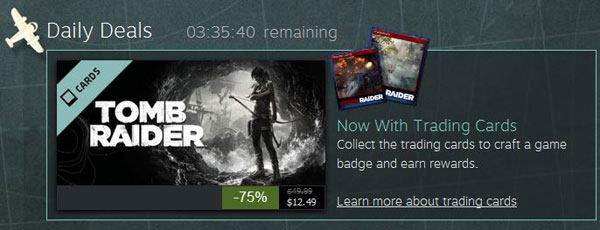
Face it: you could spend the same money you’re spending on Steam games in any number of ways. You could buy other games, even if they are fewer in number. But psychological reactance might be making you think that you’ll get more total enjoyment out of the ones that will soon be unavailable.
The Endowed Progress Effect
It’s human nature to not want to leave something undone once we start it. It nags at our minds every time we’re reminded of it and checking the last thing off or filling in the final progress makes us feel a little better. It’s why so many of us have trouble moving on the main quest in a meaty RPG game when there are so many subquests left unchecked. In one experiment,6 researchers gave car wash customers a card that let them earn a wash if they collected enough stamps. Half the customers got a blank “Buy 8, get 1 free” card. The rest got a “Buy 10, get 1 free” card, but with two complimentary stamps to get them started. Thus, both groups needed to buy 8 to get 1 free. But those who got the “Buy 10, get 1 free” card with the 2 starter stamps tended to come back more often and to wait less time between purchases.

Steam uses this quirk of human nature with its Summer Getaway trading cards by giving you one random card out of the set of 10 for every $10 you spend.7 Adding a game to your cart displays a progress bar showing how much more you need to spend to get your next card. Just showing that you’ve begun progress towards that goal is enough to create some mental tension over not having yet reached it, and some people are likely to toss in just one more cheap game to get them over that hump. It’s also clever of Steam to show you the progress before you check out so that you have one more reason to complete the transaction.
Of course, once you get the card, the effect happens again because you’ve now started checking off what you’ve collected from the 10 card set needed to craft the Summer Getaway Badge. So double whammy. That’s out of a three whammy set. Get just one more whammy to craft the “I Got Whammied!” badge.
Commitment and Consistency
We don’t like to appear inconsistent. Once we make a commitment or state a preference, some amount of mental inertia sets in and we feel pressure to keep our behaviors in line with our thoughts. In his book Influence: Science and Practice8 Robert Cialdini describes a trip to a introductory class on “transcendental meditation” that he and a friend attended on a lark. When the instructors offered to teach an advanced course on how to perform such wonders as floating and walking through walls, Cialdini’s friend tore into them and exposed their claims as impossible flimflam. Amazingly, many people in the audience who listened to him still proceeded to plunk down $75 for the advanced course because they had taken the time to attend and thus signal a belief in what was being sold. To back out then would send the wrong signal, they thought.
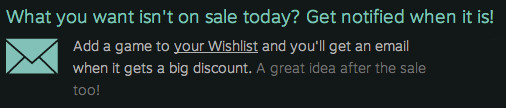
So, with that in mind, ever notice how Steam will e-mail you when something from your wish list goes on sale, including during the big sales events? I throw stuff on there all the time to keep track of what I want to buy during sales, and when I get a notification I feel like a commitment is being called in. Steam even has a “Friend Activity” page where you can see what other people have added to their wishlist.
Steam also banks on your commitment when you vote on Community Choice polls, assuming you don’t already own the game you vote for. Actively involving yourself, hoping for a certain outcome, and forming an intention means that you’re more likely to buy if your choice wins. And having your choice actually win feels like a reward –like you won a little contest– so you’re more likely to associate good feelings with that game.
Random Reward Schedules
One of the first topics covered in a Psychology 101 class is likely to be reward and punishment schedules. If your goal is to get people to adopt and then repeat behaviors, giving them rewards is key but the scheduling of those rewards can have a big impact. If you give someone a food pellet every tenth time they press a lever, that’s a fixed interval schedule.9 But randomly give or withhold a pellet after each lever press, that’s called a random or variable reward schedule, and it’s generally the most effective way to get people to keep slapping that lever.
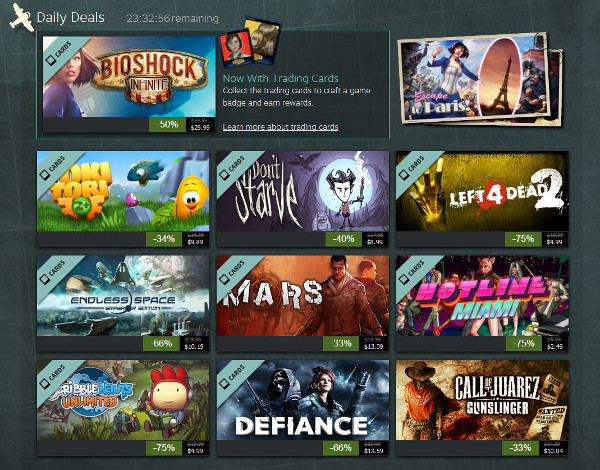
Seeing a game you want show up as a Daily or Flash Deal on the Steam Summer Sale is like getting a food pellet. It’s a reward you get for checking the storefront. In fact, checking Steam at 12 noon every day to see what the new batch of deals are is my very favorite thing about the event –second only to checking back every 8 hours or so for the handful of Flash deals. And let’s not forget seeing what Community Choice games won the last round of votes. While I’m sure Valve has the slate of deals worked out ahead of time, the selection of games seems random to us. And Steam spaces things out masterfully, making sure that you come back to the site throughout the day to see if you’re going to get a reward in the form of a great deal.
So there you go: five psychological hooks to the Steam Summer Sale –or any of its sales for that matter. As I said, I love these events and get a lot out of them. You should buy stuff you want during them, because HEY VIDEOGAMES! But a little knowledge means that you can come at them more on your own terms.
1. Rounding down.
2. A virtual trading card, it should be noted. Not physical.
3. Which is good for experience points towards earning higher Steam account levels, which …you know what? It’s too complicated to get into right now.
4. Worchel, S., Lee, J., & Adewole, A. (1975). Effects of supply and demand on rating of object value.Journal of Personality and Social Psychology, 32, 906-914.
5. Mazis, M. B., Settle, R., & Leslie, D. (1975). Antipollution measures and psychological reactance theory: A field experiment. Journal of Marketing Research, 10 654-666.
6. Nunes, J. & Dreze, X. (2006). The Endowed Progress Effect: How Artificial Advancement Increases Effort. Journal of Consumer Research, 32 442-52.
7. You can also buy cards directly from other users in the Community Marketplace for a lot less, but most customers won’t know that. And even if they do, Valve is still making money off those transactions.
8. Cialdini, R. (2009). Influence: Science and Practice. Boston: Pearson Press.
9. Essentially. I won’t dice hairs over the finer points.