A pair of patent applications related to Apple's new flagship iPhone feature Touch ID shed some new light on how the fingerprint sensor itself works, as well as the "Secure Enclave" inside the A7 processor that analyzes and stores user fingerprints.
The first, as noticed by Patently Apple, details a method by which the iPhone scans a finger and then provides that data to the "Secure Enclave" for matching and eventual approval.
Rather than storing actual images of fingerprints, Apple takes a fingerprint map and runs it through a sort of encryption to prevent thieves from pulling fingerprint data from a compromised iPhone. The enclave only allows fingerprints to be checked against known valid ones, not the other way around.

Apple's invention includes a process of collapsing the full [finger] maps into a sort of checksum, hash function, or histogram. For example, each encrypted ridge map template can have some lower resolution pattern computed and associated with the ridge map. One exemplary pattern could be a histogram of, e.g., the most common angles (e.g., a 2 dimensional (2D) array of common angles). The exemplary pattern could include in each slot an average value over a respective vector of the map. The exemplary pattern could include in each slot a sum of the values over a respective vector of the map. The exemplary pattern could include the smallest or largest value within a respective vector of the map, or could be a difference between a largest and a smallest value within the respective vector of the map.
One interesting note about the secure enclave patent is the main inventor, Wayne Westerman. He was one of the lead inventors on the multi-touch technology that Apple eventually purchased and uses as the key feature in Apple's billion-dollar iPhone and iPad lines. Westerman has been a senior engineer at Apple since his company, Fingerworks, was purchased by Apple in 2005.
In a separate application, Apple lays out the different parts that make up the Touch ID fingerprint sensor, including the different bits that Apple shows off in its marketing materials (shown below). Bottom image courtesy Patently Apple.
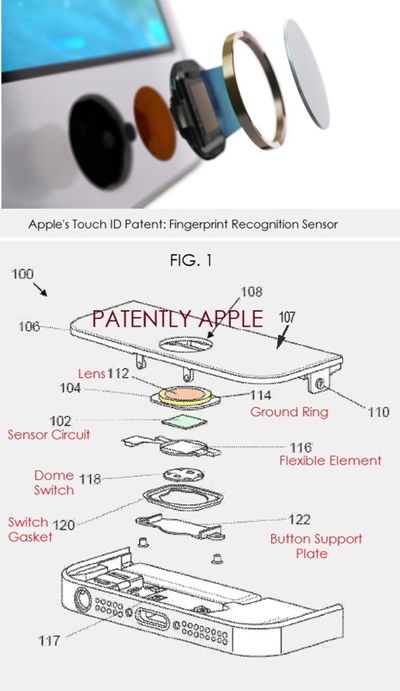
AppleInsider notes that the patent addresses the opaque home button that nonetheless scans fingerprints:
Touch ID's aesthetic treatments have been included as well, as the patent details "an ink assembly...printed on the lens" that "has the effect that the otherwise-translucent button can be made opaque, so the elements of the fingerprint recognition sensor are not immediately visible to the user."
Neither patent has yet been awarded, with the applications initially filed in March. Provisional applications were filed back in May of 2012, illustrating how long the technology has been in development.