One of the significant new features in OS X Mountain Lion is Gatekeeper, a new security system to help keep users from installing nefarious applications on their machines.
The new system relies not only on Mac App Store distribution as means of vetting apps, but also on a new "identified developer" program under which developers distributing their applications outside of the Mac App Store can register with Apple and receive a personalized certificate they can use to sign their applications. Apple can then use that system to track developers and disable their certificates if malicious activity is detected.
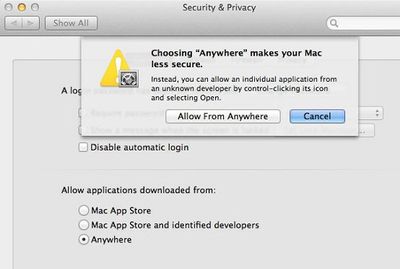
As Macworld notes in its review of Gatekeeper, OS X Mountain Lion's default setting will be to only allow initial launching of apps either downloaded from the Mac App Store or which are digitally signed under Apple's identified developer program. Users will be able to access Gatekeeper's settings in the Security & Privacy section of System Preferences, where they will also be able to choose from an even stricter setting that will allow for installation of Mac App Store apps only or a looser setting that will allow all applications to be installed and launched.
Located in the General tab of the Security & Privacy preference pane is a setting called “Allow applications downloaded from,” with three options:
Anywhere: This choice uses the same set of rules as every previous version of Mac OS X. If an app isn’t known malware and you approve it, it opens.
Mac App Store: When this choice is selected, any apps not downloaded from the Mac App Store will be rejected when you try to launch them.
Mac App Store and identified developers: This is the new default setting in Mountain Lion. In addition to Mac App Store apps, it also allows any third-party apps that have been signed by an identified developer to run.
For users on the default setting, they can bypass the initial Gatekeeper check the first time they launch an unsigned third-party app by right clicking on the app itself and choosing the "Open" command. Once the application has been opened one time, Gatekeeper no longer has any control over it.
As for apps that are signed by an identified developer, Macworld notes that OS X Mountain Lion will perform a daily check with Apple's servers for blacklisted developer signatures, and if an app from a blacklisted developer is installed on the user's system it will not open.
Importantly, Apple's identified developer program does not involve any sort of vetting on Apple's part, as certificates are automatically issued upon request and can be freely used by the developers. But what the program does do is provide a way for Apple to link specific developers to specific apps and use Gatekeeper to revoke application functionality should a developer be discovered to be distributing malware.