After tearing down and repairing the LG G3 I received someone’s broken Nexus 5, also known as LG D820. A part of the screen was shattered, but the digitizer still worked. It did, however, behave erratically. First I thought the digitizer was recording touches that weren’t there, but after disconnecting it, the problem persisted.
As it turned out, the power button was broken. Unlike the power button on my iPhone 4 – which didn’t respond at all – this button continuously registered presses when it was left alone. This makes the phone unusable because it will shut itself down, try to reboot, but before it can do anything thinks you’re trying to reset the thing.

The internet has dubbed this the “boot loop” and it’s a massive problem. Search for “lg boot loop” and you’ll get 4.3M results. “Nexus 5 boot loop” on YouTube yields 70K (!) videos. Probably not all of these boot loops are due to the power button; some reports suggest that some other connection on the main board degrades due to components heating up.
So what’s up with this particular instance? I fixed the phone by replacing the power button. When you can do this repair yourself, it will take about $1 and half an hour. I you go to a service company, they’ll probably charge $50+. As is so often the case, these tactile switches cost only a few cents but end up defining the (economic) lifetime of an expensive piece of hardware when they fail. I received 5 new buttons, so I decided to take one apart to try and understand what happened. Unfortunately, the original button was lost when I desoldered it.
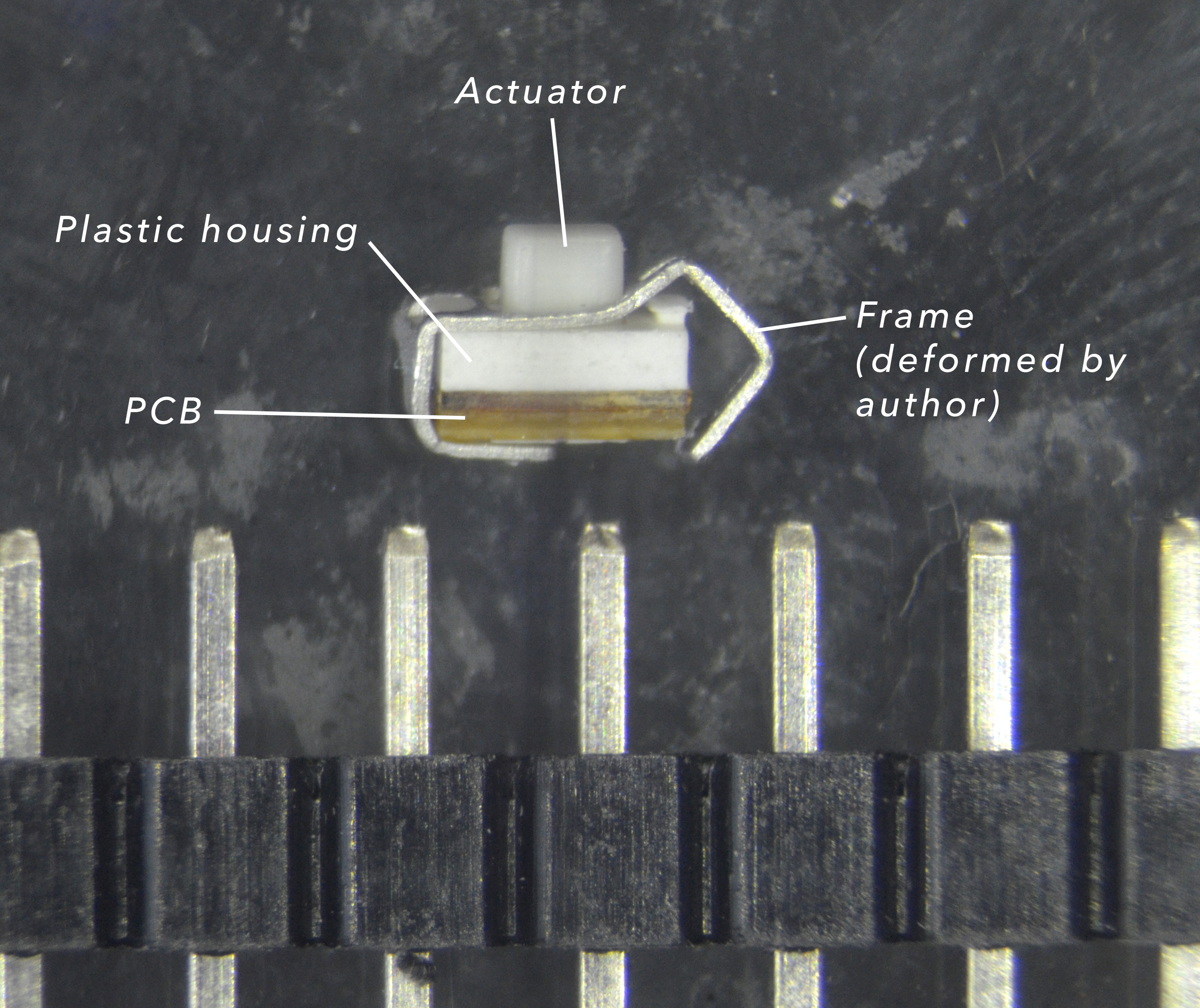
Side view of the switch. 2.54mm (100mil) pinheader for size reference.

The same switch, flipped on its side. Left side is intact, on the right side the frame has been deformed and soldermask removed to expose the copper tracks.
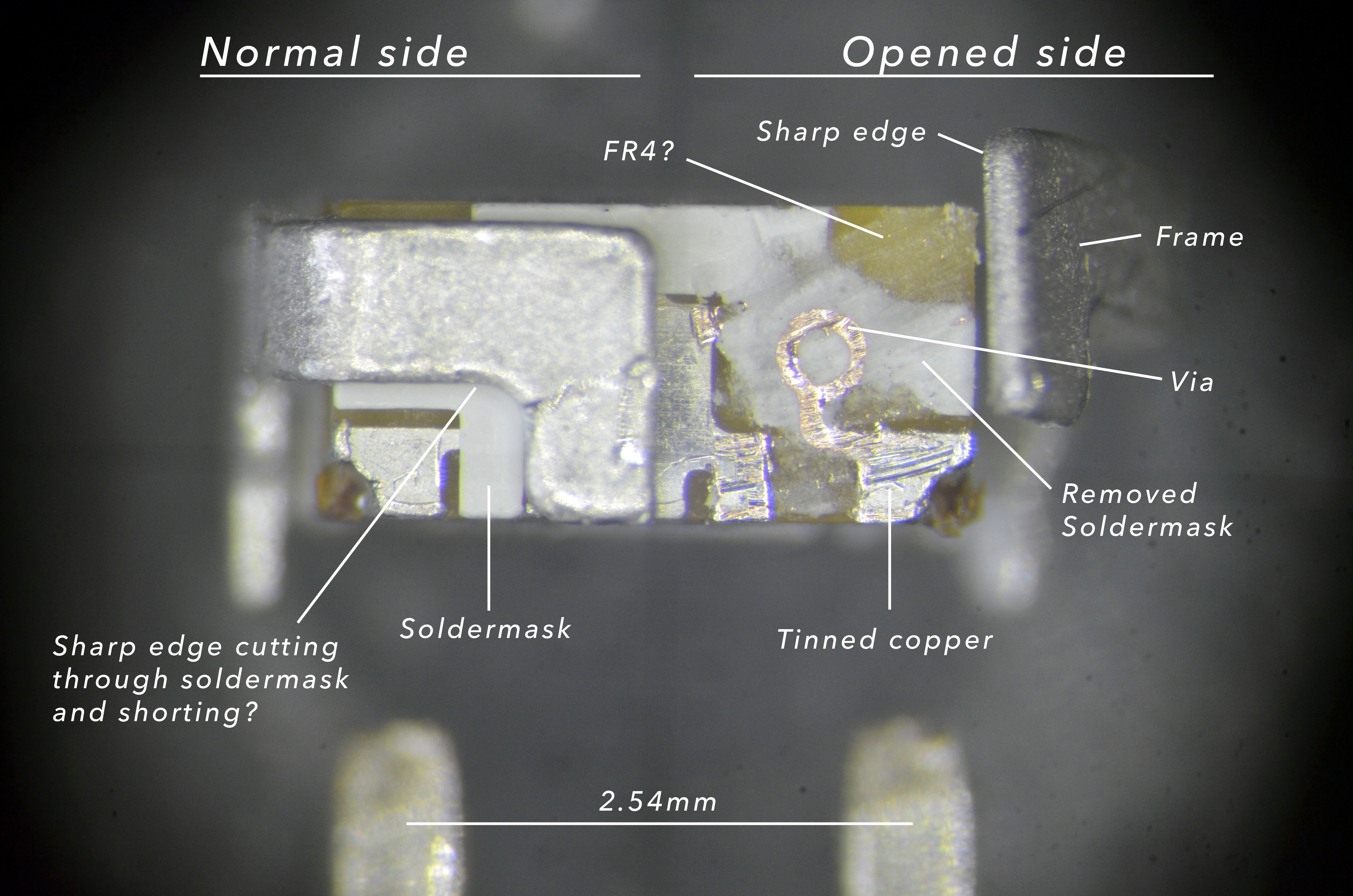
Same view, enhanced. Annotation shows which parts probably cause the malfunction.
Tinier problems.
First of all, this switch is tiny. Above is a microscope photo with a 2.54mm (100mil) header for size reference. When you make something electromechanical smaller, it becomes more error-prone. One thing that struck me immediately is that a big chunk of this switch is actually printed circuit board (PCB). The PCB and a plastic housing containing the switch disc is held together by a metal frame. The tin-coated copper tracks (metallic coloured) of the PCB are shielded against the metal frame by soldermask (white). The metal frame is stamped and still has the sharp edges associated with that process.
This is speculation, but I guess something like this is at the core of LG’s problems: Every time you press the power button of your phone, the soldermask of the PCB is pushed against these sharp edges. After a while, the mask will be worn away, and when it’s gone on both sides, the metal frame will short the contacts of the power button. Hence the erratic behaviour. The same short could also be caused by ingress of metallic dust. There are a lot of ways the design of this switch can cause problems, but I wouldn’t be surprised if this is it.
The never-ending quest for smaller consumer electronics prompted LG engineers to design or specify a switch with durability issues. It’s a shame that a valuable device like a smartphone is discarded prematurely because of a cheap part like a switch or headphone jack. I hope this helps someone diagnose their phone. Or maybe it helps fight LG in the class-action suit 🙂
Like this? You might be interested in my latest project. It's a desk light made completely from a single sheet of printed circuit board. Check it out: